Want more images or videos?
Request additional images or videos from the seller
1 of 5

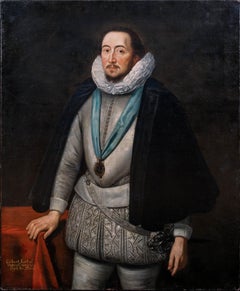
Portrait of Sir Henry Guildford

$69,430.36
£50,000
€59,447.11
CA$95,808.27
A$97,522.92
CHF 55,511.93
MX$1,177,174.29
NOK 647,299.44
SEK 655,104.10
DKK 444,400.53

About the Item

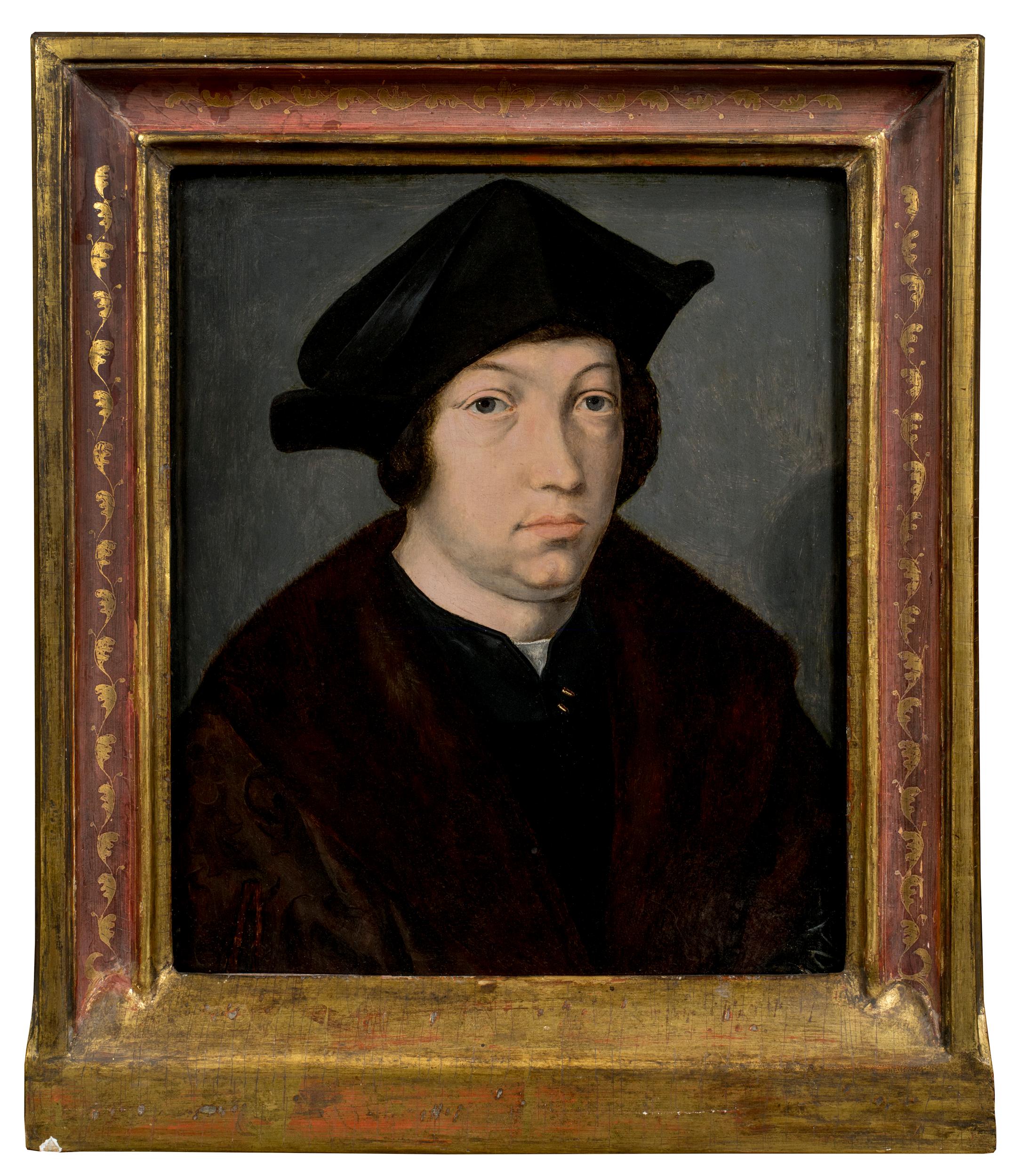
English School Portrait of Sir Henry Guildford 16th Century Oil on oak panel, unsigned Image size: 15 x 11 inches (38 x 28 cm) Contemporary style frame Provenance Private Collection, France This copy of the portrait by Hans Holbein the Younger painted in 1527, in the Royal Collection Trust, focuses on the head and shoulders of the sitter, rather than depicting the three-quarters portrait in its entirety. Guildford was a keen scholar and his humanist interests likely drew him to Holbein. The two almost certainly worked together in the planning of the revels at Greenwich in 1527 when a ‘Master Hans’ carried out a large portion of the decorative painting for the event. Guildford was one of the first in England to commission a portrait from Holbein and both the preparatory drawing and finished painting survive. Holbein reportedly also painted a portrait of Guildford’s wife Margaret, though this has now been lost, and painted Guildford himself again during his second trip to England in 1633. The work captures the solemn expression of Guildford, at odds with his role as Master of Revels and carefully copies the exquisite details of the Collar of the Garter around Guildford's neck, though less so the knight on horseback beneath.  Sir Henry Guildford (1489 - 1532) was an English courtier during the reign of King Henry VIII, Master of the horse, Comptroller of the Royal Household and various other offices. Son of Sir Richard Guildford and his second wife Joan, sister of Sir Nicholas Vaux, 1st Baron Vaux of Harrowden, Henry had been a childhood companion and cupbearer of King Henry VIII when he was Duke of York. As a result, Guilford remained one of King Henry’s closest friends and was appointed Esquire of the Body (personal attendant to the King) and Master of Revels when King Henry took the crown, meaning he was responsible for organising lavish entertainments at court. On one occasion, as part of this role, he and his half-brother Sir Edward, along with several others, impersonated Robin Hood and his men to entertain Queen Catherine of Aragon, whilst on another, to celebrate Twelfth Night, he organised a mountain to be presented to the King from which, when opened, Morris-dancers burst forth. Guildford’s antics were put to an end in the 1519 efforts of older statesmen to limit the influence of younger, hot-headed men on the King. He did, however, return to court soon after where he was appointed Comptroller of the Royal Household, developing a distinguished career.   He married Margaret, daughter of fellow courtier Sir Thomas Bryan, in May 1512 with the King granting the manors of Hampton-in-Adren (Warwickshire) and Byker, Swineshead (Lincolnshire) to the couple. Though there is no record of Margaret’s death, Guildford married a second time to Mary, daughter of Robert Wotton of Boughton Malherbe, Kent. Guildford was a strong supporter of Catherine of Aragon and was strongly opposed to the King casting her out without the Pope’s blessing in favour of Anne Boleyn. He was so open with his views that Anne, recognising him as an enemy, threatened that when she became Queen she would have him removed from the office of Comptroller. He reportedly responded that she need not trouble herself, he would give up the role himself and immediately went to the King to tender his resignation. The King told him to pay no heed to what women said and insisted he take back the office. For a short time Guildford retired from court, though he remained one of the King’s council, though he passed away soon after in 1532. It is a mark of his friendship with King Henry that he was not only able to remain in his post until his death, but that the King was willing to overlook the opinion of the woman he was determined to split from the Catholic Church for in Guildford’s favour.
  • Dimensions:
    Height: 15 in (38.1 cm)Width: 11 in (27.94 cm)
  • Medium:
  • After:
    (After) Hans Holbein The Younger (1497 - 1543, German)
  • Period:
  • Condition:
  • Gallery Location:
    London, GB
  • Reference Number:
    1stDibs: LU52417928192

More From This Seller

View All
Portrait of William Herbert, 3rd Earl of Pembroke, Early 17th Century Portrait

Portrait of William Herbert, 3rd Earl of Pembroke, Early 17th Century Portrait

Located in London, GB

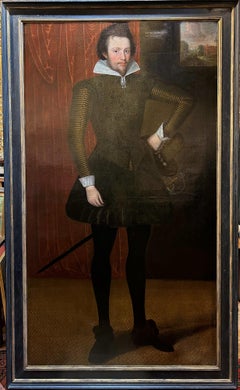
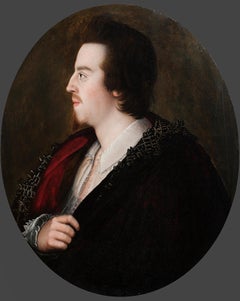
English School, (circa 1600) Portrait of William Herbert, 3rd Earl of Pembroke Oil on panel, oval Image size: 29¼ x 23⅞ inches Painted wooden frame Provenance: 176, Collection of Francis Greville, 1st Earl of Warwick. The Trustees of the Lord Brooks’ Settlement, (removed from Warwick Castle). Sotheby’s, London, 22nd March 1968, lot 81. Painted onto wooden panel, this portrait shows a dark haired gentleman in profile sporting an open white shirt. On top of this garments is a richly detailed black cloak, decorated with gold thread and lined with a sumptuous crimson lining. With the red silk inside it’s all very expensive and would fall under sumptuary laws – so this is a nobleman of high degree. It’s melancholic air conforms to the contemporary popularity of this very human condition, evident in fashionable poetry and music of the period. In comparison to our own modern prejudices, melancholy was associated with creativity in this period. This portrait appeared in the earliest described list of pictures of Warwick castle dating to 1762. Compiled by collector and antiquary Sir William Musgrave ‘taken from the information of Lord & Lady Warwick’ (Add. MSS, 5726 fol. 3) is described; ‘8. Earl of Essex – an original by Zuccharo – seen in profile with black hair. Holding a black robe across his breast with his right hand.’ As tempting as it is to imagine that this is a portrait of Robert Devereux, the 2nd Earl Essex, we might take this with a pinch of salt. Its identification with this romantic and fatal Elizabethan might well have been an attempt to add romance to Warwick Castle’s walls. It doesn’t correspond all that well with Essex’s portraits around 1600 after his return from Cadiz. Notably, this picture was presumably hung not too far away from the castle’s two portraits of Queen Elizabeth I. The first, and undoubtedly the best, being the exquisite coronation portrait that was sold by Lord Brooke in the late 1970s and now hangs in the National Portrait Gallery. The second, described as being ‘a copy from the original at Ld Hydes’, has yet to resurface. The portrait eventually ended up being hung in the State Bedroom of Warwick Castle. Archival documents present one other interesting candidate. The Greville family’s earliest inventory of paintings, made in 1630 at their home Brooke House in Holborn, London, describes five portraits of identified figures. All five belonged to the courtier, politician and poet Sir Fulke Greville (1554-1628), 1st Baron Brooke, and were hung in the ‘Gallerie’ of Brooke House behind yellow curtains. One of them was described as being of ‘Lord of Pembrooke’, which is likely to have been William Herbert (1580-1630), 3rd Earl of Pembroke. William was the eldest son of Greville’s best friend’s sister Mary Sidney, and was brought up in the particularly literary and poetically orientated household which his mother had supported. Notably, the 3rd Earl was one of the figures that Shakespeare’s first folio was dedicated to in 1623. The melancholic air to the portrait corresponds to William’s own pretensions as a learned and poetic figure. The richness of the robe in the painting, sporting golden thread and a spotted black fabric, is indicative of wealth beyond that of a simple poet or actor. The portrait’s dating to around the year 1600 might have coincided with William’s father death and his own rise to the Pembroke Earldom. This period of his life too was imbued with personal sadness, as an illicit affair with a Mary Fitton had resulted in a pregnancy and eventual banishment by Elizabeth I to Wilton after a short spell in Fleet Prison. His illegitimate son died shortly after being born. Despite being a close follower of the Earl of Essex, William had side-stepped supporting Devereux in the fatal uprising against the Queen and eventually regained favour at the court of the next monarch James I. His linen shirt is edged with a delicate border of lace and his black cloak is lined on the inside with sumptuous scarlet and richly decorated on the outside with gold braid and a pattern of embroidered black spots. Despite the richness of his clothes, William Herbert has been presented in a dishevelled state of semi-undress, his shirt unlaced far down his chest with the ties lying limply over his hand, indicating that he is in a state of distracted detachment. It has been suggested that the fashion for melancholy was rooted in an increase in self-consciousness and introspective reflection during the late 16th and early 17th centuries. In contemporary literature melancholy was said to be caused by a plenitude of the melancholy humor, one of the four vital humors, which were thought to regulate the functions of the body. An abundance of the melancholia humor was associated with a heightened creativity and intellectual ability and hence melancholy was linked to the notion of genius, as reflected in the work of the Oxford scholar Robert Burton, who in his work ‘The Anatomy of Melancholy’, described the Malcontent as ‘of all others [the]… most witty, [who] causeth many times divine ravishment, and a kind of enthusiamus… which stirreth them up to be excellent Philosophers, Poets and Prophets.’ (R. Burton, The Anatomy of Melancholy, London, 1621 in R. Strong, ‘Elizabethan Malady: Melancholy in Elizabethan and Jacobean Portraits’, Apollo, LXXIX, 1964). Melancholy was viewed as a highly fashionable affliction under Elizabeth I, and her successor James I, and a dejected demeanour was adopted by wealthy young men, often presenting themselves as scholars or despondent lovers, as reflected in the portraiture and literature from this period. Although the sitter in this portrait is, as yet, unidentified, it seems probable that he was a nobleman with literary or artistic ambitions, following in the same vain as such famous figures as the aristocratic poet and dramatist, Edward de Vere...

Category

Early 17th Century Old Masters Portrait Paintings

Materials

Oil, Wood Panel

Portrait of Edward VI when Prince of Wales

Portrait of Edward VI when Prince of Wales

By English School

Located in London, GB

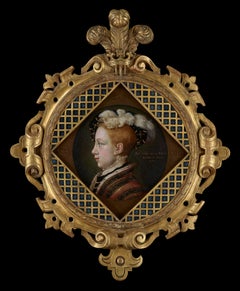
Studio of William Scrots Portrait of Edward VI when Prince of Wales 16th Century Oil on oak panel, unsigned Image size: 11 ½ x 11 ½ inches (29.3 x 29.3 cm) Early hand-carved gilt frame Provenance: The Hunter Blair collection, Blairquhan, Scotland By descent Christie’s London, 24th May 2007, lot 39 Mould Gallery Private Collection This striking portrait depicts Edward VI in the regalia of the Prince of Wales, shortly before he was to become the King of England. The Roman numerals on the painting indicate a creation year of 1546, meaning that Edward was only nine when this likeness was captured. It is believed that this work is a copy of a portrait held by the Met Museum of New York, completed by the Flemish portraitist William Scrots, who worked extensively with Henry VIII as the King’s Painter. Henry VIII had utilised the side-profile perspective as an artistic motif to assert the power of his Tudor dynasty. The perspective became associated with royalty, and its application in this portrait affirms Edward’s succession and future role as the English monarch. Portraits were an important way in which those in the 16th century captured likenesses of important public figures, such as the crown prince - for this reason, Edward VI is one of the most well documented Tudor monarchs, with multiple portraits capturing his childhood. This current work is exquisitely detailed, with great care taken to depict Edward’s lavish clothing. It is possible to make out the most minute of details, from the acorns on his collar to the individual barbs of the feathers on his cap. The gold chains fixing his jacket in place and the metallic aglets on his cap are also remarkable, indicating the absolute wealth and power of the Tudor dynasty. This portrait recently underwent dendrochronological analysis, which revealed that the work was painted during Edward’s lifetime. It was later altered to fit the diamond format that we see currently, which is also likely when the ‘ich dien’ (the motto of the Prince of Wales, meaning ‘I serve’) was added. King Edward VI On the 12th of October 1537, Jane Seymour gave birth to Henry VIII’s only son, who would be named Edward. As a celebration of this new heir to the throne, two thousands rounds of ammunition were shot from the Tower of London, and parties and festivities occurred all across England. Edward was baptised three days after his birth by Thomas Cranmer in a lavish ceremony before retiring to the Queen’s apartments to receive parental blessings. In a sad turn of events, Jane Seymour never recovered from the birth of her son, dying only 12 days after giving birth. Increasingly paranoid about Edward’s wellbeing as his only male heir, Henry VII ordered that he would remain at Hampton Court Palace. Edward was afforded a luxurious suite, but was initially kept in the presence chamber in a ‘cradle of state’ so that nobles and courtiers could visit the young prince. After this, Edward lived in his own bedchamber and was served by his own kitchen to avoid contamination. Once weaned, his food was tested by a servant to ensure it was safe for the prince to consume. Edward’s clothes were washed before he wore them, everything he touched had to be cleaned before he could do so, and the walls, floors and ceilings of his suite had to be scrubbed clean multiple times a day. Any visitors were forced to wash before seeing the prince, and they could not attend the chambers if they had even the smallest sign of sickness. Edward was raised by the women of the court and was known as a healthy, handsome, tall and well-fed young boy. He was shy and looked to his nurses for reassurance, and it is documented that even the most stern of nursemaids doted upon him. His elder half-sister Mary visited him regularly and showered him with lavish gifts - this makes their later divide over religion all the more heartbreaking. He was educated alongside his sister, Elizabeth, to whom he was the closest in age. Edward saw little of his father until he became an ‘adult’ at the age of six. From this point on, Edward was expected to play the heir to the throne. His female attendants were dismissed and his education became that of a prince. His suite and wardrobe were redesigned to match Henry VIII’s own. His schoolmasters noted him for his maturity, but also for his fierce temper. Edward studied humanist subjects such as classics, Latin, Greek and rhetoric, as well as gentlemanly pursuits of fencing, riding, and music. He was also educated in religion and scripture by the Archbishop Thomas Cranmer, who became somewhat of a father figure for the prince. In 1547, when Edward was nine years old, Henry VII died - his young son was crowned as King only a month later. Due to his young age, Edward was supported by a regency council, but this was quickly overpowered by the King’s uncle, Edward Seymour, who seized control as Lord Protector. Edward kept a diary during this period, whose writings characterise him as a cold and unfeeling young boy - these qualities may well have become disastrous for a monarch if he had survived. Edward is most renowned for his Protestant reforms. He introduced a new Book of Common Prayer in 1549, and again in 1552. This second Book provided the basis for worship within the Church of England for the next four hundred years. He also banned Catholic rituals such as casting of holy water, pilgrimages, and using rosaries...

Category

16th Century Portrait Paintings

Materials

Panel, Oil

Portrait of an Officer, English School, 17th Century Old Masters

Portrait of an Officer, English School, 17th Century Old Masters

By Cornelius Johnson

Located in London, GB

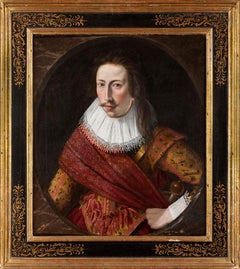
Circle of Cornelius Johnson Circa 1620’s Portrait of a Officer Oil on canvas Image size: 28 x 24 inches Period style hand made frame Provenance Private European Estate This striking portrait dates to around 1620, as you can see from the images of the sash the detail is very high. The sash is decorated with gold thread and would have cost a small fortune at the time. Sashes were originally developed for a military function (making officers more visible for their men during combat), but soon became a primarily male fashion...

Category

Early 17th Century Old Masters Portrait Paintings

Materials

Oil

Portrait of a Gentleman, 17th Century Dutch Old Masters Oil

Portrait of a Gentleman, 17th Century Dutch Old Masters Oil

Located in London, GB

Circle of Gerard van Honthorst 1592 - 1656 Portrait of a Gentleman Oil on wooden panel Image size: 29 x 23 inches Contemporary gilt frame Gerard van Honthorst was a Dutch Golden Age...

Category

17th Century Old Masters Portrait Paintings

Materials

Oil, Wood Panel

Portrait of Nicholas Poyntz

Portrait of Nicholas Poyntz

Located in London, GB

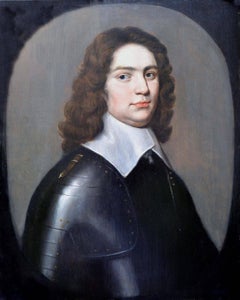
Remigius Van Leemput Portrait of Nicholas Poyntz 1607-1675 Oil on oak panel, unsigned Image size: 13 x 10 1/4 inches (33 x 26 cm) Contemporary style frame Provenance The Dalva Brot...

Category

17th Century Flemish School Portrait Paintings

Materials

Oil, Panel

You May Also Like

Portrait of a Man

Portrait of a Man

Located in New York, NY

Provenance: with Leo Blumenreich and Julius Böhler, Munich, 1924 Dr. Frederic Goldstein Oppenheimer (1881-1963), San Antonio, Texas; by whom given to: Abraham M. Adler, New York, until 1985; thence by descent to the present owners While old inscriptions on the verso of this panel propose its author to be Hans Holbein and the sitter Sir John More—a lawyer, judge, and the father of Sir Thomas More—this fine portrait has long been recognized to be by a Flemish hand. Max Friedländer gave the painting to Bernard van Orley (1487/1491 – 1541) in 1924, but did not include it in the volume dedicated to the artist in his Early Netherlandish Paintings...

Category

16th Century Old Masters Portrait Paintings

Materials

Oil, Panel

Portrait Of Franz von Sickingen Knight Of The Holy Roman Empire (1481-1523)

Portrait Of Franz von Sickingen Knight Of The Holy Roman Empire (1481-1523)

Located in Liphook, GB

Portrait Of Franz von Sickingen Knight Of The Holy Roman Empire (1481-1523) Italian School Large 16th/17th Century Italian Old Master portrait of Franz von Sickingen, Knight Of The...

Category

17th Century Portrait Paintings

Materials

Canvas, Oil

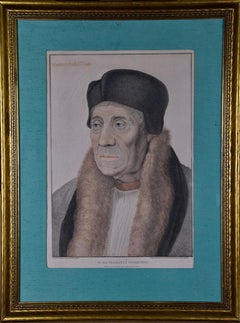
Holbein Hand-colored Portrait of Warham, Archbishop of Canterbury for Henry VIII

Holbein Hand-colored Portrait of Warham, Archbishop of Canterbury for Henry VIII

By (After) Hans Holbein The Younger

Located in Alamo, CA

This framed hand colored stipple engraving and etching portrait of William Warham, Archbishop of Canterbury under King Henry VII and his son King Henry VIII was created by Francesco Bartolozzi (1728–1815) after a drawing and a painting by Hans Holbein (1497-1543), who was Henry VIII's court painter. The print was published in London by John Chamberlaine in 1795. The print was created utilizing stipple engraving and etching techniques by the Italian artist Francesco Bartolozzi, who was employed as the royal engraver by King George III of England. The publisher, John Chamberlaine, was Keeper of the King's Drawings and Medals. The inscription beneath the portrait reads" "In His Majesty's Collection", "Engraved by F. Bartolozzi R A Historical Engraver to His Majesty'' in the lower right, and ''From an original drawing by Hans Holbien'' in the lower left. The original painting by Holbein is displayed at Lambeth Castle and the original drawing is in the art collection at Windsor Castle. The engraving is held by many museums, including: The British Museum, The Metropolitan Museum of Art, The National Portrait Gallery, The Chicago Art Institute and The Fine Arts Museums of San Francisco. This portrait depicts Archbishop William Warham facing to his right, wearing a black cap covering his ears and fur trimmed clerical robes. The print is presented in a decorative gold-colored wood frame with a blue-grey fabric mat. The frame measures 26.5" x 20.13" x 1". The print is in excellent condition. William Warham (1450-1532) was the last of the pre-Reformation archbishops of Canterbury, serving under King Henry VII and then under King Henry VIII. He was a quiet, unassuming intellectual whose career ended with a strong and brave stance against the divorce of King Henry VIII and the king's resultant withdrawal of England from the Catholic church and his draconian actions against the clergy. As Lord Chancellor...

Category

Late 18th Century Portrait Prints

Materials

Engraving, Etching

Portrait Of Gilbert Talbot 7th Earl of Shrewsbury (1552-1616), 16th Century

Portrait Of Gilbert Talbot 7th Earl of Shrewsbury (1552-1616), 16th Century

Located in Liphook, GB

Portrait Of Gilbert Talbot 7th Earl of Shrewsbury (1552-1616), 16th Century Circle of George Gower (c.1540–1596) Huge 16th Century Portrait Of Gilbert Talbot 7th Earl of Shrewsbury...

Category

18th Century Portrait Paintings

Materials

Canvas, Oil

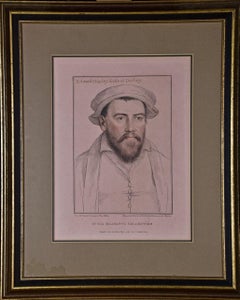
18th C. Portrait of Edward Stanley from Henry VIII's Court after Holbein Drawing

18th C. Portrait of Edward Stanley from Henry VIII's Court after Holbein Drawing

By Hans Holbein

Located in Alamo, CA

This is an 18th century engraved portrait of "Edward Stanley" created by Francesco Bartolozzi (1728–1815), after a drawing by Hans Holbein the Younger (1497- 1543) in the 16th century. Holbein was the official artist in the court of King Henry VIII. Bartolozzi used both etching and stipple engraving techniques to create the work which was published by John Chamberlaine in London in 1793 in "The Book of Imitations of Original Drawings by Hans Holbein in the Collection of His Majesty". Edward Stanley, 3rd Earl of Derby...

Category

Late 18th Century Old Masters Portrait Prints

Materials

Engraving, Etching