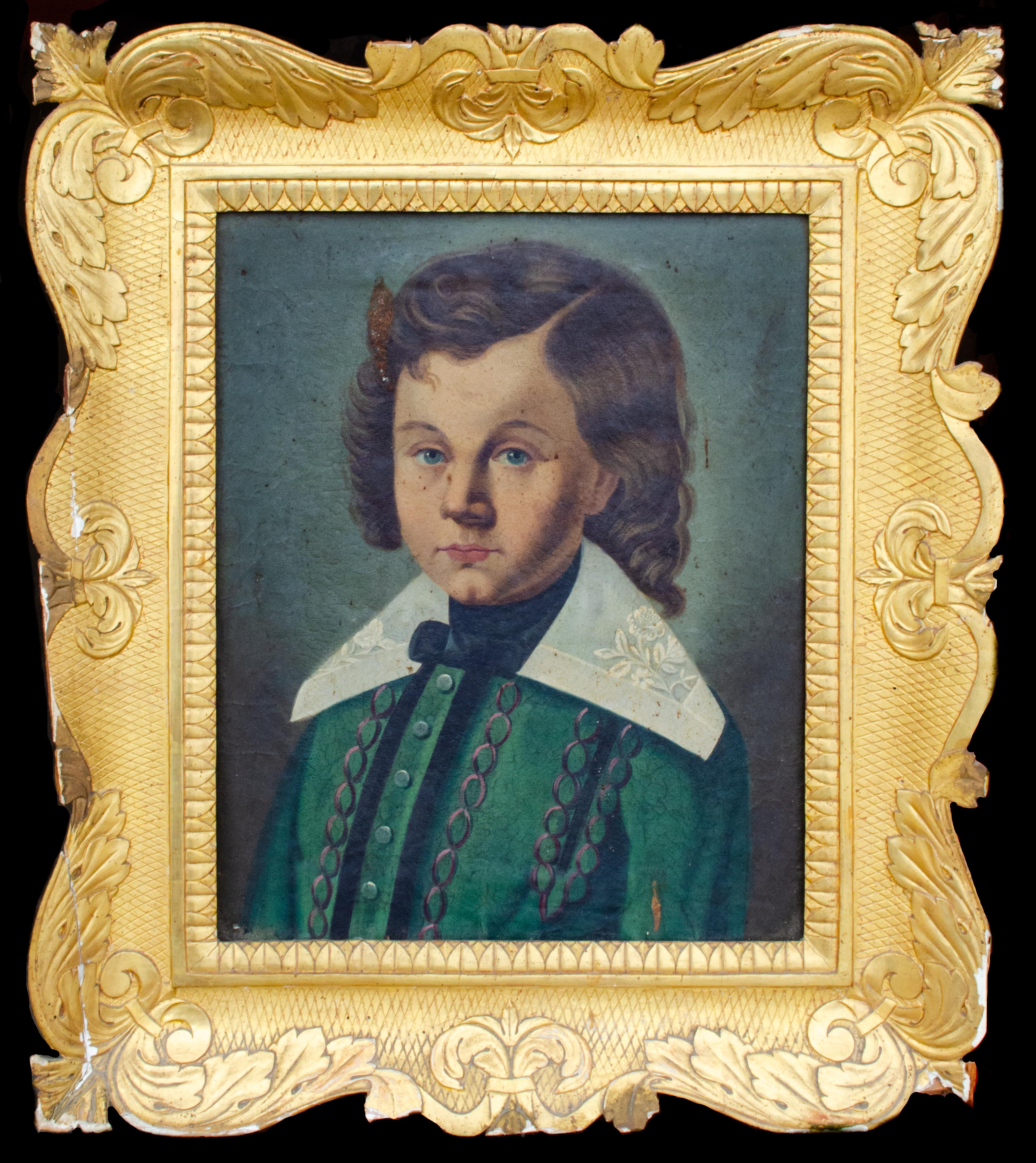
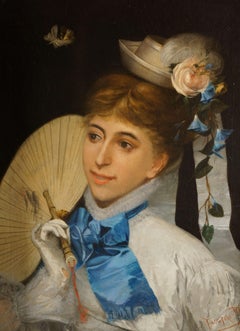
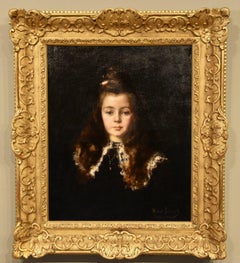
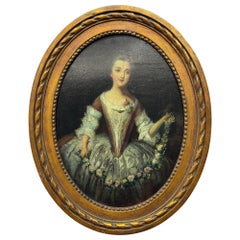
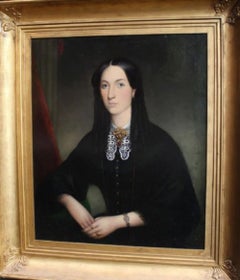
"Portrait of elegant little girl" , extraordinary oil painting on wood panel signed and dated at upper left "A. Robert 1879" for Alexandre Robert.
A Belgian painter of great talent, after studying in Paris and spending time in Rome he became, beginning in 1850, the portrait painter in vogue among the Belgian aristocracy and bourgeoisie after the government commissioned him to paint a portrait of Baron de Stassart. His exceptional pictorial and introspective skills left their mark on the portraiture of the time: his portraits are of intense realism, capturing the viewer with eyes that seem to come alive, faces that come to life. This outstanding portrait of a child of the wealthy bourgeoisie is a good example: dressed with the refined elegance befitting her rank, this beautiful child leaves no one indifferent.
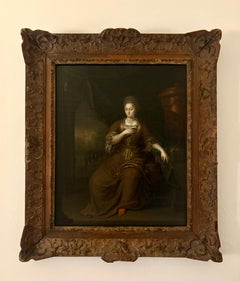
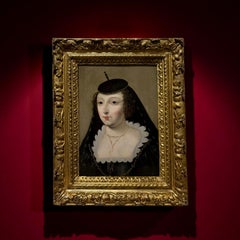
The painting is framed in a magnificent gilded wooden frame of the same period.
Measurements
48 x 39.5 cm panel
frame 68 x 59.5 cm
BIOGRAPHY
Nestor Alexandre Louis Robert (known as Alexandre Robert) (1817-1890)
Trazegnies - Brussels, Belgian School
The son of a notary public, Alexandre Robert was destined to pursue a military career. However, he continued in his vocation: to be a painter. We know that from childhood his aptitude for drawing was noticed; he would sketch portraits of his classmates in notebooks. It was François-Joseph Navez (1787-1869), director of the Brussels Academy and a painter of the same origins as Alexandre Robert, who became his teacher.
The painter's earliest known work dates back to 1838; it is a portrait of his father. Then, in 1841, he made two large religious paintings, which can be seen today in the churches of Trazegnies and Courcelles: "The Martyrdom of Sainte-Barbe" which appeared at the Ghent Exposition of 1841 and "Moses on the Mountain" exhibited at the Brussels Salon of 1842 at the same time as a "Resurrection of Jairus' Daughter."
Following these successes, Alexandre Robert undertook to complete his studies in Paris. He left in early 1842, armed with his master's recommendation that he would secure admission to Paul Delaroche's workshop. But he regretted that he was rejected because the lab was already full.
Thus it was that he found himself sharing a room with Jean-François Portaels (1818-1895), who had been admitted a few months earlier to the study of Paul Delaroche (1797-1856), telling himself that he would benefit from the transfer of lessons through his fellow student. For his part, Alexandre Robert also devoted himself to studying the Masters of the Louvre, admiring Raphael and Poussin, and the Spanish paintings that formed the Aguado de las Marismas gallery. That was until Jean-François Portaels decided to compete for the Prix de Rome and was declared the winner of this artistic tournament.
After this brief stay in Paris, he left the city to follow Jean-François Portaels to Rome. They visited Germany, northern and southern France, Switzerland and Italy.
Installed in Rome, his correspondence exchanges with Navez and the Marquis de Trazegnies show us Alexandre Robert's uncertainty in pursuing history painting. However, he sent for the 1845 Brussels Salon "The Return of Slavery." Also in Rome he executed one of his masterpieces, "Lucas Signorelli paints his dead son," which is now in the Royal Museum of Fine Arts in Brussels and earned him a gold medal at the Brussels Salon in 1848. He also painted "A Regret" in 1849, which was a great success at the Salon in Ghent.
His stay was unfortunately interrupted in 1849 because of Garibaldi's revolution. In 1850, the government commissioned him to paint a portrait of Baron de Stassart for the gallery of the presidents of the legislative chambers, and he became the fashionable portrait painter in the official world, among the aristocracy and the bourgeoisie. His portrait of M. Adolphe van Soust de Borckenfeldt was judged the best at the Paris World's Fair in 1855. A letter from Arthur Stevens to Robert is said to mention the praise given to his portrait by Eugène Delacroix.
The "Charles Quint Before Death" exhibited at the 1854 Salon, initially for the Belgian government, was purchased by the Argentine government after its exhibition in Buenos Aires.
In 1860 he married Alice Madou, the eldest daughter of the distinguished painter Jean-Baptiste Madou.
Aspiring to teaching, from 1864 he directed the drawing course based on ancient figures at the Brussels Academy, then, from 1881, the painting course shared with Joseph Stallaert and Joseph Van Severdonck.
From 1870, following Navez's death the previous year, he was put in charge of the Academy's Fine Arts Class. For the record, through his tenure at the Academy, he was the instigator of the March 26, 1886 Copyright Act, which until then did not exist.
He was made a knight of the Order of Leopold in 1856 and an officer of the Order of Leopold in 1866, at the same time as Joseph Stevens (1816-1892) and Charles Verlat (1824-1890).
His portrait was painted by Félicien Rops for the Galerie d'Uylenspiegel in 1856. He is depicted in costume before a multitude of portraits. (Copy preserved in the British Museum, inv. no. 1896,0511.468.76.