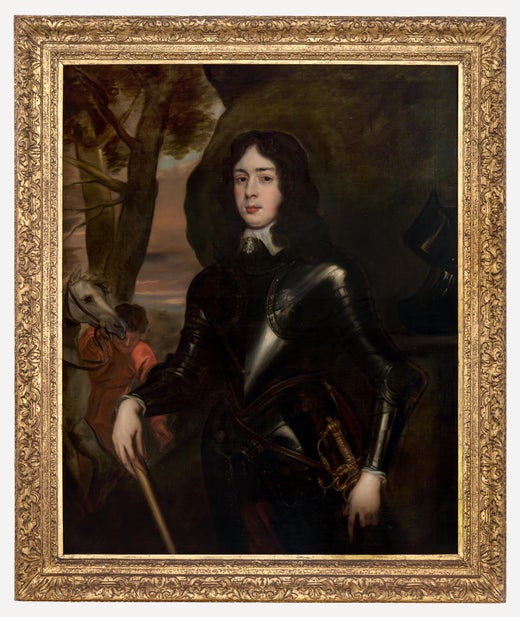
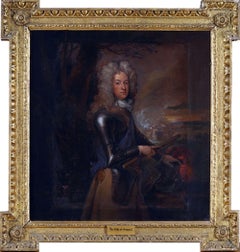
Portrait of a Royalist Officer in Armour, with a Horse and Groom Beyond, c.1650–1665
Follower of Sir Anthony van Dyck (Anglo-Flemish School) (1599-1641)
This commanding portrait belongs to the immediate artistic legacy of Anthony van Dyck, whose arrival in England in 1632 fundamentally reshaped the visual language of aristocratic portraiture. By the mid-17th century, his compositional formulas—elegant contrapposto stance, gleaming armour, baton of command, and expansive landscape—had become the definitive mode through which status, authority, and martial identity were expressed. The present work is a sophisticated and highly competent example of that tradition, produced within the Anglo-Flemish milieu that sustained and disseminated Van Dyck’s style in London after his death.
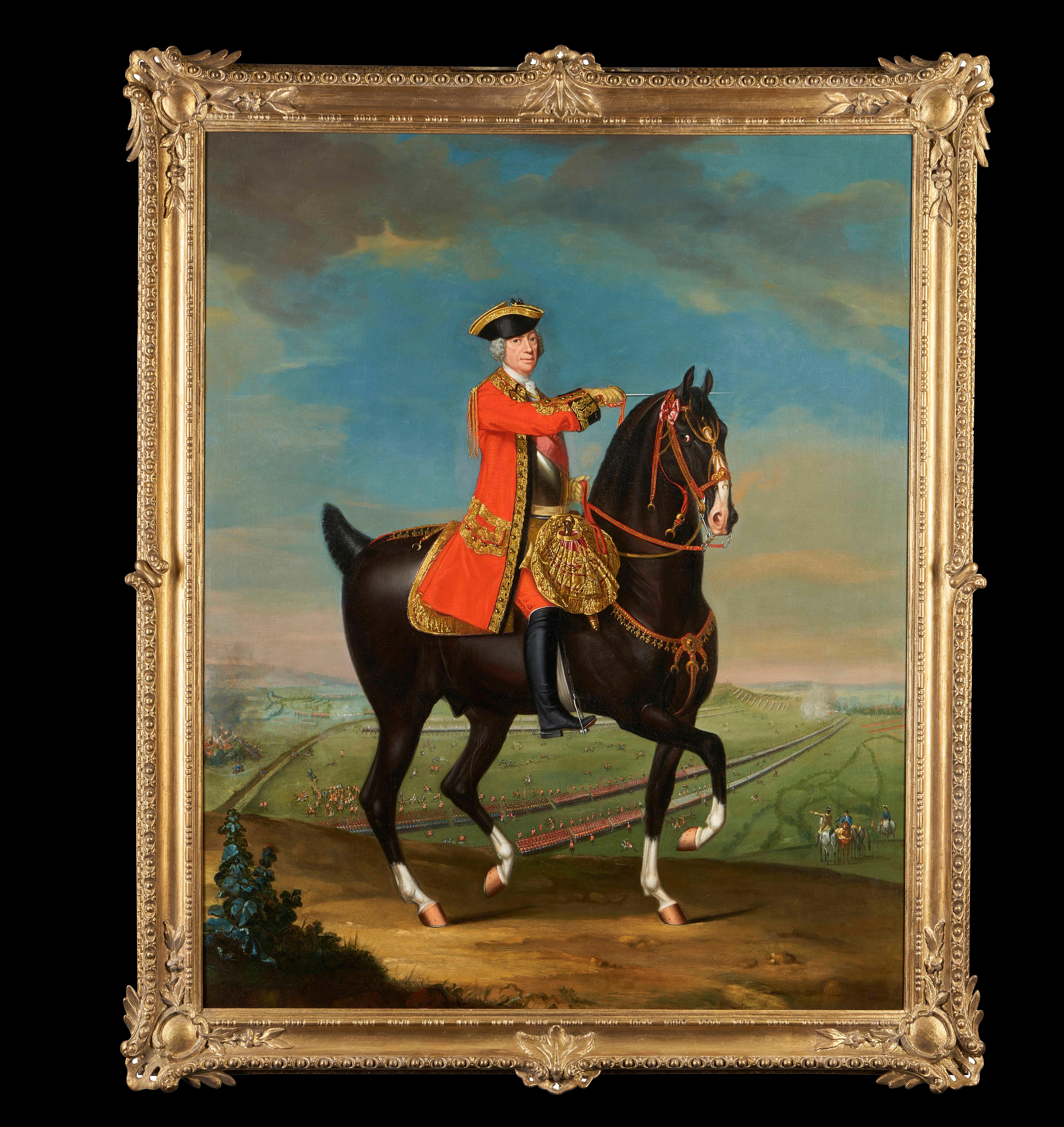
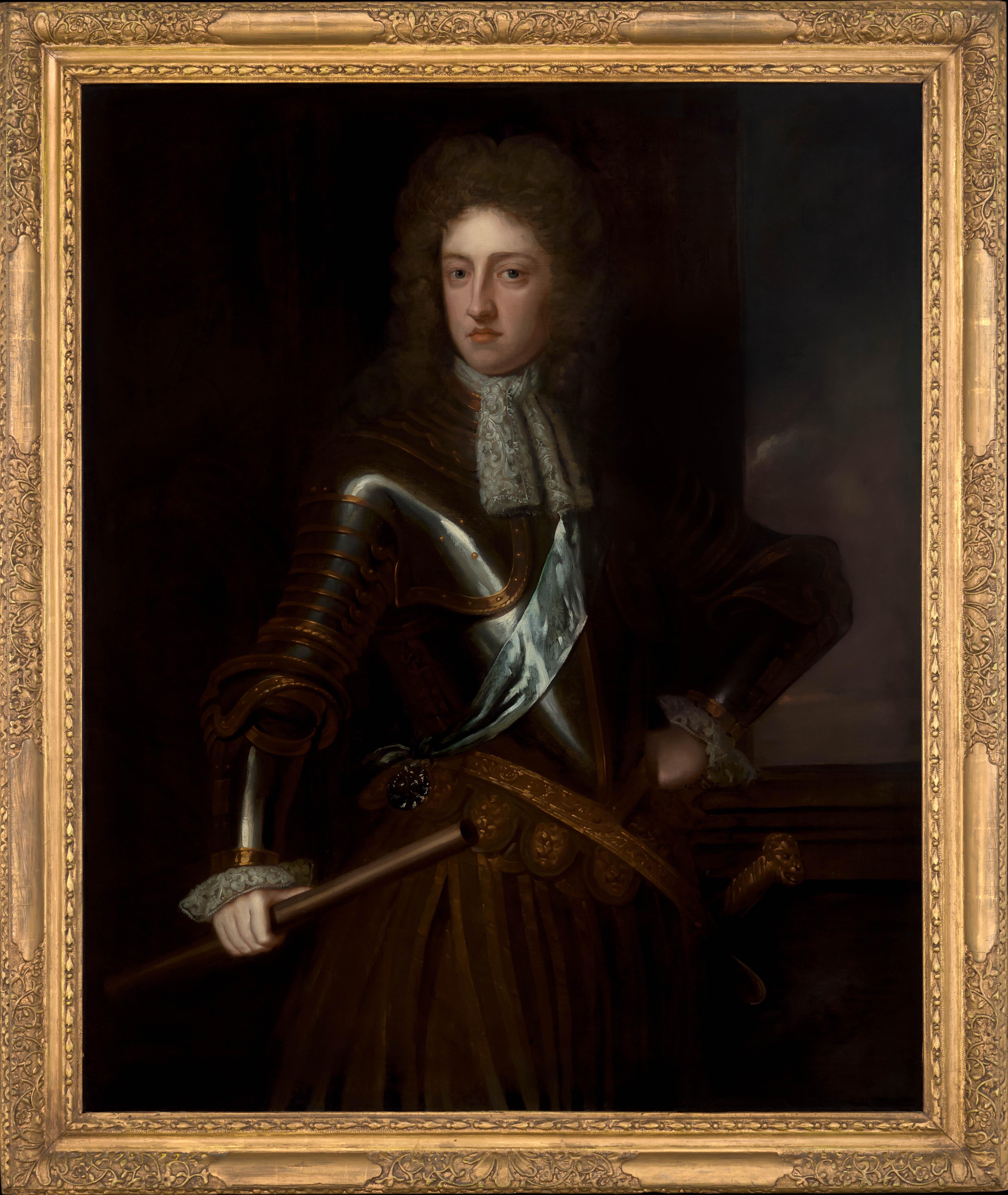
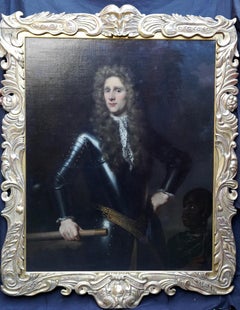
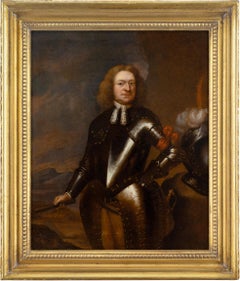
The sitter is shown three-quarter-length, turned slightly to his left, dressed in polished black armour and holding a baton, the traditional emblem of command. Beyond him, a horse and attendant animate the landscape, reinforcing his identity as a cavalry officer and situating him within the aristocratic military culture of the Civil War and its aftermath. This combination of portrait and equestrian reference derives directly from Van Dyck’s great court portraits of the 1630s, in which nobility were presented not merely as individuals, but as embodiments of rank, leadership, and cultivated authority.
Stylistically, the painting reflects the practice of an accomplished Anglo-Flemish hand working in London around the middle of the century, circa 1650–1665. The smooth, enamel-like modelling of the face, with its controlled transitions and softly idealised features, demonstrates a painter trained in the disciplined studio conventions that evolved from Van Dyck’s workshop. The eyes are rendered with a calm, generalised clarity rather than sharp individuality, and the lips are formed with delicate glazing, both characteristic of painters working within established portrait types rather than from direct, highly individualised observation.
The armour is handled with confident economy: highlights are laid in broad tonal bands, and the rivets picked out with small accents of light, creating a convincing impression of sheen without laborious detail. This approach—prioritising effect over microscopic description—is entirely consistent with mid-century London practice, where painters adapted Van Dyck’s methods into a repeatable and marketable visual language. The hand, with its elongated fingers and refined taper, further reinforces this lineage, echoing Van Dyck’s elegant manner while revealing the slightly softened articulation typical of his followers.
The work sits particularly close, in spirit and execution, to painters active in the circle of Gerard Soest, one of several Continental artists who absorbed and perpetuated Van Dyck’s style in England during the Interregnum and early Restoration. While not attributable to a specific named artist, the painting is firmly grounded within this Anglo-Flemish tradition, and represents a mature and assured example of its production.
The portrait’s historical context is equally compelling. The depiction of a young officer in armour, combined with the baton and equestrian elements, strongly suggests a Royalist identity. Such portraits often functioned not only as records of likeness, but as statements of allegiance, loyalty, and social position during a period of profound political upheaval. Whether painted during the later years of the Civil War or in the Restoration period that followed, the image projects continuity—an assertion of status that transcended the instability of the age.
The painting is presented in a fine carved and gilded period frame, which complements the work’s scale and status and reinforces its function as a formal statement piece within an interior. The overall condition allows the picture to be immediately enjoyed, with the essential qualities of the paint surface—particularly the vitality of the flesh tones and the depth of the darker passages—well preserved.
What distinguishes this portrait is the coherence of its conception. It is not a fragmentary or purely decorative survival, but a complete statement of 17th-century aristocratic identity, combining portraiture, landscape, and martial symbolism within a unified and highly recognisable visual language. As such, it offers both strong decorative impact and genuine historical resonance.
In the market, works of this type represent an accessible entry point into the world of Van Dyck and his enduring influence. These works were produced within the artistic ecosystem he created, and carry forward the aesthetic that defined an era of English portraiture. This example, with its scale, compositional completeness, and assured execution, stands as a particularly compelling representative of that tradition.
Measurements:
Height 146cm, Width 123cm framed (Height 57.5”, Width 48.5” framed)
Titan Fine Art
Not Signed