Want more images or videos?
Request additional images or videos from the seller
1 of 6

Arthur Devis
Portrait of a Gentleman

1755

$50,930.31
£37,415
€44,482.07
CA$71,571.24
A$73,268.85
CHF 41,537.74
MX$888,993.32
NOK 489,534.45
SEK 492,267.73
DKK 332,506.65

About the Item

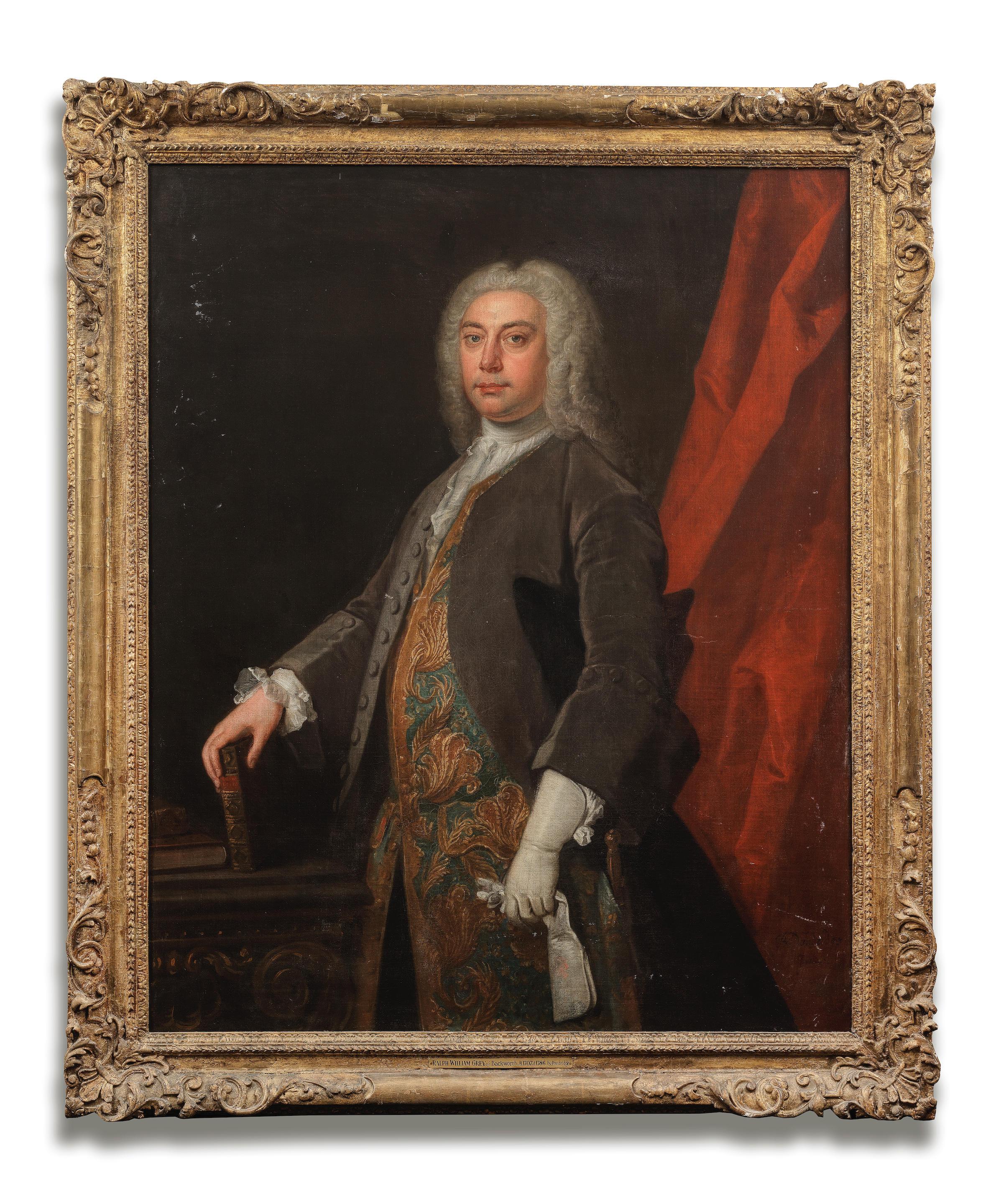
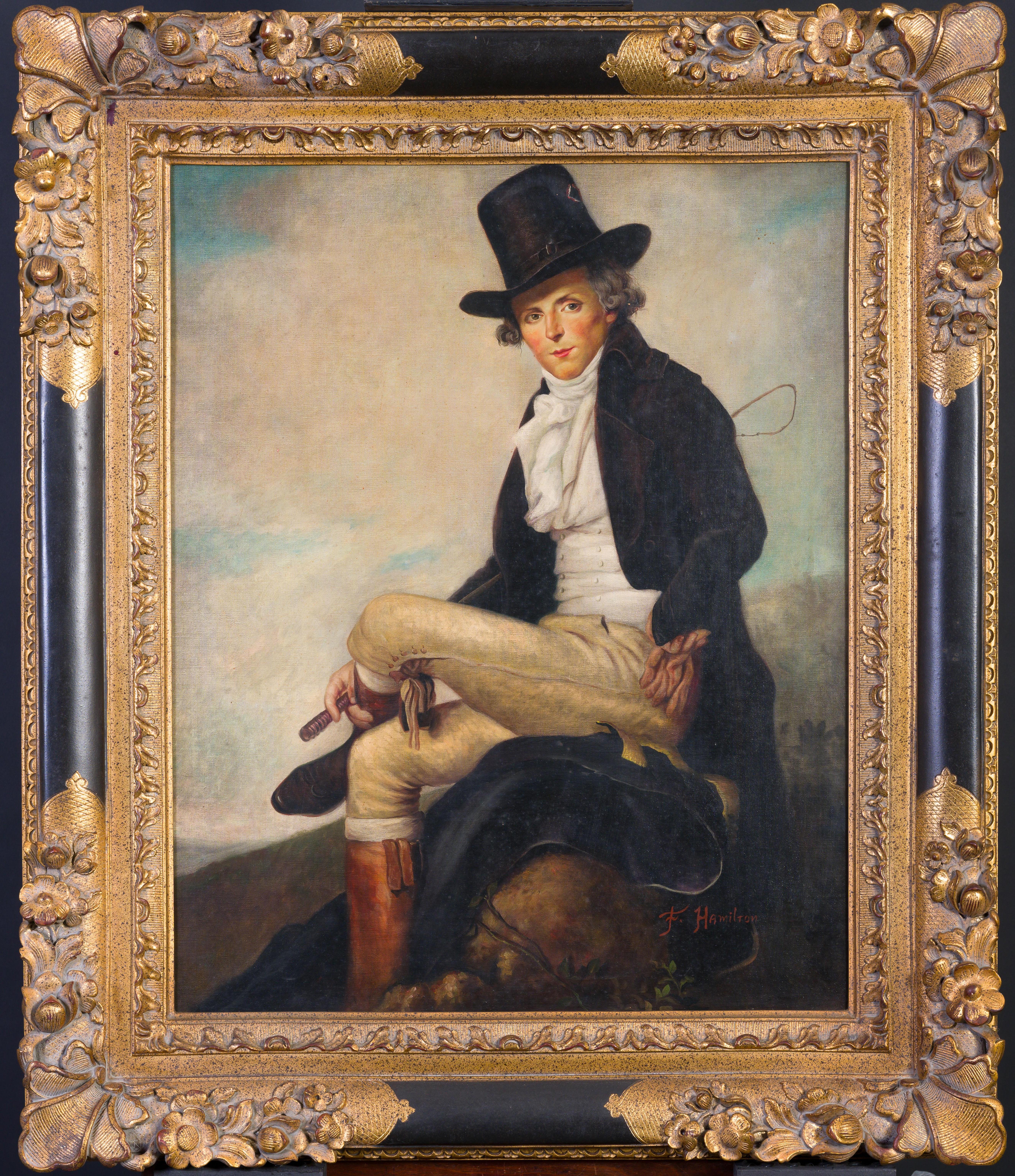
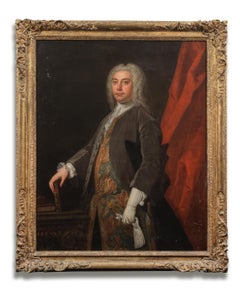
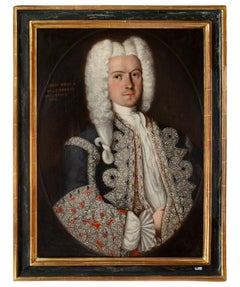
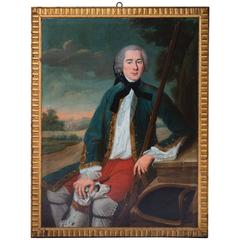
Oil on canvas, signed and dated 'Art Devis/fe 1755' lower left Image size: 29 1/2 x 24 1/4 inches (75 x 62 cm) Original ornate gilt wood frame Provenance: Ian Douglas Leonard Cochrane, 14th Earl of Dundonald Christie's London, June 16, 1961, lot 56, to Leggatt for 5,200 Guineas The Viscountess Rothermere (1929-1992) Anonymous sale ('The Property of a Lady'), London, Christie's, July 16, 1982, lot 60 Private collection, U.K Sotheby's London, December 14, 2021, lot 52 The Jerold Krouse Collection Literature:  E.G. D'Oench, Arthur Devis: Master of the Georgian Conversation Piece, unpublished PhD thesis, 1979, p. 469, cat. no. 222 E.G. D'Oench, The Conversation Piece, Arthur Devis and his contemporaries, New Haven 1980, p. 91, cat. no. 222 Exhibited: Bath, Holbourne Museum, on loan from 1988-2006 In this portrait, a well-dressed gentleman leans nonchalantly on a chair, the book clasped in his hand operating as a symbol of his education. His posture, with one hand on his hip brushing away his overcoat, has allowed for Devis to masterfully depict a range of different fabric textures - for example, the lace cuffs, the satin waistcoat, and the velvet lapels of his overcoat. Whilst the focus of the portrait is firmly on the powerful presence of its central figure, the beauty of the landscape in the background pays testament to Devis’ early training as a portraitist. The river and rolling hills recede into the background and create a sense of scale, whilst the Church behind the figure’s shoulder provides an aspect of potential realism - perhaps this was a local church associated with the lands, titles or heritage of the sitter. Arthur DevisArthur Devis was born in Preston, Lancashire in 1712, the son of a carpenter and councillor. He moved to London and was trained by Pieter Tillemans, who was known for his sporting and topographical scenes. He produced a number of Italianate landscapes during this time, but soon diverted from landscape painting into portraiture, becoming well-known for his conversation pieces and small-scale works. Devis moved between London and Lancashire, taking commissions and earning acclaim in both locations - he used his father’s position as a town councillor in Lancashire to earn commissions from local noble families. In 1745, he opened a studio in Lincoln’s Inn Fields.Devis is well-known for his conversation pieces, which depict one or more full-length figures within interiors or small-scale landscapes, surrounded by a few identifying or prized possessions. This genre, started by Hogarth, was immensely popular in the 18th century and Devis has been immortalised as one of the most prolific conversation piece artists. He worked largely for the gentry and has become recognisable for his doll-like figures. The uncanny quality of his figures is due to their references being mannequins that Devis would dress and pose for the bodies of his portrait sitters to save their constant attendance at his studio. Devis had little familiarity with human anatomy, having trained under a sporting and topographical artist. For this reason, some of Devis’ works have a clear visual format, with recycled poses and costumes. His interiors and landscape backgrounds were also often imagined.From 1761, Devis exhibited at the Free Society of Artists and became its president in 1780. Although he is best known for his portrait of the landed gentry, Devis also painted in class. He was commissioned to restore paintings for Sir Roger Newdigate, and to clean and repair the Painted Hall at the Royal Naval Hospital, Greenwich. After the founding of the Royal Academy, however, Devis’ reputation began to decline in the face of a younger generation of increasingly innovative artists.Devis sold his estates in 1783 and moved to Brighton, where he would pass away in 1787. Both of his sons, his half-brother, and his son-in-law were respected artists in their own right. His works have taken on a new significance as they represent the social hierarchies between families in the 18th century, through the positioning and posing of the figures.
  • Creator:
    Arthur Devis (1712 - 1787)
  • Creation Year:
    1755
  • Dimensions:
    Height: 29.5 in (74.93 cm)Width: 24.25 in (61.6 cm)
  • Medium:
  • Period:
    1750-1759
  • Condition:
  • Gallery Location:
    London, GB
  • Reference Number:
    1stDibs: LU52417443652

More From This Seller

View All
Portrait of a Gentleman

Portrait of a Gentleman

Located in London, GB

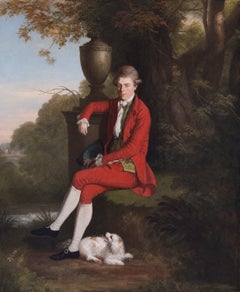
Here we see a finely painted English gentleman, dressed in a crimson suit which boldly stands out against the more muted greens of the garden setting, along with a fashionable wig. D...

Category

18th Century Portrait Paintings

Materials

Canvas, Oil

William, 1st Viscount Bateman and Family

William, 1st Viscount Bateman and Family

Located in London, GB

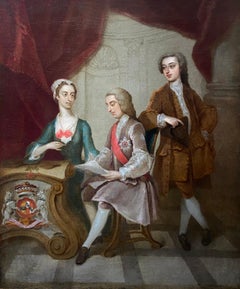
Oil on canvas Image size: 24 x 18 1/2 inches (61 x 47 cm) Gilded wood framed Provenance Estate of Judge Davis Norton and Florence Edelstein. William Bateman was a British Whig politician who sat in the House of Commons between 1721 and 1734. He was made Knight Companion of the Order of the Bath...

Category

Early 18th Century Figurative Paintings

Materials

Canvas, Oil

Portrait of William Henry Kerr, Earl of Ancram, 4th Marquess of Lothian

Portrait of William Henry Kerr, Earl of Ancram, 4th Marquess of Lothian

Located in London, GB

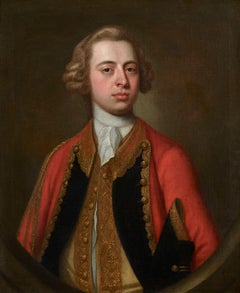
James Fellowes Flourished 1719 - 1750 Portrait of William Henry Kerr, Earl of Ancram, 4th Marquess of Lothian Oil on canvas, signed & dated 1747 Image size: 29 1/2 x 24 1/2 inches (75 x 62 cm) Original gilt wood frame William Henry Kerr was born a member of the Scottish peerage to William, third Marquess of Lothian, and his first wife Margaret, daughter of Sir Thomas Nicholson of Kemnay, first Baronet. William was styled Master Jedburgh until 1722, when his father was elevated to a Marquessate, after which he was referred to as Lord Jedburgh until 1735. Following his father’s military footsteps, on 20 June 1735 Ancram was commissioned as a cornet to the regiment (11th Dragoons) of his grand-uncle, Lord Mark Kerr. Ancram married Lady Caroline...

Category

1740s Old Masters Portrait Paintings

Materials

Oil

Portrait of Ralph William Grey

Portrait of Ralph William Grey

By Bartholomew Dandridge

Located in London, GB

Provenance By descent through the sitter's family to The Collection of R. W. Vivian-Neal of Poundisford Park, Somerset, from whom acquired by With Lane Fine Art, UK, where purchased ...

Category

Mid-18th Century English School Portrait Paintings

Materials

Oil, Canvas

Portrait of Captain George Week

Portrait of Captain George Week

Located in London, GB

William Roth Born 1754 Portrait of Captain George Meek Oil on canvas, signed & dated 1782 lower right Image size: 25 x 18 ½ inches (64 x 47 cm) Ornate giltwood William Kent style...

Category

Late 18th Century Portrait Paintings

Materials

Canvas, Oil

Portrait of a Gentleman, 18th Century Oil Painting

Portrait of a Gentleman, 18th Century Oil Painting

By Anton von Maron

Located in London, GB

Oil on canvas Image size: 20 x 24 inches (51 x 61 cm) Period gilt frame This is a half-length portrait of a gentleman wearing a emerald coat and intricately designed waistcoat, dat...

Category

1760s Portrait Paintings

Materials

Canvas, Oil

You May Also Like

large 18th century portrait gentleman oil on canvas

large 18th century portrait gentleman oil on canvas

Located in York, GB

A fine, imposing 18th century portrait of an unknown aristocrat,housed in a gilt frame The artist is also unidentified but certainly a talented hand, in the circle of one of the fine old masters of the period. Unsigned The size overall is 148 x 121 cm whilst the painting is 128 x 101 cm In overall good condition the frame at the bottom has bowed slightly The painting has been checked whilst being cleaned and has not been affected in any way . SHIPPING Free delivery to mainland uk ,worldwide shipping available please email for quote Delivery usually within 14 working days, insured please provide telephone/email details for courier. All taxes/customs etc to be paid for by purchaser. RETURNS (The Consumer Contracts Regulations) Whilst we are sure that you will be extremely happy with your purchase, if for any reason you are not, then you are entitled to return the item to us for a refund. For all purchases made you are entitled to return the item(s) for a period of up to 14 days following receipt by you or a representative indicated by you. Please contact us to confirm that you are returning the item(s) and the reason for doing so. Upon receipt of the item(s) we will refund the purchase price via your original payment method...

Category

18th Century Old Masters Portrait Paintings

Materials

Oil

A Portrait of a Gentleman, thought to be Moses Diego Lopez Pereira

A Portrait of a Gentleman, thought to be Moses Diego Lopez Pereira

Located in London, GB

Austrian School, 18th Century A Portrait of a Gentleman, thought to be Moses Diego Lopez Pereira, 1st Baron d’Aguilar, in an elaborate coat and a powdered wig Oil on canvas Provena...

Category

18th Century Paintings

Materials

Canvas, Oil

Henry Bowles Howard, 12th Earl Of Suffolk And 5th Earl Of Berkshire

Henry Bowles Howard, 12th Earl Of Suffolk And 5th Earl Of Berkshire

Located in New Orleans, LA

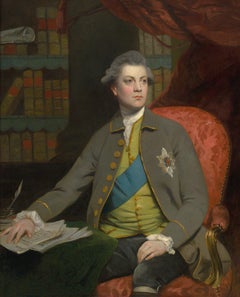
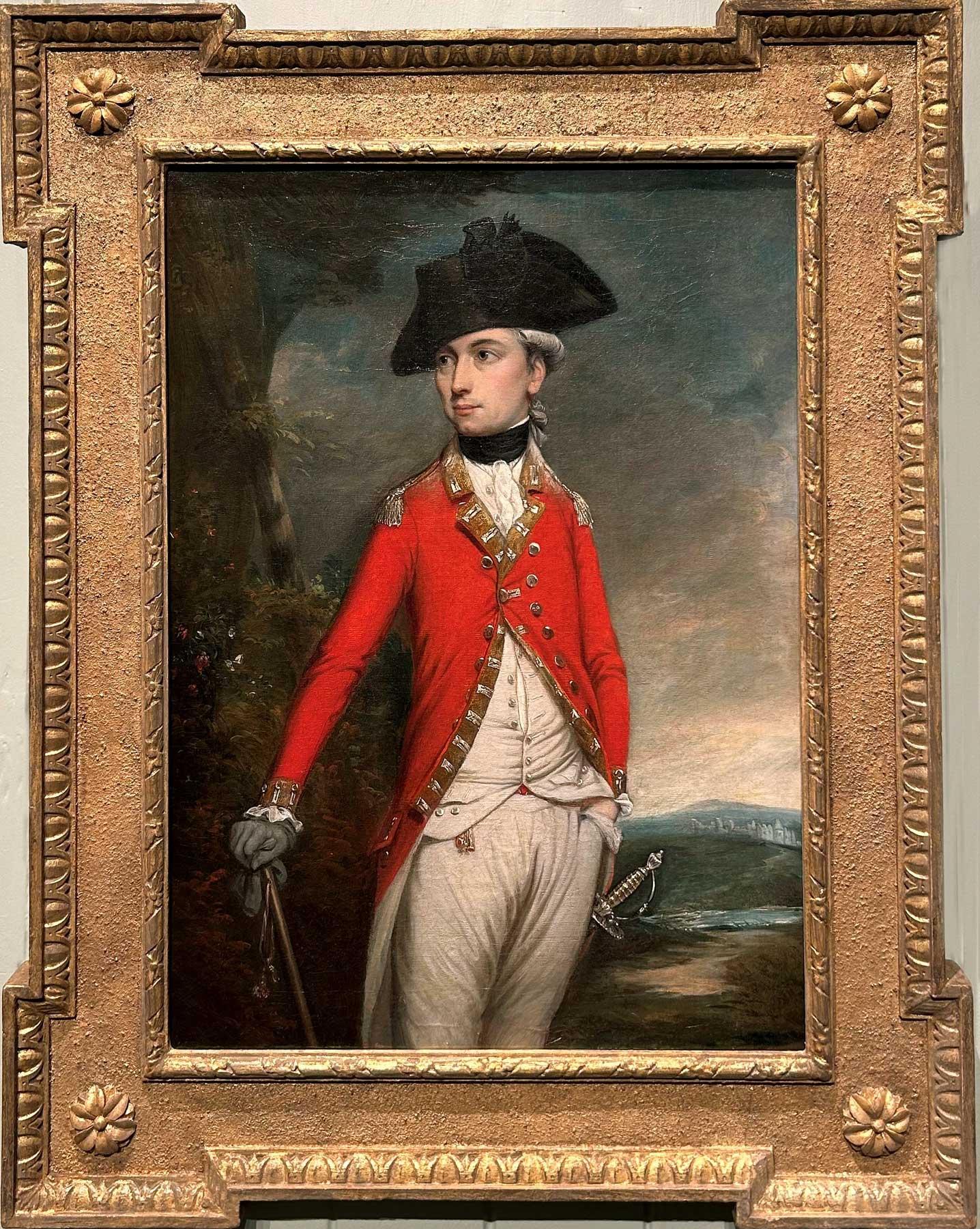
Sir Joshua Reynolds 1723-1792 British Sir Henry Bowles Howard, 12th Earl of Suffolk and 5th Earl of Berkshire Oil on canvas Sir Joshua Reynolds is unequivocally considered the most important English portraitist of the 18th century who was instrumental in adapting the Grand Manner style in the portrait genre. In fact, when the Royal Academy was founded in 1768, Reynolds was elected its first President, setting the precedent of quality for which all other portraitists would strive. Reynolds's portrait of Henry Bowles Howard, 12th Earl of Suffolk, showcases his genius in the genre and mastery over the medium. Reynolds’s portrait of the Earl expertly invokes classical values with strong lighting, rich colors and expert attention to detail to help underscore the prominence and revered echelon of the sitter. Howard was an esteemed British politician and Knight of the Garter. He served as Secretary of State for the Northern Department from 1771 to 1779, and he played a key role in utilizing mercenaries during the American Revolution and safeguarding Sweden's independence. The portrait employs Reynolds's signature style to render Howard rightfully as a gentleman of distinction. Captured seated in a stately library, the Earl appears learned and austere as he places one hand upon a stack of important documents and looks wistfully into the distance. Reynolds makes these compositional choices decisively, as the seated position gives Howard a weighty appearance of importance and the semi-profile turn captures his countenance at an attractive angle that highlights his strong, masculine features. The work draws on the classical conventions of Greek and Roman art and the Italian Renaissance masters, anchoring the nobleman in a history of refinement. Everything from his strong yet welcoming expression to his pale face enlivened by a rush of blood to the cheeks presents the picture of a strong, vital and powerful leader. As the first president of the Royal Academy in London, Reynolds’s commissions raised the status of an artist in Britain during the Romantic period and also established the portrait as an esteemed high art genre that garnered equal import to the history paintings that reigned supreme in decades prior. Today, Reynolds’s works grace the walls of the most important museums in the world, including the Louvre, the Metropolitan Museum of Art, and the National Gallery in London, among others. Circa 1770 Canvas: 50 1/2" high x 40 1/4" wide Framed: 61" high x 52 1/2" wide x 3 1/2" deep Provenance: Sir Henry Howard, 12th Earl of Suffolk and 5th Earl of Berkshire, 1739-1779 His mother, Lady Mary Howard, née Finch, Lady Andover, d. 1803 Acquired by descent to her daughter, Frances, and her husband Richard Bagot (later Howard) Acquired by descent to their daughter, Mary (1784-1877), and her husband Col. Fulke Greville Upton (later Howard), d. 1846 Acquired by descent to Lieutenant Colonel H.R.G. Howard Sale, Christie's, London, March 24, 1961, no. 29 Julius Weitzner, London and New York Sale, Paris, Musée Galliéra, December 7, 1965, no. 165 Newhouse Galleries, New York, NY Mr. and Mrs. F. Howard Walsh, Fort Worth, Texas, 1966 Walsh Family Art Trust Private collection, Oregon M.S. Rau, New Orleans Exhibited: British Institution, London, 1844, no. 130, loaned by the Hon. Fulke Greville Howard. South Kensington, "Second special exhibition of National Portraits," 1867, no. 478, lent by the Hon. Mrs. Greville. Agnew's, London, 1903, no. 17. Literature: Algernon Graves and W. V. Cronin, A History of the Works of Sir Joshua Reynolds, P.R.A., vol. 3 (London, 1899), p. 945. David Mannings...

Category

18th Century Other Art Style Portrait Paintings
Materials

Canvas, Oil

18th Century portrait oil painting of a gentleman

18th Century portrait oil painting of a gentleman

Located in Nr Broadway, Worcestershire

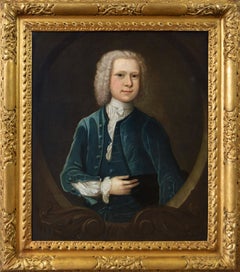
Follower of Enoch Seeman the Younger German, (1694-1744) Portrait of Gilbert Sympkin Oil on canvas Image size: 29.25 inches x 24.5 inches Size including frame: 38 inches x 33.25 inches A fine three quarter length portrait of a gentleman traditionally identified as Gilbert Simpkin (Sympkin), follower of Enoch Seeman the younger, C1720. The portrait is set in a feigned sculptured oval cartouche, a device used to give a sense of depth. The sitter is depicted wearing a fashionable blue jacket and matching waistcoat with a white chemise and lace jabot. He wears a powdered wig in the fashionable style of the day and is posed holding his hat under his left arm with the fingers of his right hand stretched out. At court, long fingers signified wealth, culture and intelligence. The painting has clearly been executed by an artist of great ability who has been influenced by Enoch Seeman the younger. Gilbert Simpkin (Sympkin) was born in London on 24 August 1683, the son of John Simpkin and Susannah Butler. His grandfather was also called Gilbert Simpkin. He entered Oxford University in 1700 where he studied at St John’s College. In 1702, he became a student of Middle Temple, which at the time was one of the world’s most important centres of legal education. He later settled in Plymouth and then Bristol. He died in Bristol on 15 May, 1744 and was buried at Bristol Cathedral. He remained unmarried and the portrait may well have been commissioned to commemorate when he was first Called to the Bar or perhaps had established his own practice. Enoch Seeman or Seemann the younger was born in Danzig, Germany now Gdansk, Poland in 1694. His father was Enoch Seeman Senior, an artist of Flemish origin and his brothers Isaac, Noah and Abraham also became artists. He came to London with his father and brothers around 1704 and established himself as a portrait artist. From 1717 he became painter to the Royal court painting...

Category

18th Century Old Masters Portrait Paintings

Materials

Canvas, Oil

Portrait of a Gentleman, Oil on Canvas

Portrait of a Gentleman, Oil on Canvas

Located in London, by appointment only

Oil on canvas Portrait of a gentleman 18th century Measures: Portrait framed 56 x 43 and 51 x 38.5.

Category

Antique 18th Century European Georgian Paintings

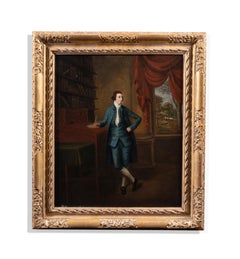
Portrait of a gentleman, standing full length, wearing a blue jacket, waistcoat

Portrait of a gentleman, standing full length, wearing a blue jacket, waistcoat

By Arthur Devis

Located in Stoke, Hampshire

Circle of Arthur Devis (1712-1787) Portrait of a gentleman, standing full length, wearing a blue jacket, waistcoat and breeches, at a desk in a library Oil on canvas Signed lower cen...

Category

18th Century Old Masters Portrait Paintings

Materials

Canvas, Oil