Ron Gorchov
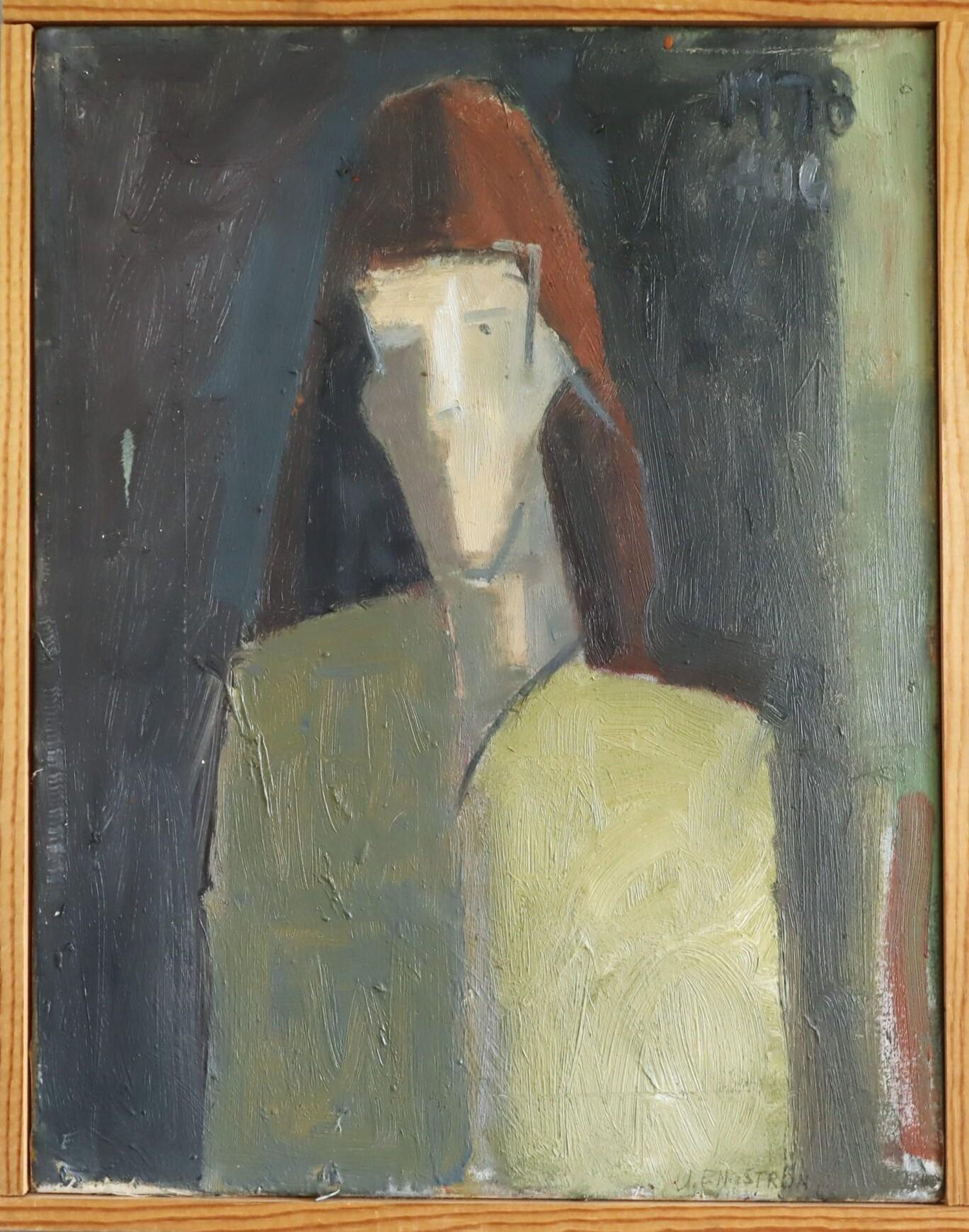
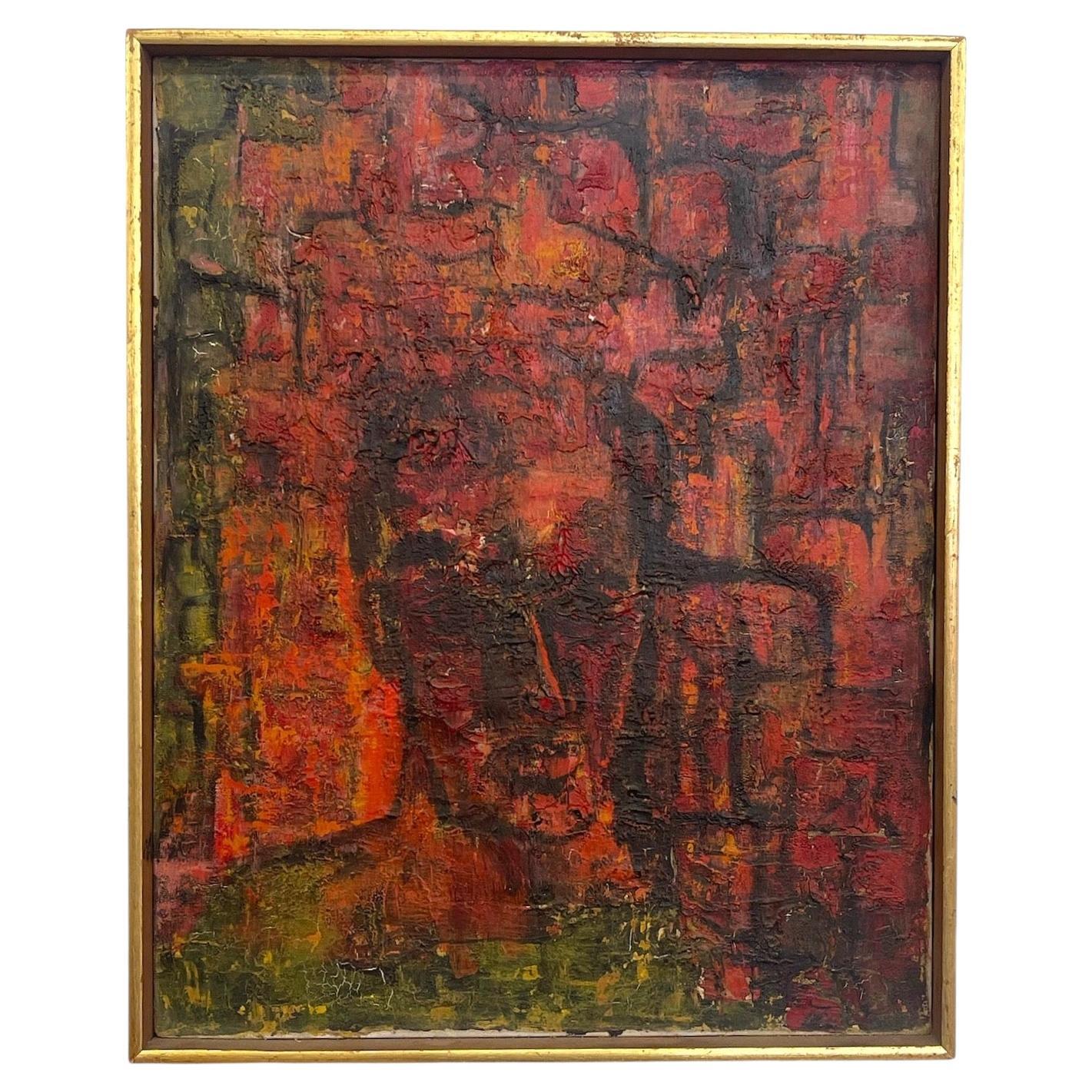
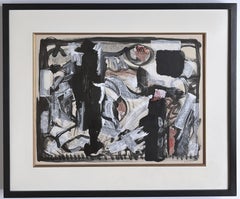
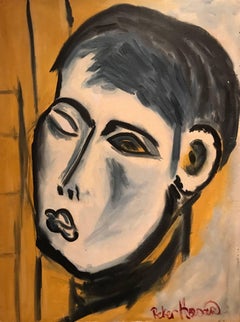
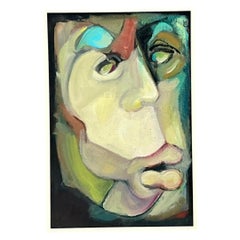
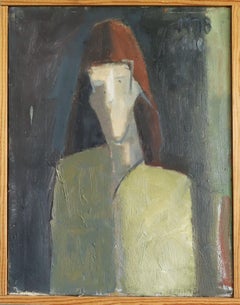
Historic Self Portrait, 1955-1959
Oil painting on board
Hand signed in paint on the upper recto and dated 1955-9
Frame included: held in original vintage artist's frame
This work was exhibited at the Sager Reeves Gallery in Columbia, Missouri in their Masters Exhibit in December, 2022, and is reproduced as a full page in their exhibition catalogue. A copy of this catalogue accompanies the artwork.
In 2019, the year before Ron Gorchov passed away, Stephen Truax, director of Cheim & Read, his then gallery, passed along details of this extraordinary painting to Gorchov's studio to be included in the forthcoming catalogue raisonne. When shown the work, Gorchov remembered it well, but was amazed that the painting was still in existence after so many years. This historic early self-portrait, done over a period of four years, from 1955-1959, starting when he was only 25 years old reveals Gorchov's distinctive and sophisticated sense of color and form. This is one of the artist's earliest works, and very few works by Gorchov from this era ever appear on the market or are known to remain in existence. It should be in any museum or career retrospective. This work was gifted by the artist to Elthea Rembrandt Peale Florman in NYC in 1959 - the year Gorchov won a prestigious Ingram Merrill Foundation award. Elthea was also an artist, and came from a long line of American artists. She was immersed in the art scene in NYC until she went to art school in Tennessee. The painting was given to her by Ron Gorchov and remained in Ms. Florman's collection until her passing, whereupon it was bequeathed to her descendants.
Measurements:
Framed 31 inches by 25 inches
Board 30 by 20 inches
Provenance:
Elthea Rembrandt Peale Florman
By descent to the present owner
More about Ron Gorchov
“My paintings are mostly made from reverie, and luck.”
— Ron Gorchov from interview with Robert Storr and Phong Bui, September 2006
Born in Chicago in 1930, Ron Gorchov was an American artist known for his curved surface artworks. The artist helped spearhead the shaped canvas movement. With his bowed wooden frames stretched with linen or canvas, he uniquely bridged sculpture and abstract painting.
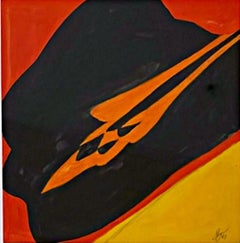
Gorchov’s oil-on-linen paintings pair one or two biomorphic colored shapes with differently colored backgrounds. The patterns of these paintings resemble living organisms, telling the story of the beginning of a certain formative state. These questions of form and existence materialize through the use of bold brushstrokes, providing chromatic contrasts.
The artist hung the work on a shaped canvas stretcher that is at once concave and convex, similar to shields or saddles. Gorchov utilized the curved shape’s ability to catch the viewers’ immediate attention faster than the traditional rectangle. While the paintings themselves play with symmetry and asymmetry, the warped edges of Gorchov’s canvases create new dimensions and depth, disorienting the perception of the audience.
Gorchov’s distinctive and assertive saddle-like stretchers were created in the late 1960s as an alternative to the pervasive Greenbergian formalism of the time, evidenced in the dominance of minimalist sculpture. He created his first shaped canvas work in Mark Rothko’s studio. He belongs to a generation of artists in New York in the 1960s and 70s that includes Frank Stella, Richard Tuttle, Blinky Palermo, and Ellsworth Kelly, who pushed painting to its extreme. Gorchov was unique in his ability to unite form and content while preserving their tensions.
Following his first solo exhibition at New York’s Tibor de Nagy Gallery in 1960, Gorchov’s artworks have since been exhibited at prominent museums and galleries around the world. His works have been shown in New York at The Museum of Modern Art, Whitney Museum of American Art, MoMA PS1, Queens Museum of Art, and the New Museum of Contemporary Art. He has also been the subject of solo exhibitions at the Contemporary Art Museum, St. Louis (‘14) and at the Centro Atlántico de Arte Moderno, Las Palmas de Gran Canaria (‘11). Recent solo exhibitions include Cheim & Read, New York (’22, ’21, ’19, ‘17, ‘12); Maruani Mercier, Brussels (’19, ’18, ’17); Modern Art, London (’19); Galerie Max Hetzler, Berlin (’18); Thomas Brambilla, Bergamo (’18, ‘15); and Vito Schnabel Gallery, New York (‘21, ’16, ’13, ’08, ‘05).
"Ron Gorchov’s paintings are among the most fully and graciously embodied being made today. They engage our whole bodies from our first encounter with them and sustain this engagement over time. You have to move to see them, and when you move, they come alive. With one’s whole body involved, the mind is also free to move, and does.”
—David Levi Strauss
“In Ron Gorchov’s paintings we find the argument that he created for himself is his poetic flight, and within the argument of lightness (his imagery) and weightiness (his structure) there arises his fine balance that truly obscures the differences between form and content. He is painting-in-between.”
—Phong Bui