Want more images or videos?
Request additional images or videos from the seller
1 of 13

Unknown
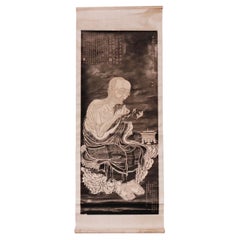
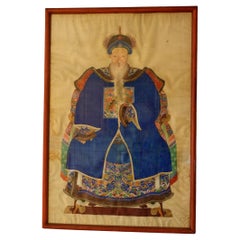
"Yue Fei", Chinese Historical Folk Hero, Late Qing Dynasty Stele Rubbing, Ink

Late 19th Century

$5,250List Price

You May Also Like

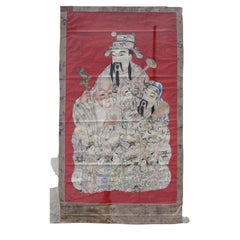
Collection of Hand Drawn Rubbings of the Portraits of Luohans

Collection of Hand Drawn Rubbings of the Portraits of Luohans

Located in West Palm Beach, FL

A collection of hand drawn rubbings of the portraits of Luohans from original engraved stone tablets that were commissioned in 1764 by the Chinese emperor...

Category

20th Century Paintings and Screens

Materials

Canvas, Linen

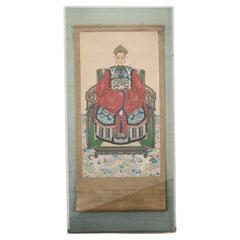
Chinese Ink and Colour on Fabric Painting, "Emperor"

Chinese Ink and Colour on Fabric Painting, "Emperor"

Located in West Palm Beach, FL

Chinese ink and colour on fabric Painting, "Emperor" Qing Dynasty, set within two lucite panels Measures: The painting 87 by 151 cm., 34.5 by 59.5 in., Please note that this l...

Category

20th Century Paintings and Screens

Materials

Silk

Monumental Chinese Ancestral Matriarch Scroll Portrait Painting

Monumental Chinese Ancestral Matriarch Scroll Portrait Painting

Located in Rio Vista, CA

Monumental Chinese Qing ancestor scroll portrait painting of a high ranking official or Imperial court matriarch. Features a intricately decorated Min...

Category

Antique Late 19th Century Chinese Qing Paintings

Materials

Linen, Silk, Plexiglass, Wood, Lacquer, Paper

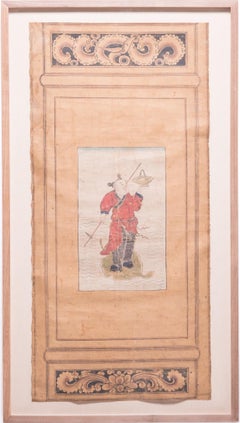
Chinese Mythical Immortal Screen Painting, c. 1850

Chinese Mythical Immortal Screen Painting, c. 1850

Located in Chicago, IL

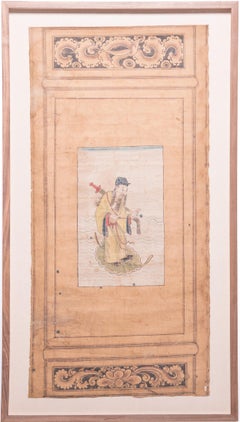
Since the 12th century, people in China have used folding screens and doors to partition and decorate their homes - the vivid scenes backing the screens added life and color to a room. This 19th-century painting is delicately brushed of gouache and ink on fabric and was originally part of a set of eight backing a wooden screen in northern China. The figure depicted is one of the mythical Eight Immortals of Taoism. Said to have attained immortality through their studies of the natural world, each of the Eight Immortals represents a different condition in life and together they impart a blessing of prosperity and longevity. Depicted here is immortal Lan Caihe, the patron saint of florists and gardeners. Standing atop a lotus leaf in open water, they hold a gardening hoe in one hand and a basket for flowers...

Category

Mid-19th Century Qing Figurative Paintings

Materials

Fabric, Ink, Pigment

Large 19th Century Chinese Framed Ancestor Portrait, #Ric.P3

Large 19th Century Chinese Framed Ancestor Portrait, #Ric.P3

Located in Norton, MA

Hand-Painted on silk, Chinese households honor their ancestors in private family rituals, invoking their spirits for long life, health, and prosperity. Commemorative portraits, which...

Category

Antique 19th Century Chinese Qing Paintings and Screens

Materials

Silk, Glass, Wood, Paint

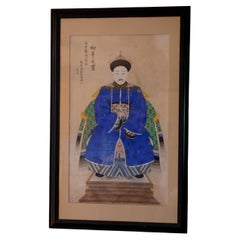
Chinese Ancestor Portrait of Mandarin Dignitary, Qing Dynasty

Chinese Ancestor Portrait of Mandarin Dignitary, Qing Dynasty

$1,760Sale Price|20% Off

H 31 in W 20 in D 0.75 in

Chinese Ancestor Portrait of Mandarin Dignitary, Qing Dynasty

Located in Vero Beach, FL

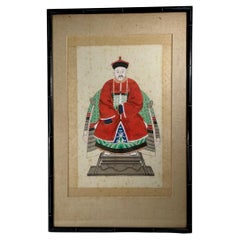
Chinese ancestor portrait of a Mandarin Dignitary. Antique tempera on paper painting of a Mandarin Dignitary wearing a red court dress and s...

Category

Antique Mid-19th Century Chinese Qing Paintings

Materials

Paint, Paper

Antique Chinese Printed Ink Rubbing of Panthaka Arhat, (scroll mounted)

Antique Chinese Printed Ink Rubbing of Panthaka Arhat, (scroll mounted)

Located in Point Richmond, CA

Chinese ink rubbing printing depicting Panthaka Arhat, no.4 of the 16 arhat images immortalized in stone at the former stupa at Shengyin Temple. Depicted here sitting on a rock with a book in his left hand and snapping his fingers in his right hand, symbolic of the speed at which he obtained enlightenment, accompanied by a beggar’s bowl and an incense burner, complete with colophons and silk scroll mounting. The Emperor Qianlong ordered the stone stele to be carved in 1764 after the arhat designs painted by the famed artist Guanxiu (832-912). Even though the temple was destroyed in the Taiping rebellion, the steles remain and have been reinstalled at the Hangzhou Stele Forest. Condition: Creases from rolling, otherwise fine condition. Mounting: 58” x 22”. 19th Century. Provenance: Frank “Till” & Peggy Durdin, San Diego, CA L'Asie Exotique, Palm Springs, CA For other rubbings of this stele see: Penn Museum, object number 2010-26-4 The Metropolitan Museum of Art AN#: 59.195.15 Fine Arts Library of Harvard University, record id: W280021_urn-3:FHCL:478850 For another example of this image rendered in jade and lacquer see: “Screen Paintings of Guanxiu’s Sixteen Arhats in the Collection of the Palace Museum” Luo Wehhua translated by Bruce Doar, Orientations, September 2010, p. 104. In this article the image is identified as the sixteenth arhat Abheda, It is explained in this article that Qianlong re-identified the arhats, thus the 16th Arhat attribution for this image. Also in this article the identical colophon by Qianlong above the image is translated as: “These accurate portraits of the Sixteen Arhats were created by the Tang Dynasty painter Guanxiu, as recorded in Xuanhe Huapu (Record of paintings in the Xuanhe Reign), and during the millennium from the Guangming reign period to the present day, the original works were to be found in Zhejiang, where they were housed in the collection of Shengyin Temple in Qiantang (Huangzhou). In spring of the dingchou year (1757) of his reign, the Qianlong emperor undertook a southern tour of inspection and stayed at an imperial lodge on the West Lake. He went to the temple to pay his respects and there he saw the arhats on display and wrote a description of these marvels. The sequence of the arhats and their names had been passed down since ancient times, but they did not correspond to their Sanskrit titles; the sequence of the arhat names conformed instead to the interpretation of the Sanskrit classics by the Zhangjia State Preceptor. The emperor penned the original names and positions in the sequence below each of the figures in accordance with the readings supplied in Tongwen Yuntong (Unified Rhymes), and below each he penned an encomium, which he signed. Then the images were returned to the collection, to be passed down as a perpetual treasure. Now, the fourth great arhat had long gone missing and we did not know where his painting was. But it was merely a trifling matter of matching the images with the names, and now surely we have found him! This I, the emperor, believe.” All 16 of these rubbings can be found in the Rubel Chinese Rubbings Collection at the Fine Arts Library of Harvard University with the following descriptive historical note: “Rubbing from stele depicting No. 4 of 16 arhats (Lohans, Buddhist saints) -- Nan ti mi duo luo qing you, Panthaka Arhat. Original painting attributed to Guanxiu, 832-912. Inscriptions written by Hongli, Emperor Qianlong (Gaozong, 1711-1799) of Qing Dynasty. 7 seals of Qianlong follow the inscriptions. Script style: in xing shu. Shi liu zun zhe -- "The 16 noble ones" are 16 lohans. Lohans are also called "a-lo-han" based on the transliteration of the Sanskrit term "arhat." (Japanese: Rakan; Chinese: Lohan; Tibetan: Gnas-brtan). Arhats or Arahants are saints or sages said to have renounced nirvana (freedom from the cycle of suffering and rebirth), vowed to remain in the world to protect the Dharma and propagate the Law of the Buddha in order to devote themselves more effectively to the relief of human misery, like the Bodhisattvas. These 16 Arhats, personal disciples distinguished by the Buddha, formed part of the 500 claimed by tradition to have attended the First Council in Rajagrha. The names and abodes of these 16 arhats are given in a work entitled "Record on the Duration of the Law, spoken by the Great arhat Nadimitra," which was translated into Chinese by the famous pilgrim Xuanzang (596-664) in 654. 16 lohans are quite often represented, especially in China and Japan, in sculpture and painting, in poses and with attributes. Every lohan can be easily with special icongraphic characteristics. Guanxiu (Jiang Deyin or Deyuan, a Buddhist monk also named Master Chan Yue, 832-912) -- painter during late Tang to Five Dynasties, specialized in painting lohan figures. Legend has it that the first portraits of the 18 Lohans...

Category

Antique 19th Century Chinese Qing Prints
Materials

Paper

Chinese Mythical Immortal Screen Painting, c. 1850

Chinese Mythical Immortal Screen Painting, c. 1850

Located in Chicago, IL

Since the 12th century, people in China have used folding screens and doors to partition and decorate their homes - the vivid scenes backing the screens added life and color to a roo...

Category

Mid-19th Century Figurative Paintings

Materials

Fabric, Ink, Pigment

Large Sino-Tibetan Portrait of a Seated Dignitary - Drawing - 19th Century

Large Sino-Tibetan Portrait of a Seated Dignitary - Drawing - 19th Century

Located in Roma, IT

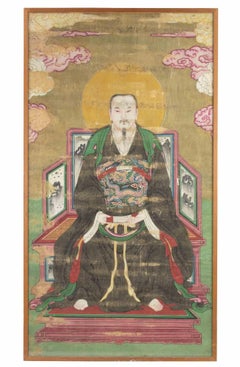
Pigments and ink on cloth, mounted on a wooden stretcher frame. China, 19th Century. A striking and finely detailed portrait depicting a seated male dignitary or religious figure, r...

Category

19th Century Modern Figurative Drawings and Watercolors

Materials

Ink

Large 19th Century Chinese Framed Ancestor Portrait, #Ric.P2

Large 19th Century Chinese Framed Ancestor Portrait, #Ric.P2

Located in Norton, MA

Hand-Painted on silk, Chinese households honor their ancestors in private family rituals, invoking their spirits for long life, health, and prosperity. Commemorative portraits, which...

Category

Antique 19th Century Chinese Qing Paintings and Screens

Materials

Glass, Wood, Paint, Silk

More From This Seller

View All
Max Weber Woodcut Print from "Primitives" Poetry Book Signed

Max Weber Woodcut Print from "Primitives" Poetry Book Signed

By Max Weber

Located in Detroit, MI

ONE WEEK ONLY SALE This woodcut print is an expressionist print on one of the poems from Max Weber's poetry collection "Primitives: Poems and Woodcuts". This work is signed in penci...

Category

1920s Expressionist Figurative Prints

Materials

Woodcut

"Travelers", Abstract Drypoint Etching and Aquatint, Numbered and Signed

"Travelers", Abstract Drypoint Etching and Aquatint, Numbered and Signed

By Richard Jacobs

Located in Detroit, MI

"Travelers" is a work that displays Richard Jacobs early Balinese influence. This abstract work made with drypoint etching manifests a layer of depth and contrast that is achieved through an Indonesian technique of drawing the lines of the resist or printing it with a copper stamp that allows an artisan to selectively color the work through the soaking process. "Travelers" is exemplary of this earlier aquatint process before Jacobs would go on to apply a diversity of colors to his work. The print is 39 x 29 inches and is signed and numbered from an edition of 30 by the artist. Numbered edition may not necessarily be number 16 as there are multiple prints in the possession of Collected Detroit...

Category

1990s Abstract Prints

Materials

Drypoint, Etching, Aquatint, Lithograph

"Ancient Man", Mixed Media on Paper

"Ancient Man", Mixed Media on Paper

By Artis Lane

Located in Detroit, MI

This mixed media on paper from the seminal artist Artis Lane is one of the many model pictures from her long and illustrious career. The subject is an older man, whom is called "Anci...

Category

Late 20th Century Mixed Media

Materials

Paper, Mixed Media