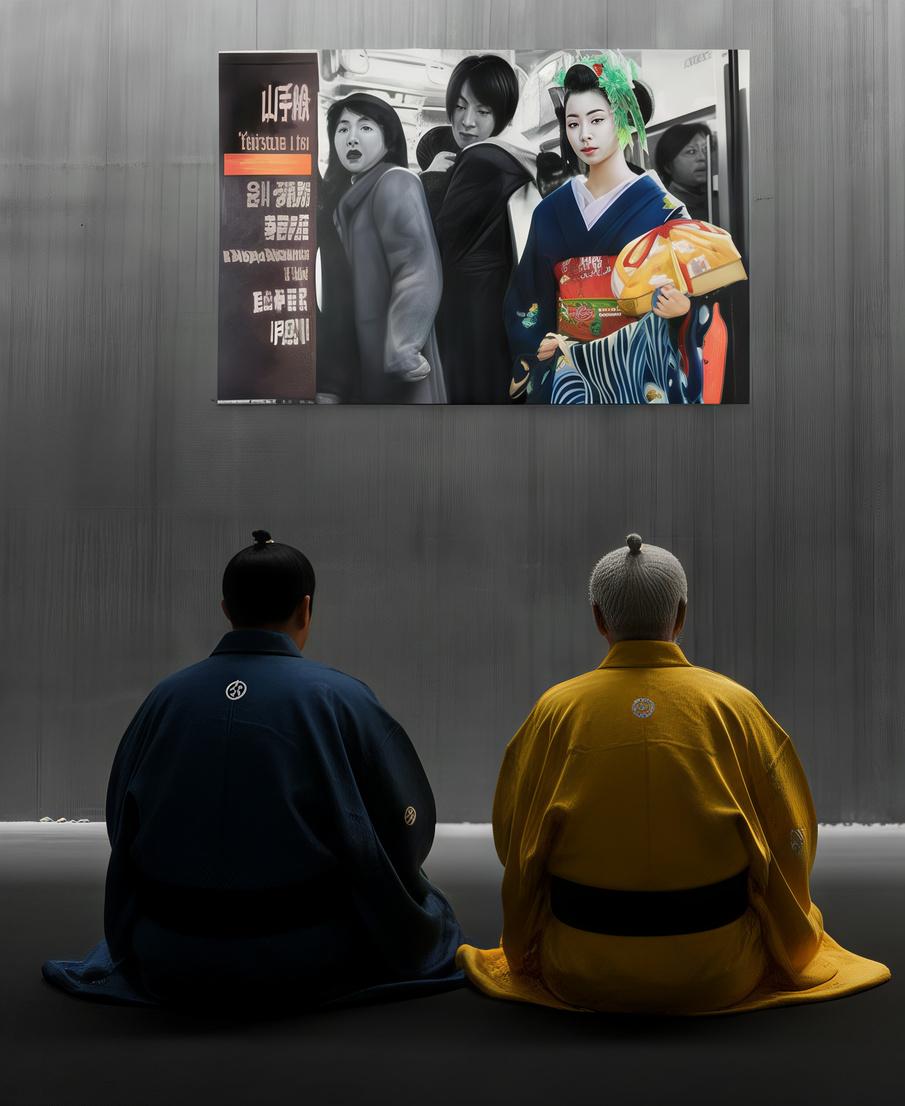
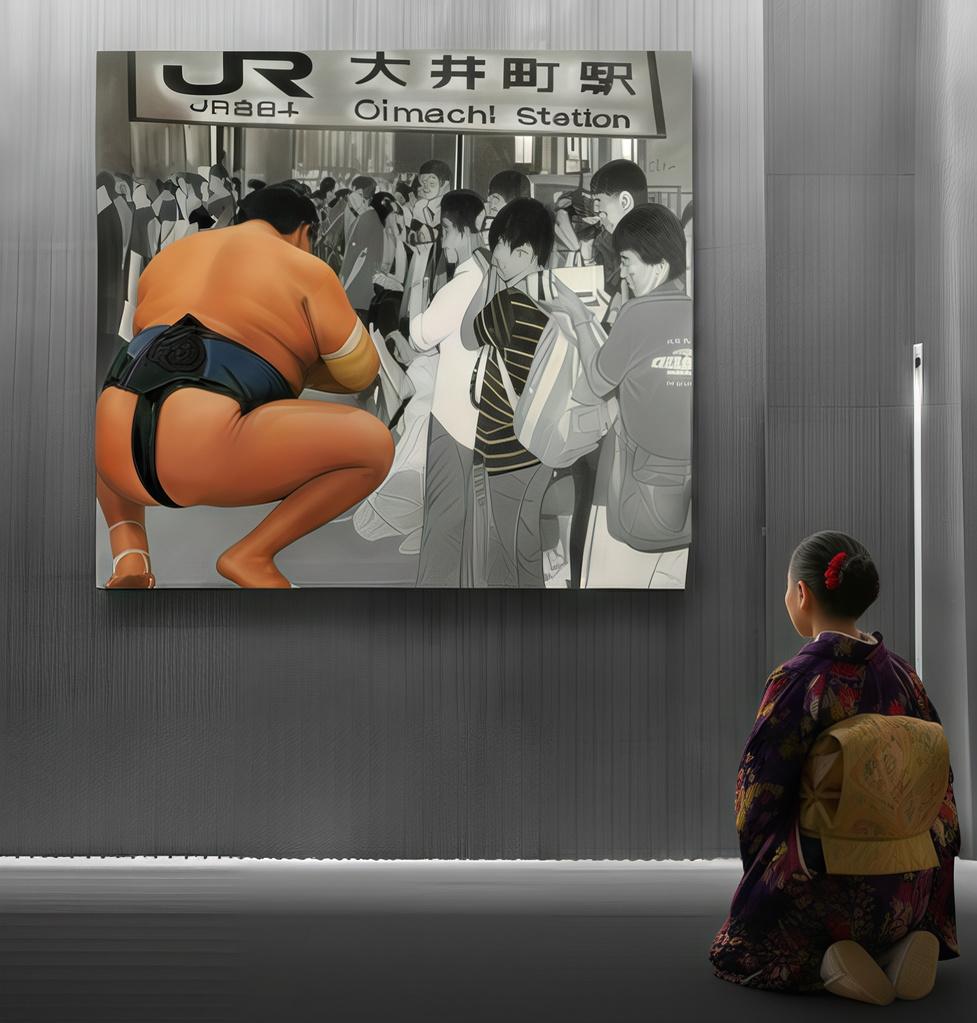
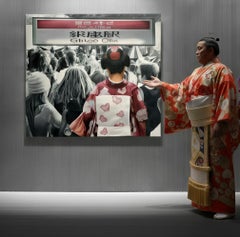
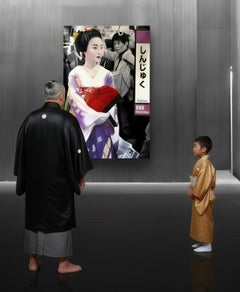
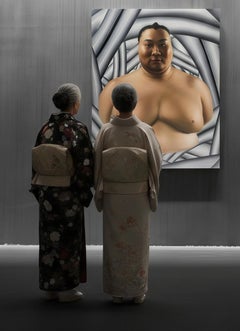
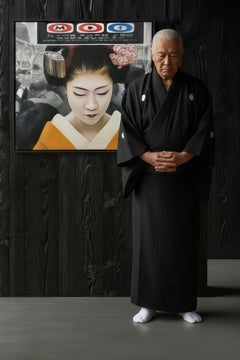
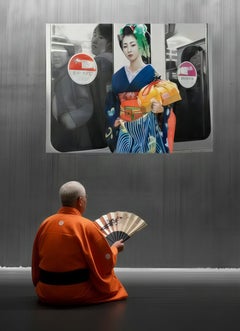
Equilibrium : Bridges of Serenity is a work of strong conceptual clarity by Ryoko Watanabe, exploring balance not as physical stillness but as a cultivated inner state within a saturated urban environment.
Part of the series Timeless Rhythms : Sumotori in the Urban Symphony, the composition centers on a sumotori captured in a moment of poised equilibrium, suspended between force and control.
Rendered in warm color, the wrestler’s body emerges powerfully from a dense black-and-white crowd locked in observation.
Rather than depicting combat, Watanabe reframes sumo as an art of restraint, concentration, and internal discipline.
Here, balance becomes a quiet act of resistance against collective agitation.
The surrounding crowd, stripped of color, embodies social pressure, perpetual movement, and external scrutiny.
In contrast, the sumotori introduces a slower, deliberate temporality into the scene.
His posture forms a visual and symbolic bridge between physical strength and mental serenity.
Urban signage and directional panels frame the image with rigid geometry, reinforcing the structure of the modern city.
Within this architecture of flow, the human body becomes a site of centering and calm.
Watanabe suggests that true equilibrium exists not in the absence of tension, but in its precise mastery.
The sumotori functions as an axis around which the crowd revolves.
The notion of “bridges” evokes passage, connection, and the possibility of harmony between opposing forces.
Tradition and modernity meet here not through confrontation, but through balance.
The viewer is invited to slow their gaze and inhabit the density of the moment.
The scene reads less as performance than as a state of being.
As a major member of the Japanese studio CrazyNoodles, founded by Hiro Ando, Ryoko Watanabe brings an introspective dimension to the Nippon Neo-Pop movement.
Her treatment of sumotori renews their symbolism, positioning them as contemporary figures of inner discipline.
Equilibrium : Bridges of Serenity demonstrates her ability to merge corporeal power with psychological depth.
Through its controlled composition, contained tension, and symbolic resonance, Equilibrium : Bridges of Serenity stands as a mature and compelling work.
A refined acquisition for collectors of contemporary Japanese art and Neo-Pop, drawn to works that explore balance, inner strength, and the silent poetry of the body within the urban collective.
LITERATURE ABOUT THE SERIE “Timeless Rhythms : Sumotori in the Urban Symphony ”
The series Timeless Rhythms : Sumotori in the Urban Symphony represents a pivotal chapter in the artistic evolution of Ryoko Watanabe, where the ritualized body of the sumotori confronts the anonymous pulse of contemporary Japanese cities.
Across these compositions, Watanabe constructs a visual dialogue between the symbolic weight of tradition and the fluid, often impersonal nature of urban crowds.
The sumotori emerges as a gravitational center, anchoring each scene with physical and cultural authority.
In contrast, the surrounding crowd functions as a shifting collective presence, suggesting the anonymity embedded in modern metropolitan life.
Through this juxtaposition, Watanabe highlights a silent negotiation between cultural continuity and rapid social transformation.
The sumotori’s disciplined posture evokes endurance, ritual, and inherited values deeply rooted in Japanese history.
Meanwhile, the monochromatic crowd reflects the growing standardization of behavior within shared public environments.
Urban transport signage introduces a framework of precision and order, reinforcing the structured rhythm of daily movement.
These graphic elements emphasize repetition, direction, and the collective choreography of urban existence.
The series suggests that modernity imposes a tempo that often overrides individual identity.
Within this dynamic, the sumotori becomes a visual counterpoint, embodying stillness, resilience, and introspection.
Watanabe explores how individuals maintain psychological balance amid the demands of efficiency and speed.
The chromatic contrast between the central figure and the grayscale background serves as a metaphor for contemporary emotional detachment.
The crowd is never portrayed as hostile, yet its presence exerts a subtle, persistent pressure.
This tension mirrors the Japanese urban experience, where proximity does not necessarily imply intimacy.
Moments of suspension recur throughout the series, capturing pauses within collective momentum.
Through the figure of the sumotori, Watanabe reflects on the equilibrium between social obligation and inner life.
Recurring transit settings evoke the cyclical structure of routine and expectation.
Each artwork operates as a variation on coexistence between heritage and adaptation.
Psychologically, the series reveals a deep awareness of visibility, scrutiny, and public perception.
Rather than glorifying her subjects, Watanabe humanizes them by placing them within contemporary pressures.
Her visual language aligns with the Nippon Neo-Pop movement, where traditional iconography intersects with modern concerns.
The sumotori thus becomes a mirror for broader tensions within Japanese society today.
Collectively, the works propose a meditation on individuality within increasingly codified social systems.
Through compositional rigor, symbolic depth, and emotional clarity, Timeless Rhythms : Sumotori in the Urban Symphony stands as a significant contribution to contemporary reflections on identity, continuity, and the human condition in modern Japan.