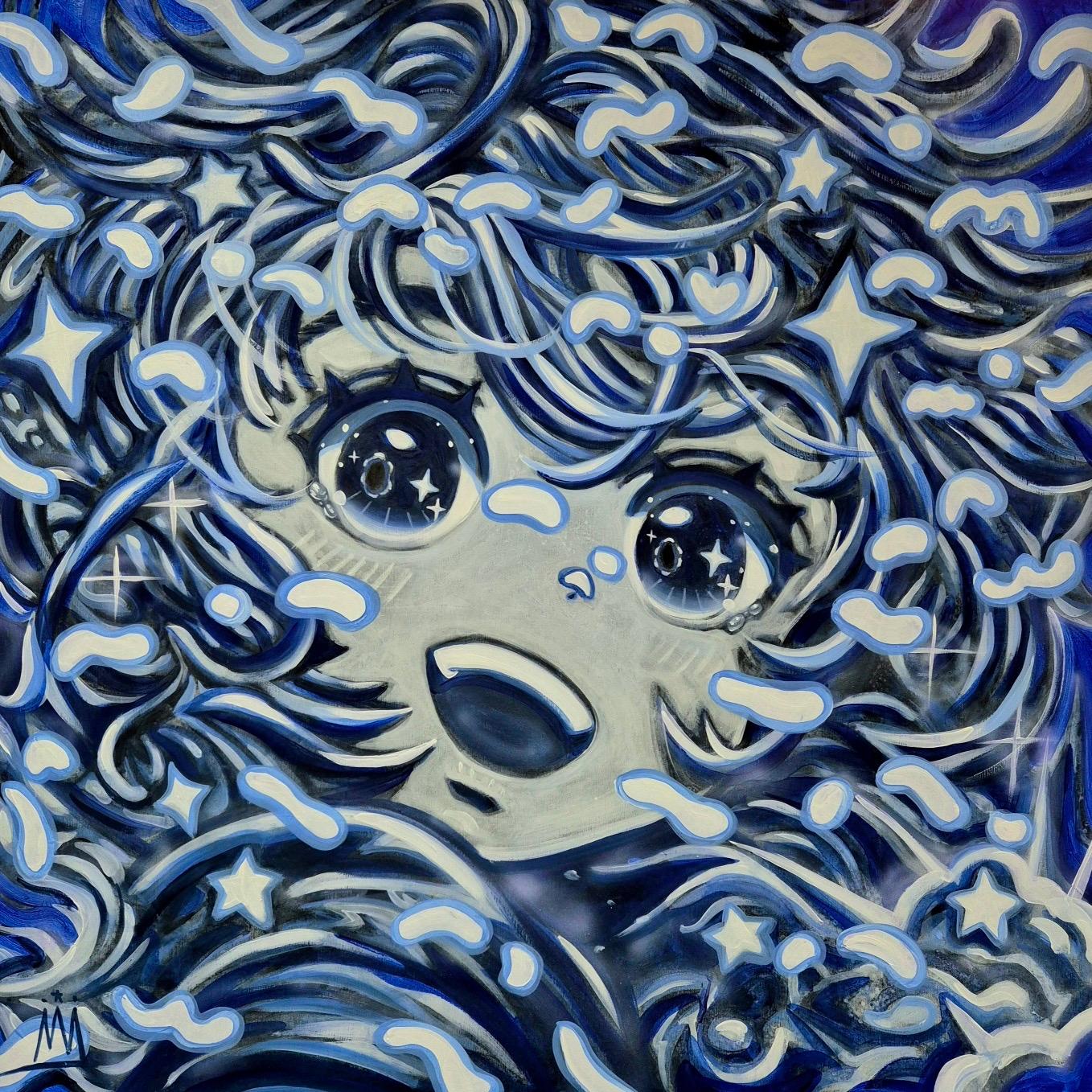
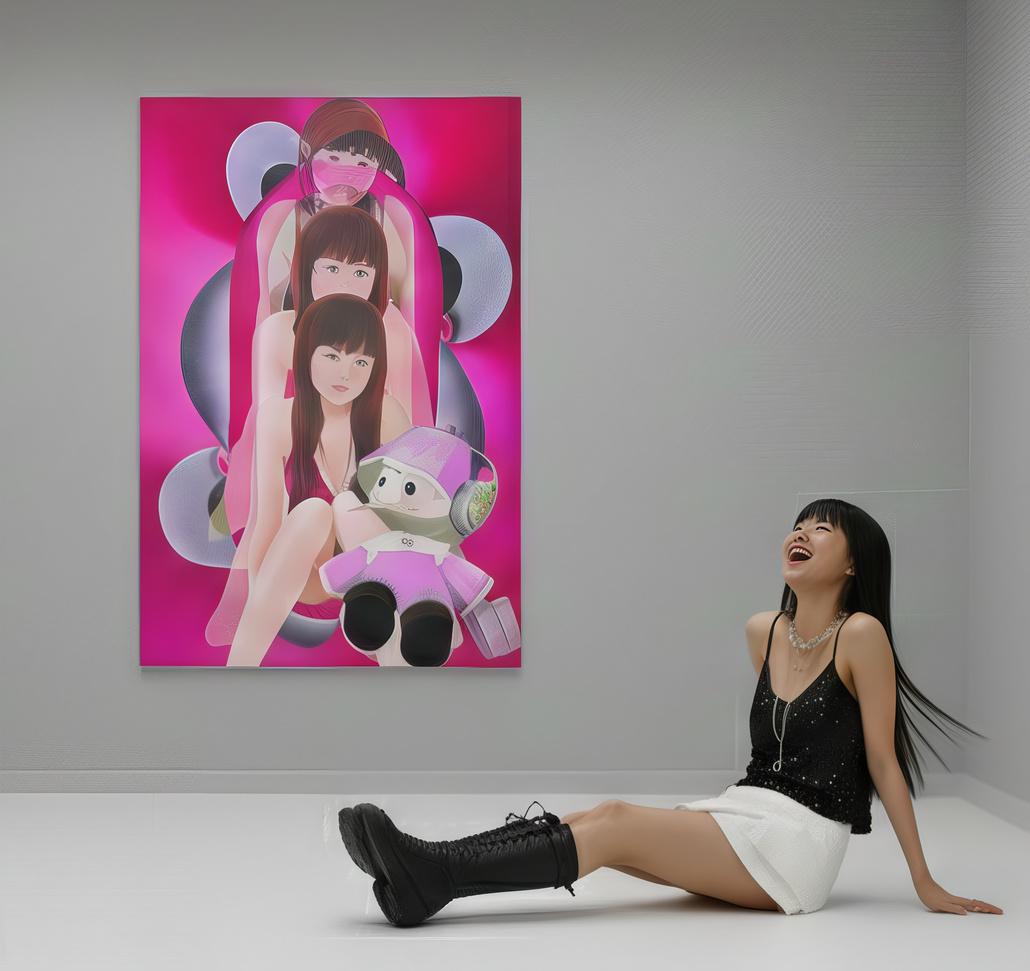
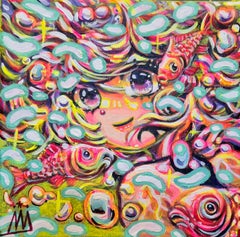
Deep Sea: Kawaii Serenity in the Ephemeral Lolita Tide stands as one of the most immersive works in the series Ephemeral Innocence: Neo-Pop Visions of Lolita, where Saori Nakamishi submerges her figures in a nocturnal aquatic atmosphere charged with emotional ambiguity. Three iterations of the same young woman appear like successive mental reflections, suggesting memory, desire, and fragmented identity, while deep blue tones and luminous filaments evoke underwater currents flowing through the psychological space of the characters. The figures seem suspended between appearance and dissolution, mirroring the fragility of self-image within a society where youth evolves under the constant gaze of social media and cultural expectations. The presence of a soft kawaii mascot introduces a comforting, almost childlike counterpoint to this emotional turbulence. No Pokémon appear in this composition, marking Nakamishi’s deliberate shift away from playful nostalgia toward a more personal and introspective territory. The glowing lines crossing the bodies can be interpreted as digital connections, emotional scars, or invisible ties linking individuals while simultaneously exposing their vulnerability. Through this composition, Nakamishi reveals an artistic psychology oscillating between fascination with youthful beauty and a melancholic awareness of its transience, projecting empathy toward a generation seeking emotional refuge within an overstimulated world. The painting thus becomes a visual meditation on vulnerability, intimacy, and the modern construction of feminine identity, affirming Nakamishi’s distinctive voice within the Nippon Neo-Pop movement.
Acquiring this work means integrating into a collection a piece where atmospheric power, psychological depth, and visual seduction converge, offering a magnetic presence capable of transforming both private and institutional spaces. Through its hypnotic palette, emotional narrative, and instantly recognizable aesthetic language, Deep Sea: Kawaii Serenity in the Ephemeral Lolita Tide carries strong iconic potential, making it both an emotional and strategic acquisition for collectors attentive to the international rise of major new voices in contemporary Japanese Neo-Pop art.
LITERATURE ABOUT THE SERIE “Ephemeral Innocence : Neo-Pop Visions of Lolita”
The series “Ephemeral Innocence: Neo-Pop Visions of Lolita” by Saori Nakamishi stands as one of the most sensitive and ambiguous explorations within the contemporary Nippon Neo-Pop movement. Through highly refined oil paintings, the artist stages young female figures immersed in psychedelic, almost fluid environments where electric colors and shifting forms dissolve the boundaries between reality and imagination. These vibrant backgrounds function as psychological landscapes, translating the emotional tensions experienced by contemporary youth, caught between aspirations for freedom, social pressure, and the hyper-mediatization of image and identity.
The recurring multiplication or duplication of female figures suggests the fragmentation of identity experienced by a generation compelled to adopt multiple roles simultaneously: idealized child, desirable woman, consumer of pop culture, and socially constructed persona shaped for external perception. Nakamishi’s protagonists constantly oscillate between confidence and vulnerability, creating visual tension that resists any simplistic reading of innocence or seduction. This ambiguity becomes one of the emotional driving forces of the series.
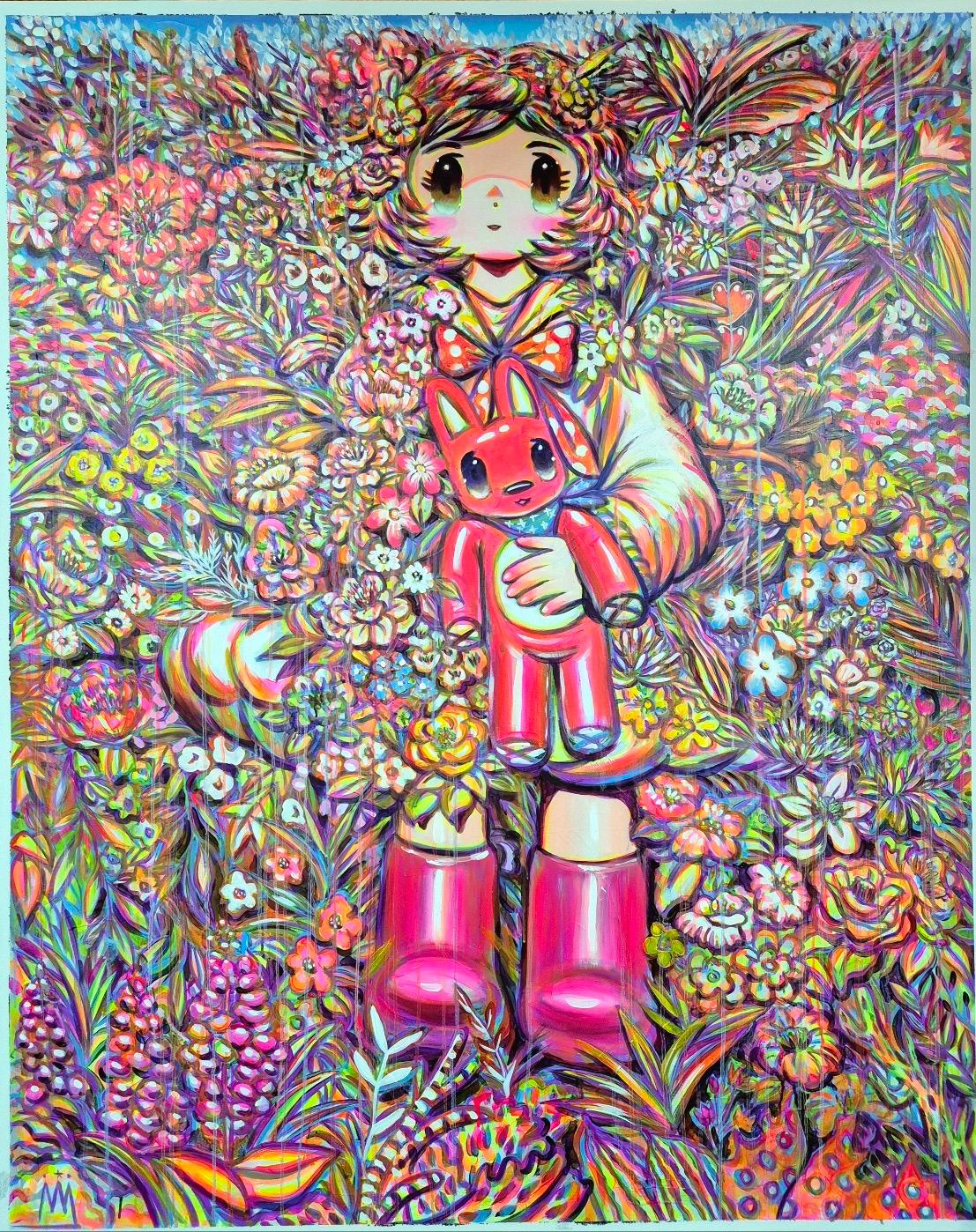
The recurring presence of kawaii characters, mascots, or pop-cultural creatures acts as a counterpoint to the emotional charge of the portraits. These childlike figures become visual shelters, symbols of protection against the anxieties of modern life, but also indicators of how contemporary society transforms nostalgia and childhood into permanent cultural commodities. Nakamishi reveals how kawaii culture simultaneously functions as both emotional escape and subtle social conditioning.
The impact of contemporary Japanese society is deeply embedded in these works. Between academic pressure, professional expectations, aesthetic standards, and the omnipresence of social media, youth appears trapped in a system where identity is constantly observed and evaluated. The saturated, sometimes hypnotic backgrounds reflect this sensory and media overload typical of major urban centers such as Tokyo, where individuals remain hyperconnected yet emotionally isolated.
Psychologically, Saori Nakamishi’s work reveals a constant oscillation between fascination with pop beauty and concern over the gradual disappearance of innocence. Her characters appear suspended in a fragile transitional moment where childhood recedes but never fully disappears. Rather than condemning or celebrating this transition, the artist observes it with lucid tenderness, revealing a sensitivity focused on the intermediate zones of contemporary feminine identity.
Thus, “Ephemeral Innocence: Neo-Pop Visions of Lolita” transcends pure pop aesthetics to become a visual reflection on desire construction, emotional fragility, and the transformation of feminine representation within modern society. Through this series, Saori Nakamishi asserts a distinctive signature within the Nippon Neo-Pop movement, combining immediate visual seduction with psychological depth, producing works that captivate while leaving a lasting impact on the viewer’s perception.