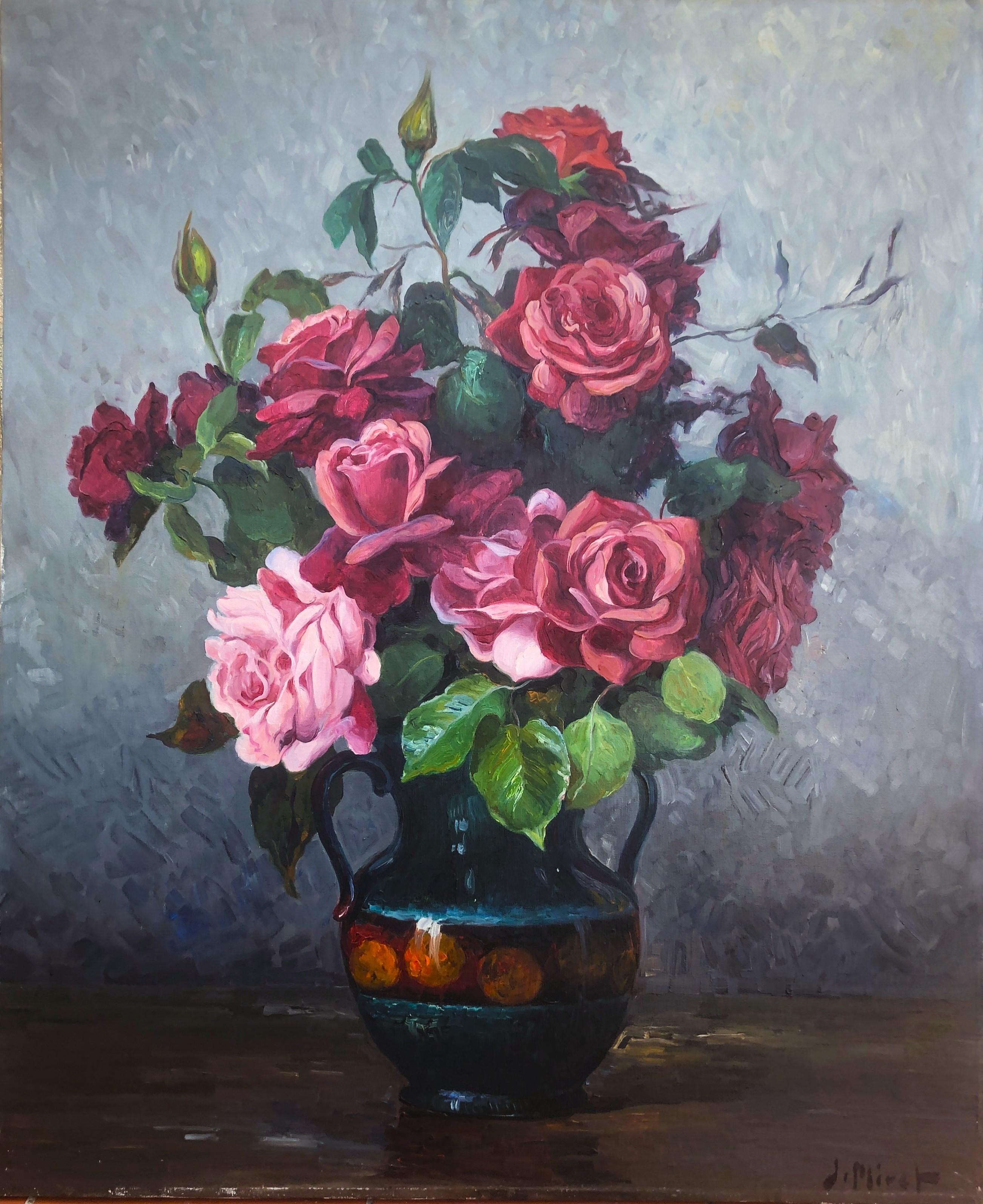
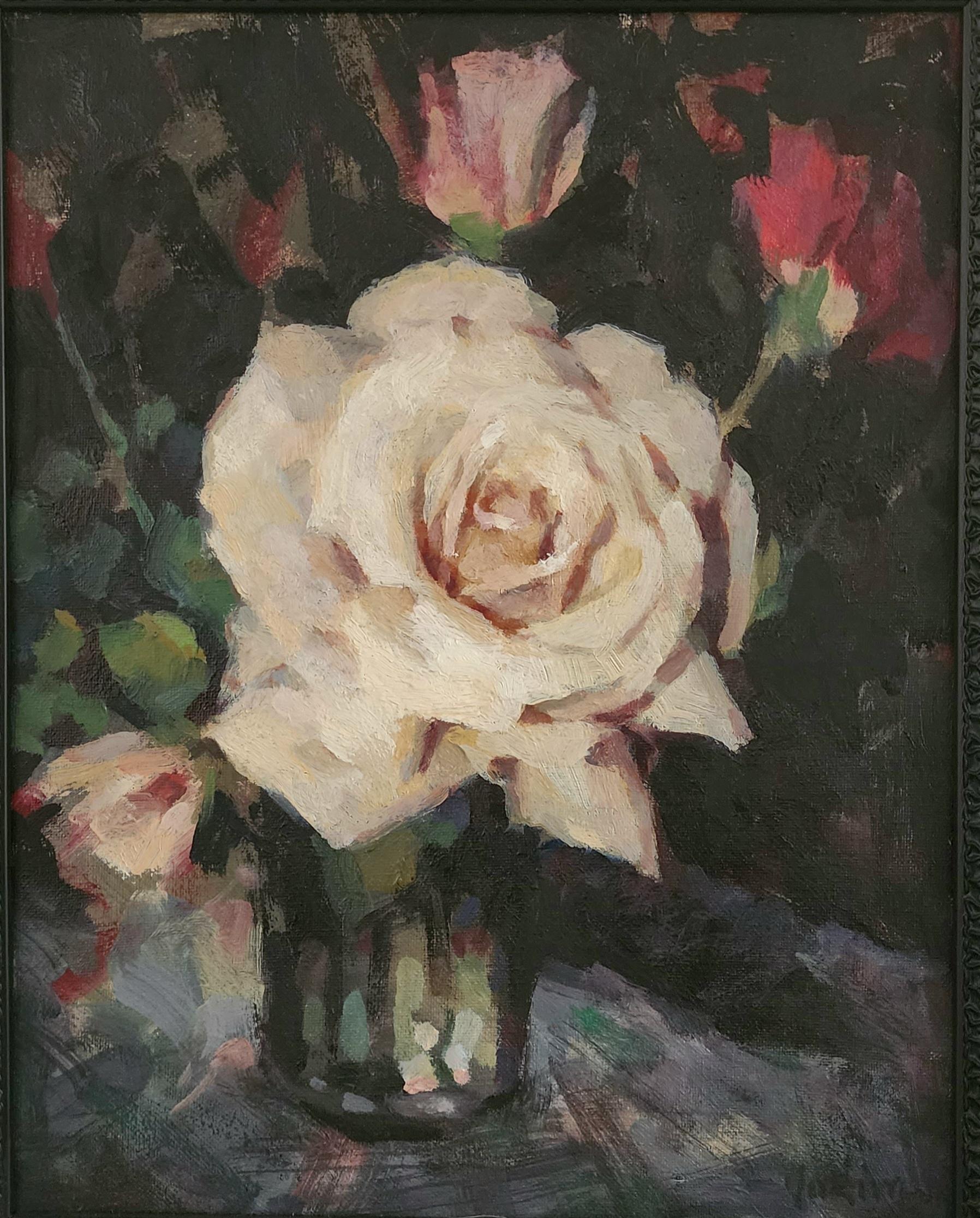
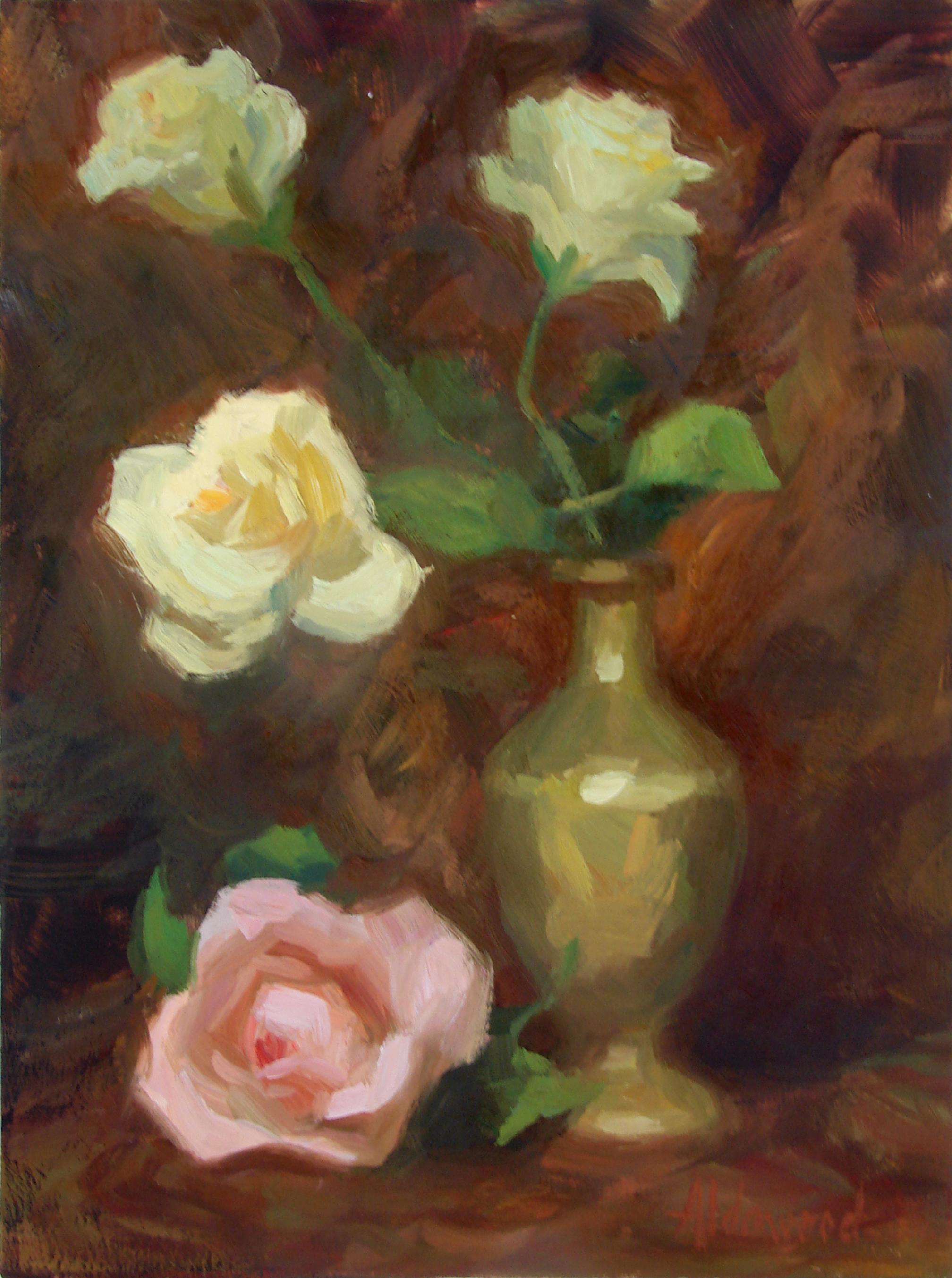
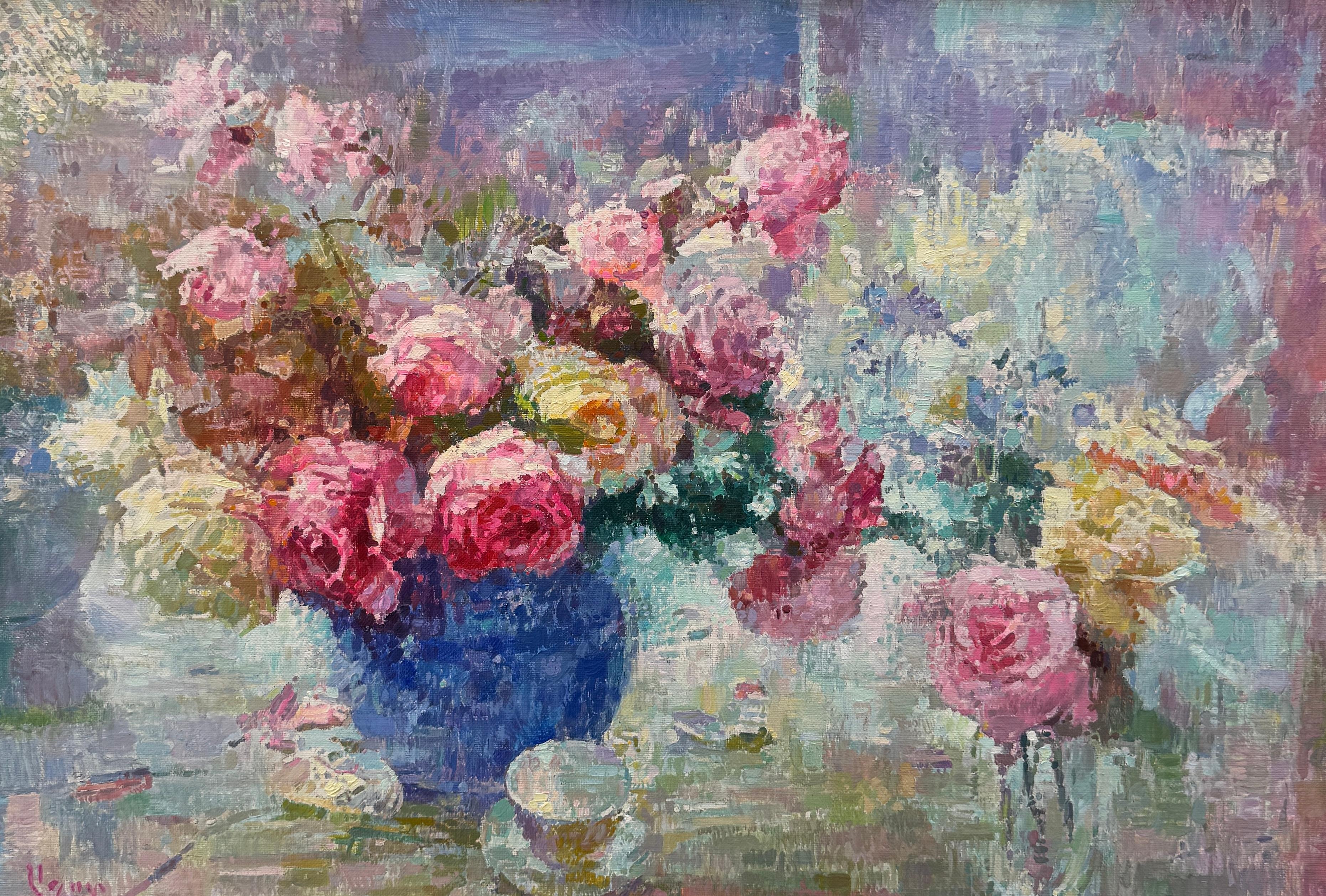
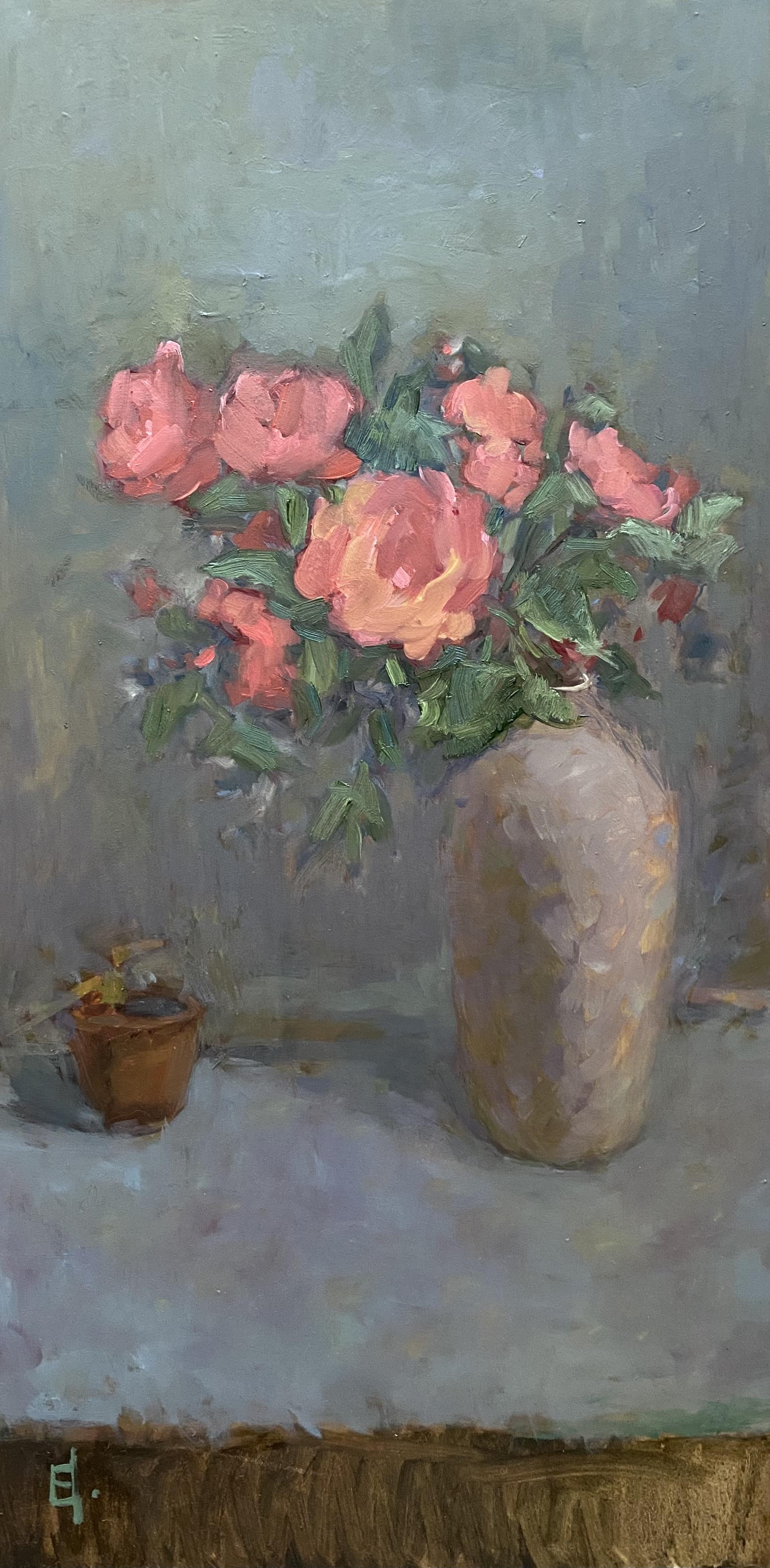
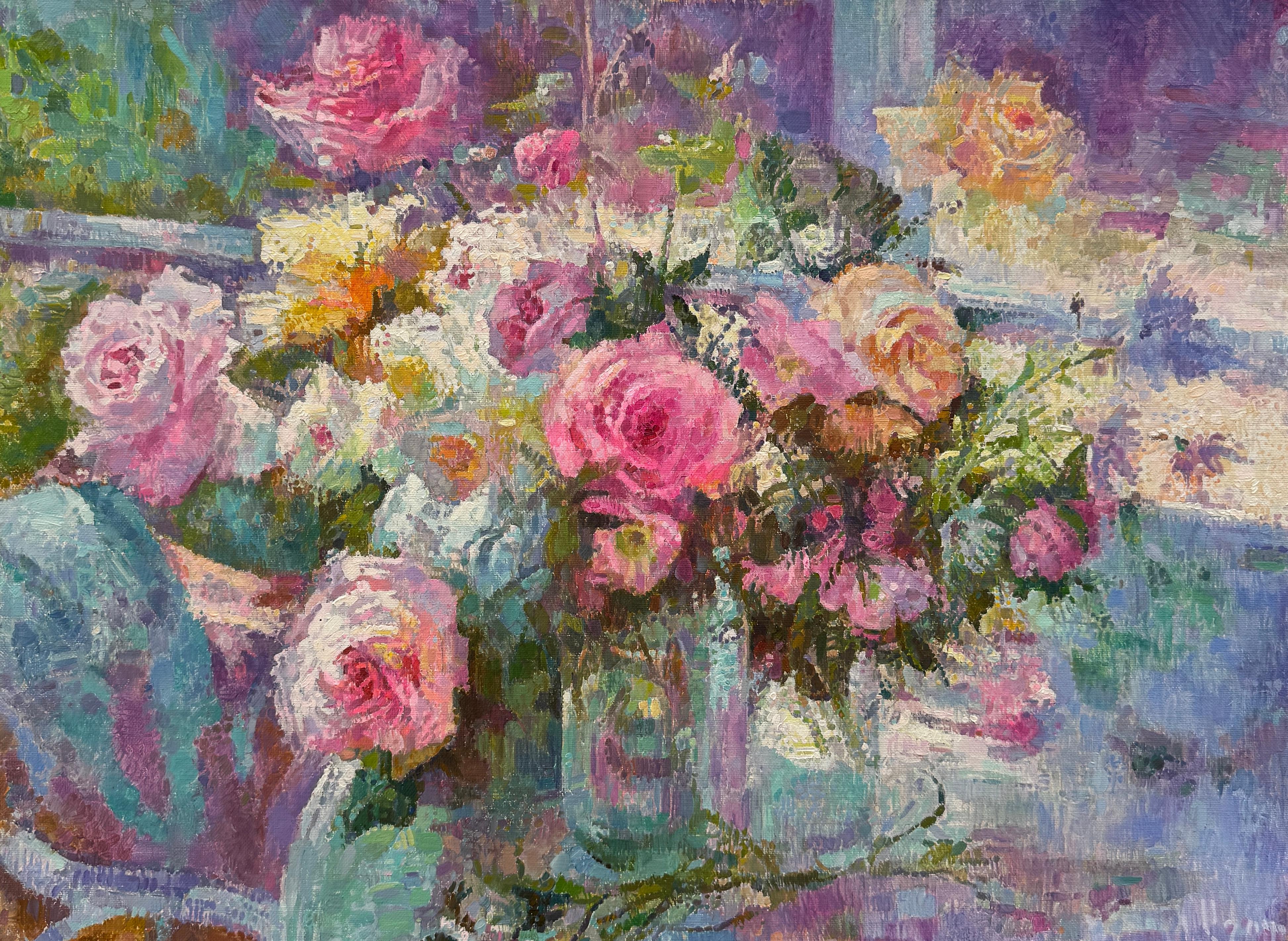
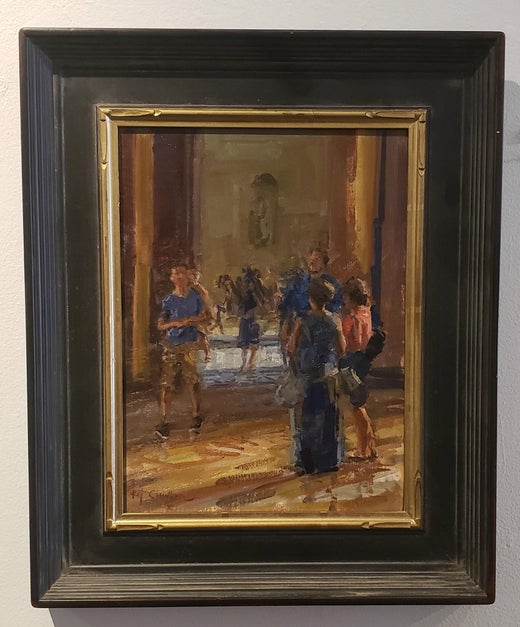
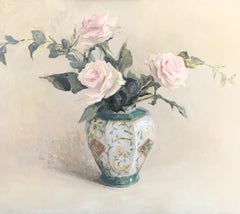
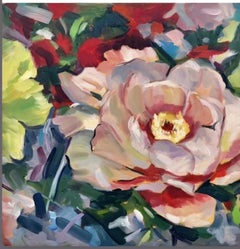
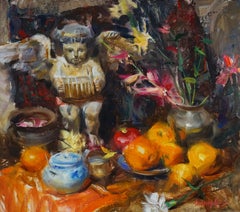
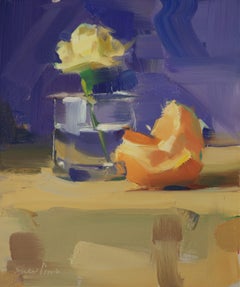
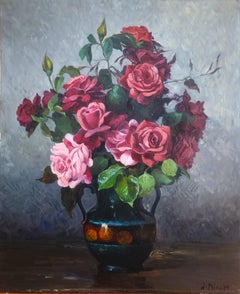
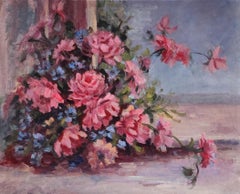
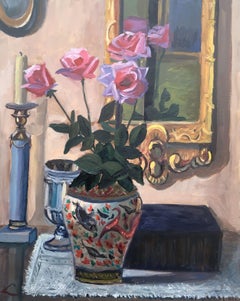
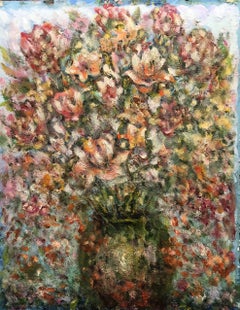
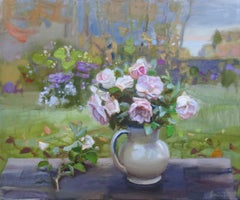
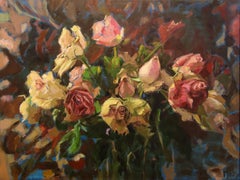
Roses for Vishnu is a 20" x 24" oil painting completed in December 2024. . Raj Chaudhuri describes himself as one of the New Orientalists ,a traveling painter in the modern world. Also shown are other paintings by Raj Chaudhuri .
Vishnu is the god of Preservation, the great maintainer who often appears in various incarnations (avatara) to provide salvation for humanity. Some of his best-known avatars, who are tremendously popular and beloved throughout Hindu India, are the gods Krishna and Rama. Vishnu is one of the principal deities of Hinduism and known for his 10 primary avatars who descend to Earth to preserve order.
Vishnu is a principal deity in Hinduism, known as the Preserver and Protector of the universe, a key member of the Trimurti (the trinity with Brahma the creator and Shiva the destroyer). He maintains cosmic order (dharma) and descends to Earth in various incarnations (avatars, like Krishna and Rama) to fight evil and restore balance, with his followers (Vaishnavites) considering him the supreme being. He is often depicted with four arms holding a lotus, conch, mace, and discus, resting on the serpent Shesha
Interview with Raj Chaudhuri in Bold Journey:
Raj, thank you so much for taking the time to share your lessons learned with us and we’re sure your wisdom will help many. So, one question that comes up often and that we’re hoping you can shed some light on is keeping creativity alive over long stretches – how do you keep your creativity alive?
Like everything else, Creativity to a large extent is a learned skill. I practice it all the time. Having a process to allow the creativity to flow from me is indeed the key. With painting, I am constantly going out to get the information I want to paint. If I expect it to come to me and sit and wait for it, it is not going to. Collecting reference, designing paintings are all huge efforts and I am constantly doing it. Art is not done in a vacuum. I am studying painters and their works from many centuries. Sketching ideas from the reference; making friends and family pose; hiring models and painting in Plein air (out door painting) are part of my process. As a professional artist, I work on several paintings at a time. So I spend a few days on a painting and then set it aside (as soon as I find I am not making progress on it). I do this with 3-4 paintings. This keeps my eye fresh too! Ultimately, I am trying to find a design first in whatever I am painting and then build on it using abstract concepts, but finishing the painting to the point where most things are clearly recognizable and identifiable.
Great, so let’s take a few minutes and cover your story. What should folks know about you and what you do?
Art has always been my passion. I found ways to incorporate my artistic abilities in UI design and software development before coming to art full time. To a great extent I find that what like in computer design and now in art is that we are creating abstractions of the real world. There are repeating patterns in how we solve problems in many arenas. The creation of a painting is a technical and visual problem, with many aspects behind the brushstrokes and values. These challenges underlie the thrill of creating a piece that speaks to viewers, to see what we feel and know about the world around us in art.
If you had to pick three qualities that are most important to develop, which three would you say matter most?
Surround yourself with other professionals, especially a few that are very established and really good at their craft! Don’t get discouraged, keep working at it. Work hard and engage with the community – in art, there’s professional groups that have competitions and shows. Study what’s been done. Figure out what you love and grow that knowledge. Find your passion!
Who has been most helpful in helping you overcome challenges or build and develop the essential skills, qualities or knowledge you needed to be successful?
Having more than 1 mentor is a huge. Each successful artist does it differently. I have had three very big influences in my journey, Dan Sprick, Quang Ho and Mark Daily. Each brought their own approach and what they are most passionate about. That has helped me grow and find my passions.
You want to find teachers that teach you the fundamentals as well how you can search inwards for your sense of design and how you want to paint.
Art is a highly technical field. There’s so much from a visual abstract standpoint that you really need to know – a vocabulary and process to help you succeed in making good paintings.
Work hard at it. Period. Set hours and work on it. For painters the key skill is drawing!
ARTIST STATEMENT:
Raj Chaudhuri describes himself as a traveling painter in the modern world. Storytelling is his focus, creating exotic imagery from ceremonial camel races to paintings utilizing bright flashes of color such as "Rajasthani Women Waiting for a Bus" which recently won Raj an Honorable Mention Award at the 15th Annual American Impressionist Society's National Juried Show.
Raj Chaudhuri says: "Art has always been my passion." Raj teaches a 3-day workshop at Art Students League of Denver - his subjects vary but his favorite is The Traveling Painter. Students review works of traveling painters and Orientalist's such as Sargent, Sorolla and others. They learn composition, emotional content and storytelling. Raj believes in learning the visual vocabulary of a painting.
Raj currently serves on the faculty of Art Students League - Denver, Colorado Teaching classes on "The Traveling Painter" and "Composition".
Since my earliest memory, I have always drawn and painted. But, I didn't pursue it as a profession in the beginning, rather keeping it as a hobby while I pursued a career in software for 17 years! In 2009, I was able to make the transition to painting full-time (started part-time in 2003). It is in art that I am determined to make a success of myself and have devoted all my efforts and attention towards it.
I have had the privilege of learning from Quang Ho and Mark Daily here in Denver. Both, amazing painters, teachers and instrumental in my development as an artist. I have also been very fortunate to spend time with Dan Sprick, a remarkable painter and person.
The painting process to me is two fold. One part is the subject matter and the other, the process of utilizing an artist’s vocabulary.
My subject matter has been things that I love and understand. A lot of it is material from India, where I grew up. Figurative work, Cityscapes and the still life also feature in my paintings. Poker chips, cards and sports scenes (hockey, soccer) are dear to me. I really enjoy painting people. My family have been subjected to many a pose for my paintings!
The second part is technical in approach. Here my goal is to be very clear what I’m trying to accomplish in my painting to the viewer. Whether it’s the visual approach (such as light and Shadow, Local Tone, Color, etc.) or in the visual design (shapes, values, color) of the painting, I want to lead the viewer through a very clear and engaging journey. The painting becomes an exploration of these abstract elements and my search for finding a solution to a visual problem.
My goal is to try to and find a balance between the abstract and the real. Ultimately, it is all abstract from a purely artistic standpoint. To me the challenge is to find that abstract connection in every painting – the pattern of red through the painting, the big shapes grading to small ones, light sliding into dark. All of this happens within the context of the design (or shapes) in the painting. For the overall balance and beauty, simplicity in the composition is key; yet the painting of that very simplicity must provide layers upon layers of treats for the viewer – juxtaposing various colors of the same value next to each other to make the painting shine, or the use of half-tones to provide transitions between big value shifts.
In my previous career in Software, I taught a fair amount of technical workshops and facilitated numerous requirements discovery workshops (based on a methodology called ‘UML’). In the past few years I have done painting workshops for art groups in town such as Aurora Arts Guild and Palleteers. In each case the response to my teaching has been very positive and I really enjoy sharing my knowledge. It makes me a better painter and artist. I plan on pursuing more opportunities to teach.