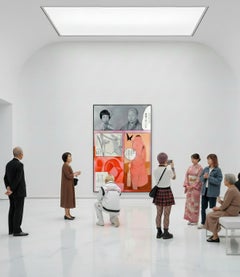
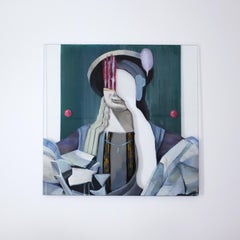
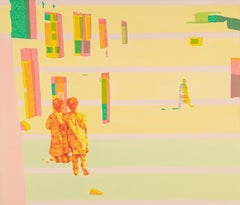
Heartbeat Elixirs: Love Infusions in Couture Capsules stands as one of the most symbolically structured and emotionally resonant works within Couture Capsules: Fashioning Tradition with Neon Elegance by Tomomi Mishima.
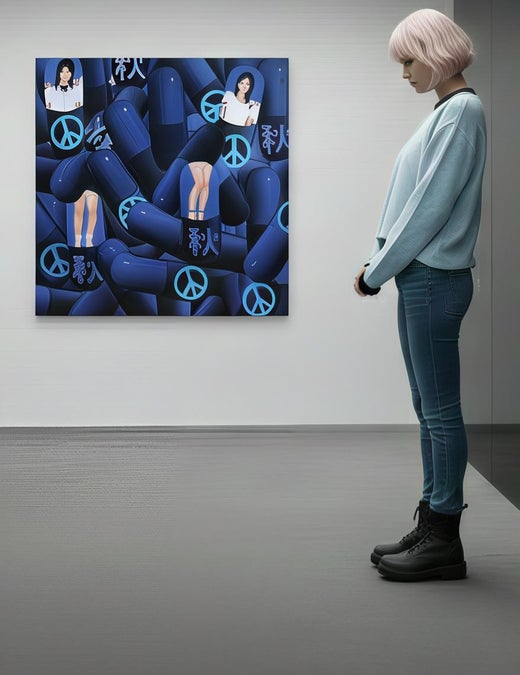
The composition is organized around a large circular peace and love symbol, conceived and painted as a glowing neon sign. This emblem functions as the visual heart of the work, regulating the entire pictorial rhythm.
Surrounding and inhabiting this symbol is a dense landscape of vividly colored pharmaceutical capsules. Repeated and layered, the pills form an almost organic environment, evoking the medicalization of emotion and the contemporary impulse to regulate affection, stabilize desire, and control emotional intensity.
The young Japanese women depicted—rooted in the imagery of school uniforms—have exchanged institutional attire for ultra-luxurious silhouettes inspired by high fashion. They embody a generation suspended between inherited cultural structures, social pressure, and an ongoing search for emotional equilibrium. Their calm, restrained postures contrast sharply with the symbolic charge of the setting.
Here, the peace and love symbol is stripped of naïve idealism. Rendered in neon, it becomes an artificial heartbeat—an illuminated electrocardiogram suggesting a form of conditional serenity, an affection administered like a prescribed elixir.
The work articulates a constant tension between chemistry and sentiment, utopia and normalization, desire and control. Mishima does not moralize; she observes with quiet precision, allowing the symbolism to speak through repetition and restraint.
As a major member of the CrazyNoodles studio, founded by Hiro Ando, Tomomi Mishima asserts a distinctly introspective position within Nippon Neo-Pop.
With Heartbeat Elixirs, she composes a visual score in which love becomes rhythm, light, and substance—an emotional infusion suspended between biology, pop culture, and contemporary visual poetry.
LITERATURE ABOUT THE SERIE “ Couture Capsules: Fashioning Tradition with Neon Elegance”
With the series Couture Capsules: Fashioning Tradition with Neon Elegance, Tomomi Mishima presents one of the most psychologically nuanced and socially resonant bodies of work within contemporary Nippon Neo-Pop. Across these five paintings, Mishima constructs a tightly unified visual language that examines the condition of young Japanese women at the intersection of tradition, luxury, and emotional regulation.
At the core of the series lies a deliberate iconographic shift. Mishima depicts young Japanese schoolgirls who have exchanged the standardized school uniform—emblem of discipline, equality, and social order—for ultra-luxurious silhouettes inspired by high-end fashion houses. This transformation is not aspirational but diagnostic. It reflects a passage from overt institutional control to a more insidious system in which identity is shaped by image, desirability, and performance.
The omnipresent pharmaceutical capsules form the psychological architecture of the series. Repeated, brightly colored, and visually seductive, they evoke the medicalization of everyday life in contemporary Japan—where stress, emotion, fatigue, love, and even belief are increasingly managed, regulated, and optimized. In Mishima’s work, the capsule becomes a total metaphor: emotion is contained, measured, and administered. Intimacy itself is encapsulated.
Opposing this clinical structure, neon emerges as a force of exposure. Painted as genuine luminous signage, the words and symbols—psy chic, God is love, peace and love, sliders—borrow directly from the language of advertising, nightlife, and consumer culture. Neon translates inner states into public signals. It illuminates, seduces, and pressures simultaneously, turning emotion into spectacle and belief into slogan.
This tension reveals Mishima’s psychological stance. Her figures are calm, frontal, and restrained. They do not rebel; they endure. Their stillness suggests a profound internalization of social expectations, where elegance functions as armor and emotional control becomes a silent obligation. Unlike a Neo-Pop driven by provocation or excess, Mishima’s approach is introspective, measured, and quietly unsettling.
As a major member of the CrazyNoodles, founded by Hiro Ando, a central figure of the Nippon Neo-Pop movement, Mishima occupies a singular position. Where Neo-Pop often celebrates surface, saturation, and iconography, she probes depth, psychological cost, and emotional residue.
With Couture Capsules: Fashioning Tradition with Neon Elegance, Tomomi Mishima offers a contemporary redefinition of Neo-Pop—one that is quieter, more introspective, yet deeply incisive. Here, neon is never pure celebration, and the capsule is never neutral. Together, they articulate a world striving to stabilize emotion, beauty, and identity—without ever fully containing them.