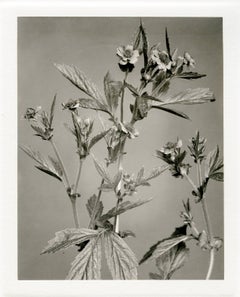
No. 365 Yellow Avens
By Edwin Hale Lincoln
Located in Fairlawn, OH
No. 365 Yellow Avens
From: Wild Flowers of New England, 1914, 6 volumes
Volume II, Plate 86
Platinum print, mounted on presentation mount, 1914
Unsigned, as issued
Condition: Excellent
Image size: 9 1/4 x 7 1/4 inches
Mount size: 15 x 13 inches
Edwin Hale Lincoln (1848-1938) was an award winning photographer at the end of the 19th and beginning of the 20th century. He took his photographs with a box camera and developed his negatives using the platinum printing process, one of the most durable and beautiful processes available. He began his career shooting nautical and architectural images, but his true passion was flora in nature. Lincoln’s work was especially important to two early 20th-century movements--the Arts and Crafts movement to preserve wild flowers and wild gardens in America and the movement to include photography in the fine arts.
Courtesy Digital Commonwealth
Approved biography for Edwin Hale Lincoln
(Courtesy of Christian Peterson)
Naturalistic photographer Edwin Hale Lincoln is known for his extensive series of flower images. Between 1904 and 1914, he self-published Wild Flowers of New England, eight volumes (issued both loose and bound) of four hundred original platinum prints.
Lincoln was born on January 2, 1848, in Westminster, Massachusetts, the son of a Unitarian minister. At fourteen years of age he served as a drummer boy in the Union Army during the American Civil War. He started his photographic career in 1876, as a salesman and partner in a photographic business in Brockton, Massachusetts. In 1883, he began photographing Berkshire estates for their wealthy owners and wooden yachts sailing at Newport, Rhode Island.
Before the turn of the twentieth century, he was involved with both amateur and professional organizations. He joined the Society of Amateur Photographers of New York and in 1885 showed work in the annual exhibition of the Boston Society of Amateur Photographers. His work was included in shows at the annual conventions of the Photographers’ Association of America in 1886 (St. Louis) and 1890 (Washington, D.C.). In 1892, his photographs were seen in the Fifth Annual Joint Exhibition, organized by the leading camera clubs of Boston, New York, and Philadelphia.
In 1893, Lincoln moved to Pittsfield, Massachusetts, where he commenced his interest in wildflowers. A sensitive naturalist, he was always careful not to destroy his subjects or their habitat. Though he dug up the flowers he photographed, he lovingly nurtured them while in his care and returned them to their natural setting when done. He preferred working in his home studio, where he used an 8-x-10-inch camera and could more easily control the light. All of his photographs are contact prints made directly from his large-format negatives.
To support himself and his family, Lincoln sold his finished portfolios and books largely to institutional collections. From 1902 to 1921, he also worked as the resident caretaker on a wealthy estate in Pittsfield. He may also have garnered fees for reproductions of his work, when they illustrated four 1915 articles in Craftsman, the leading magazine of the Arts and Crafts movement.
In 1931, Lincoln issued his last set of photographs...
Category
American Realist 1910s Black and White Photography
![A Street in China [After Baron Adolph de Meyer]](https://a.1stdibscdn.com/baron-adolf-de-meyer-photography-a-street-in-china-after-baron-adolph-de-meyer-for-sale/a_9323/1530218011643/Meyer_A_Street_in_China_1stdibs_master.jpg?width=240)

![Forrester's Child, Westerwald [Farm Child on Bicycle]](https://a.1stdibscdn.com/august-sander-photography-forresters-child-westerwald-farm-child-on-bicycle-for-sale/a_9323/a_33352411576598740827/Sander_Foresters_Child_Westerwald_Farm_Child_on_Bicycle_artnet_master.jpg?width=240)