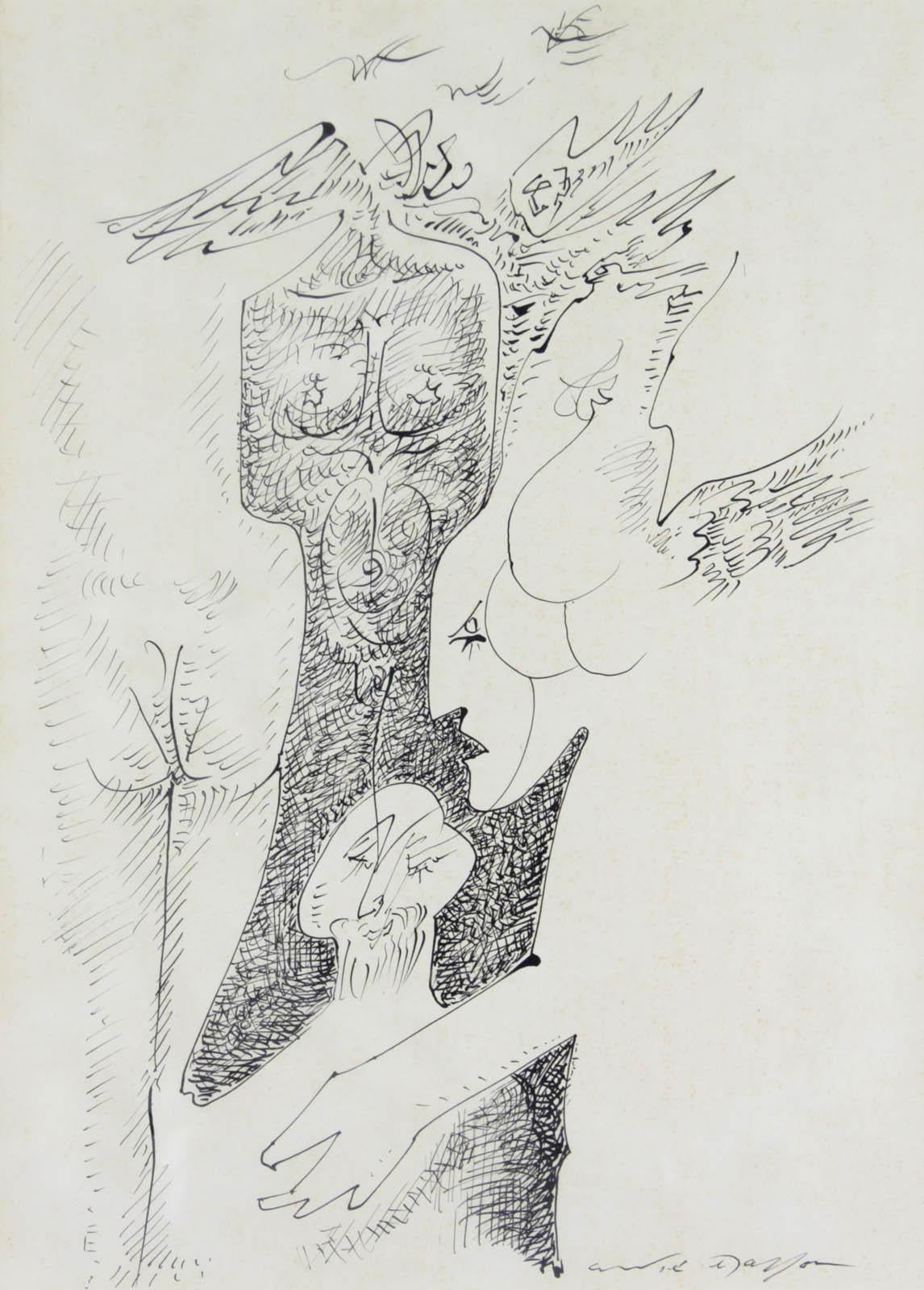
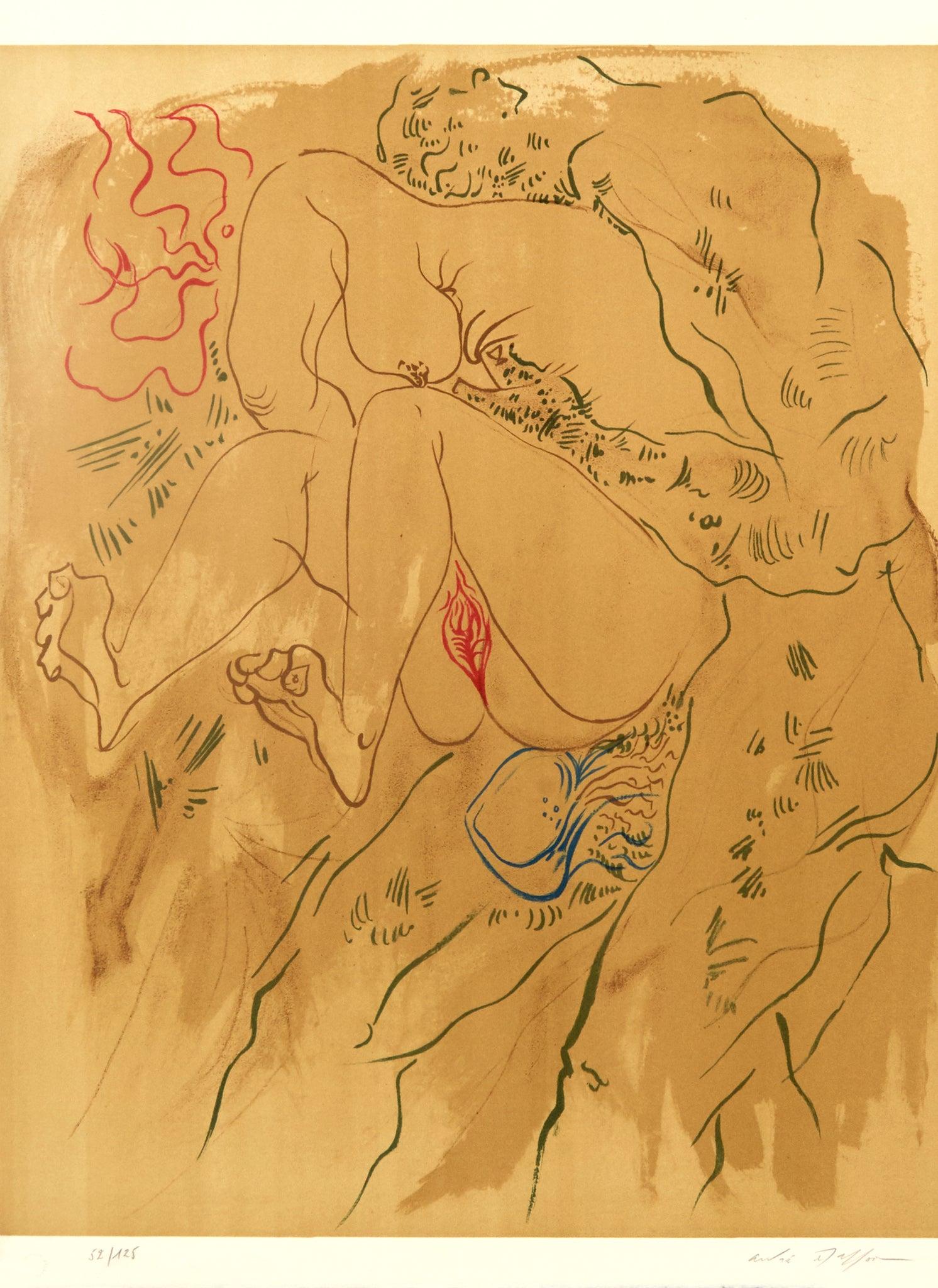
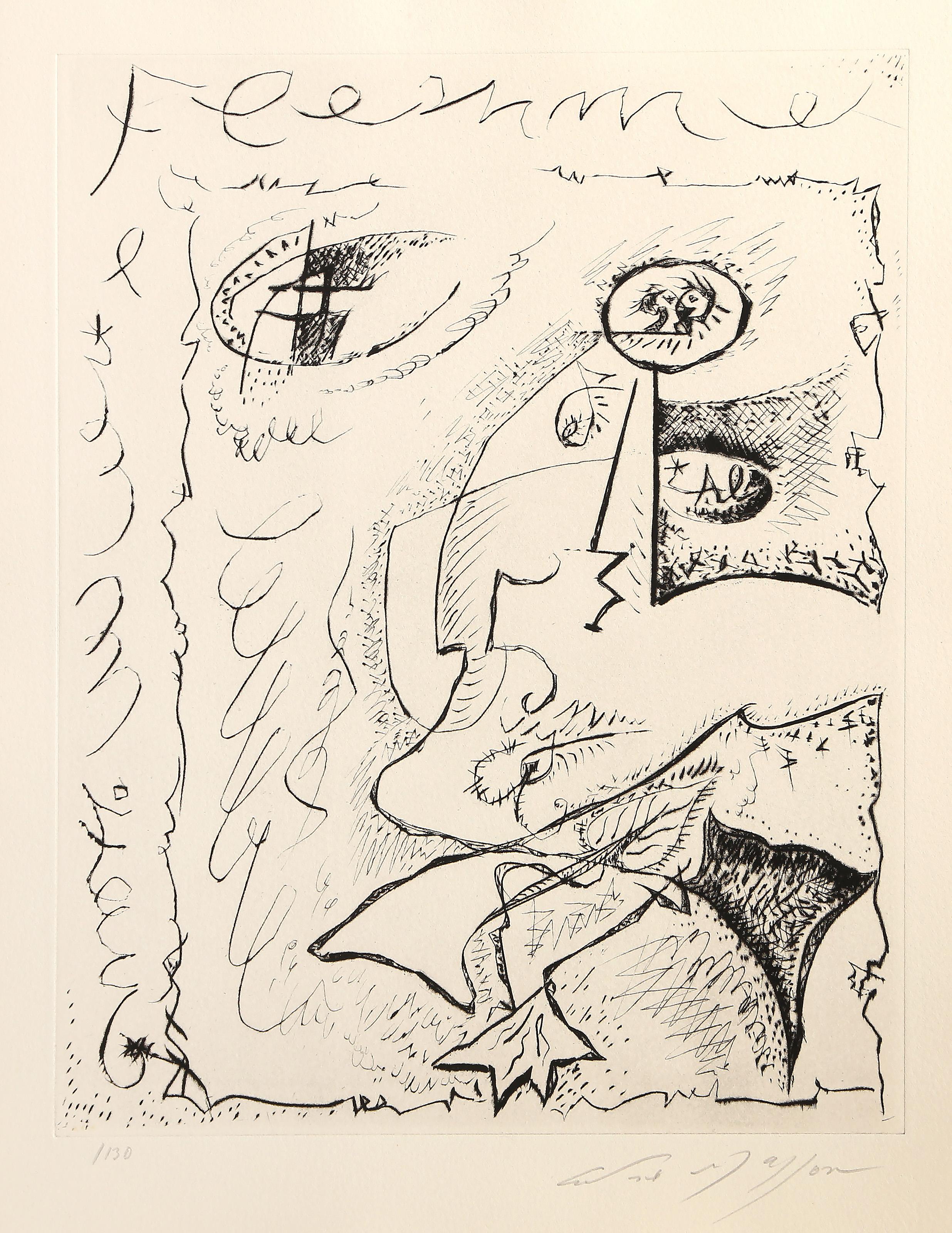
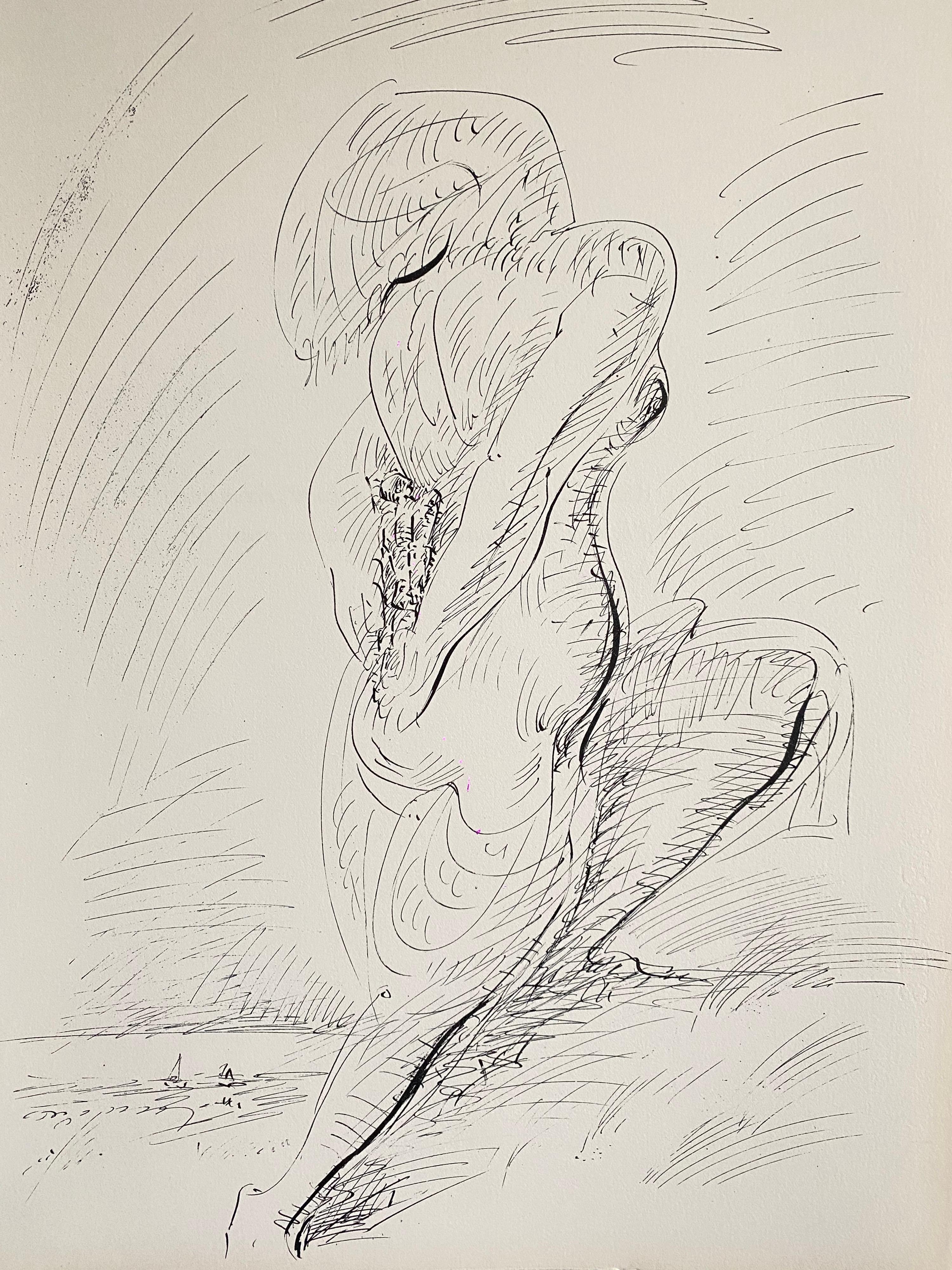
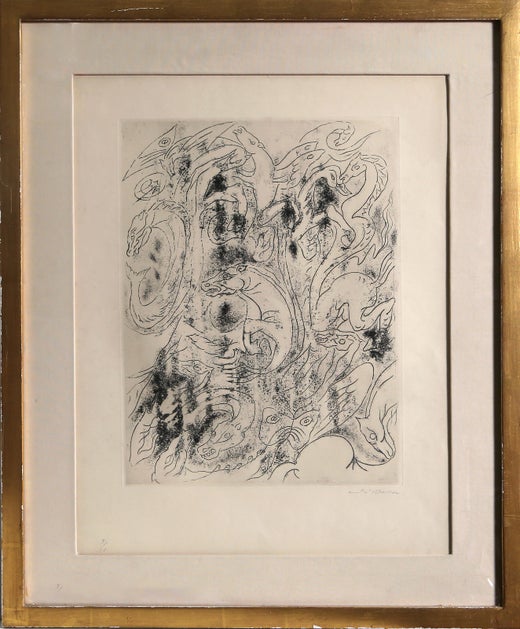
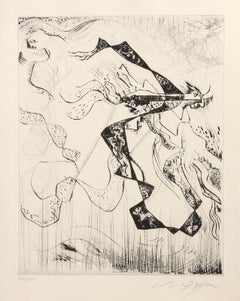
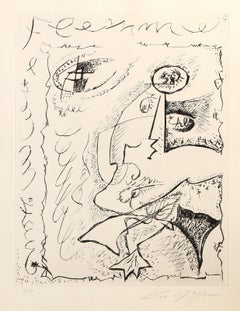
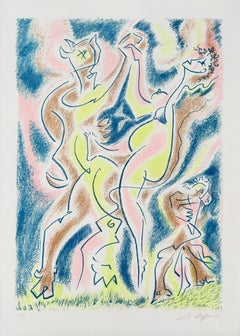
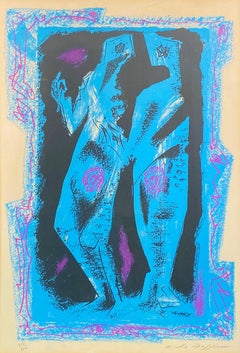
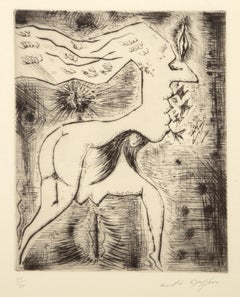
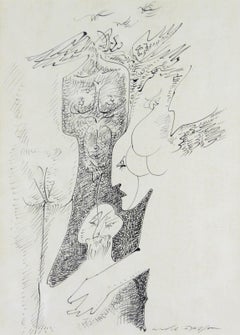
This exquisite lithograph by Andre Masson (1896–1987), titled Les Amants (The Lovers), from the album XXe Siecle, numero special hors abonnement, Hommage a Dorothea Tanning, originates from the 1977 edition published by Societe Internationale d'Art XXe siecle, Paris, and printed by Mourlot Freres, Paris, 1977. Les Amants reflects Masson’s fluid mastery of line and form, merging eroticism, symbolism, and abstraction in a dreamlike vision that captures the emotional intensity and poetic sensuality central to his Surrealist imagination.
Executed as a lithograph on velin paper, this work measures 12.5 x 9.75 inches. Unsigned and unnumbered, as issued. The edition exemplifies the superb craftsmanship of Mourlot Freres, Paris.
Artwork Details:
Artist: Andre Masson (1896–1987)
Title: Les Amants (The Lovers), from the album XXe Siecle, numero special hors abonnement, Hommage a Dorothea Tanning
Medium: Lithograph on velin paper
Dimensions: 12.5 x 9.75 inches (31.75 x 24.77 cm)
Inscription: Unsigned and unnumbered, as issued
Date: 1977
Publisher: Societe Internationale d'Art XXe siecle, Paris
Printer: Mourlot Freres, Paris
Catalogue raisonne reference: Masson, Catalogue de l'oeuvre grave, Poligrafa, Barcelona, illustration 285.
Condition: Well preserved, consistent with age and medium
Provenance: From the album XXe Siecle, numero special hors abonnement, Hommage a Dorothea Tanning, published by Societe Internationale d'Art XXe siecle, Paris; printed by Mourlot Freres, Paris, 1977
About the Publication:
Gualtieri di San Lazzaro's XXe Siecle (Twentieth Century) was one of the most influential art journals of the modern era, founded in Paris in 1938 as a platform for the greatest painters, sculptors, and writers of the 20th century. San Lazzaro, a visionary editor, critic, and champion of modernism, believed that art and literature should coexist as expressions of a shared human imagination. Under his direction, XXe Siecle became a cultural bridge between Europe and the wider world, publishing special issues devoted to leading figures such as Picasso, Matisse, Chagall, Braque, Calder, Miro, Kandinsky, and Leger. Each edition combined essays by renowned critics and poets with original lithographs printed by the foremost ateliers of Paris, London, and New York, including Mourlot, Curwen, and Universal Graphics, creating a uniquely rich dialogue between text and image. Through XXe Siecle, San Lazzaro preserved the creative spirit of the avant-garde during and after World War II, championing freedom of expression and the evolution of abstraction, surrealism, and modern thought. Over nearly four decades, the journal shaped international taste and defined the intellectual landscape of postwar art publishing. Today, XXe Siecle remains celebrated for its extraordinary synthesis of art, literature, and design, an enduring testament to Gualtieri di San Lazzaro's belief that the visual arts are the soul of the modern age.
About the Artist:
Andre Masson (1896–1987) was a French painter, draughtsman, and printmaker whose revolutionary exploration of automatism, abstraction, and the subconscious made him one of the most influential figures in 20th-century modernism. Born in Balagny-sur-Therain, France, and educated at the Ecole des Beaux-Arts in Paris, Masson developed a deep respect for classical structure while embracing the avant-garde spirit that defined interwar Europe. A leading member of the Surrealist movement founded by Andre Breton, Masson pioneered automatic drawing—an intuitive process that sought to bypass conscious control and reveal the raw power of the subconscious. His approach aligned him with artistic visionaries such as Pablo Picasso, Alexander Calder, Alberto Giacometti, Salvador Dali, Joan Miro, Wassily Kandinsky, Marcel Duchamp, and Man Ray, whose collective innovations redefined the boundaries of modern art. Masson’s compositions, characterized by fluid lines, organic forms, and symbolic energy, bridged the realms of dream and reality, chaos and order, giving visual form to the emotional and psychological depths of human experience. His early works from the 1920s and 1930s captured both sensuality and violence through abstract imagery that prefigured the gestural dynamism of postwar Abstract Expressionism, profoundly influencing artists such as Jackson Pollock, Arshile Gorky, and Willem de Kooning. Exiled to the United States during World War II, Masson became a vital conduit between European Surrealism and the emerging New York School, introducing American artists to the liberating concepts of automatism and subconscious creation. His later paintings evolved toward lyrical abstraction, blending natural rhythms, mythological imagery, and cosmic harmony in compositions that celebrated the interconnectedness of life. A close friend of Picasso, Dali, and Miro, Masson shared their belief in the transformative power of imagination, merging classical intellect with spontaneous energy. His works were exhibited internationally and are held in major museum collections including the Museum of Modern Art in New York, the Tate in London, and the Centre Pompidou in Paris. Revered for his ability to unite emotional freedom with intellectual rigor, Masson remains a cornerstone of modern art history, standing alongside Picasso, Calder, Giacometti, Dali, Miro, Kandinsky, Duchamp, and Man Ray as one of the great innovators who shaped the visual language of the 20th century. His highest auction record was achieved by Massacre (1931), which sold for $9.1 million at Christie’s, Paris, on October 20, 2022, reaffirming his enduring legacy as one of the most visionary, influential, and collectible artists of the modern era.
Andre Masson Les Amants, Masson The Lovers, Masson 1977 XXe siecle, Masson Mourlot lithograph, Masson velin paper, Masson collectible print.