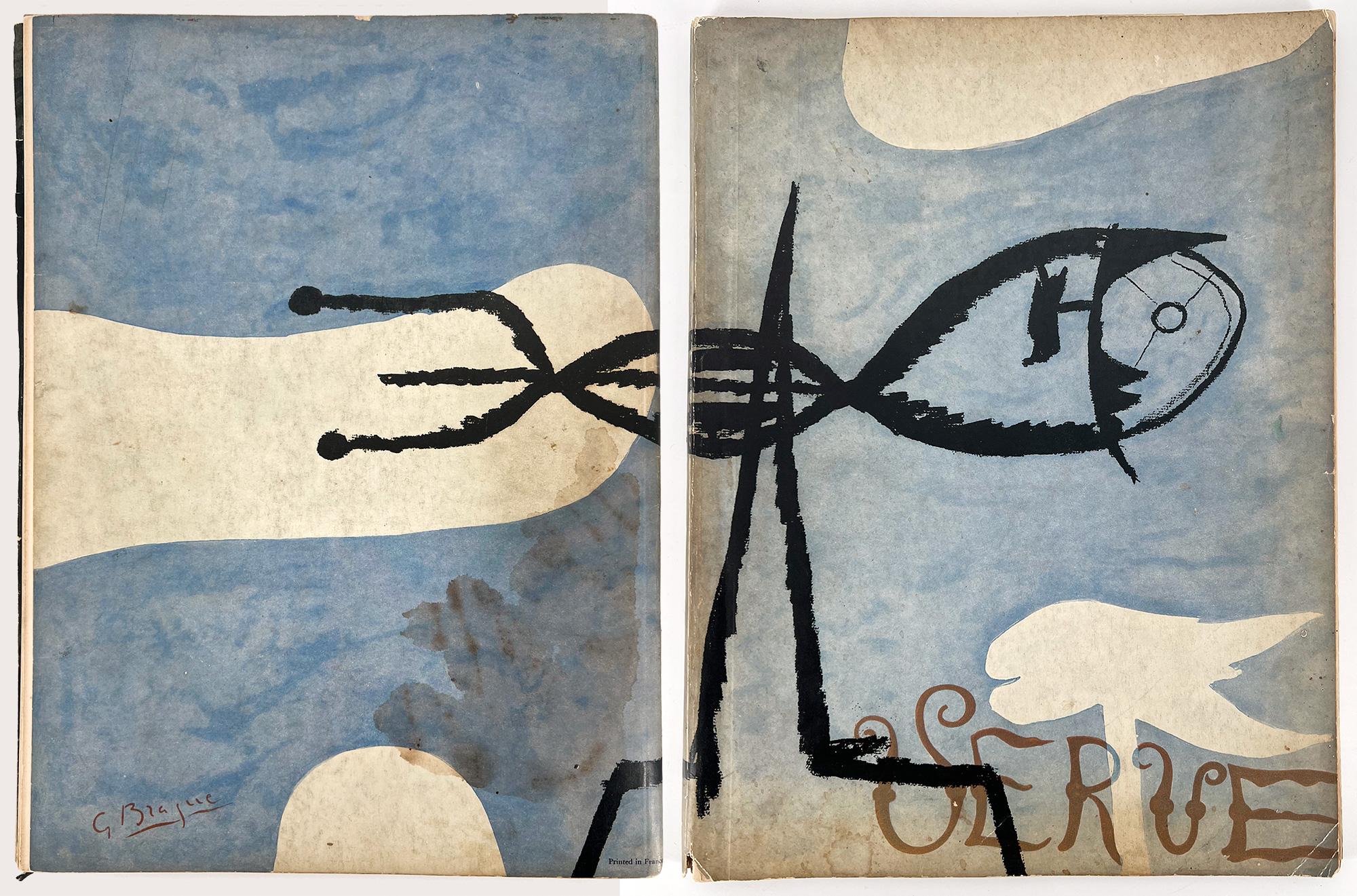
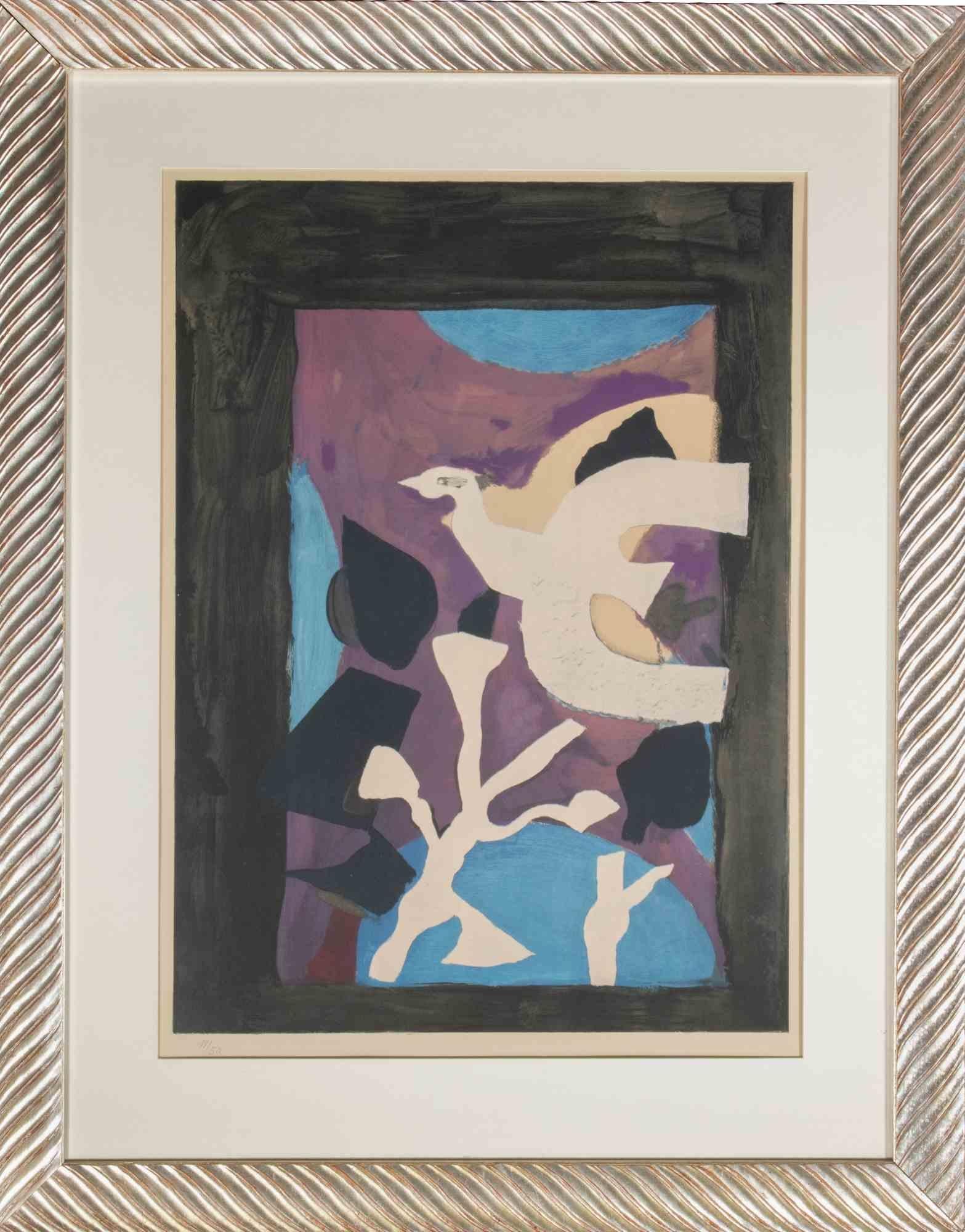
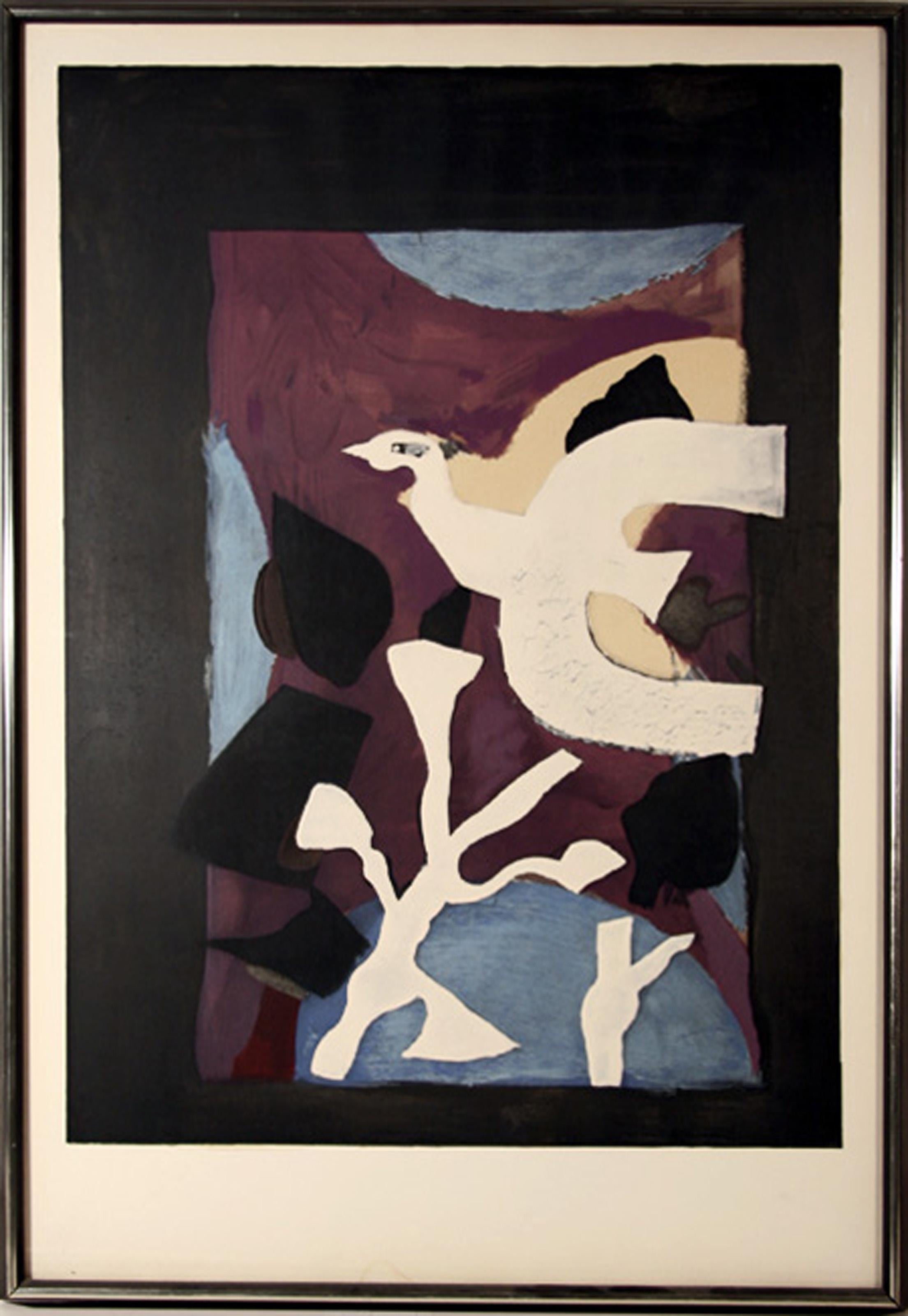
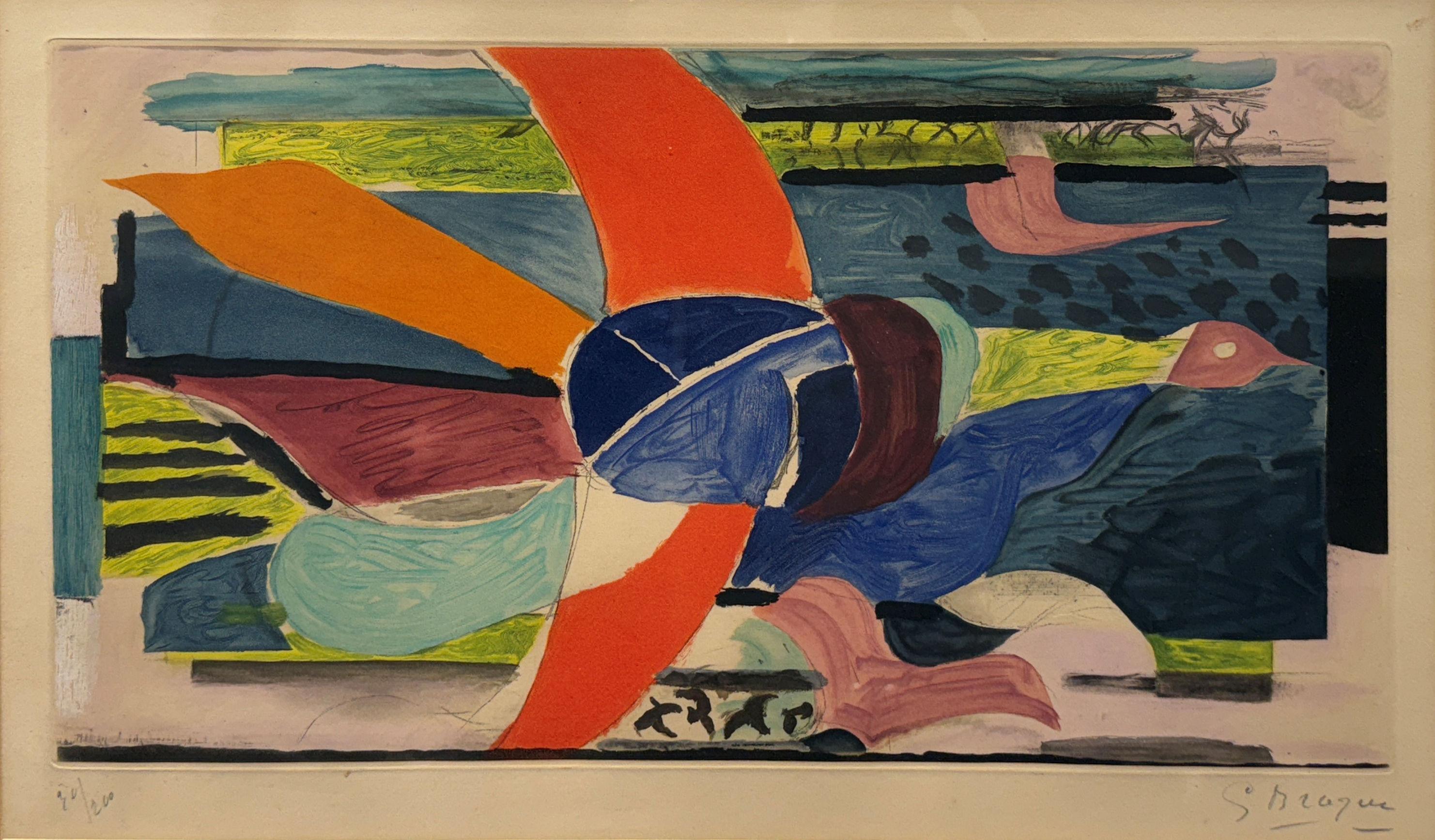
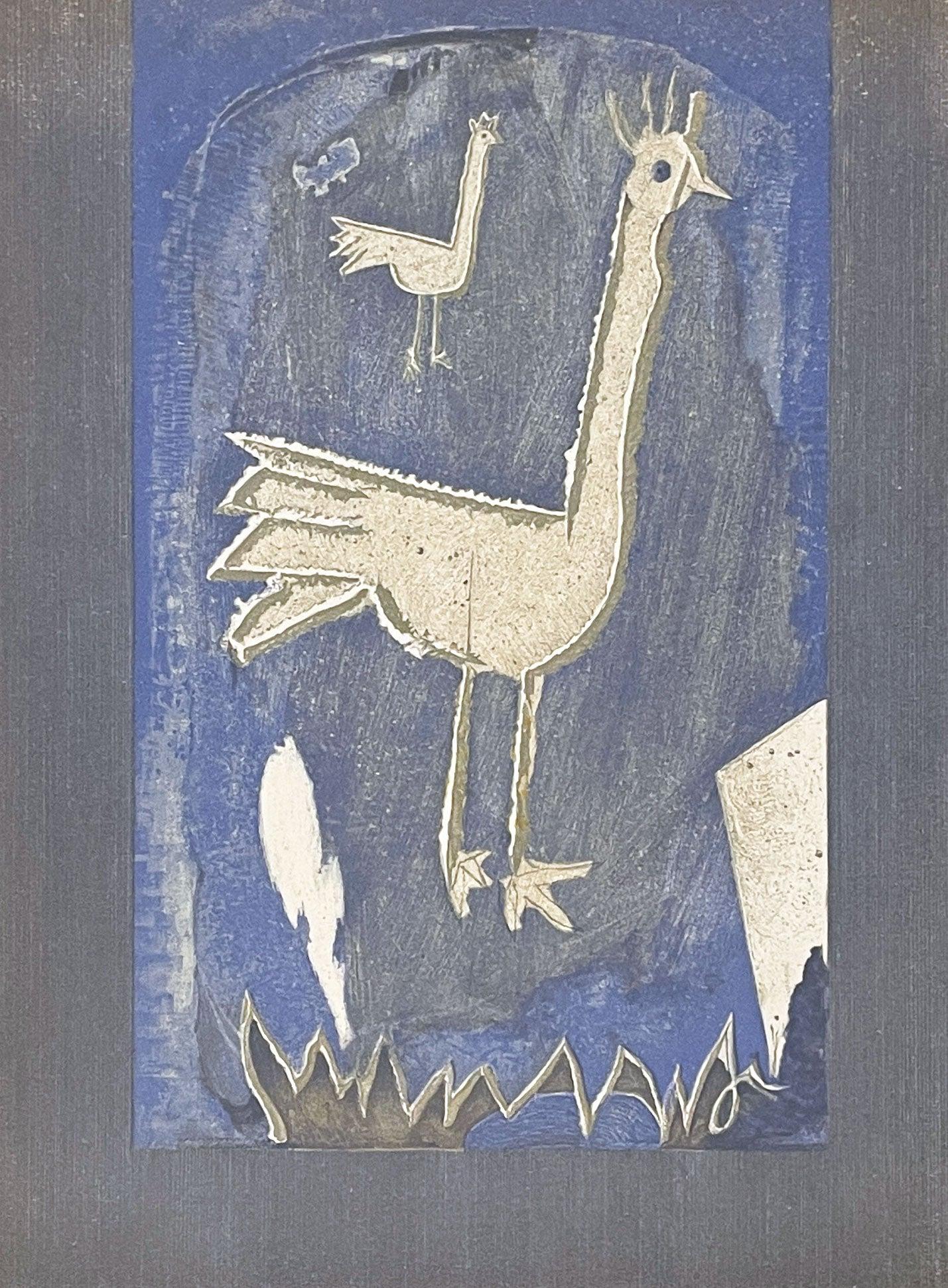
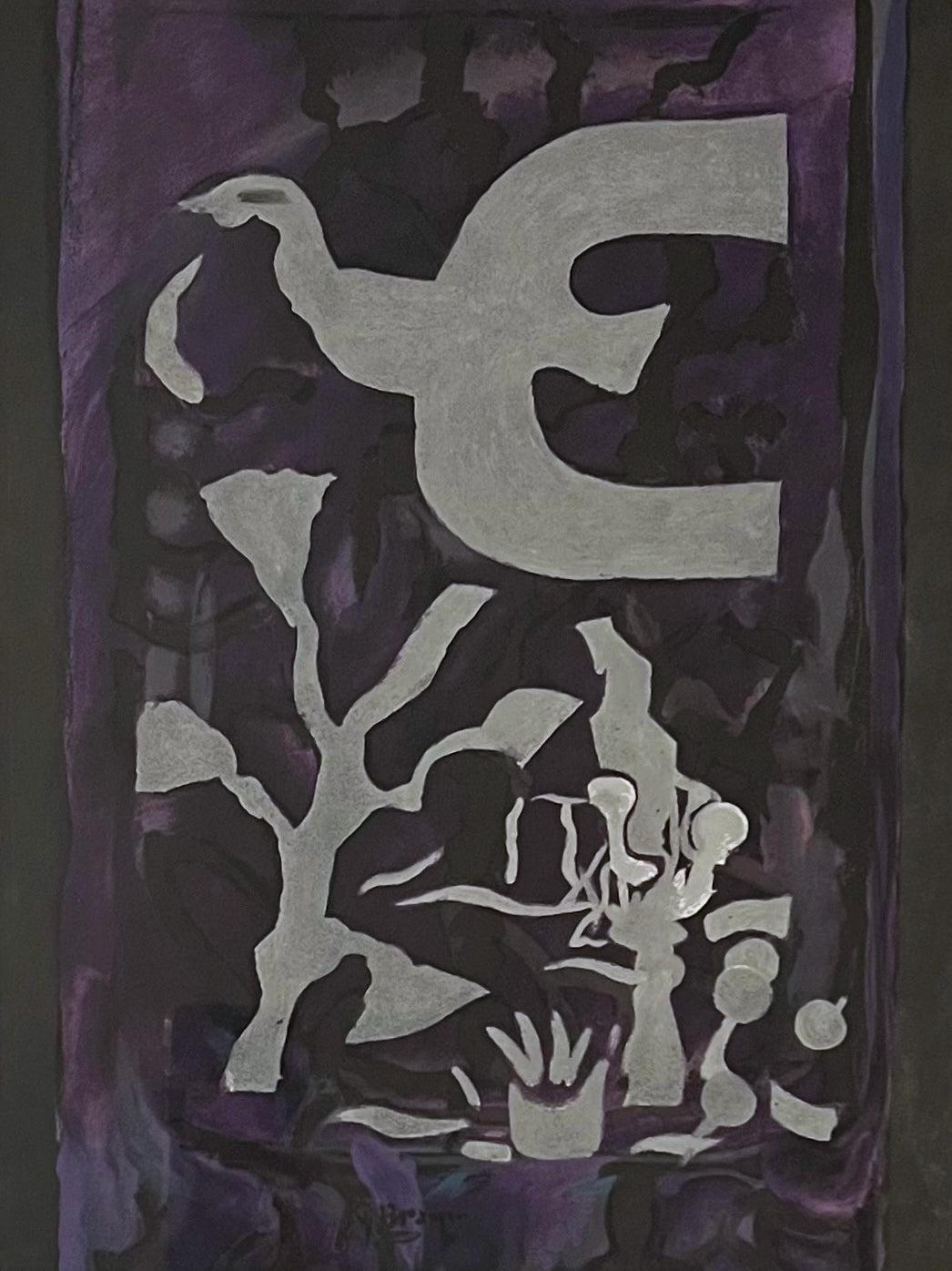
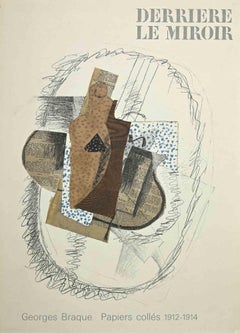
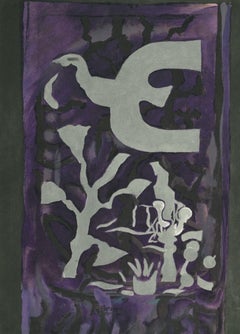
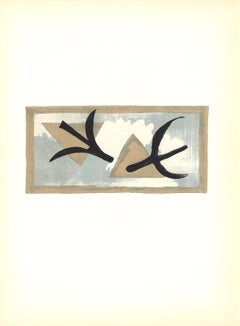
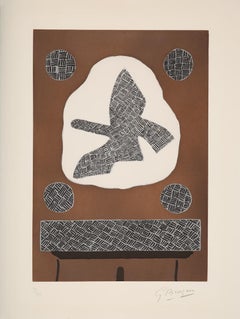
This exquisite lithograph after Georges Braque (1882–1963), titled Cheval et oiseau (Horse and Bird), from the folio Derriere le miroir, Hesiod, Theogony, Etchings by Georges Braque, No. 71–72, originates from the 1954 edition published by Maeght Editeur, Paris, and printed by Mourlot Freres, Paris, 1954. This work exemplifies Braque’s masterful synthesis of symbolism and abstraction, reflecting his lifelong fascination with myth, nature, and poetic form.
Executed as a lithograph on velin paper, this work measures 15 x 11 inches. Unsigned and unnumbered as issued. The edition exemplifies the superb craftsmanship of Mourlot Freres, Paris.
Artwork Details:
Artist: After Georges Braque (1882–1963)
Title: Cheval et oiseau (Horse and Bird), from the folio Derriere le miroir, Hesiod, Theogony, Etchings by Georges Braque, No. 71–72
Medium: Lithograph on velin paper
Dimensions: 15 x 11 inches (38.1 x 27.9 cm)
Inscription: Unsigned and unnumbered as issued
Date: 1954
Publisher: Maeght Editeur, Paris
Printer: Mourlot Freres, Paris
Condition: Well preserved, consistent with age and medium
Provenance: From the folio Derriere le miroir, Hesiod, Theogony, Etchings by Georges Braque, No. 71–72, published by Maeght Editeur, Paris; printed by Mourlot Freres, Paris, 1954
Notes:
Excerpted from the folio (translated from French), This edition of the Theogony of Hesiod is composed of capitales Europe corps XVI. The non-text engravings were executed in 1932 by Georges Braque at the request of Ambroise Vollard. The cover, the frontispiece, the head of the chapter, and the cul-de-lamp were engraved by Georges Braque in 1953. Each cover was varnished by the artist. Printing was finished in Paris on the presses of Fequet et Baudier on Monday, January 10, 1955. It was drawn on papier d'Auvergne a la main, CL examples, numbered, all signed by Georges Braque. The original size is 45 x 35 cm. The binding for Georges Braque's "Theogony" was made by Madame Claude Stably. Each box consists of an original collage executed with torn and glued papers obtained by the so-called "a la cuve" process. The spontaneous graphics of these papers is due to the use and dosage of the different products that are added to the couleur a huile: alcohol, essence, ox bile, varnish, gum tragacanth, etc. The color then moves on the water, creating sporadic archipelagos of unusual beauty, caught on the fly by dipping the paper quickly into the tank. Madame Claude Stably won the 2eme prix de la Reliure Originale, 1954.
About the Publication:
Derriere le miroir (Behind the Mirror) was one of the most important art publications of the 20th century, created and published by Maeght Editeur in Paris from 1946 to 1982. Founded by the visionary art dealer and publisher Aime Maeght, the series served as both an exhibition catalogue and a work of art in its own right, uniting original lithographs by leading modern and contemporary artists with critical essays, poetry, and design of the highest quality. Printed by master lithographers such as Mourlot Freres and Arte, Derriere le miroir became synonymous with the artistic vanguard of postwar Europe. Each issue was devoted to a single artist or theme and published to accompany exhibitions at the Galerie Maeght in Paris, featuring works by Pablo Picasso, Henri Matisse, Georges Braque, Joan Miro, Marc Chagall, Alexander Calder, Fernand Leger, and Alberto Giacometti, among others. The publication reflected Maeght’s belief that art should be both accessible and elevated—an ideal realized through its luxurious production values, meticulous printing, and collaboration with the greatest creative minds of its time.
About the Artist:
Georges Braque (1882–1963) was a French painter, sculptor, and printmaker whose pioneering vision transformed the course of 20th-century art. A central figure in modernism and the co-founder of Cubism alongside Pablo Picasso, Braque redefined visual perception by breaking objects into geometric forms and reassembling them from multiple perspectives, creating a new visual language that bridged the gap between abstraction and reality. His early work was influenced by the vibrant colors and expressive energy of the Fauvist painters Henri Matisse and Andre Derain, before evolving toward the more analytical and structured compositions inspired by Paul Cezanne’s theories of form and perspective. Braque’s collaboration with Picasso between 1908 and 1914 marked one of the most fertile and revolutionary periods in art history, resulting in works that challenged traditional notions of space, depth, and illusion. Throughout his career, Braque maintained a deep interest in harmony, rhythm, and balance, infusing his still lifes, landscapes, and later reliefs with poetic subtlety and intellectual rigor. He moved among a brilliant circle of contemporaries including Pablo Picasso, Henri Matisse, Marc Chagall, Juan Gris, Fernand Leger, and Amedeo Modigliani—artists united in their pursuit of new modes of artistic expression. Braque’s influence extended well beyond his own era, shaping the creative approaches of later modernists such as Alexander Calder, Alberto Giacometti, Salvador Dali, Joan Miro, Wassily Kandinsky, Marcel Duchamp, and Man Ray, all of whom drew inspiration from his structural innovations and aesthetic integrity. His works are held in major museum collections worldwide, including the Museum of Modern Art, the Centre Pompidou, the Tate, and the Guggenheim, where they continue to embody the essence of modern artistic thought and visual poetry. The highest price ever paid for a Georges Braque artwork is approximately 15 million USD, achieved in 2013 at Christie’s New York for Paysage a la Ciotat (1907).
Georges Braque Cheval et oiseau Derriere le miroir No. 71–72, Braque Mourlot Freres, Braque Maeght Editeur, Braque velin paper, Braque collectible lithograph.