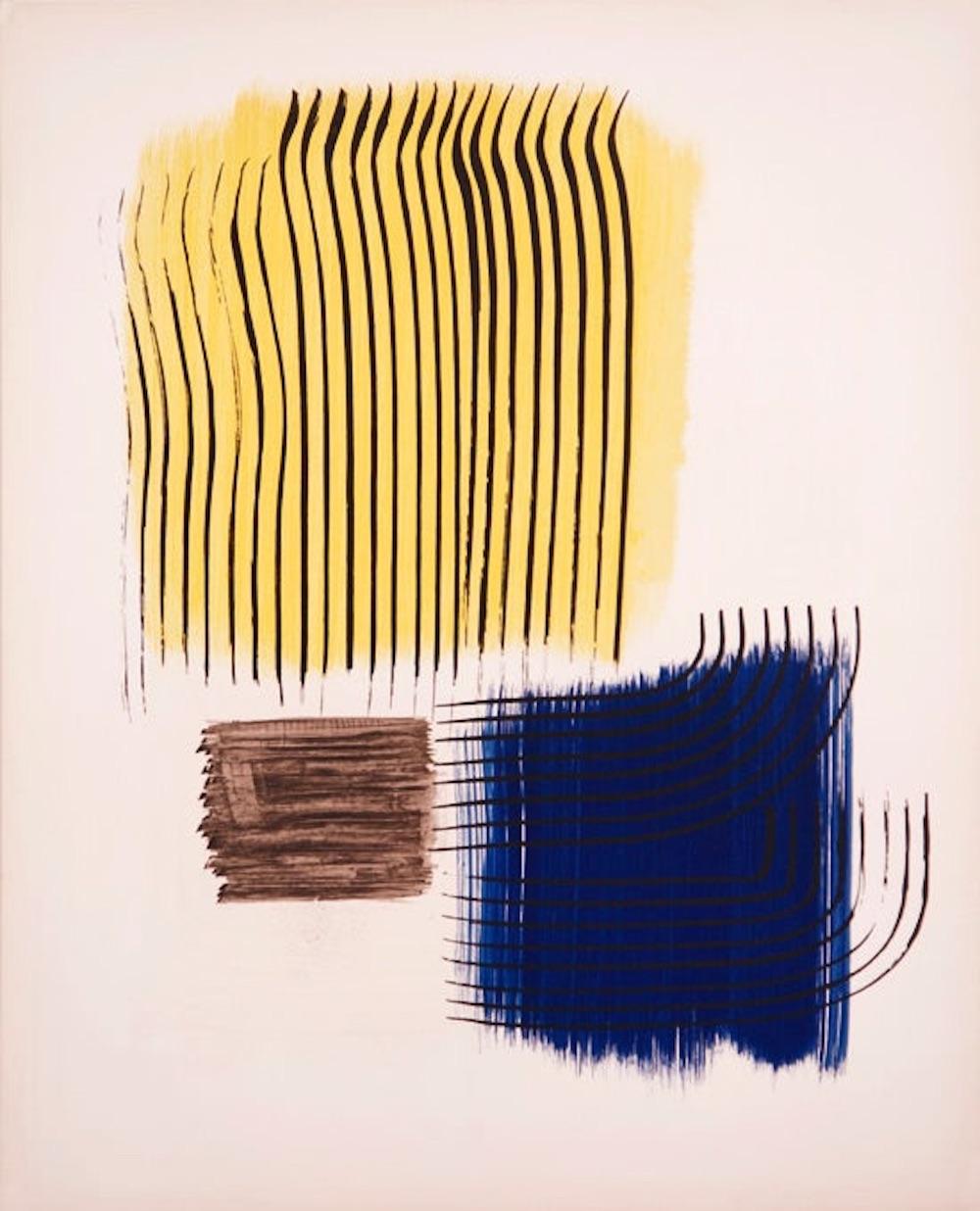
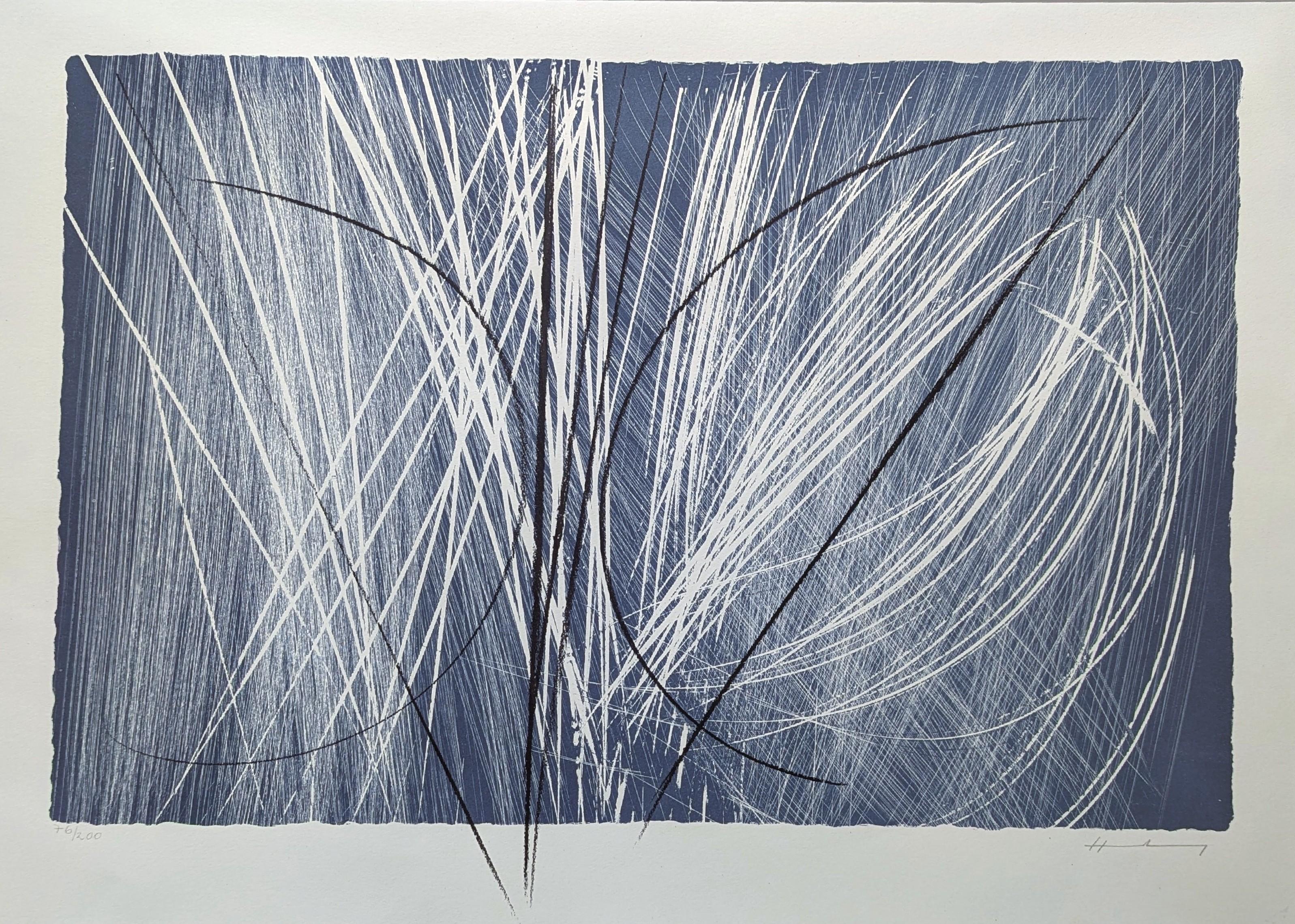
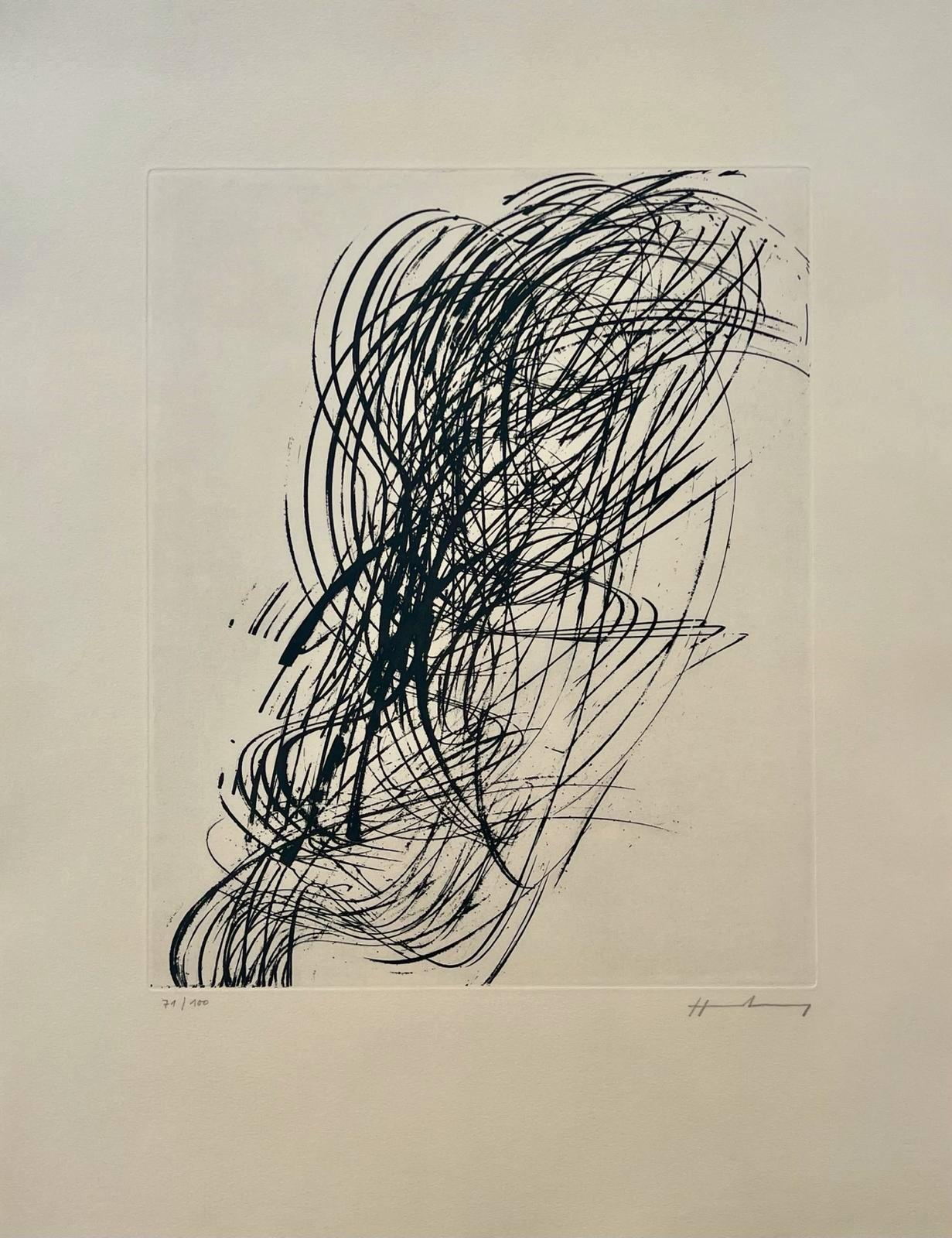
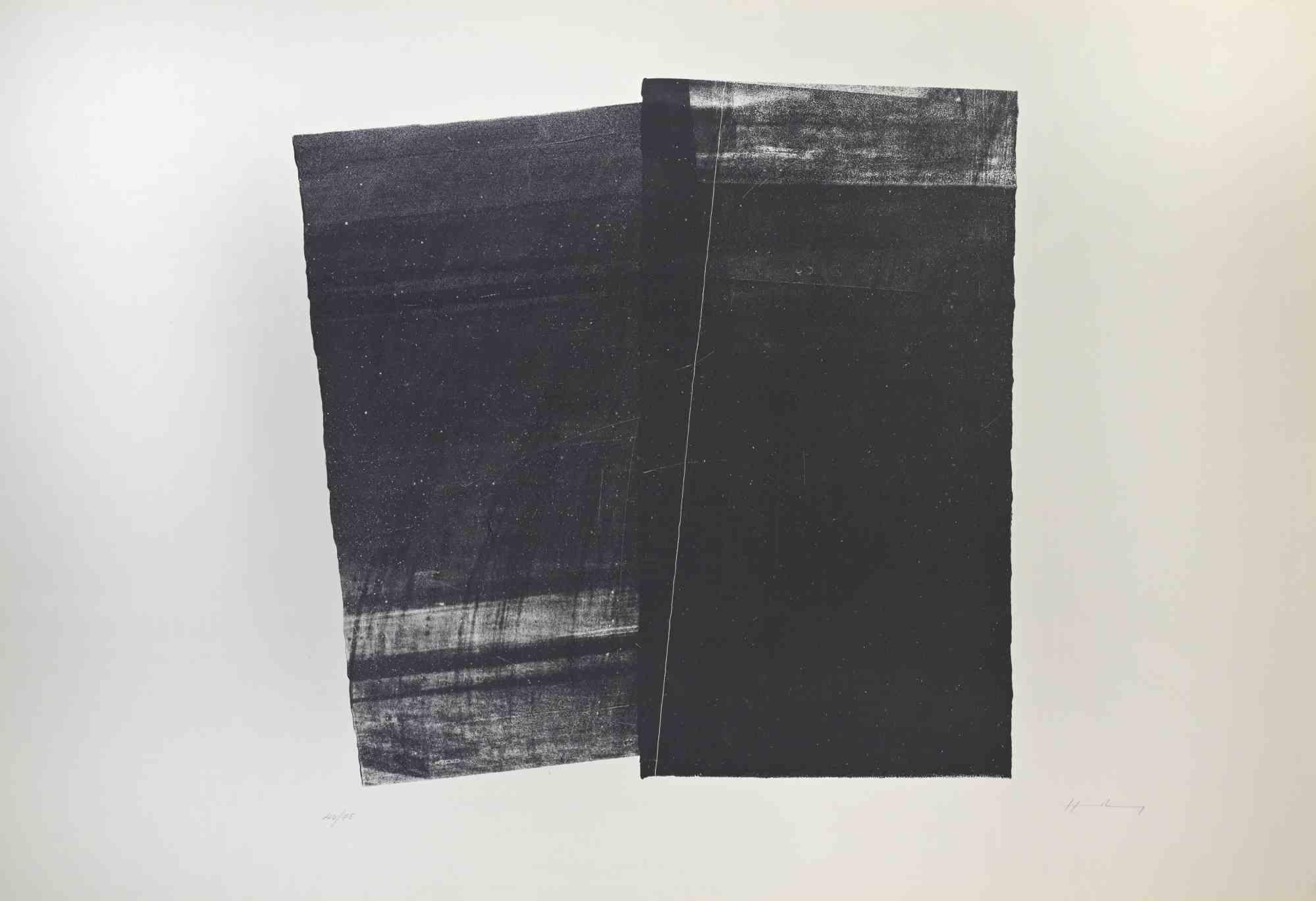
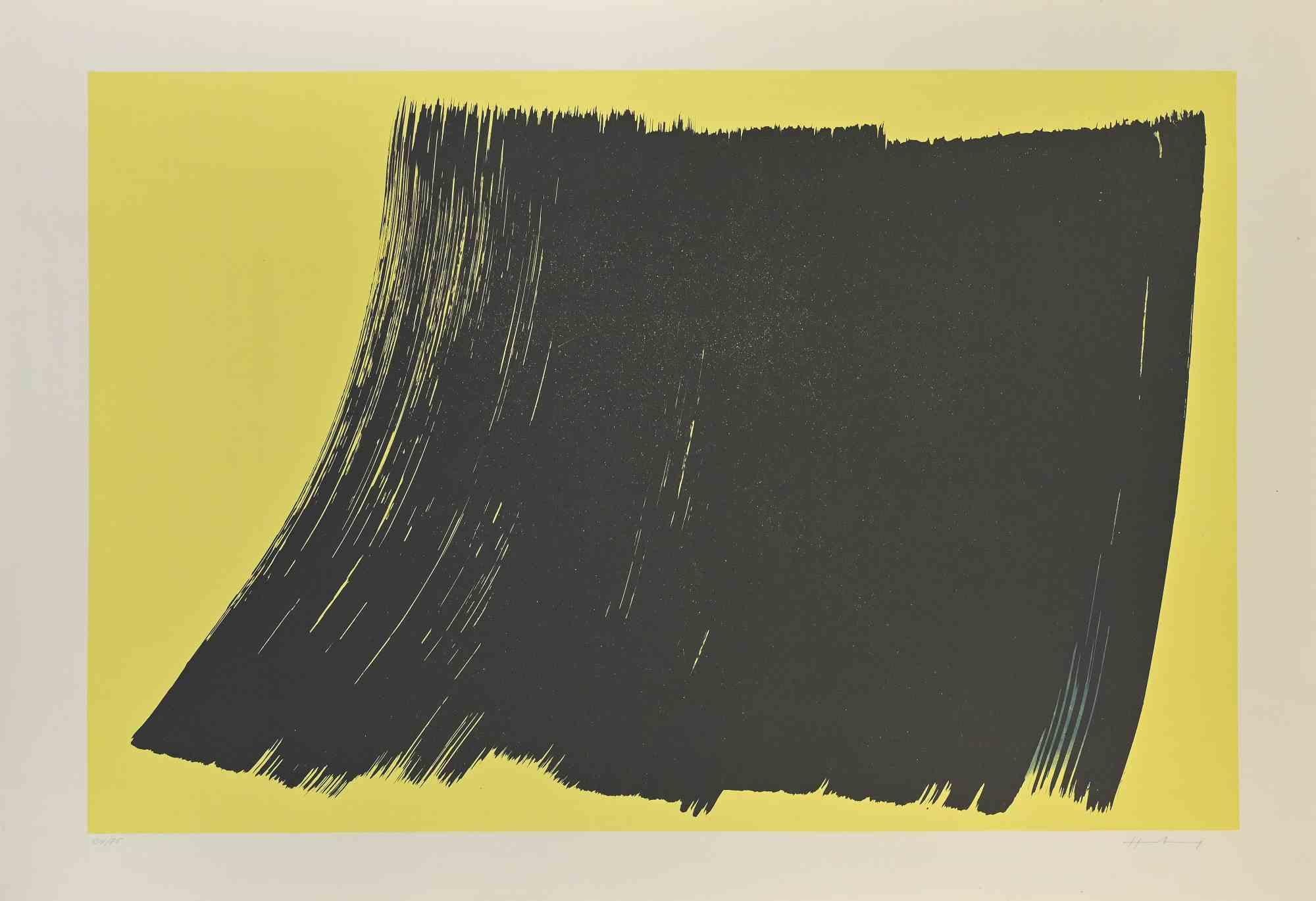
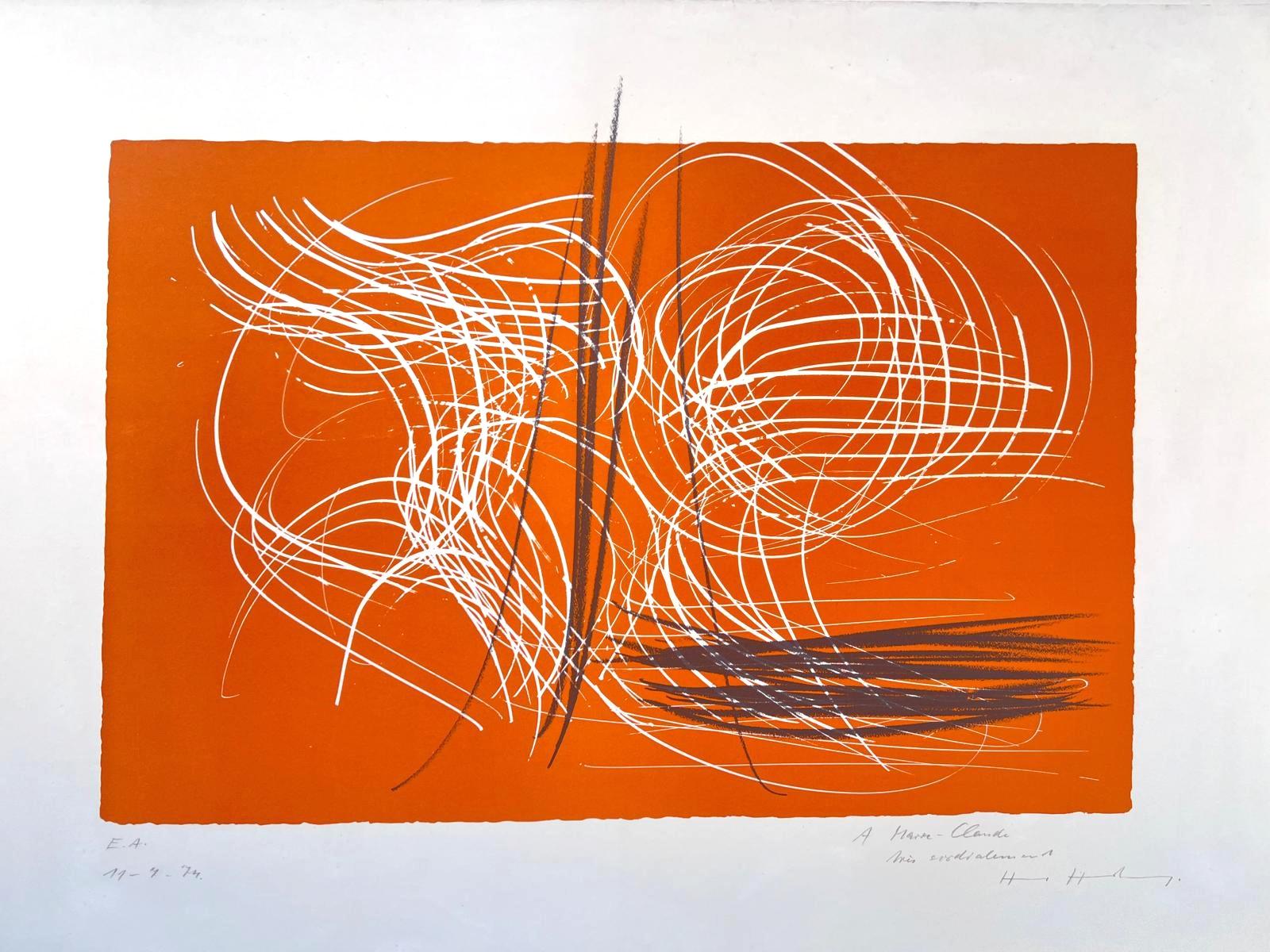
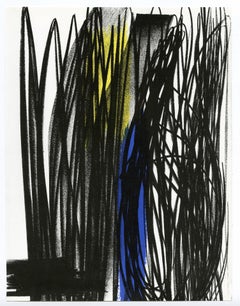
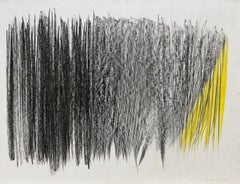
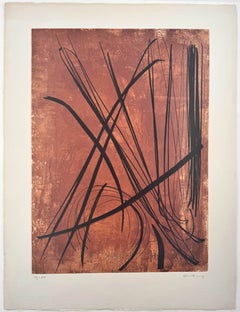
This exquisite heliogravure after Hans Hartung (1904–1989), titled P. 1958-10, from the folio Hans Hartung, Peintres d'aujourd'hui (Hans Hartung, Painters of Today), originates from the 1962 edition published by Fernand Hazan, Editeur, Paris, rendered by Cliches Union, Paris, and printed by l'Imprimerie Lecot, Paris, December 1962. P. 1958-10 reflects Hartung’s mastery of gesture, rhythm, and expressive abstraction, embodying his lifelong pursuit of visualizing energy through movement and form.
Executed as a heliogravure on velin paper, this work measures 10.83 x 13.78 inches. Unsigned and unnumbered as issued. The edition exemplifies the refined craftsmanship of Cliches Union and the exceptional production standards of Fernand Hazan, Editeur, Paris.
Artwork Details:
Artist: After Hans Hartung (1904–1989)
Title: P. 1958-10, from the folio Hans Hartung, Peintres d'aujourd'hui (Hans Hartung, Painters of Today)
Medium: Heliogravure on velin paper
Dimensions: 10.83 x 13.78 inches (27.5 x 35 cm)
Inscription: Unsigned and unnumbered as issued
Date: 1962
Publisher: Fernand Hazan, Editeur, Paris
Printer: l'Imprimerie Lecot, Paris
Renderer: Cliches Union, Paris
Condition: Well preserved, consistent with age and medium
Provenance: From the folio Hans Hartung, Peintres d'aujourd'hui (Hans Hartung, Painters of Today), published by Fernand Hazan, Editeur, Paris, December 1962
Notes:
Excerpted from the folio (translated from French), The illustrations of this album, completed in December 1962, were produced by Cliches Union and shot by l'Imprimerie Lecot. The text has been composed and drawn by l'Imprimerie Darantiere and the binding made by F.l.A.P. according to the models of Marcel Jacno. Fernand Hazan Editeur, 35-37 rue de Seine, Paris. 1962. Tous droits de reproduction reserves. Printed in France.
About the Publication:
Hans Hartung, Peintres d'aujourd'hui (Hans Hartung, Painters of Today), published in Paris in 1962 by Fernand Hazan, Editeur, stands as one of the most distinguished albums in the celebrated Peintres d’aujourd’hui series. Dedicated to presenting the foremost modern artists of the mid-20th century, the publication unites critical scholarship and the finest Parisian craftsmanship in fine art printmaking. Produced under the technical supervision of Cliches Union and printed by l’Imprimerie Lecot, the heliogravures achieve exceptional tonal depth and fidelity, capturing the dynamic intensity and gestural lyricism central to Hartung’s oeuvre. Each element of the folio, from its text composed by l’Imprimerie Darantiere to its binding designed by F.l.A.P. under the guidance of Marcel Jacno, reflects the precision and aesthetic integrity that define Fernand Hazan’s art publications. As part of the acclaimed Peintres d’aujourd’hui series, this 1962 edition embodies the French postwar tradition of uniting visual art, scholarship, and craftsmanship in the service of modernism, preserving the essence of the artist’s vision through the enduring medium of print.
About the Artist:
Hans Hartung (1904–1989) was a German-French painter and one of the great pioneers of postwar European abstraction, celebrated for his bold gestural mark-making, experimental techniques, and ability to translate pure energy and emotion into visual form. Born in Leipzig, Germany, Hartung studied philosophy, art history, and fine art in Leipzig, Dresden, and Munich, where he absorbed the groundbreaking ideas of Pablo Picasso, Wassily Kandinsky, and Joan Miro—artists whose innovations profoundly shaped his artistic philosophy. Influenced by Picasso’s daring structure, Kandinsky’s spiritual abstraction, and Miro’s lyrical biomorphism, Hartung sought to create an art that transcended representation and captured the rhythm of existence itself. In 1935, he moved to Paris and joined the avant-garde circle that included Alexander Calder, Alberto Giacometti, Salvador Dali, Marcel Duchamp, and Man Ray, whose explorations of form, movement, and perception encouraged him to experiment beyond the traditional boundaries of painting. His early works revealed a fascination with the expressive power of line—arcs, cross-hatching, and gestural brushwork that balanced chaos and control, tension and harmony. After losing a leg in World War II while fighting for the French Foreign Legion, Hartung transformed his personal pain into artistic liberation, creating works that embodied both destruction and renewal. Emerging as a leader of Art Informel in the 1940s and 1950s, he developed a radical process of painting using unconventional tools such as spray guns, knives, and branches to achieve luminous layers, textures, and explosive movement across his canvases. Each composition became a record of physical action and psychological intensity, a visual symphony that paralleled the spontaneity of Abstract Expressionism in America but with the lyrical precision of European modernism. His dynamic gestures—arcing lines, scratches, and splatters—conveyed both cosmic motion and meditative stillness, evoking the universal energies of nature, sound, and light. Like Duchamp and Man Ray, he viewed creation as experimentation; like Calder and Miro, he saw art as rhythm and freedom; and like Kandinsky, he understood abstraction as visual music. By the 1960s, Hartung had achieved international acclaim, winning the Grand Prix for painting at the Venice Biennale and exhibiting at Documenta, the Musee d’Art Moderne de la Ville de Paris, and major museums worldwide including MoMA, the Tate, the Guggenheim, and the Centre Pompidou. His influence extended to generations of artists such as Joan Mitchell, Pierre Soulages, Zao Wou-Ki, Anselm Kiefer, Gerhard Richter, and Sean Scully, who drew inspiration from his fusion of control and spontaneity. In his late career, Hartung continued to innovate with monumental airbrush works that radiated light and motion, confirming his lifelong belief that abstraction is a universal language of energy. Standing alongside Pablo Picasso, Alexander Calder, Alberto Giacometti, Salvador Dali, Joan Miro, Wassily Kandinsky, Marcel Duchamp, and Man Ray, Hans Hartung remains a cornerstone of modern abstraction—an artist whose fearless experimentation bridged chaos and beauty, intellect and instinct, and emotion and form. His highest auction record was achieved by T1962-R6 (1962), which sold for $4.4 million USD at Sotheby’s, Paris, on December 5, 2023, reaffirming Hans Hartung’s enduring legacy as one of the most visionary, expressive, and collectible abstract artists of the modern era.
Hans Hartung P. 1958-10 Peintres d'aujourd'hui Painters of Today Fernand Hazan heliogravure Cliches Union Imprimerie Lecot abstraction modern art.