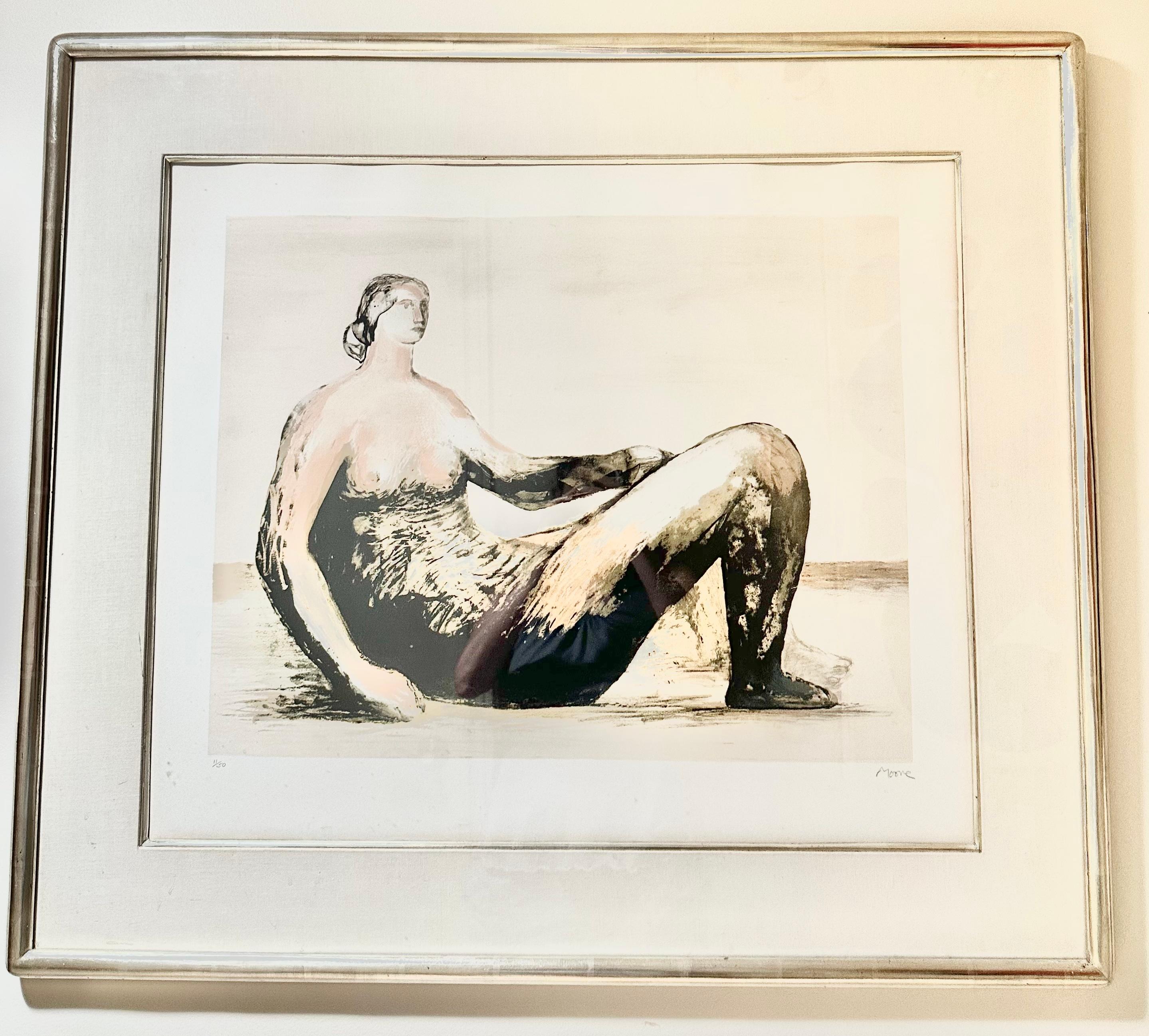
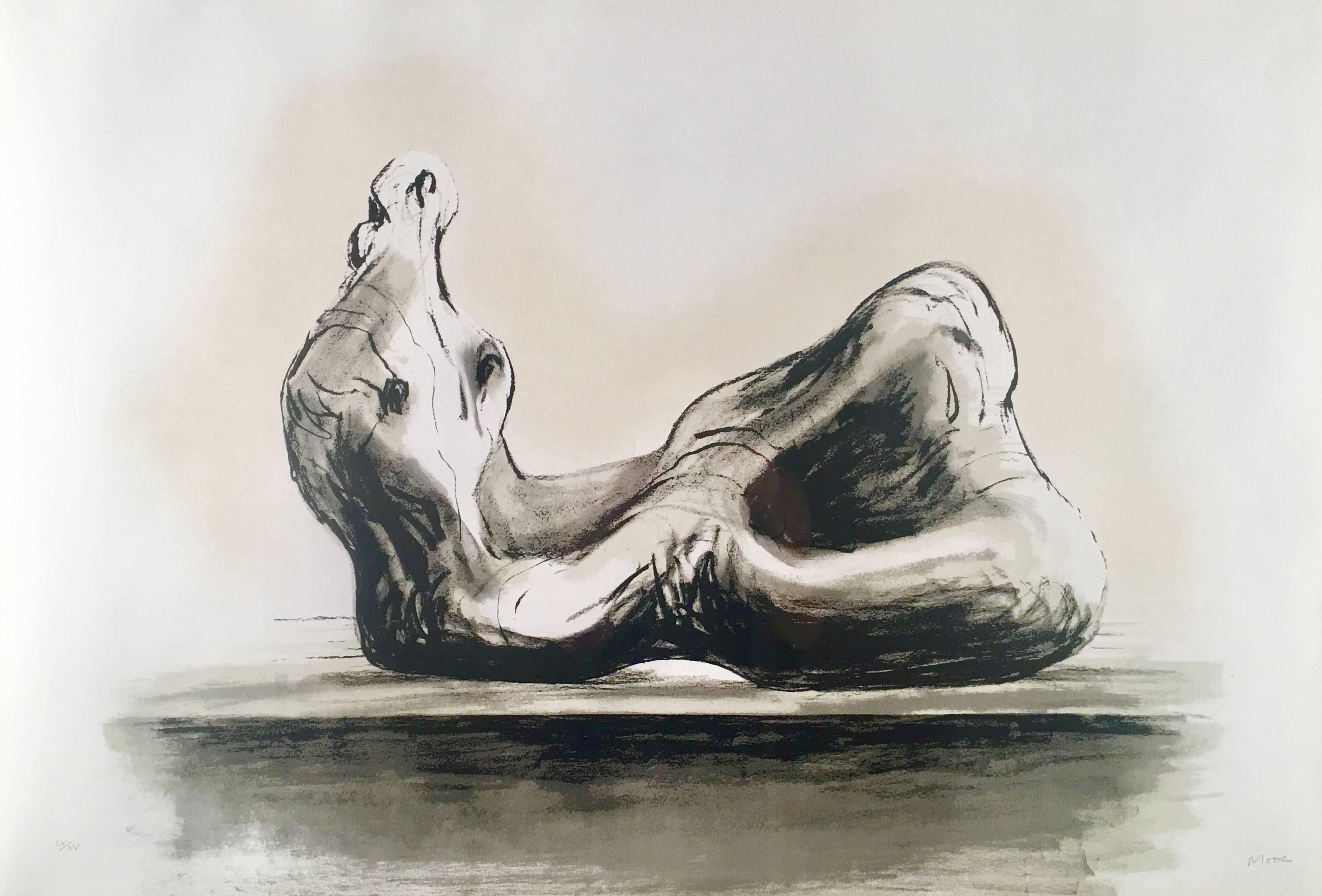
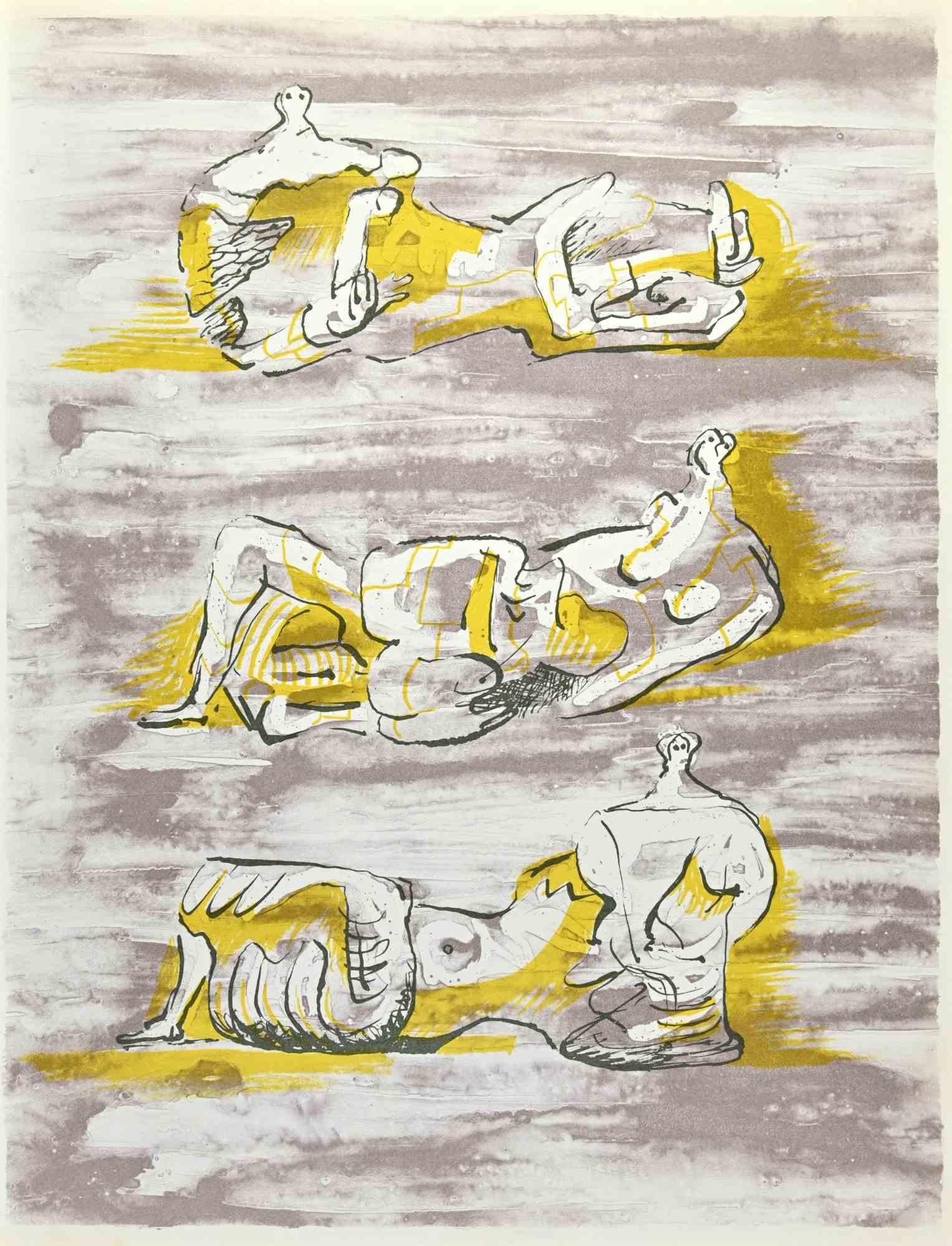
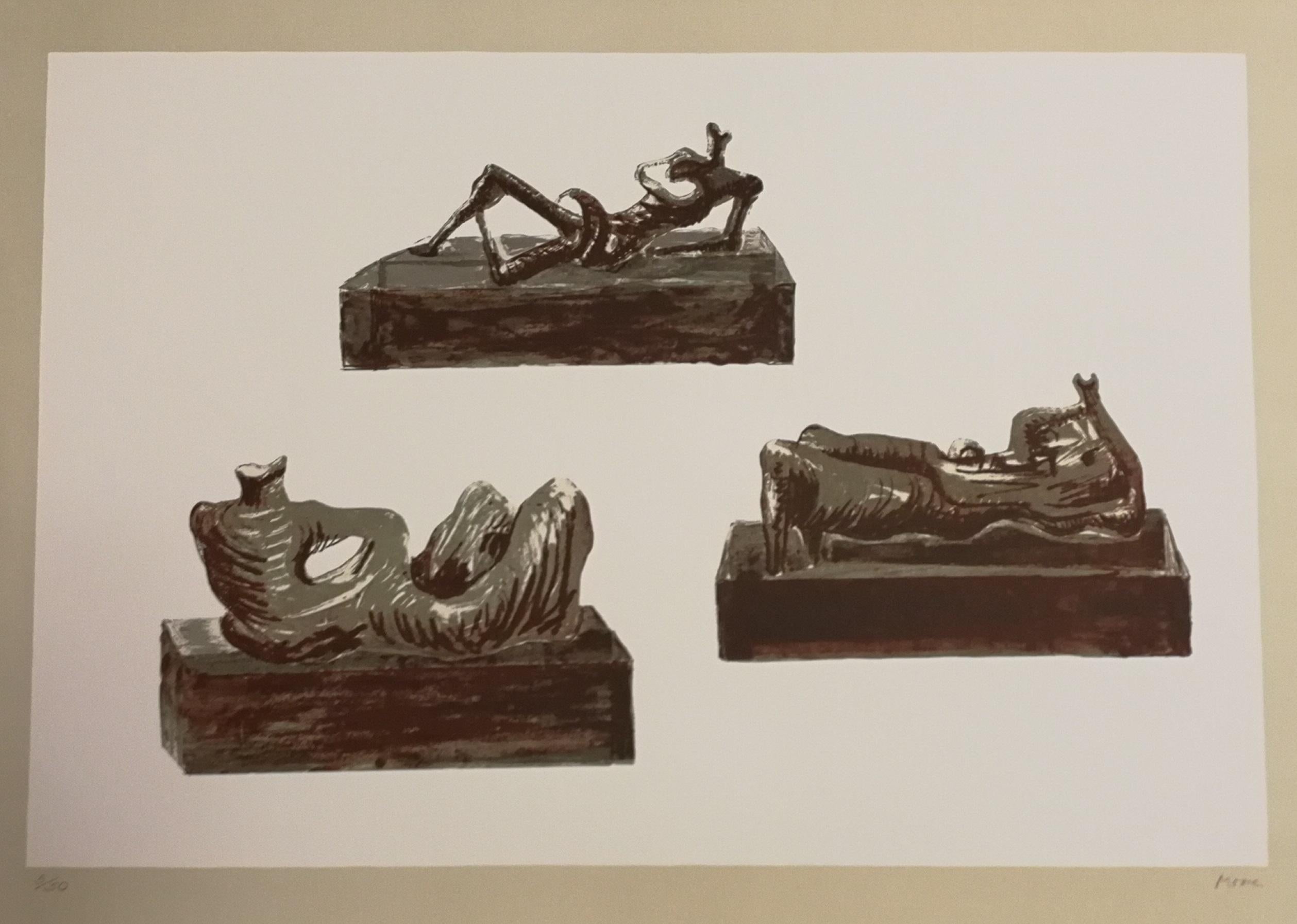
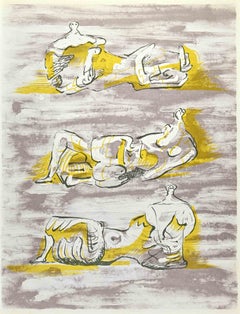
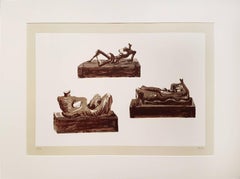
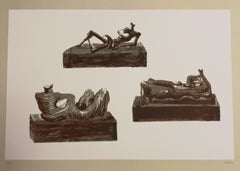
Henry Spencer Moore (1898 – 1986)
Moore was born in Castleford, the son of a coal miner. He became well-known through his carved marble and larger-scale abstract cast bronze sculptures, and was instrumental in introducing a particular form of modernism to the United Kingdom later endowing the Henry Moore Foundation, which continues to support education and promotion of the arts.
After the Great War, Moore received an ex-serviceman's grant to continue his education and in 1919 he became a student at the Leeds School of Art (now Leeds College of Art), which set up a sculpture studio especially for him. At the college, he met Barbara Hepworth, a fellow student who would also become a well-known British sculptor, and began a friendship and gentle professional rivalry that lasted for many years. In Leeds, Moore also had access to the modernist works in the collection of Sir Michael Sadler, the University Vice-Chancellor, which had a pronounced effect on his development. In 1921, Moore won a scholarship to study at the Royal College of Art in London, along with Hepworth and other Yorkshire contemporaries. While in London, Moore extended his knowledge of primitive art and sculpture, studying the ethnographic collections at the Victoria and Albert Museum and the British Museum.
Moore's familiarity with primitivism and the influence of sculptors such as Constantin Brâncuși, Jacob Epstein, Henri Gaudier-Brzeska and Frank Dobson led him to the method of direct carving, in which imperfections in the material and marks left by tools became part of the finished sculpture. After Moore married, the couple moved to a studio in Hampstead at 11a Parkhill Road NW3, joining a small colony of avant-garde artists who were taking root there. Shortly afterward, Hepworth and her second husband Ben Nicholson moved into a studio around the corner from Moore, while Naum Gabo, Roland Penrose, Cecil Stephenson and the art critic Herbert Read also lived in the area (Read referred to the area as "a nest of gentle artists"). This led to a rapid cross-fertilization of ideas that Read would publicise, helping to raise Moore's public profile. The area was also a stopping-off point for many refugee artists, architects and designers from continental Europe en route to America—some of whom would later commission works from Moore.
In 1932, after six year's teaching at the Royal College, Moore took up a post as the Head of the Department of Sculpture at the Chelsea School of Art. Artistically, Moore, Hepworth and other members of The Seven and Five Society would develop steadily more abstract work, partly influenced by their frequent trips to Paris and their contact with leading progressive artists, notably Pablo Picasso, Georges Braque, Jean Arp and Alberto Giacometti. Moore flirted with Surrealism, joining Paul Nash's modern art movement "Unit One", in 1933. In 1934, Moore visited Spain; he visited the cave of Altamira (which he described as the "Royal Academy of Cave Painting"), Madrid, Toledo and Pamplona. Moore made his first visit to America when a retrospective exhibition of his work opened at the Museum of Modern Art in New York City.[28]
Before the war, Moore had been approached by educator Henry Morris, who was trying to reform education with his concept of the Village College. Morris had engaged Walter Gropius as the architect for his second village college at Impington near Cambridge, and he wanted Moore to design a major public sculpture for the site.
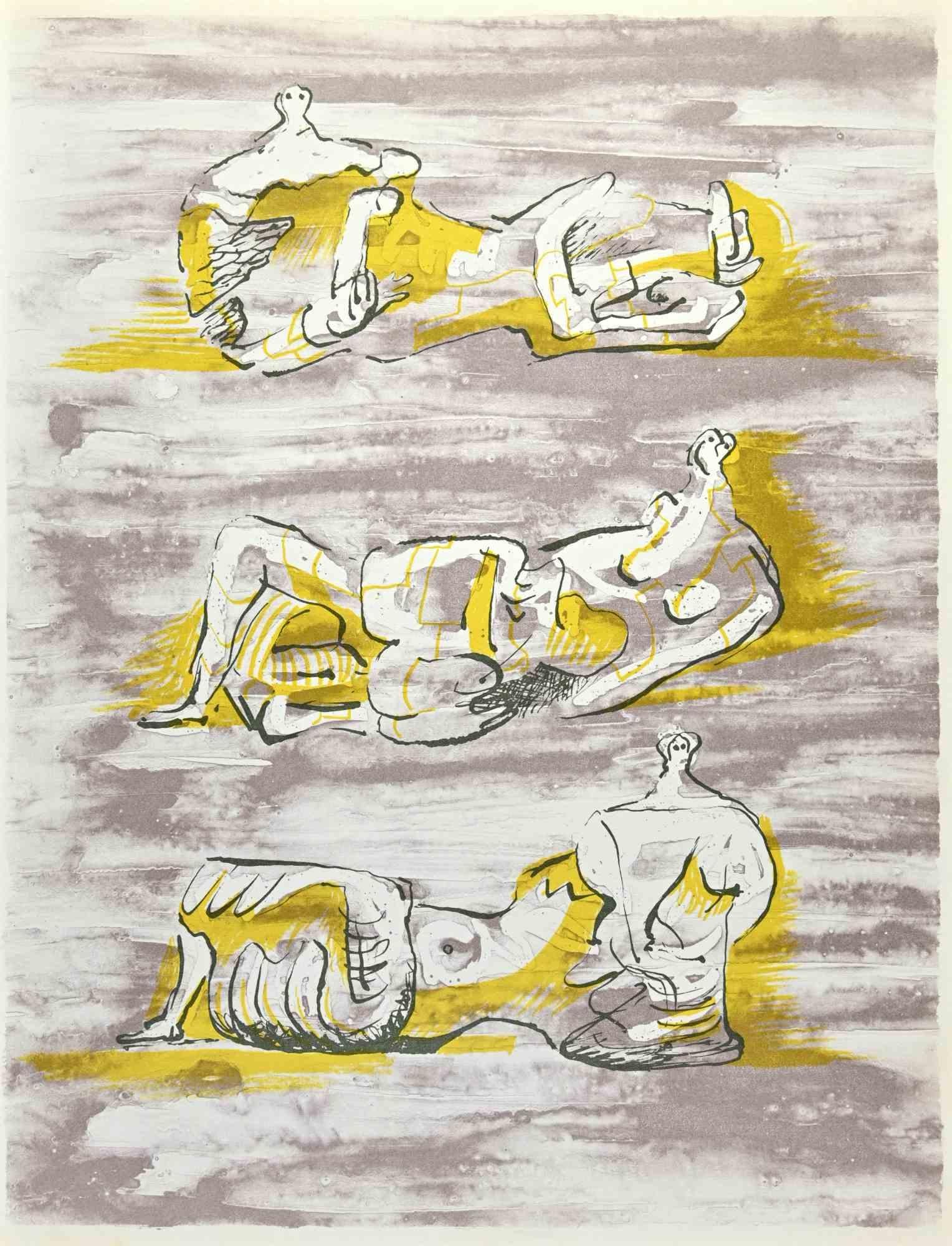
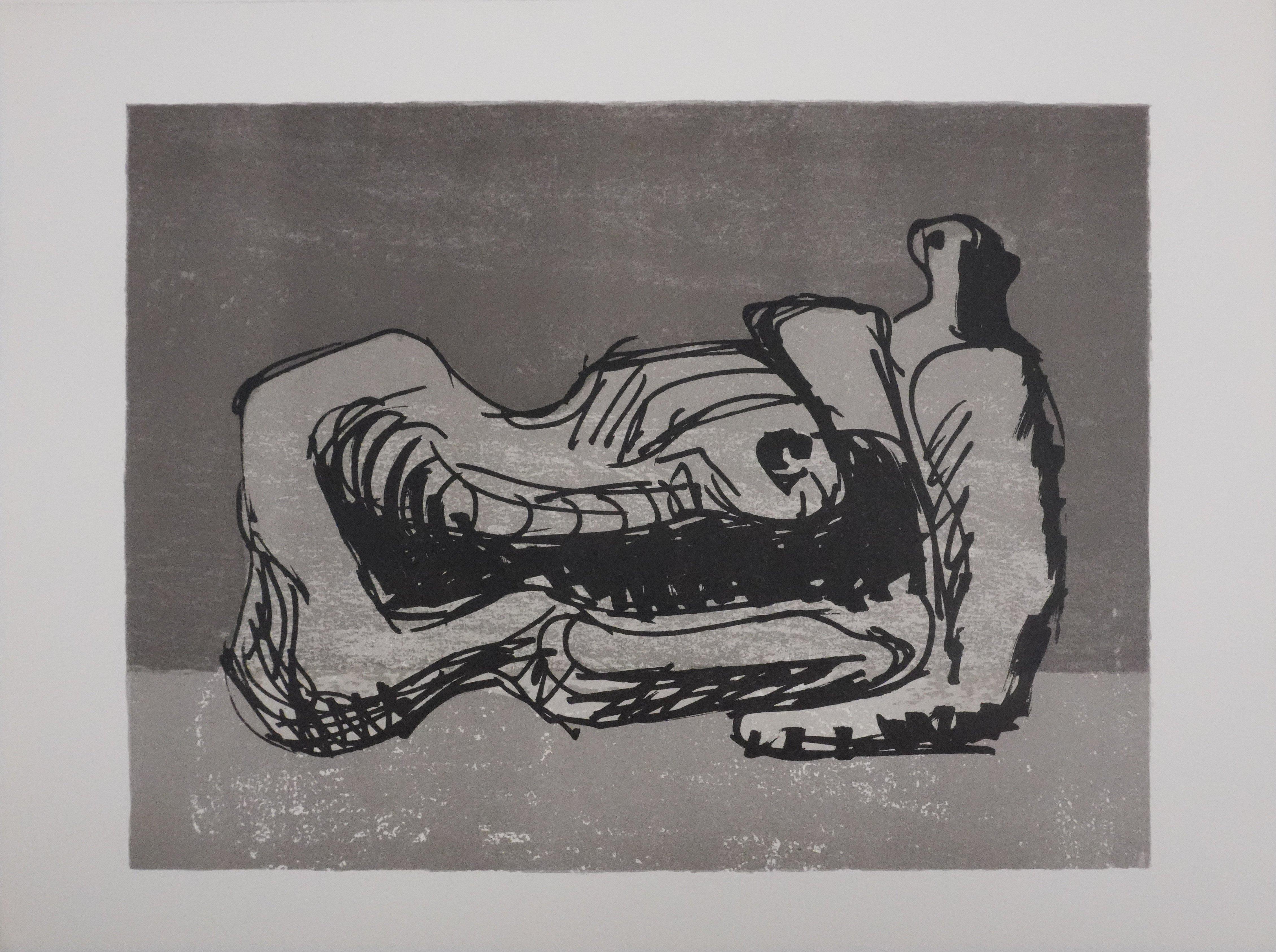
In the 1950s, Moore began to receive increasingly significant commissions. He exhibited Reclining Figure: Festival at the Festival of Britain in 1951, and in 1958 produced a large marble reclining figure for the UNESCO building in Paris. With many more public works of art, the scale of Moore's sculptures grew significantly and he started to employ an increasing number of assistants to work with him at Much Hadham, including Anthony Caro and Richard Wentworth.
Moore produced at least three significant examples of architectural sculpture during his career. In 1928, despite his own self-described extreme reservations, he accepted his first public commission for West Wind for the London Underground Building at 55 Broadway in London, joining the company of Jacob Epstein and Eric Gill..At an introductory speech in New York City for an exhibition of one of the finest modernist sculptors, Alberto Giacometti, Sartre spoke of The beginning and the end of history Moore's sense of England emerging undefeated from siege led to his focus on pieces characterised by endurance and continuity.
Yet Moore had a direct influence on several generations of sculptors of both British and international reputation. Among the artists who have acknowledged Moore's importance to their work are Sir Anthony Caro,[ Phillip King and Isaac Witkin, all three having been assistants to Moore. Other artists whose work was influenced by him include Helaine Blumenfeld, Drago Marin Cherina, Lynn Chadwick, Eduardo Paolozzi, Bernard Meadows, Reg Butler, William Turnbull, Robert Adams, Kenneth Armitage, and Geoffrey Clarke.
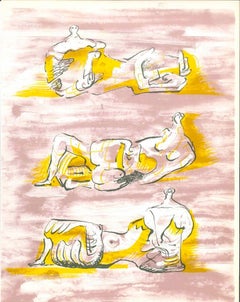
Moore presented 36 sculptures, as well as drawings, maquettes and other works to the Tate Gallery in 1978. He participated in the School printsissue. The sheer logistics of the operation, the costly effort of distribution to over 4000 schools, finally ended the great adventure of the School Prints scheme. The expensive endeavor peaked in 1949 with the magnificent European series, made possible by the plastic portable plates, which, in addition to Moore, featured Matisse, Picasso, Leger, Dufy and Braque.
By the end of his career, Moore was the world's most successful living artist at auction. In 2012, his eight-foot bronze, Reclining Figure: Festival (1951) sold for a record £19.1 million at Christie's, making him the second most expensive 20th-century British artist after Francis Bacon