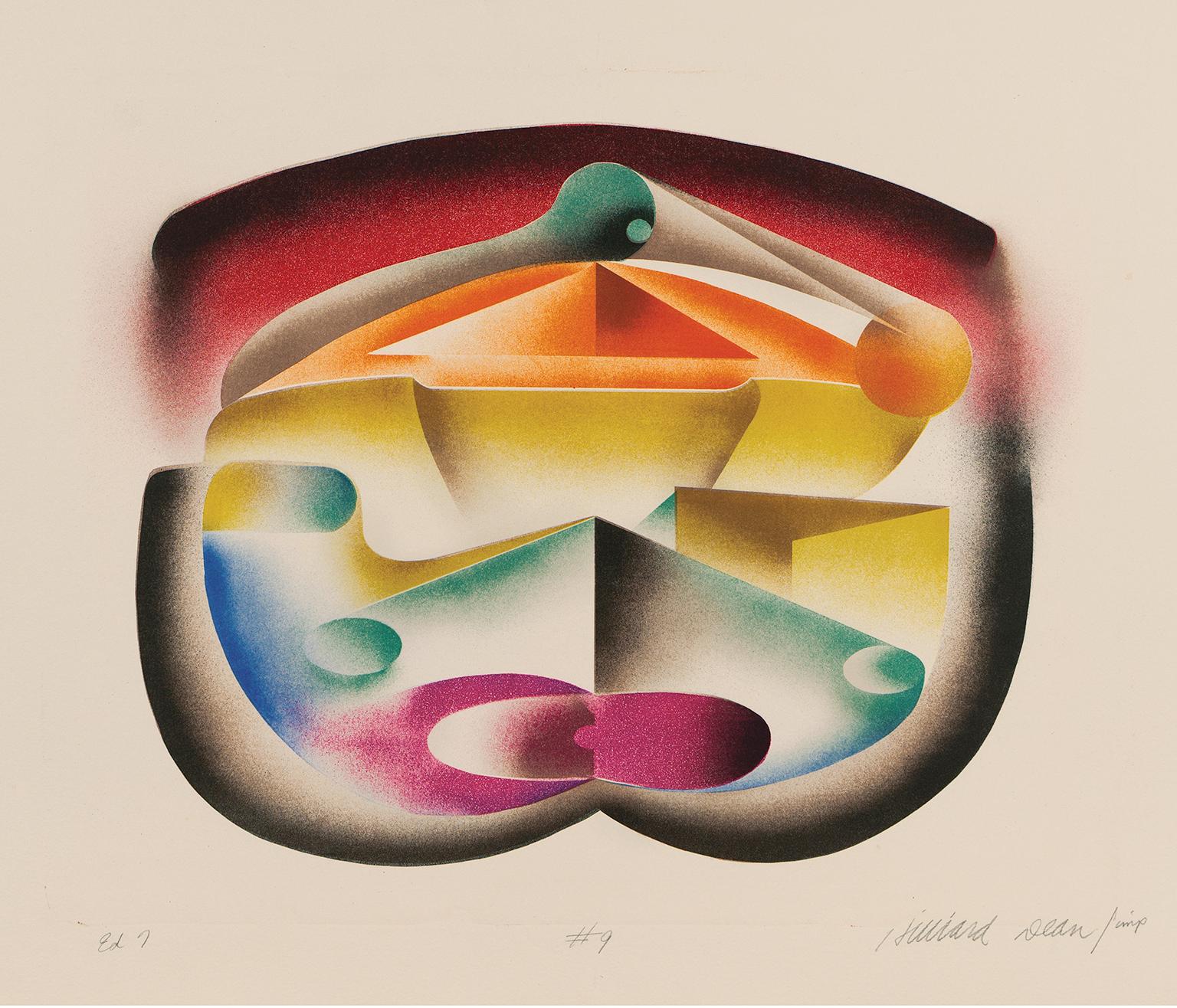
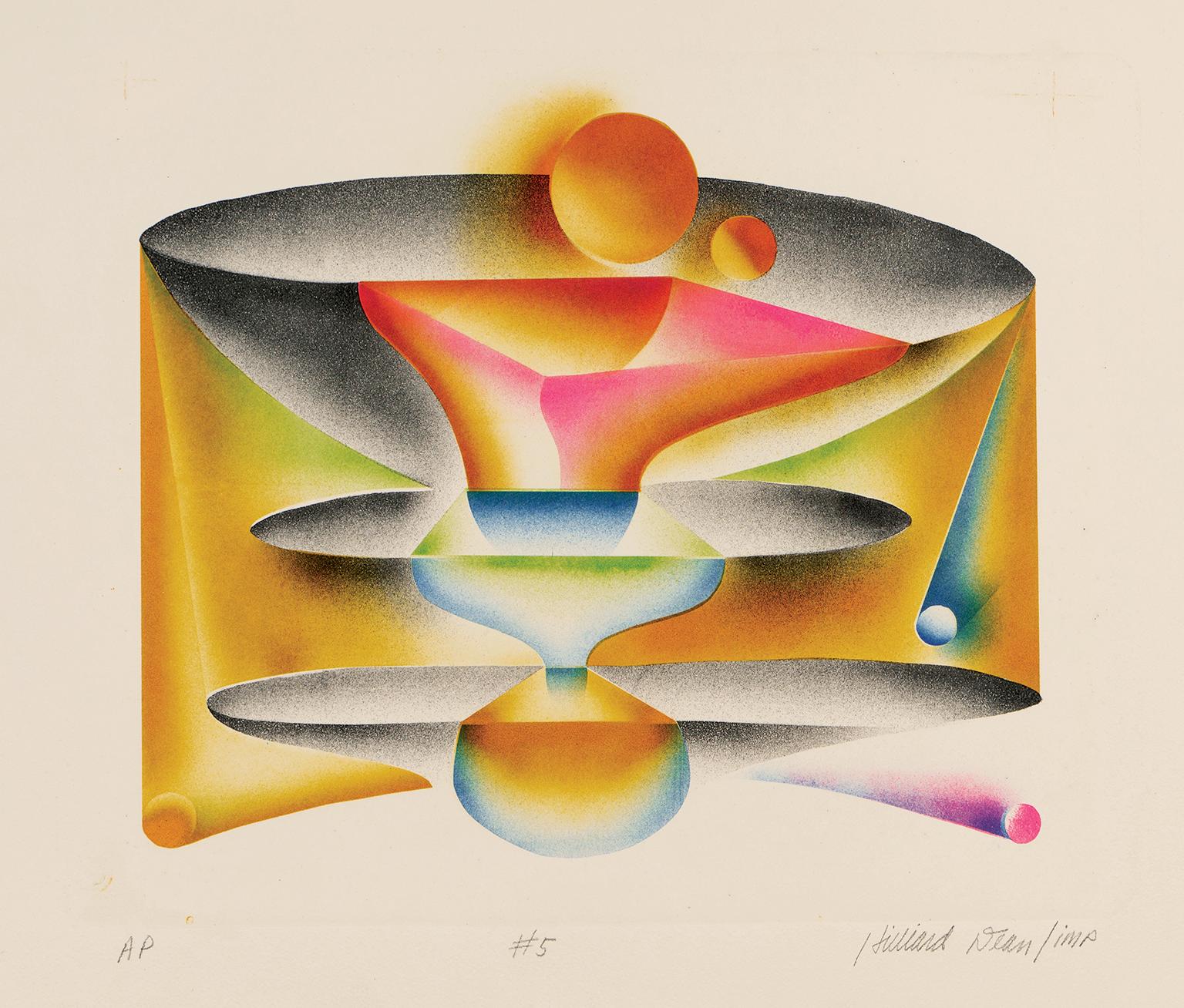
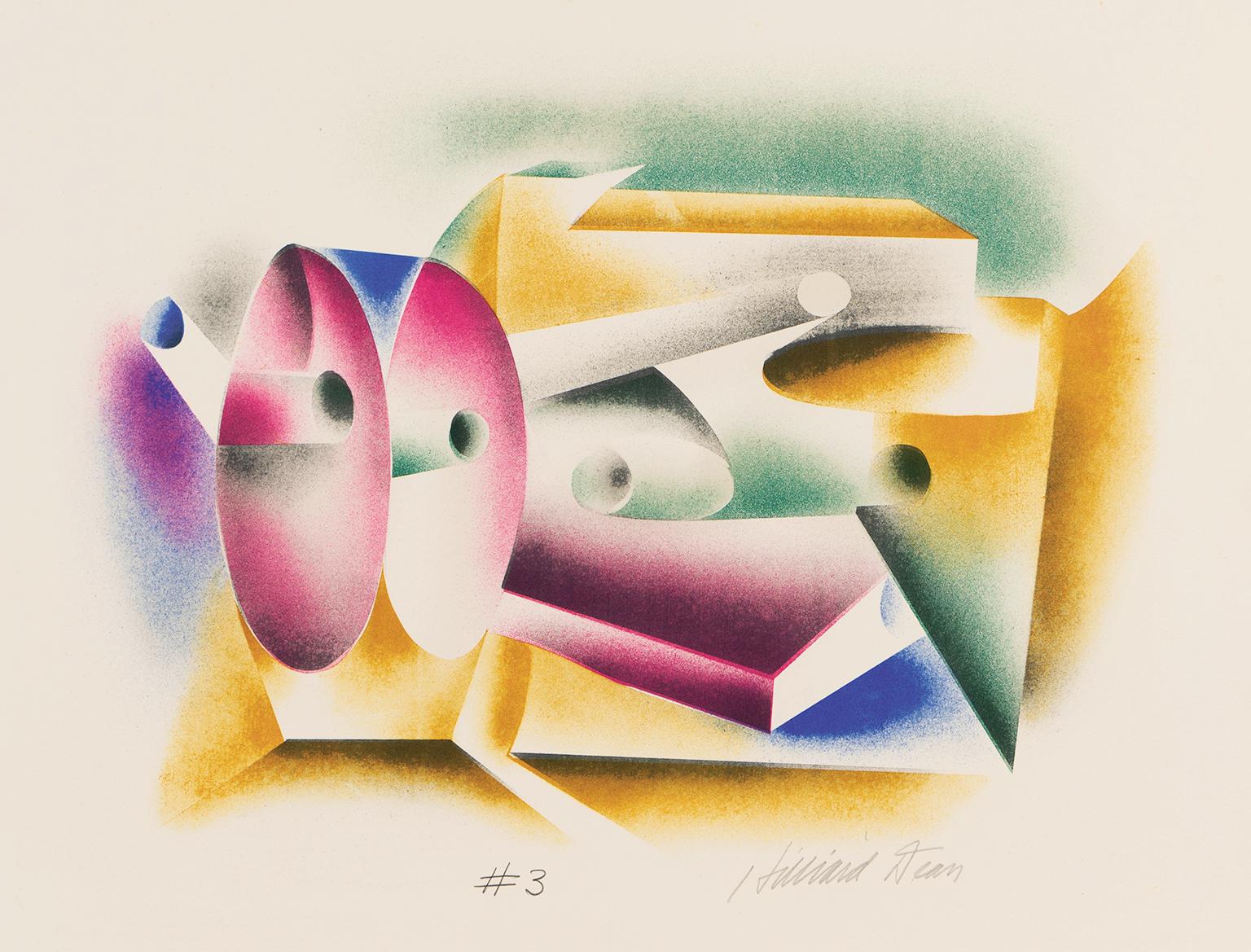
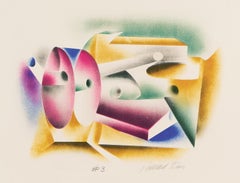
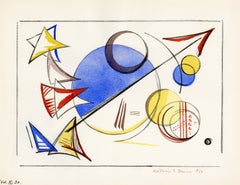
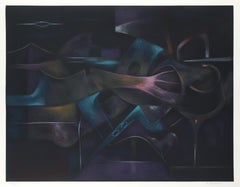
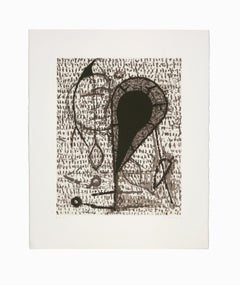
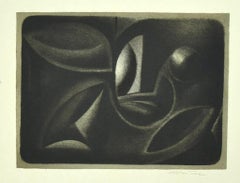
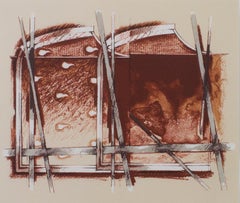
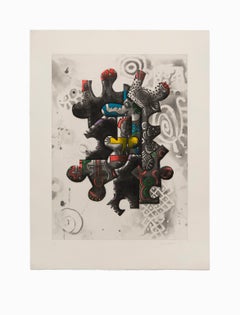
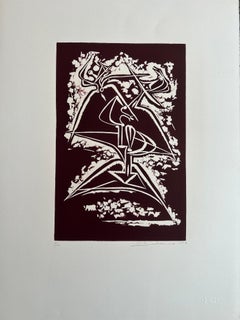
Hilliard Dean, '#6', color lithograph, 1970, edition 9. Signed, titled, and annotated 'Ed 9' in pencil. A fine impression, with fresh colors, on Arches, heavy, cream wove paper; the full sheet with margins (2 1/4 to 3 1/4 inches); reinforced crease and repaired tear (1/2 inch) in the top sheet edge; minor foxing in the outside bottom margin, all well away from the image, otherwise in very good condition. Printed by the artist. Archivally sleeved, unmatted.
Image size 14 1/4 x 17 1/2 inches (362 x 445 mm); sheet size 22 3/4 x 24 5/8 inches (578 x 625 mm).
ABOUT THE ARTIST
Hilliard Reynolds Dean (b. 1933) is an American painter and printmaker whose work encompasses both figurative and abstract imagery. Born in Washington, D.C., Dean was active in the Washington art community and is particularly notable for a small body of experimental color lithographs produced during the late 1960s and early 1970s. Although biographical information on the artist remains surprisingly limited, his inclusion in important surveys of African American art and the acquisition of his prints by the Smithsonian American Art Museum establish his place within the history of postwar American printmaking.
Dean's earliest documented prints at the Smithsonian date from 1968. Fisherman, a color lithograph of that year, remains representational, depicting a male figure, fishing boat, and waterscape. In the same year, however, Dean produced Untitled (#B), which the Smithsonian classifies as abstract; this was followed by Untitled (#C) in 1969. Dean himself gave these works to the museum in 1969, indicating that abstraction had already become an important direction in his printmaking by the end of the decade.
It is in the color lithographs of approximately 1969–70 that Dean's graphic work becomes especially distinctive. These compositions abandon conventional representation in favor of interlocking organic and geometric forms, irregular contours, concentrated areas of color, and complex spatial relationships. Shapes appear to overlap, penetrate, or emerge from one another, creating compositions that seem simultaneously constructed and in motion. The resulting imagery occupies an interesting position between geometric abstraction and the more biomorphic vocabulary that had developed within postwar American modernism.
Color is integral to these prints rather than simply descriptive. Dean juxtaposed saturated hues with darker linear and planar elements, allowing individual forms to advance or recede across the sheet. The compositions consequently possess considerable visual energy while retaining a carefully controlled internal structure. Their combination of hard-edged passages, curvilinear forms, gradated color, and ambiguous spatial layering places them firmly within the broader experimentation in abstraction characteristic of American art around 1970, while their particular visual vocabulary remains recognizably Dean's own.
The prints are also notable as works of printmaking. Dean printed the lithographs himself, generally on substantial sheets of Arches or Grumbacher wove paper. Surviving examples indicate exceptionally small editions: several are designated simply as artist's proofs or have no stated edition, while others were issued in editions of only seven or nine impressions. Individual impressions are sometimes dated precisely—including May 1970 and June 11, 1970—suggesting an intensive period of experimentation in which Dean developed related compositions in relatively quick succession.
These small editions help explain the relative scarcity of Dean's abstract lithographs today. They appear less as commercial multiples conceived for broad distribution than as an artist-printmaker's concentrated investigation of lithography as a uniquely expressive medium. The numbered titles—#1, #2, #3, and so forth—further emphasize their serial character and encourage the works to be understood as stages within an evolving formal exploration rather than as isolated images.
Dean's work received institutional recognition at an early date. The Smithsonian American Art Museum holds several of his lithographs, including Fisherman (1968), Untitled (#B) (1968), and Untitled (#C) (1969), all gifts of the artist. He is also documented in Theresa Dickason Cederholm's Afro-American Artists: A Bibliographical Directory (Boston Public Library, 1973) and Regenia A. Perry's Free Within Ourselves: African-American Artists in the Collection of the National Museum of American Art (1992).
Seen today, Dean's late-1960s and early-1970s abstractions constitute a particularly compelling aspect of his work. Their combination of ambitious color, compressed spatial relationships, biomorphic and geometric form, and unusually small artist-printed editions places them within the fertile period of experimental American printmaking that accompanied the expansion of abstraction during the postwar decades. Their scarcity, together with the limited published record of Dean's career, has left this body of work considerably less familiar than its visual sophistication merits.
Selected public collection: Smithsonian American Art Museum, Washington, D.C.