Want more images or videos?
Request additional images or videos from the seller
1 of 3

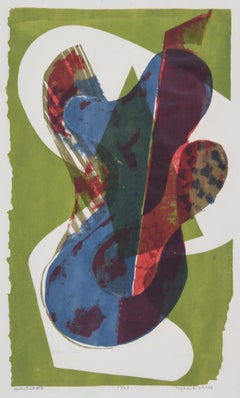
James Houston McConnell
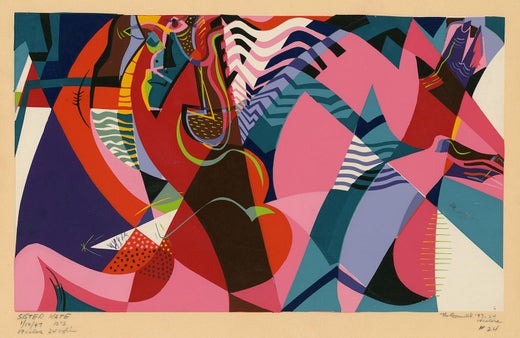
Sister Kate — Mid-century, Jazz-inspired Modernism

1947

$1,800
£1,345.49
€1,571.94
CA$2,532.13
A$2,562.71
CHF 1,469.39
MX$31,082.44
NOK 17,088.36
SEK 17,394.30
DKK 11,750.80

About the Item

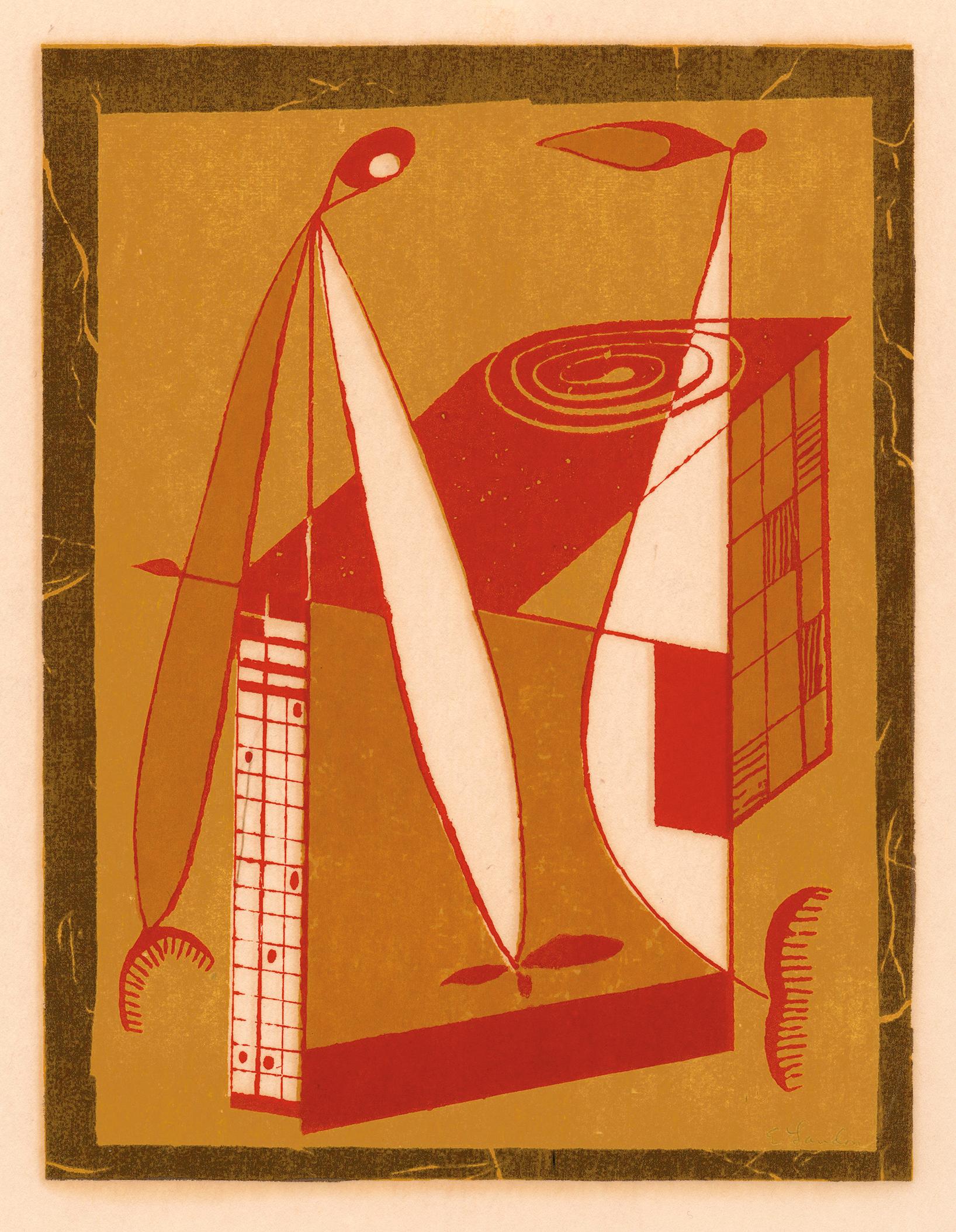
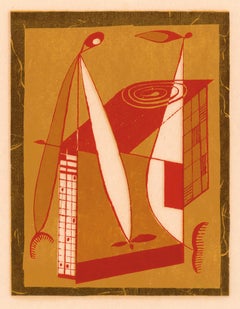
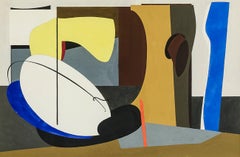
James Houston McConnell, 'Sister Kate', color serigraph, 1947, edition 24. Signed, dated, titled, and numbered '24' in pencil. Annotated '10.00 - 19 colors - 24 copies - #24' in pencil. A fine impression, with vibrant, fresh colors, on heavy tan wove paper, with full margins (11/16 to 1 1/2 inches). Tack holes in the four margin corners, well away from the image, otherwise in excellent condition. Matted to museum standards, unframed. Scarce. Image size 8 5/8 x 14 1/16 inches (219 x 357 mm); sheet size 11 1/16 x 15 1/2 inches (281 x 393 mm). Another of McConnell's mid-century modernist, jazz-inspired serigraphs, 'Combo', is featured in the British Museum's 2008 publication (and traveling exhibition) 'The American Scene: Prints from Hopper to Pollock'. ABOUT THE IMAGE "I Wish I Could Shimmy Like My Sister Kate", often simply "Sister Kate", is an up-tempo jazz dance song, written by Armand J. Piron and published in 1922. The lyrics of the song are narrated in the first person by Kate's sister, who sings about Kate's impressive dancing skill and her wish to be able to emulate it. She laments that she's not quite "up to date", but believes that dancing like "Sister Kate" will rectify this, and she will be able to impress "all the boys in the neighborhood" like her sister. Over the years this song has been performed and recorded by many artists, including Frances Faye and Rusty Warren, a 1959 version by Shel Silverstein, The Olympics in 1960 (released as "Shimmy Like Kate"), the Red Onion Band, and a beat version by The Remo Four in 1964. It was performed live by The Beatles in 1962, and a recording of one such performance appears on 'Live! At the Star-Club in Hamburg, Germany; 1962'. The song arrived in the 1960s and 1970s folk scene thanks to Dave Van Ronk (recording it twice on In the Tradition and on Dave Van Ronk and the Ragtime Jug Stompers) and Jim Kweskin, who made it part of a "Sister Kate's Night Out" medley on his Relax Your Mind album[3] with Mel Lyman and Fritz Richmond. In 1967, the Nitty Gritty Dirt Band included it in their eponymous The Nitty Gritty Dirt Band (album). David Bowie used to team this song with an updated version of the Flares 1960 doo-wop song "Foot Stompin'" during the (1974) Diamond Dogs tour, as heard on the compilation Rarest One Bowie. Guitarist Carlos Alomar blessed the update with a riff that became Bowie's hit "Fame", co-written with John Lennon. Judith Durham recorded a version for her album, Judith Durham and The Hottest Band in Town (1974). ABOUT THE ARTIST Painter and printmaker James Houston McConnell (1914-200) was born in Chicago. He studied at Denison University, the State University of Iowa, and with Grant Wood, Jean Charlot, Fletcher Martin, and Emil Ganso. He taught at Michigan State College and was a member of both the National Serigraphy Society and the American Color Print Society. McConnell’s work was shown in numerous mid-century museum exhibitions including the Whitney Museum of American Art, 1941; Kansas City Art Institute, 1941-42; American Color Print Society, 1942 (prize); Northwest Print Museum, 1942-46; City Art Museum of St. Louis, 1942 (prize); Springfield (Mo.) Museum of Art, 1942 (prize); Zanesville, Ohio, 1945 (prize); Union Seaman’s Service Traveling Exhibition, 1943-33; National Academy of Design, 1946; United States Library of Congress, 1946; and Laguna Beach Art Association, 1946. McConnell’s work is held in the permanent collections of the Brooklyn Museum, The British Museum, Denison University, State University of Iowa, and the City Art Museum of St. Louis.
  • Creator:
  • Creation Year:
    1947
  • Dimensions:
    Height: 8.63 in (21.93 cm)Width: 14.07 in (35.74 cm)
  • Medium:
  • Movement & Style:
  • Period:
  • Condition:
  • Gallery Location:
    Myrtle Beach, SC
  • Reference Number:
    Seller: 1001491stDibs: LU53234490801

More From This Seller

View All
'Equus Uirumpu' — Mid-century American Modernism

'Equus Uirumpu' — Mid-century American Modernism

By James Houston McConnell

Located in Myrtle Beach, SC

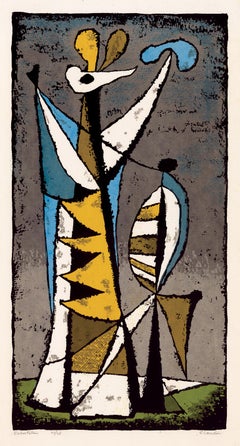
James Houston McConnell, 'Equus Uirumpu' (The Man's Horse), color serigraph, c. 1945, edition not stated but small. Signed and titled in pencil. Initialed in the image, lower right. ...

Category

1940s American Modern Abstract Prints

Materials

Screen

'Kaf With'  — Mid-century American Surrealism

'Kaf With' — Mid-century American Surrealism

By Robert Vale Faro

Located in Myrtle Beach, SC

Robert Vale Faro, 'Kaf With', color lithograph, 1945, edition 15. Signed, dated, titled and numbered '84' and '6/15' in pen, recto. Titled, numbered '#84' and '6/15' and dated '7/22/...

Category

1940s American Modern Abstract Prints

Materials

Lithograph

'Chinoiserie' — Mid-Century Modernism

'Chinoiserie' — Mid-Century Modernism

By Edward August Landon

Located in Myrtle Beach, SC

Edward Landon 'Chinoiserie', color serigraph, 1947, edition 50, Ryan 36. Signed in pencil in the image, lower right. Titled, dated, and annotated '4 COLORS – EDITION 50' in the scree...

Category

Mid-20th Century American Modern Abstract Prints

Materials

Screen

'Exhortation' (Priest) — Mid-Century Modernism

'Exhortation' (Priest) — Mid-Century Modernism

By Edward August Landon

Located in Myrtle Beach, SC

Edward Landon 'Exhortation (Priest)', color serigraph, 1957, edition 28, Ryan 72. Signed, titled, and numbered '21/28' in pencil. A superb, richly-inked impression, with strong color...

Category

Mid-20th Century American Modern Abstract Prints

Materials

Screen

Variation 4, Vol. I

Variation 4, Vol. I

By Katherine Sophie Dreier

Located in Myrtle Beach, SC

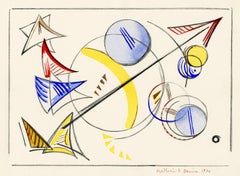
Katherine S. Dreier, 'Variation 4, Vol. I' from '1 to 40 Variations', lithograph with pochoir and hand-coloring, 1934, edition 65. Stenciled signature and date, lower right. Annotate...

Category

Mid-20th Century American Modern Abstract Prints

Materials

Watercolor, Lithograph, Stencil

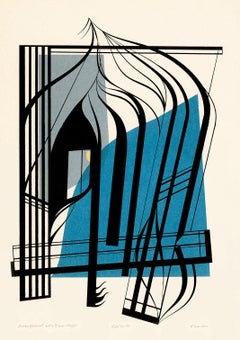
'Arrangement with Blue Major' — Musically Inspired Modernist Abstraction

'Arrangement with Blue Major' — Musically Inspired Modernist Abstraction

By Edward August Landon

Located in Myrtle Beach, SC

Edward Landon, 'Arrangement with Blue Major', color serigraph, edition 40, 1942, Ryan 9. Signed, titled, and annotated 'Edition 40' in pencil. A superb impression, with fresh colors, on cream, wove paper; the full sheet with margins (3/4 to 1 5/8 inches), in excellent condition. Image size 15 x 9 3/4 inches (381 x 248 mm); sheet size 17 15/16 x 11 3/4 inches (456 x 298 mm). Matted to museum standards, unframed. 'Arrangement with Blue Major' was selected for the landmark ‘Artists for Victory’ exhibition at the Metropolitan Museum of Art in 1942. Impressions of this work are also in the collections of the Asheville Art Museum, Five Colleges and Historic Deerfield Museum Consortium, Georgetown University (Special Collections), Mount Holyoke College Art Museum, Rutgers University, Smith College Museum of Art, and the Springfield Museum of Fine Arts. ABOUT THE ARTIST Born in Hartford, Connecticut, Edward Landon dropped out of high school to study art at the Hartford Art School. In 1930 and 1931, he was a student of Jean Charlot at the Art Students League in New York, after which he traveled to Mexico to study privately for a year with Carlos Merida. In 1933 he settled near Springfield, Massachusetts, painted murals in the local trade school, and exhibited with the Springfield Art League. His painting 'Memorial Day' won first prize at the fifteenth annual exhibition of the League at the Springfield Museum of Fine Arts. Landon became an active member of the Artists Union of Western Massachusetts, serving as president from 1934-1938. Landon acquired Anthony Velonis’s instructional pamphlet on the technique of serigraphy in the late 1930s. With colleagues Phillip Hicken, Donald Reichert, and Pauline Stiriss, he began experimenting with screen printing techniques. The artists' groundbreaking work in screen printing as a fine art medium was the subject of the group’s landmark exhibition at the Springfield Museum of Fine Arts in 1940. Landon became one of the founding members of the National Serigraph Society and served as editor of its publication, 'Serigraph Quarterly,' in the late 1940s and as its president in 1952 and 1953. The Norlyst Gallery in Manhattan held a one-person show of his prints in 1945. Awarded a Fulbright Fellowship in 1950, Landon traveled to Norway, where he researched the history of local artistic traditions and produced the book 'Scandinavian Design: Picture and Rune Stones...

Category

Mid-20th Century Abstract Abstract Prints

Materials

Screen

You May Also Like

Abstract Composition by Zoute (Leon Salter) Mid Century

Abstract Composition by Zoute (Leon Salter) Mid Century

Located in Rochester, NY

Abstract Modernist oil painting by Zoute. Oil on canvas mounted on board. Painted in circa 1940's. Zoute (Born-Leon Salter, 1903-1976) was self-taught and well exhibited during his l...

Category

Mid-20th Century Abstract Abstract Paintings

Materials

Canvas, Oil

Untitled

Untitled

By Charles Houghton Howard

Located in New York, NY

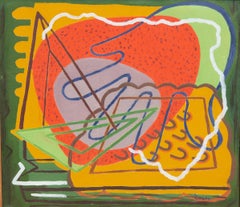
Charles Houghton Howard was born in Montclair, New Jersey, the third of five children in a cultured and educated family with roots going back to the Massachusetts Bay colony. His father, John Galen Howard, was an architect who had trained at M.I.T. and the École des Beaux-Arts in Paris and apprenticed in Boston with Henry Hobson Richardson. In New York, the elder Howard worked for McKim, Mead and White before establishing a successful private practice. Mary Robertson Bradbury Howard, Charles’s mother, had studied art before her marriage. John Galen Howard moved his household to California in 1902 to assume the position of supervising architect of the new University of California campus at Berkeley and to serve as Professor of Architecture and the first Dean of the School of Architecture (established in 1903). The four Howard boys grew up to be artists and all married artists, leaving a combined family legacy of art making in the San Francisco Bay area that endures to this day, most notably in design, murals, and reliefs at the Coit Tower and in buildings on the Berkeley campus. Charles Howard graduated from the University of California at Berkeley in 1921 as a journalism major and pursued graduate studies in English at Harvard and Columbia Universities before embarking on a two-year trip to Europe. Howard went to Europe as a would-be writer. But a near-religious experience, seeing a picture by Giorgione in a remote town outside of Venice, proved a life-altering epiphany. In his own words, “I cut the tour at once and hurried immediately back to Paris, to begin painting. I have been painting whenever I could ever since” (Charles Howard, “What Concerns Me,” Magazine of Art 39 [February 1946], p. 63). Giorgione’s achievement, in utilizing a structured and rational visual language of art to convey high emotion on canvas, instantly convinced Howard that painting, and not literature, offered the best vehicle to express what he wanted to say. Howard returned to the United States in 1925, confirmed in his intent to become an artist. Howard settled in New York and supported himself as a painter in the decorating workshop of Louis Bouché and Rudolph Guertler, where he specialized in mural painting. Devoting spare time to his own work, he lived in Greenwich Village and immersed himself in the downtown avant-garde cultural milieu. The late 1920s and early 1930s were the years of Howard’s art apprenticeship. He never pursued formal art instruction, but his keen eye, depth of feeling, and intense commitment to the process of art making, allowed him to assimilate elements of painting intuitively from the wide variety of art that interested him. He found inspiration in the modernist movements of the day, both for their adherence to abstract formal qualities and for the cosmopolitan, international nature of the movements themselves. Influenced deeply by Surrealism, Howard was part of a group of American and European Surrealists clustered around Julien Levy. Levy opened his eponymously-named gallery in 1931, and rose to fame in January 1932, when he organized and hosted Surrealisme, the first ever exhibition of Surrealism in America, which included one work by Howard. Levy remained the preeminent force in advocating for Surrealism in America until he closed his gallery in 1949. Howard’s association with Levy in the early 1930s confirms the artist’s place among the avant-garde community in New York at that time. In 1933, Howard left New York for London. It is likely that among the factors that led to the move were Howard’s desire to be a part of an international art community, as well as his marriage to English artist, Madge Knight...

Category

20th Century American Modern Abstract Drawings and Watercolors

Materials

Paper, Gouache, Graphite
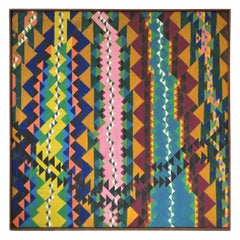
Abstract Artwork Painting

Abstract Artwork Painting

Located in New York, NY

A beautiful, relatively large, colorful abstract artwork painting, oil or acrylic, on a hand-stretched canvas finished with a modern or mini...

Category

Mid-20th Century American Mid-Century Modern Paintings

Materials

Canvas, Wood, Paint