Mary Heilmann (American, b. 1940)
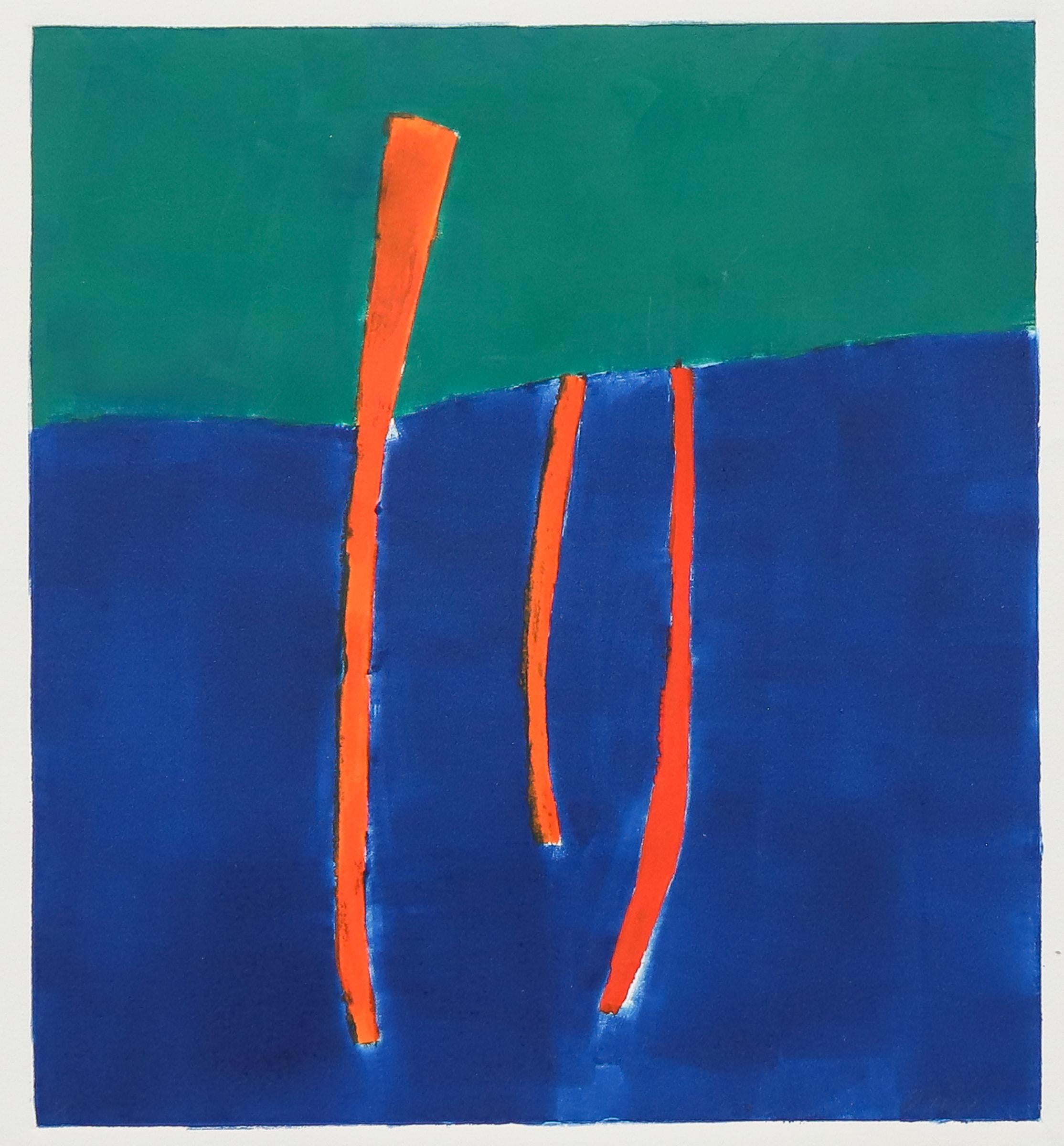
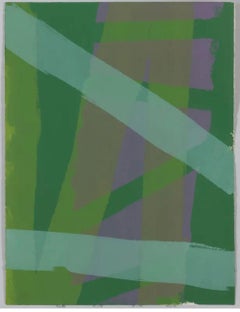
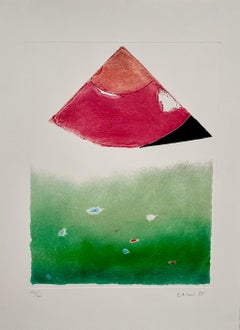
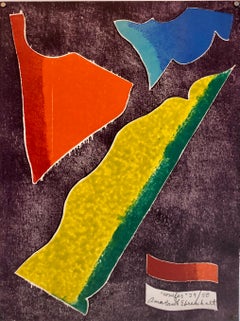
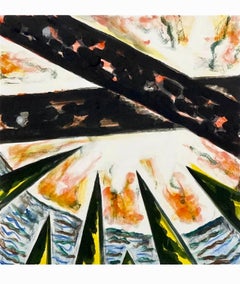
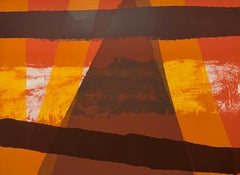
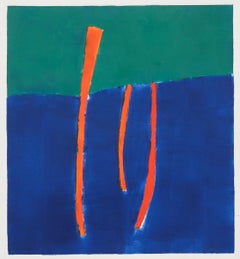
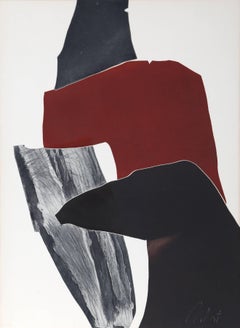
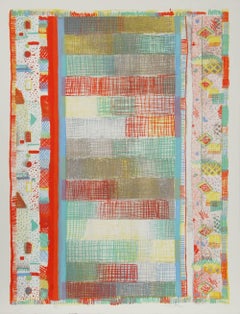
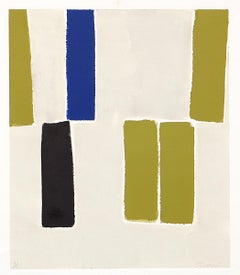
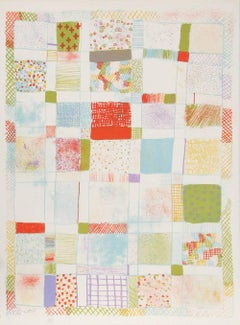
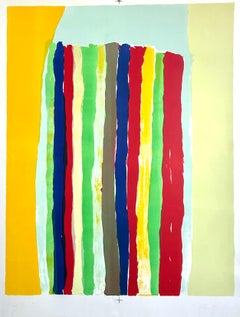
Abstract color aquatint etching
Jazz
2002
Hand signed, dated, and numbered 11/25 in pencil, lower margin.
Publisher: Pace Editions
Horizontal green, red, and blue bars overlap to create a variety of tones. Dimensions: Sheet: 39 in. H x 30 in. W. Framed: 42 1/2 in. H x 33 1/2 in. W.
Mary Heilmann is an American painter based in Manhattan and Bridgehampton in Long Island, New York. She has had solo shows and traveling exhibitions at galleries including Pace Gallery, 303 Gallery (Manhattan) and Hauser & Wirth in Zurich, Switzerland and at the Wexner Center for the Arts in Columbus, Ohio and the New Museum on the Lower East Side in Manhattan. She has been cited by many younger artists, particularly women, as being an influential figure.
Heilmann was born in San Francisco in 1940. In 1947 her family moved to Los Angeles. While in Los Angeles she joined her local diving and swimming team, an activity that she devoted herself to until 1953 when her father died of cancer and the family returned to San Francisco.
In 1959 Heilmann enrolled at the University of California, Santa Barbara. She recalled that it was “the beach, the surf, the surfers, the great shack beach houses” which drew her there, an extension of the life she had made for herself in her late teens at San Francisco's North Beach. After graduating with a bachelor's degree in literature and minoring in art, in 1962, she attended San Francisco State College (now San Francisco State University) in 1963, in the hopes of earning a teaching credential.
While at SFSC she met Ron Nagle, an artist, and began studying ceramics in earnest, having dabbled in the medium while at UCSB. In 1965 she began studying in the master's program in ceramics and sculpture at the University of California, Berkeley, drawn as so many were to the modernist ceramicist Peter Voulkos. While there Heilmann studied not only with Voulkos, but with the sculptor and ceramicist Jim Melchert, and Karl Kasten, a painter and printmaker. During her time at Berkeley Heilmann became friends with the artist Bruce Nauman, who was a student at the University of California, Davis. Naumann introduced Heilmann to his teacher, William T. Wiley, an artist who taught her for a short time.
Heilmann moved to New York City after graduating from Berkeley in 1968. She felt that both her interests and the work she was making (see Ooze, 1967) would find kinship with shows including Dick Bellamy's Hans jean Arp to Richard Artschwager Show at Noah Goldowsky Gallery; Lucy Lippard Eccentric Abstraction at Fischbach Gallery; and the Primary Structures Show at the Jewish Museum. But fellowship was not to be. Heilmann was excluded from a number of shows from the era, with 1969’s Anti-Illusion at the Whitney Museum of American Art being particularly crushing. That rejection led Heilmann away from working in sculpture (see The Big Dipper, 1969) and towards painting. She chose not to embrace the Color Field painting of the moment, and instead produced what she has called a “materials-based sort of conceptual, anti-aesthetic, earth-colored, ironic painting that was often hard to look at.” Her move into painting had her further experimenting with new spontaneous and casual styles, techniques and mediums, bright colors, drips, flatness, and unusual biomorphic geometries. The early paintings were, in her view, devoid of emotional content, possessed of a non-inflected, pure color. For Heilmann the goal was a painting which eschewed craft and seduction, and was instead “tough” and “plain.”
Heilmann places her work in the tradition of geometric painting—though she has also said that “abstraction” is a perfectly suitable term as well—and sees herself in conversation with Kazimir Malevich, Piet Mondrian, Josef Albers, and Ellsworth Kelly. (Keywords: Minimalist, Minimalism, Postmodernism Post Modernism. One of Heilmann's earliest successes as a young painter was her 1972 inclusion in the Annual Exhibition at the Whitney Museum of American Art, where she exhibited a red monochrome piece entitled The Closet, also known as Ties in My Closet. Heilmann’s work was included in the 1971 exhibition Twenty Six Contemporary Women Artists held at The Aldrich Contemporary Art Museum (artists included Alice Aycock, Sue Ann Childress, Susan Hall, Mary Heilmann, Sylvia Mangold, Louise Parks,
Shirley Pettibone, Adrian Piper and Barbara Zucker) and the 2022 exhibition 52 Artists: A Feminist Milestone also at the Aldrich. From 1976 until 1981 she was a regular in exhibitions at New York's influential Holly Solomon Gallery, with two solo shows there during that time (1976's The Vent Series and 1978's New Paintings).In 1977 Heilmann moved to the neighborhood that is now known as TriBeCa having previously lived in SoHo and Chinatown. But her time there was short, as Gordon Matta-Clark died in August 1978, this was a turning-point moment for Heilmann. The “family” that she had formed in New York City—including Matta-Clark, Norman Fisher (who died in 1977), Keith Sonnier, Liza Bear, Jackie Winsor, and Suzie Harris, among others—dispersed after Matta-Clark's death. Heilmann returned to San Francisco. While there she painted The End, an homage to her friendship with Matta-Clark and Fisher and a requiem for the life she once had in Manhattan. Heilmann returned to New York in 1979. She met the gallerist Pat Hearn in 1986. Hearn represented her by and gave her a show at the gallery later in 1986.
Heilmann “abandoned” her picture of herself as an outsider entering the 1990s, moving up the art world ranks with Pierson, Ross Bleckner and David Reed. Younger artists like Jessica Stockholder and Lari Pittman looked up to Heilmann. No longer longing to be “alienated,” she embraced that she had become part of the establishment, what she saw as a sort of return to her roots. She called it a place of the “Catholic middle class of schoolteachers, engineers, cops, and nurses.” Since the 1990s Heilmann's influence among a younger generation of painters has grown. The curator Elizabeth Armstrong observed that Heilmann has “played a significant role in the revival of painting, especially on the West Coast, where former students such Ingrid Calame, Laura Owens, and Monique Prieto were helping to reinvigorate painting for a new generation.” In 1995 Heilmann moved her studio from a TriBeCa loft to a farm in the town of Bridgehampton on Long Island. With the purchase of the house and the subsequent shift away from the city, Heilmann's work returned to its earlier emphasis on the importance water and the ocean, as was evident not only in the titles she chose for her paintings, but in her palette and use of wave imagery.
Since the early 2000s, there has been an increased interest in Heilmann's work with solo shows at Whitechapel Gallery in London, 303 Gallery in Manhattan, and Hauser & Wirth in Zurich. She has received grants from the National Endowment for the Arts, the Guggenheim Foundation, and an Anonymous Was a Woman award in 2006. Perhaps most importantly, Heilmann was welcomed into the art historical canon with her 2007-2008 retrospective, To Be Someone. The show began at the Orange County Museum of Art in Newport Beach, CA and travelled to the Contemporary Arts Museum Houston, the Wexner Center for the Arts in Columbus, Ohio with its final stop at the New Museum in Manhattan. Writing in the New York Times the art critic Ken Johnson concluded that: “A part of Ms. Heilmann rebels against the elevation of fine art over the applied arts and resists the separation of art and life. The furniture and dishes reveal an expansive impulse to produce a holistic world…she continues to funnel her most ambitious energies into the concentrative art of painting and in doing so she achieves states of grace that are harder won than they look.”
During the 2000s, Heilmann returned to a connection she had with ceramic sculpture, producing cups, plates, and saucers with the artist Steve Keister, reincorporating the vessels into her art. Beginning in 2002 Heilmann expanded her interests and began making furniture, specifically the creation of simple yet vibrantly colorful chairs (plywood and nylon), what she calls “home arts.” Heilmann's furniture making follows in the tradition of artists like Donald Judd and Franz West, however in having the chairs speak with and relate to the paintings Heilmann engages with them not merely as objects to be sat in but rather works of art installed in conversation with the paintings themselves. She said, “I have designed the chairs to fit in sculpturally and pictorially with the look and feel of the rest of my work. Sometimes I even make a painting and a chair to work well together.”
In 2016 a retrospective of Heilmann's work was held at the Whitechapel Gallery in London.
Heilmann's work was included in the 2021 exhibition Women in Abstraction at the Centre Pompidou. (artists included luminaries such as
Magdalena Abakanowicz, Lygia Clark, Sonia Delaunay, Carmen Herrera,
Sophie Taeuber-Arp, Joan Mitchell, Helen Frankenthaler, Elaine de Kooning, Barbara Hepworth, Ruth Asawa, Sheila Hicks, Louise Bourgeois, Bridget Riley and Judy Chicago).
From April 2025 to April 2026, The Whitney Museum is holding a solo exhibition for Heilmann entitled Mary Heilmann: Long Line which is organized by Laura Phipps, Associate Curator. This exhibition includes a hand-painted enlargement of her painting Long Line, 2020, and a variety of her colorful chairs which are intended to relate to her painting.
Public Collections and Museums
AD&A Museum UC Santa Barbara, California
Art Institute of Chicago
Brooklyn Museum, New York
Cantor Arts Center at Stanford University, California
Cincinnati Art Museum, Ohio
Cleveland Museum of Art, Ohio
de Young Fine Arts Museums, San Francisco
Hammer Museum, Los Angeles
High Museum of Art, Atlanta
Musée de Grenoble (The Museum of Grenoble), France
Museum of Contemporary Art, Chicago
Museum of Modern Art, New York
Museum De Pont (De Pont Museum of Contemporary Art), Tilburg, Netherlands
National Academy of Design, New York
National Gallery of Art, Washington D.C.
Orange County Museum of Art, Newport Beach, California
Pennsylvania Academy of the Fine Arts, Philadelphia
Rose Art Museum, Waltham, Massachusetts
San Diego Museum of Art, California
Smithsonian American Art Museum, Washington D.C.
Städel Museum, Frankfurt, Germany
Whitney Museum of American Art, New York