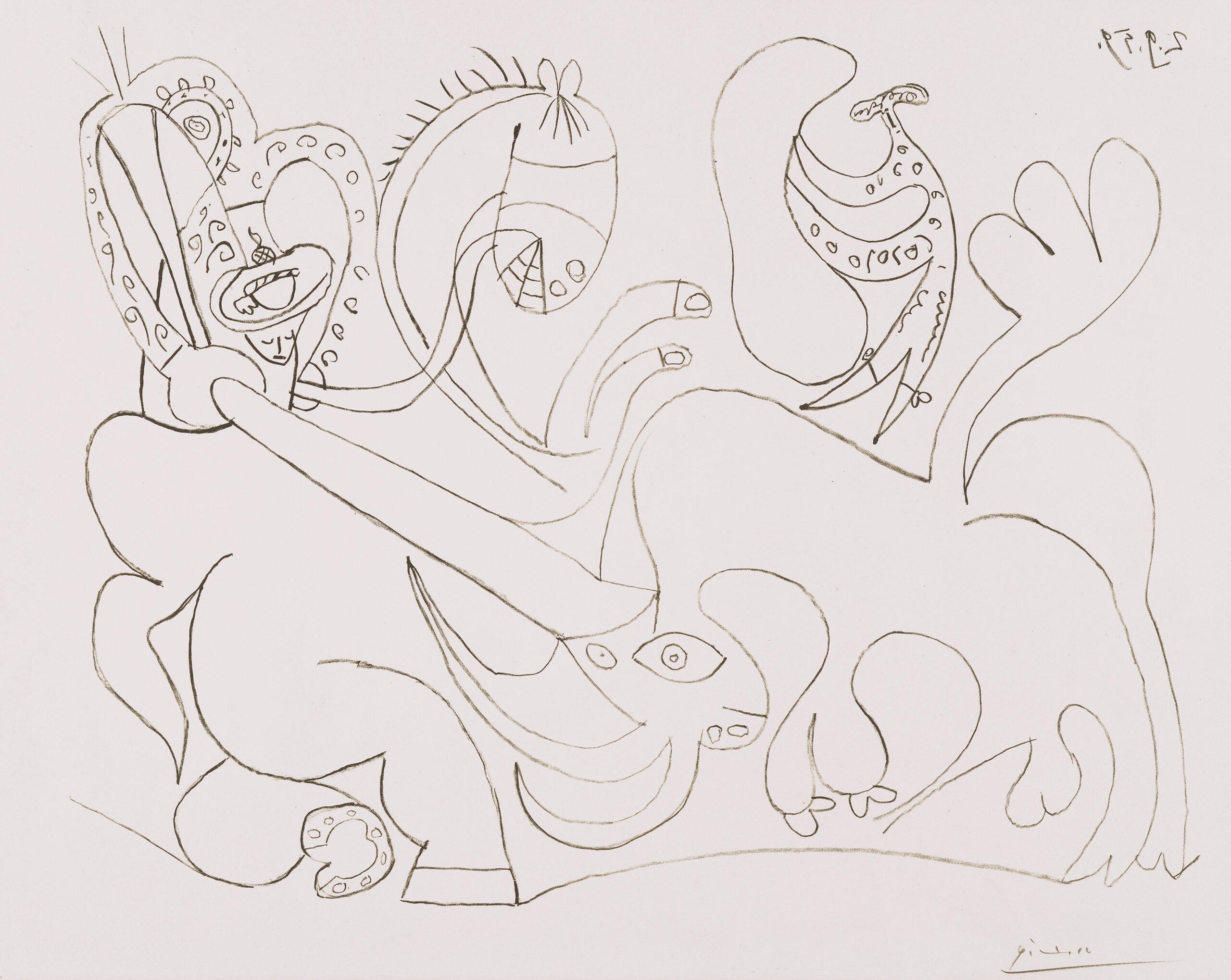
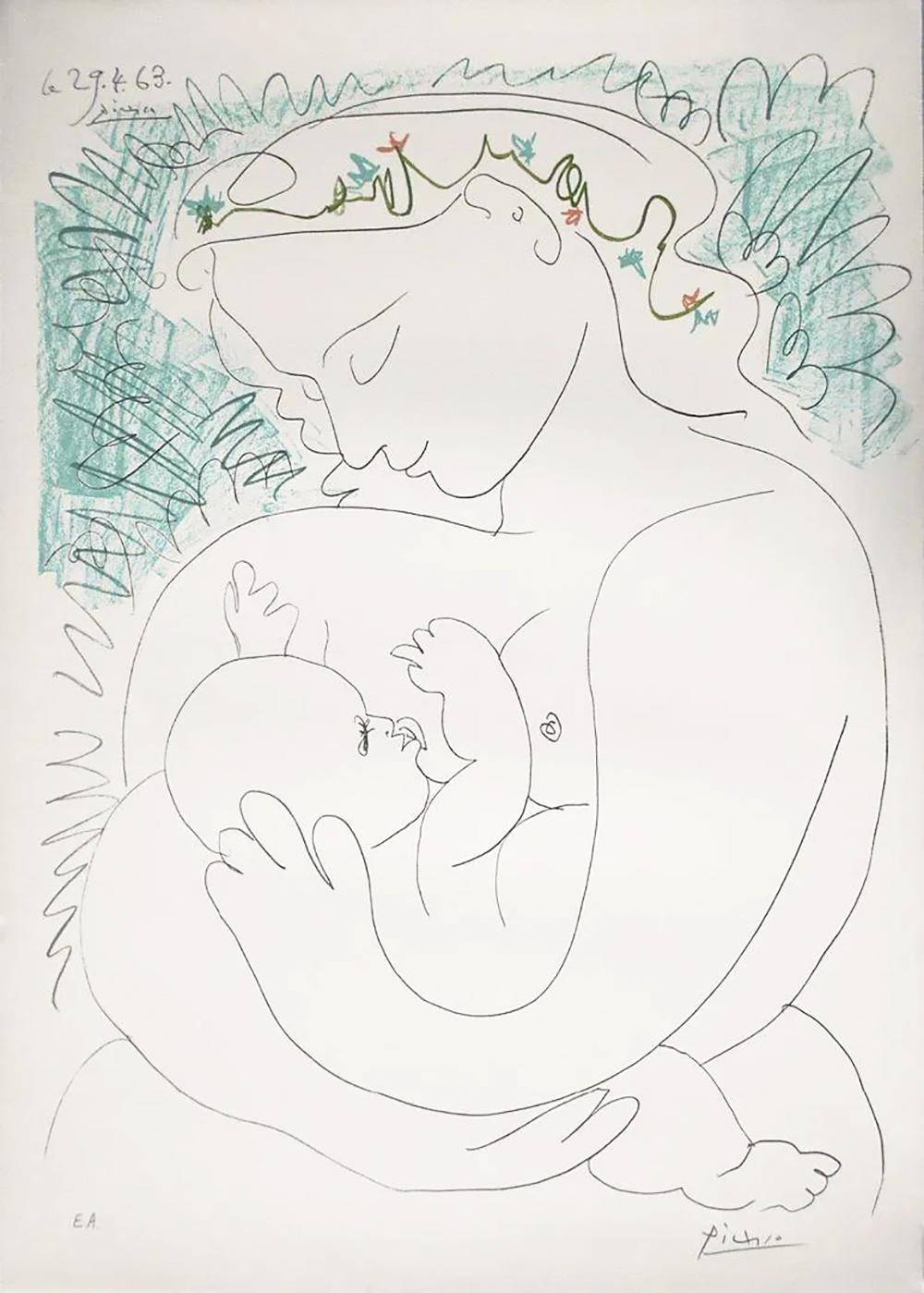
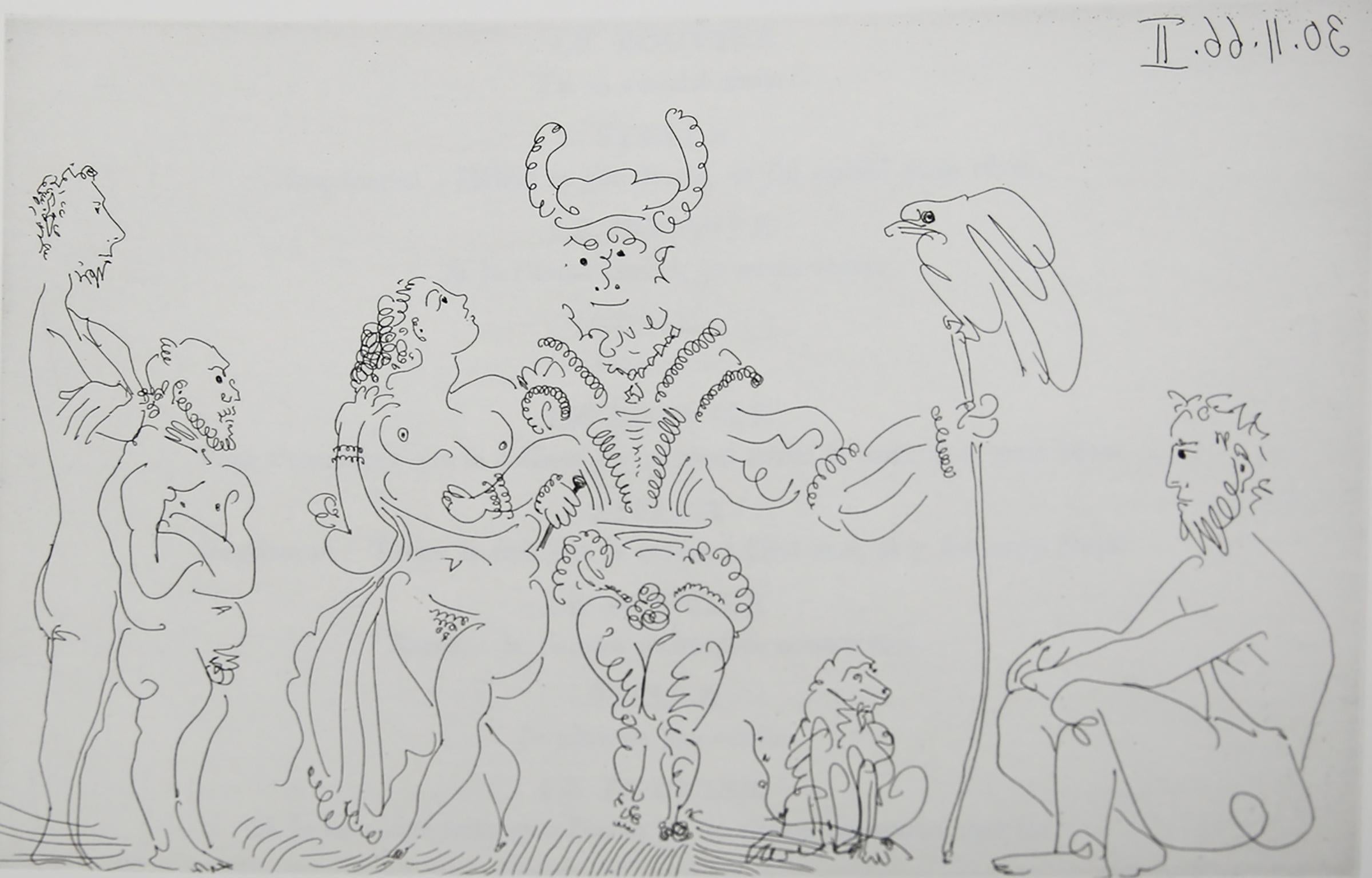
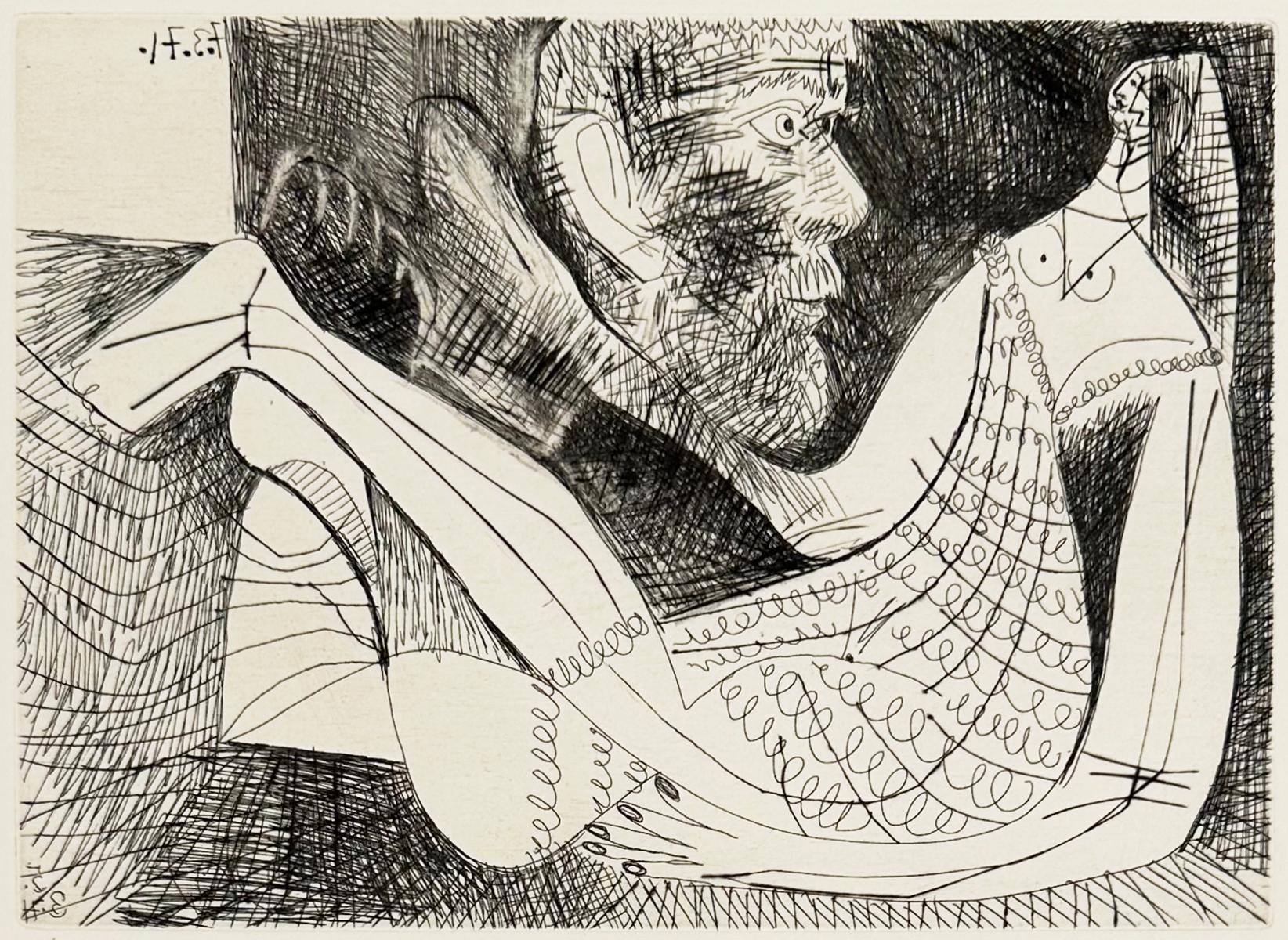
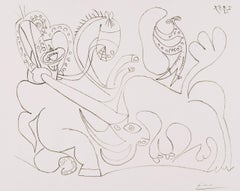
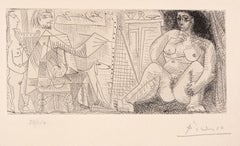
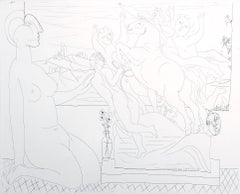
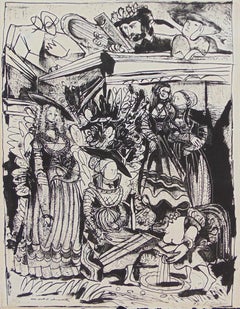
This exquisite engraving by Pablo Picasso (1881–1973), titled Naissance du Petit Centaure (Birth of the Little Centaur), from Dos Contes, El centaure, picador, El capvespre d'un faune (Two Tales, The Centaur, Picador, The Twilight of a Faun), originates from the 1947 edition published by Editorial Albor, Paris and Barcelona; printed by Atelier Lacouriere-Frelaut, Paris, Spring 1947. This compelling composition reflects Picasso’s mastery of intaglio technique, where incisive line, dramatic contrast, and expressive distortion converge to translate mythological subject matter into a powerful and poetic graphic language.
Executed as an engraving on velin du Lana Papiers Speciaux pur fil paper, this work measures 12.937 x 10 inches (32.86 x 25.4 cm). Unsigned and unnumbered as issued. The impression exemplifies the technical excellence and material sensitivity characteristic of Atelier Lacouriere-Frelaut’s celebrated editions.
Artwork Details:
Artist: Pablo Picasso (1881–1973)
Title: Naissance du Petit Centaure (Birth of the Little Centaur), from Dos Contes, El centaure, picador, El capvespre d'un faune (Two Tales, The Centaur, Picador, The Twilight of a Faun)
Medium: Engraving on velin du Lana Papiers Speciaux pur fil paper
Dimensions: 12.937 x 10 inches (32.86 x 25.4 cm)
Inscription: Unsigned and unnumbered as issued
Date: 1947
Publisher: Editorial Albor, Paris and Barcelona
Printer: Atelier Lacouriere-Frelaut, Paris
Catalogue raisonne references: Bloch, Georges. Pablo Picasso: Catalogue of the Printed Graphic Work 1904–1967. Kornfeld & Klipstein, 1968, illustration 468-471; Cramer, Patrick. Pablo Picasso, The Illustrated Books: Catalogue Raisonne. Patrick Cramer, 1983, illustration 44.
Condition: Well preserved, consistent with age and medium
Provenance: From the folio Dos Contes, El centaure, picador, El capvespre d'un faune (Two Tales, The Centaur, Picador, The Twilight of a Faun), 1947
Notes:
Excerpted from the folio (translated from French), Of this work illustrated and decorated by Pablo Picasso, there have been printed CCL examples, of which XX with a suite, numbered I to XX, and the remaining CCXXX examples numbered XXI to CCL, in addition to the collaborators’ examples. Printing was completed in Paris in the spring of 1947, under the direction of Henri Jonquieres. Typography by Coulouma, Hourdebaigt and Crampe, phototypists, carried out the setting of the titles, subtitles, and initials drawn by Pablo Picasso, and Lacouriere, engraver, printed the edition of the five plates.
About the Publication:
Dos Contes, El centaure, picador, El capvespre d'un faune (Two Tales, The Centaur, Picador, The Twilight of a Faun), published in 1947 by Editorial Albor in Paris and Barcelona, stands as an important early postwar illustrated edition that reflects Pablo Picasso’s deep engagement with classical mythology and literary narrative. Conceived within the rich European tradition of artist illustrated publications, the edition brings together poetic texts with a suite of original engravings executed by Picasso, demonstrating his continued exploration of mythological subjects such as fauns, centaurs, and bullfighting imagery. Printed by the distinguished Atelier Lacouriere-Frelaut in Paris, under the direction of master printers closely associated with Picasso’s graphic production, the publication achieves an exceptional level of technical refinement and clarity of line. The typography, executed by Coulouma, Hourdebaigt and Crampe, integrates seamlessly with Picasso’s imagery, incorporating decorative initials and compositional elements drawn by the artist himself. Issued in a carefully structured edition that included examples with additional suites, the publication reflects the collaborative nature of mid twentieth century Parisian printmaking, uniting artist, printer, typographer, and publisher in a cohesive artistic vision. Today, Dos Contes remains a significant example of Picasso’s contributions to the livre d’artiste tradition, embodying both his technical mastery of engraving and his enduring fascination with the interplay between text and image.
About the Artist:
Pablo Picasso (1881–1973) was a Spanish painter, sculptor, printmaker, and ceramicist whose extraordinary vision revolutionized modern art and defined the visual language of the 20th century. A child prodigy from Malaga, Spain, Picasso’s career spanned more than seven decades and encompassed an astonishing range of styles and innovations—from the melancholic Blue and romantic Rose periods to his pioneering invention of Cubism with Georges Braque, which shattered conventional notions of perspective and form. Influenced by the bold expressiveness of El Greco, the structure of Cezanne, and the vitality of African and Iberian sculpture, Picasso became a central figure of the Paris avant-garde, working in creative dialogue with contemporaries such as Henri Matisse, Alexander Calder, Alberto Giacometti, Salvador Dali, Joan Miro, Wassily Kandinsky, Marcel Duchamp, and Man Ray. His insatiable experimentation extended across painting, drawing, printmaking, ceramics, and sculpture, forever expanding the boundaries of artistic expression. A master of reinvention, Picasso profoundly shaped generations of artists who followed—from Andy Warhol, Roy Lichtenstein, David Hockney, and Jean-Michel Basquiat to Jeff Koons and Banksy—cementing his status as a timeless cultural icon whose works remain among the most sought after worldwide. His landmark painting Les Femmes d'Alger (Version "O") achieved a record-breaking sale of $179,365,000 at Christie's, New York, on May 11, 2015, affirming Picasso's enduring legacy as one of the most influential and valuable artists in history.
Pablo Picasso Naissance du Petit Centaure Birth of the Little Centaur 1947 engraving Lacouriere Frelaut Lana modern master print.