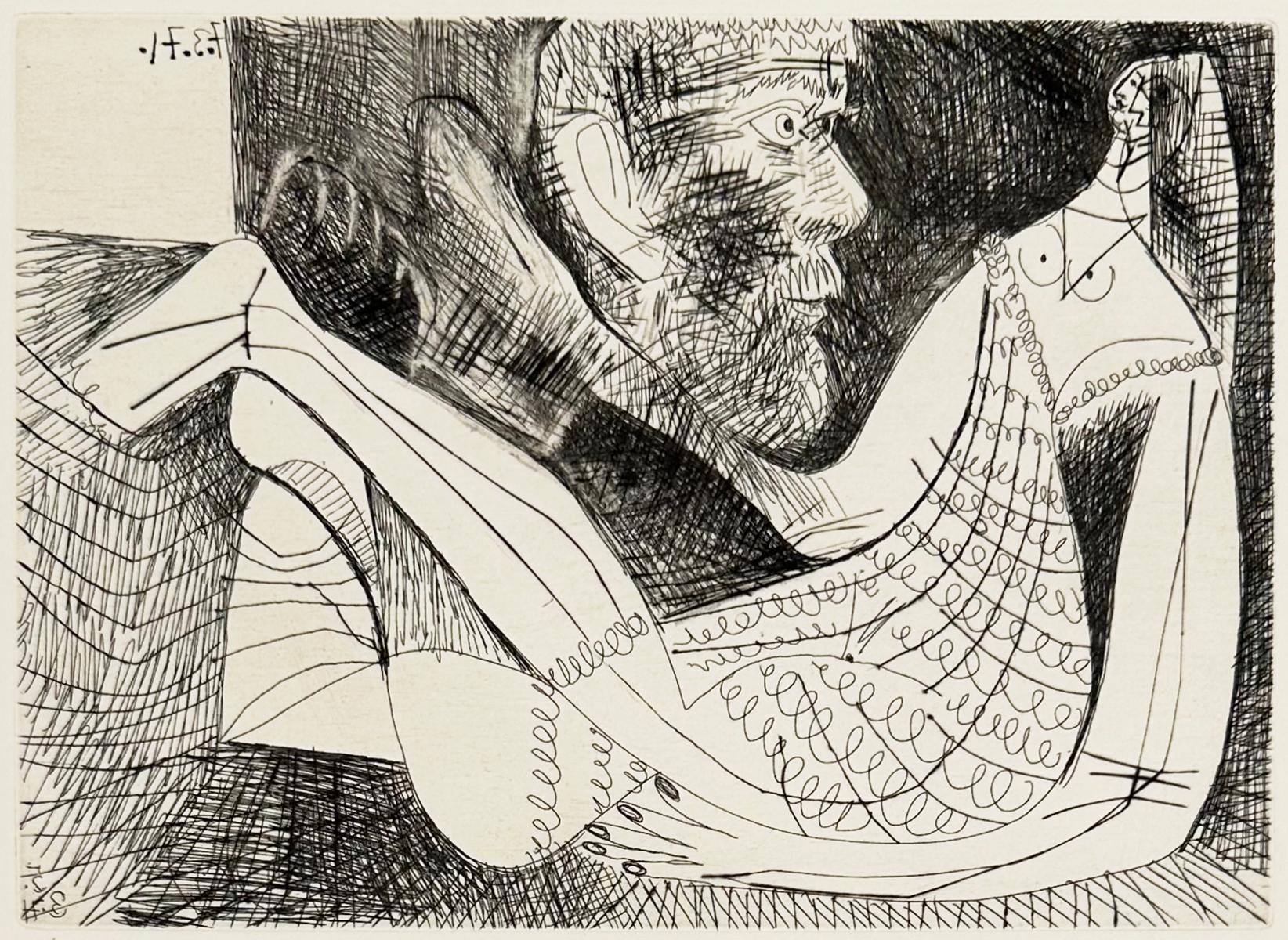
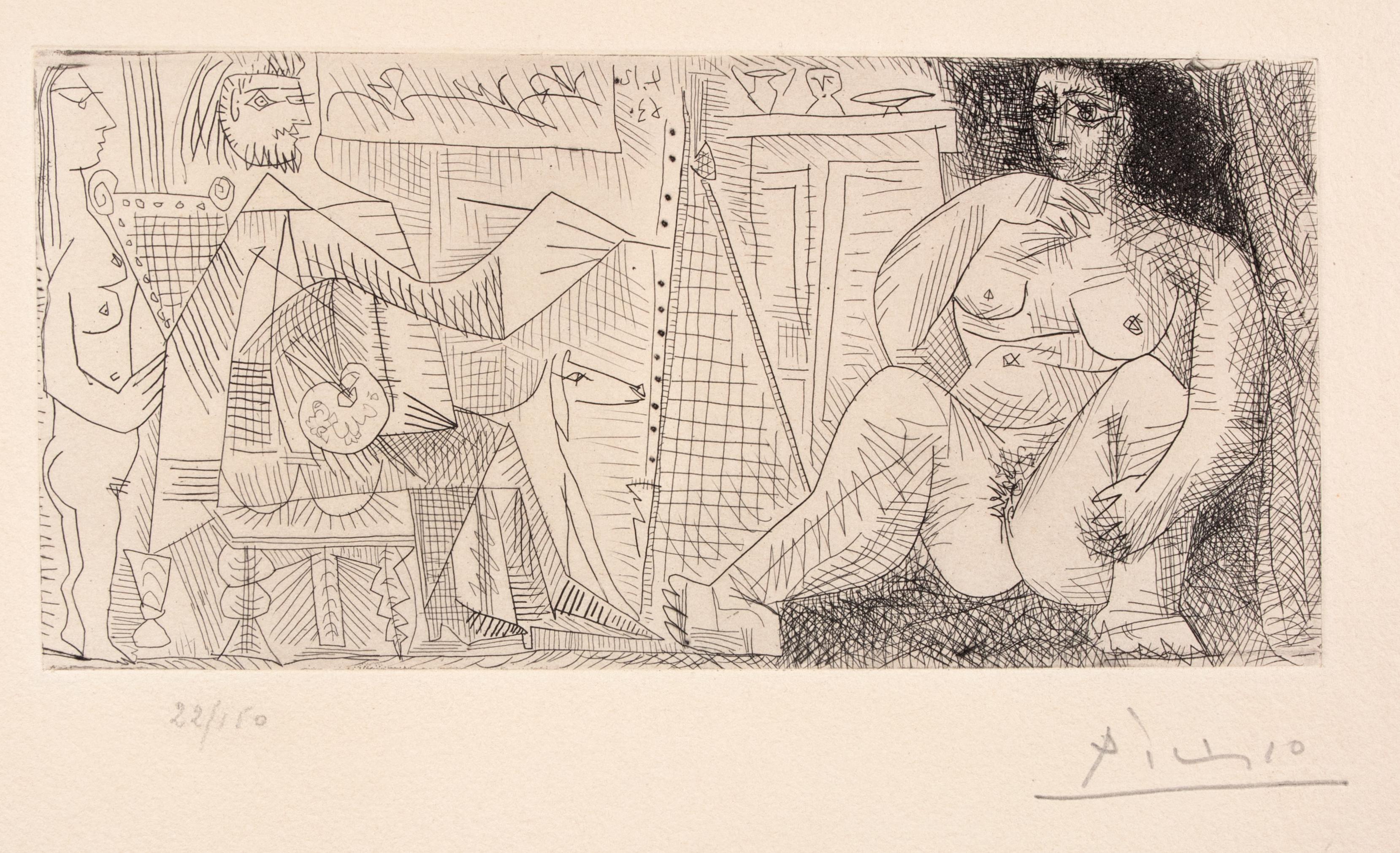
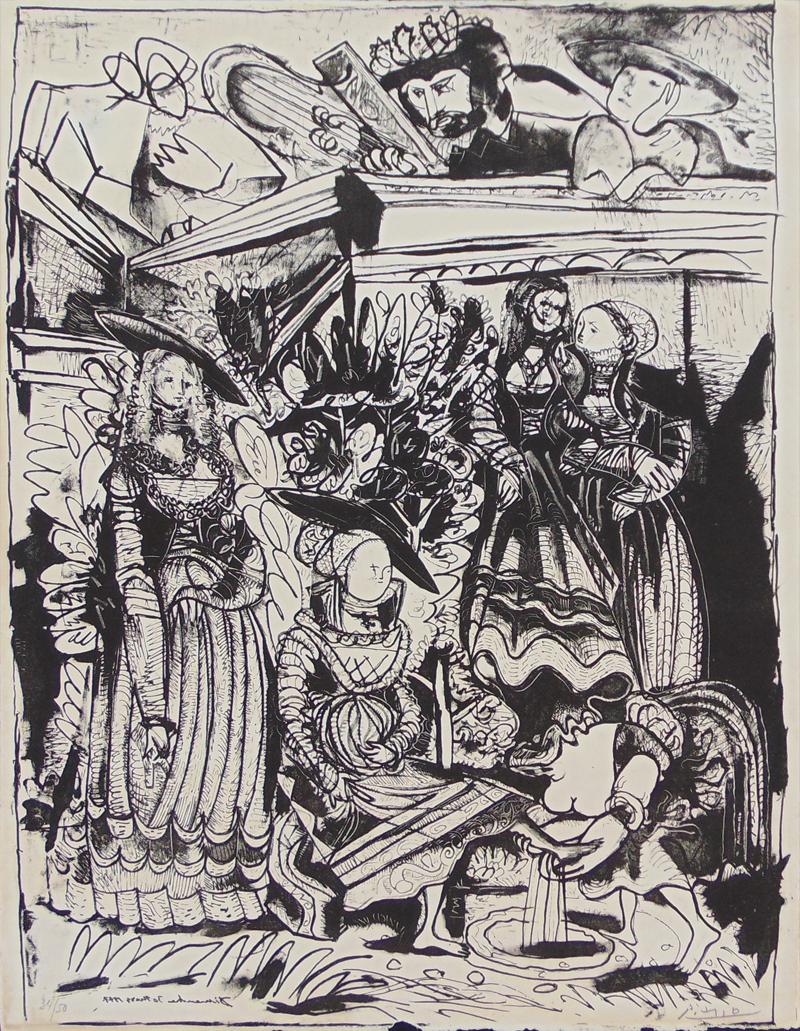
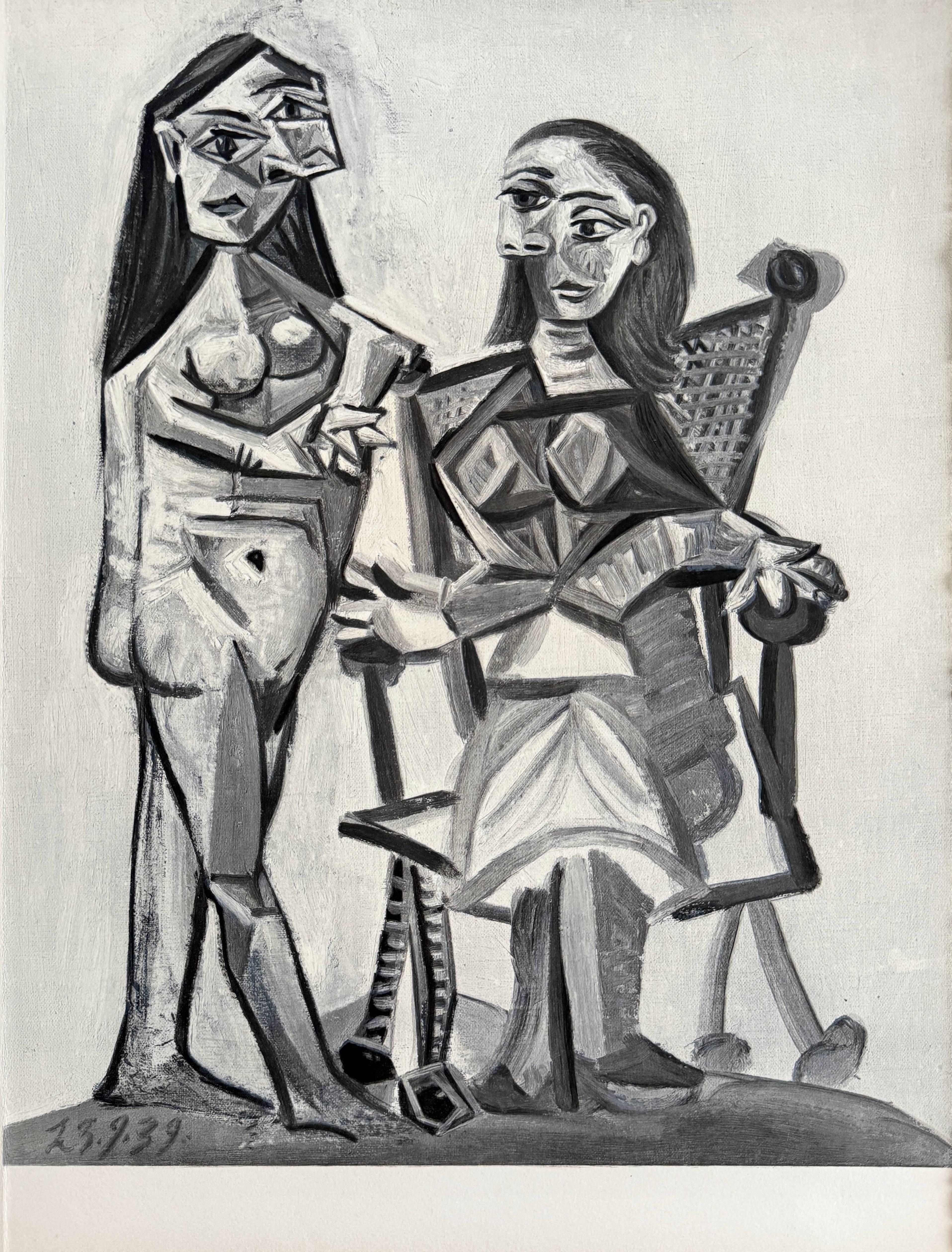
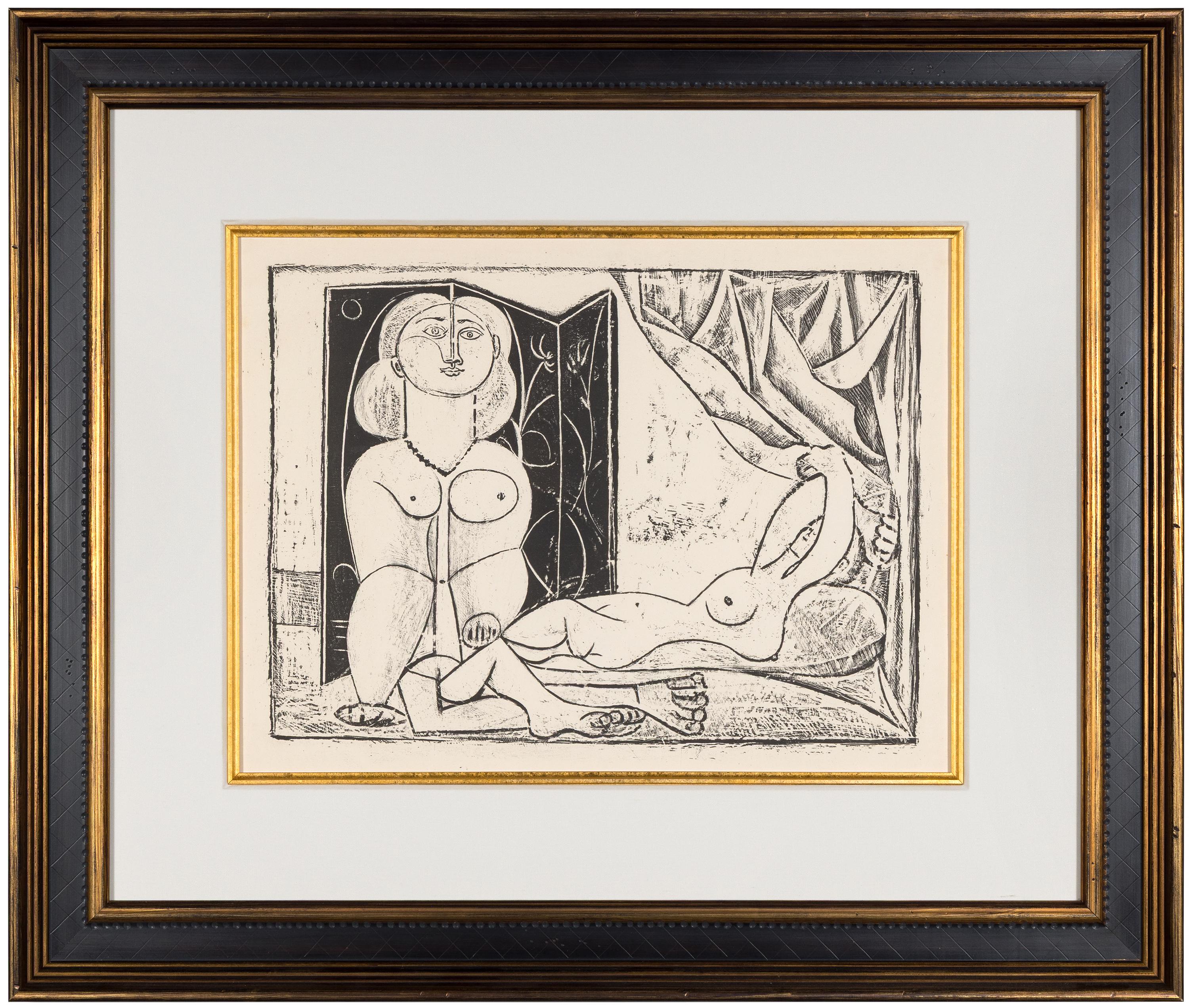
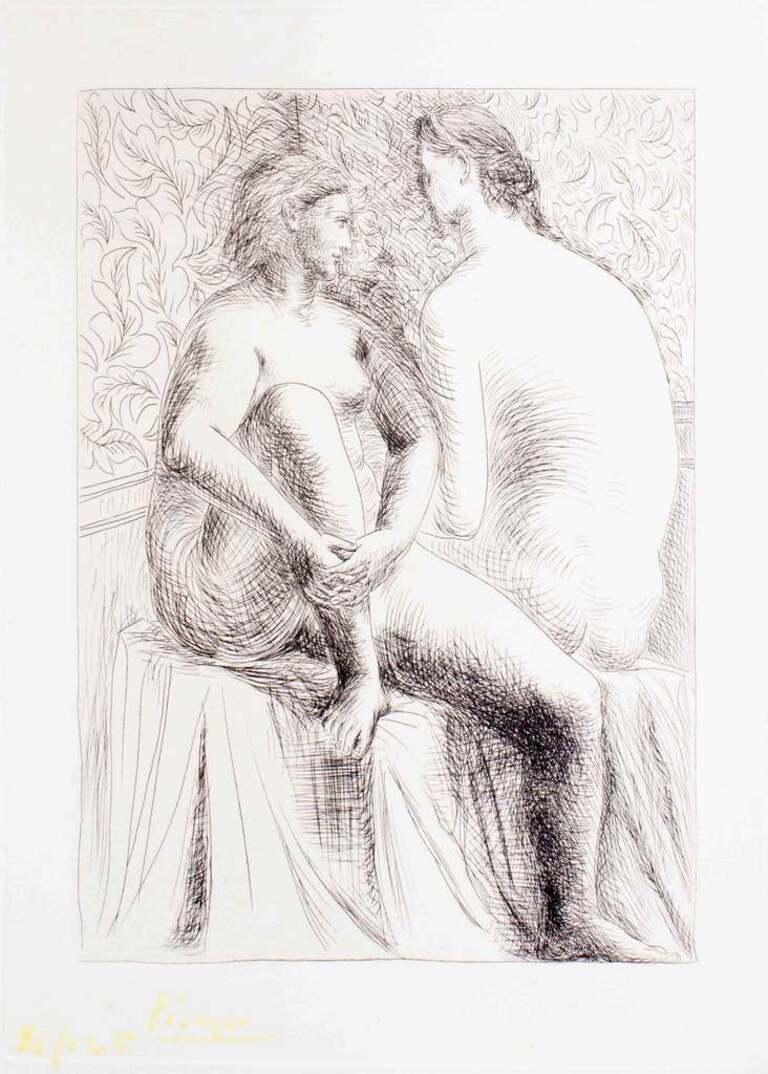
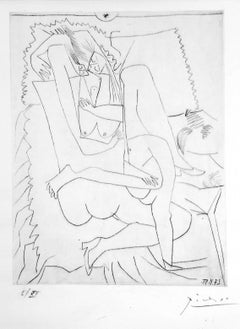
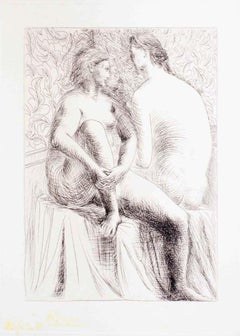
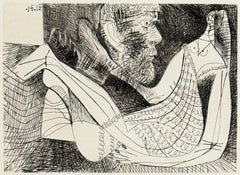
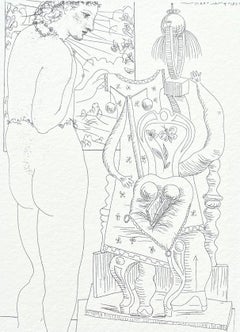
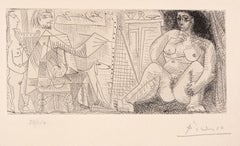
This exquisite zincograph by Pablo Picasso (1881–1973), titled Deux baigneurs (Two Bathers), from the album Le Chevre-Feuille (The Honeysuckle), originates from the 1943 edition published by Robert-J. Godet, Editeur, Paris; printed by E. Durand, Paris, December 4, 1943. Deux baigneurs reveals Picasso’s wartime graphic intensity, pairing figures through incisive contour and compact spatial construction while preserving immediacy and expressive vitality.
Executed as a zincograph on velin pur fil Lafuma paper, this work measures 11 x 8.875 inches (27.94 x 22.54 cm). Unsigned and unnumbered as issued. The impression reflects the clarity and structural precision characteristic of Picasso’s illustrated projects of the early 1940s.
Artwork Details:
Artist: Pablo Picasso (1881–1973)
Title: Deux baigneurs (Two Bathers), from Le Chevre-Feuille (The Honeysuckle)
Medium: Zincograph on velin pur fil Lafuma paper
Dimensions: 11 x 8.875 inches (27.94 x 22.54 cm)
Inscription: Unsigned and unnumbered as issued
Date: 1943
Publisher: Robert-J. Godet, Editeur, Paris
Printer: E. Durand, Paris
Catalogue Raisonne: Bloch, Georges. Pablo Picasso: Catalogue of the Printed Graphic Work 1904–1967. Kornfeld & Klipstein, 1968, illustration 361a-e; Cramer, Patrick. Pablo Picasso, The Illustrated Books: Catalogue Raisonne. Patrick Cramer, 1983, illustration 38
Condition: Well preserved, consistent with age and medium
Provenance: From the album Le Chevre-Feuille, published 1943
Notes:
Excerpted from the album (translated from French), Of this work, published under the direction of Robert-J. Godet and completed printing on the presses of E. Durand on December 4, 1943, the first anniversary of the meeting of the author with the chevre-feuille, there were printed: XXV examples on velin d'Arches, signed by the author and the illustrator, containing the suite in three colors of the engravings and an original etching by Pablo Picasso, numbered from I to XXV; and D examples on Lafuma, numbered from XXVI to DXXV. In addition, VI author's examples were printed on velin d'Arches, numbered from I to VI, and III nominative examples on Bristol d'Arches, intended for the author, the illustrator, and the publisher. The illustrations were engraved in etching by Pablo Picasso in such a way as to be printed within the text by the usual typographical processes. The etching, intended solely for the examples de tete, is one of the VI illustrations printed in intaglio on the presses of Roger Lacouriere.
About the Publication:
Le Chevre-Feuille (The Honeysuckle), published in Paris in 1943 under the direction of Robert-J. Godet and printed by E. Durand, represents a significant wartime illustrated edition that united poetry and Picasso’s incisive graphic language. Issued during the occupation years, the publication reflects the perseverance of the Parisian literary and artistic avant garde under challenging historical circumstances. The integration of Picasso’s etched and zincographic illustrations within the typographic structure demonstrates a deliberate synthesis of image and text, conceived to function as a cohesive visual and poetic experience. Today, Le Chevre-Feuille stands as an important example of mid twentieth century illustrated art editions, embodying both artistic experimentation and cultural resilience.
About the Artist:
Pablo Picasso (1881–1973) was a Spanish painter, sculptor, printmaker, and ceramicist whose extraordinary vision revolutionized modern art and defined the visual language of the 20th century. A child prodigy from Malaga, Spain, Picasso’s career spanned more than seven decades and encompassed an astonishing range of styles and innovations—from the melancholic Blue and romantic Rose periods to his pioneering invention of Cubism with Georges Braque, which shattered conventional notions of perspective and form. Influenced by the bold expressiveness of El Greco, the structure of Cezanne, and the vitality of African and Iberian sculpture, Picasso became a central figure of the Paris avant-garde, working in creative dialogue with contemporaries such as Henri Matisse, Alexander Calder, Alberto Giacometti, Salvador Dali, Joan Miro, Wassily Kandinsky, Marcel Duchamp, and Man Ray. His insatiable experimentation extended across painting, drawing, printmaking, ceramics, and sculpture, forever expanding the boundaries of artistic expression. A master of reinvention, Picasso profoundly shaped generations of artists who followed—from Andy Warhol, Roy Lichtenstein, David Hockney, and Jean-Michel Basquiat to Jeff Koons and Banksy—cementing his status as a timeless cultural icon whose works remain among the most sought after worldwide. His landmark painting Les Femmes d'Alger (Version "O") achieved a record-breaking sale of $179,365,000 at Christie's, New York, on May 11, 2015, affirming Picasso's enduring legacy as one of the most influential and valuable artists in history.
Pablo Picasso Deux baigneurs Two Bathers Le Chevre-Feuille 1943 zincograph Robert J Godet Modernism.