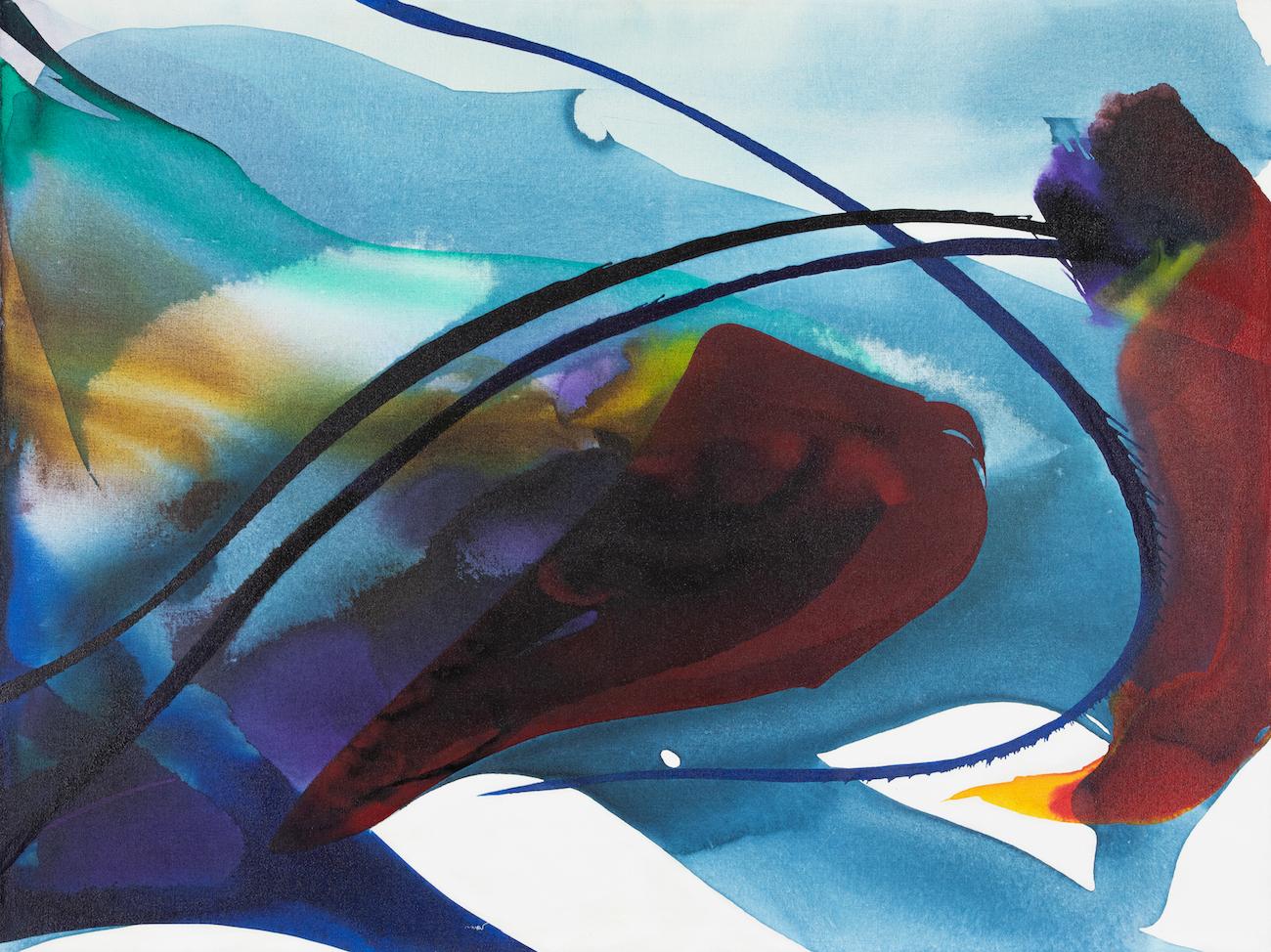
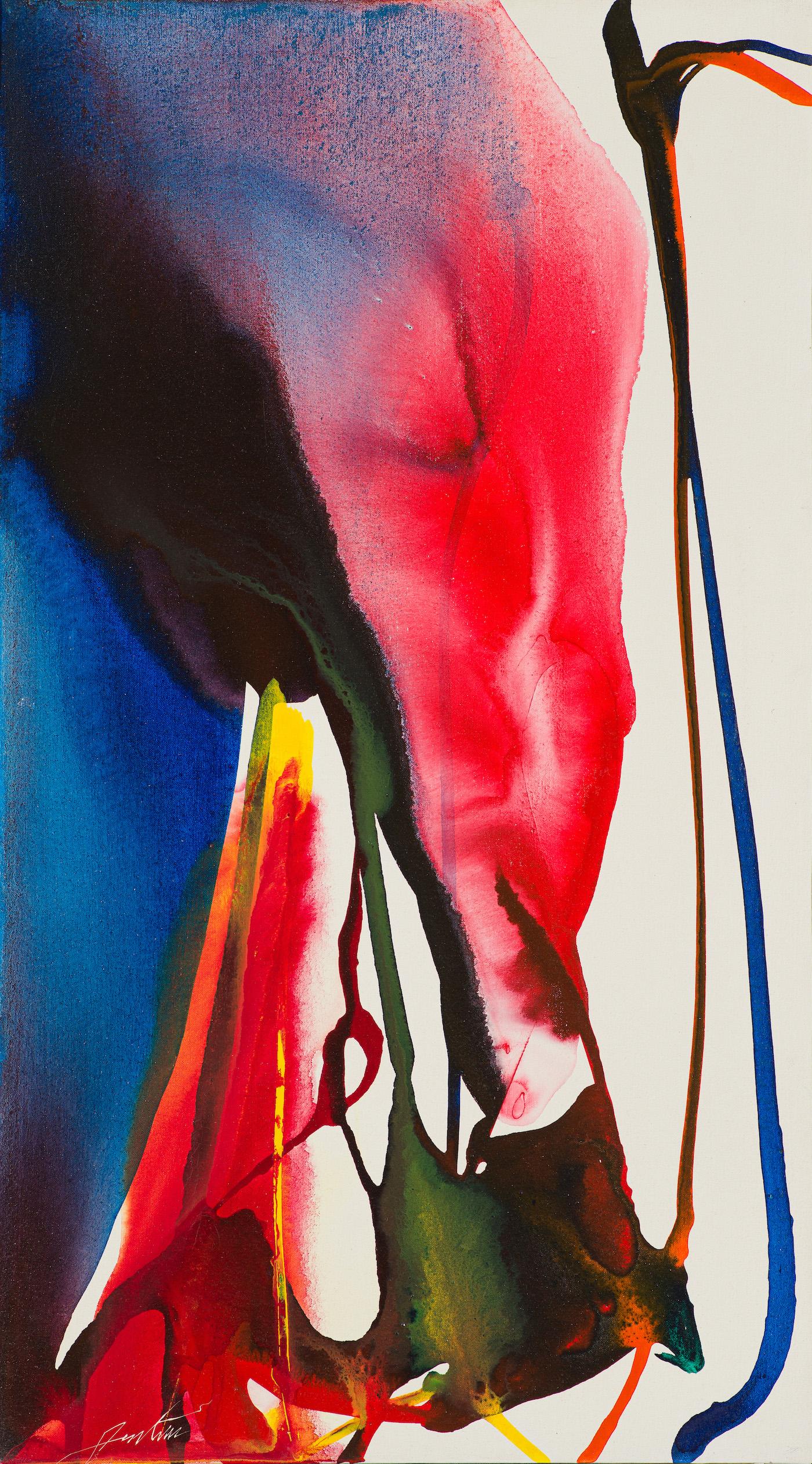
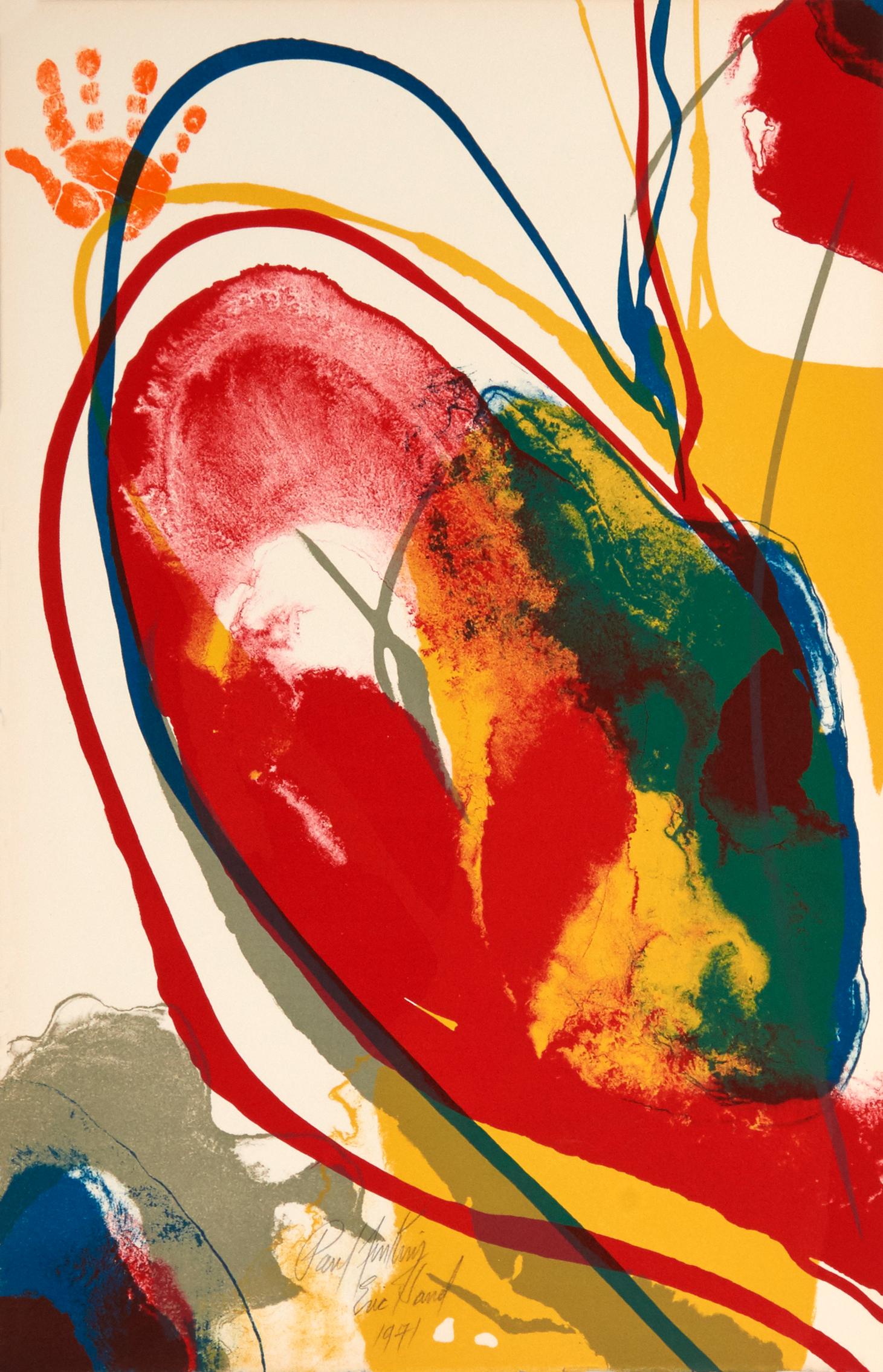
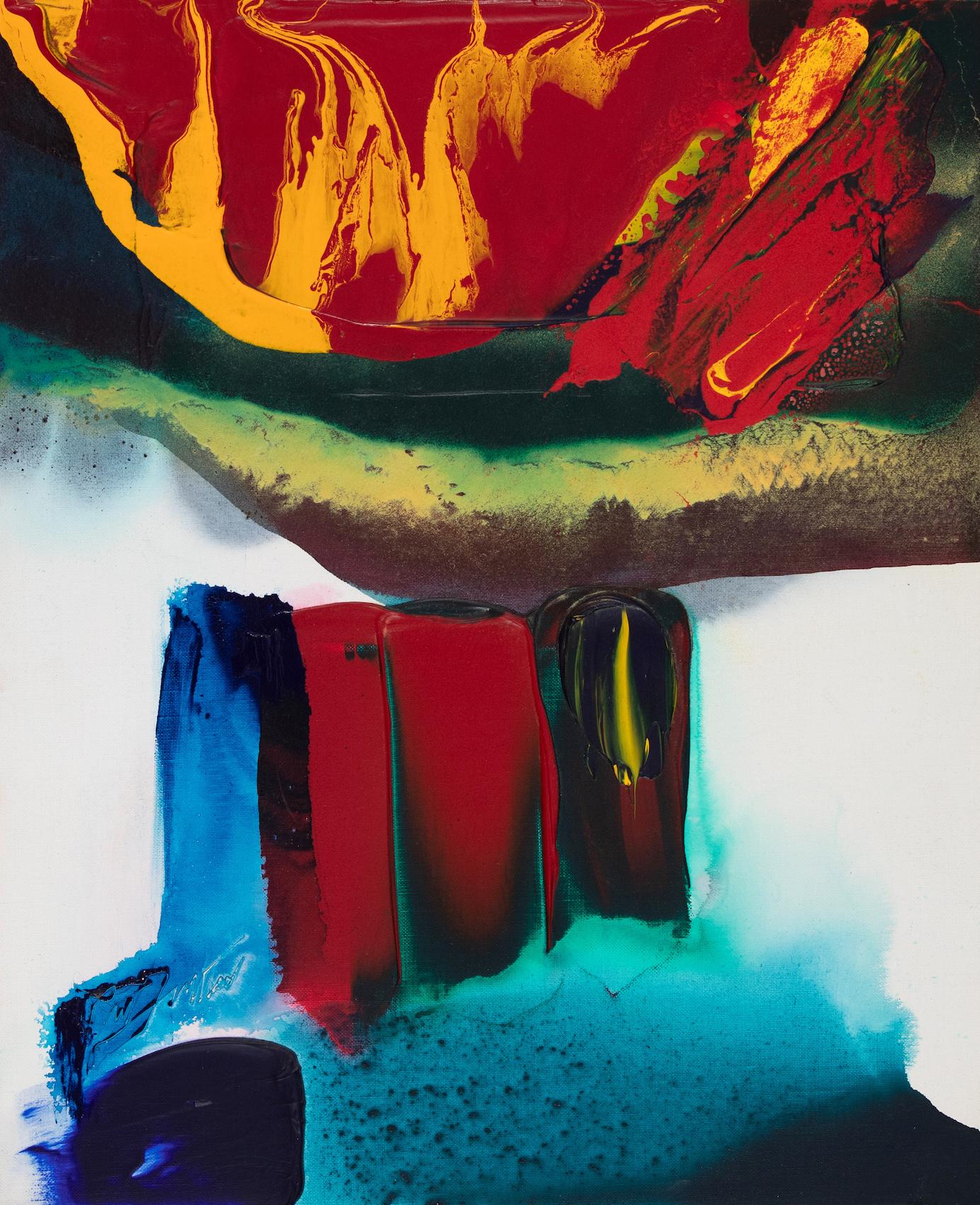
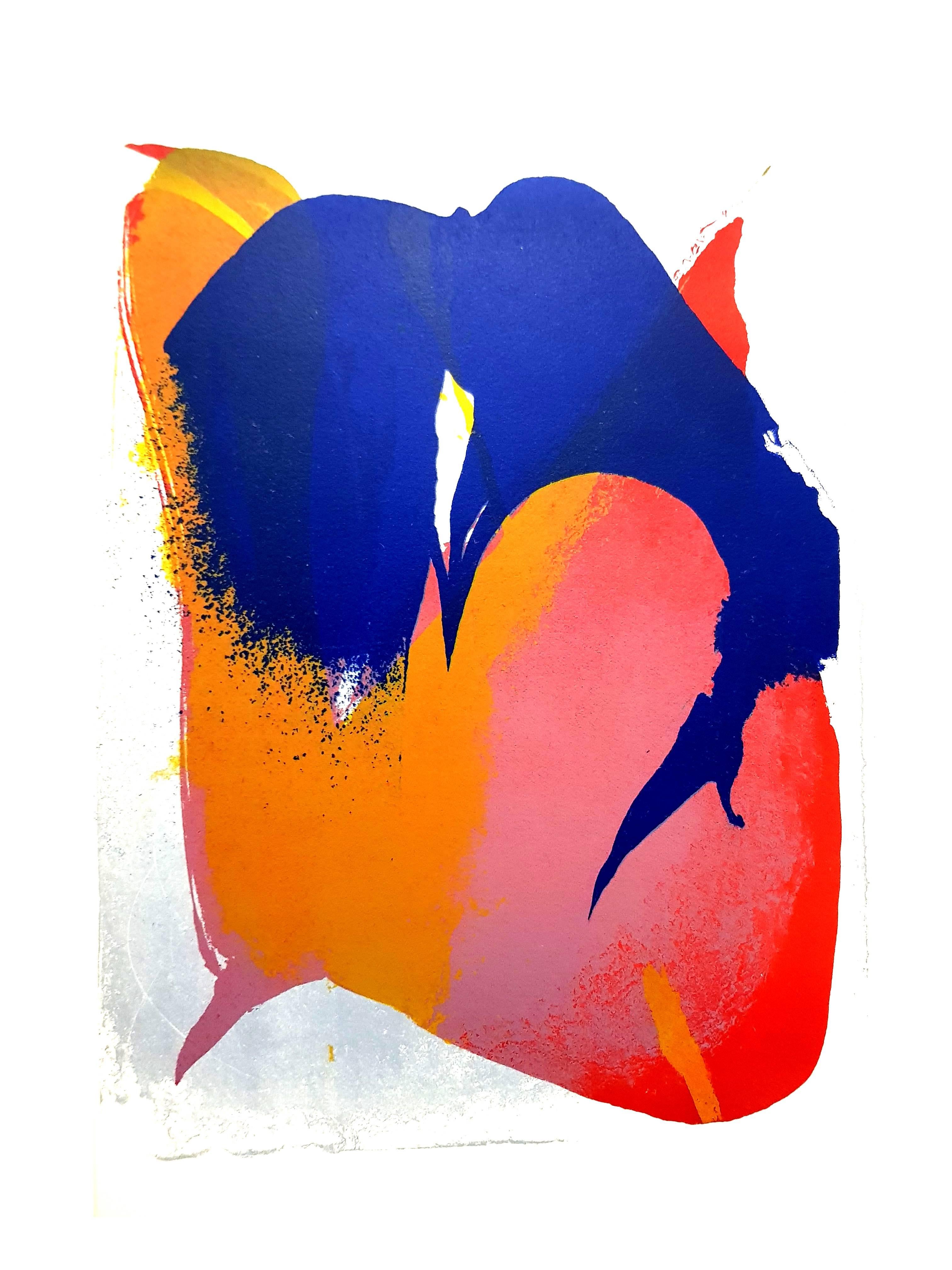
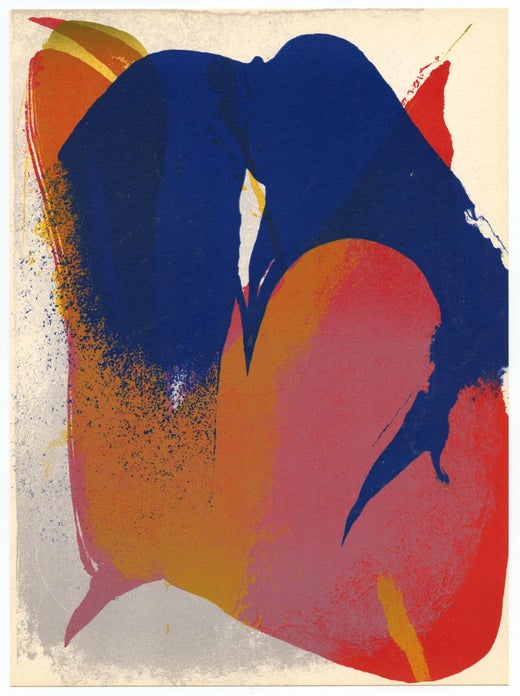
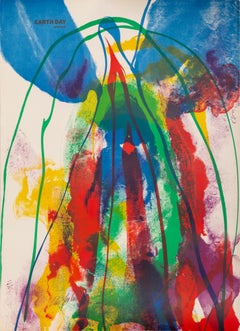
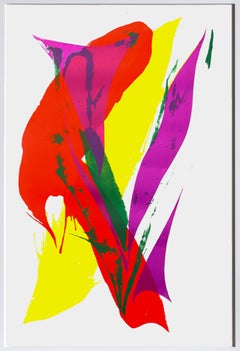
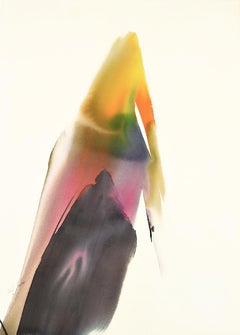
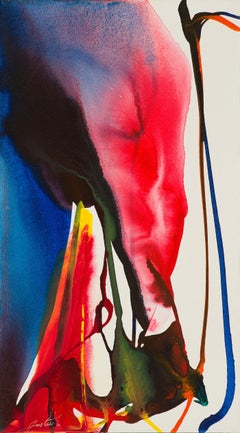
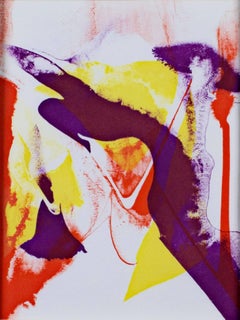
This exquisite lithograph by Paul Jenkins (1923–2012), titled Composition pour Eric (Composition for Eric), originates from the 1972 edition published by Editions A. C. Mazo et Cie., Paris, in collaboration with Leon Amiel, editeurs, New York, and printed by Mourlot Freres, Paris, April 5, 1972. This vibrant and fluid composition exemplifies Jenkins’ mastery of color, transparency, and gesture, embodying his unique “controlled pour” technique that fuses spontaneity with harmony. Composition pour Eric radiates energy and serenity, its flowing chromatic fields reflecting Jenkins’ belief that color itself is a living force capable of expressing the metaphysical and emotional dimensions of existence. The work captures the artist’s poetic approach to abstraction, where intuition and structure merge in luminous balance.
Executed as a lithograph on velin d’Arches paper, this work measures 19.62 x 12.81 inches (49.83 x 32.54 cm), with centerfold as issued. Signed in the plate and unnumbered as issued. The edition exemplifies the exceptional craftsmanship of the Mourlot Freres atelier, renowned for its collaboration with leading modern artists of the 20th century.
Artwork Details:
Artist: Paul Jenkins (1923–2012)
Title: Composition pour Eric (Composition for Eric), 1972
Medium: Lithograph on velin d’Arches paper
Dimensions: 19.62 x 12.81 inches (49.83 x 32.54 cm), with centerfold as issued
Inscription: Signed in the plate and unnumbered as issued
Date: 1972
Publisher: Editions A. C. Mazo et Cie., Paris, in collaboration with Leon Amiel, editeurs, New York
Printer: Mourlot Freres, Paris
Condition: Well preserved, consistent with age and medium
Provenance: From the edition published by Editions A. C. Mazo et Cie., Paris, in collaboration with Leon Amiel, editeurs, New York, 1972
Notes:
Excerpted from the album (translated from French), This album is the album of friendship, and I want to thank all the artists who wanted to participate. Some lithographs presented here, and whose authors have left us for too long, were made at my request for an album "Adieu a la rue de Chabrol" that I intended to publish ten years ago. So it was at this time that I was able to get the lithos of Braque, Cocteau, Derain, Giacometti and Villon. Mrs. Duthuit-Matisse and her brothers authorized me to print the composition of Henri Matisse, an unused original lithograph of the album by Teriade "La Religieuse portugaise". I am happy to have brought together so many works by contemporary artists, it is a great honor for me and I am infinitely grateful to them. Finished printing in Paris on April 5, 1972, this album was printed on velin d’Arches, in DCCC numbered examples. In addition, a number of copies were printed for artists, friends and collaborators of this album. The original lithographs were printed by Mourlot, and the typography is from Fequet and Baudier. Alain A.C. Mazo, Paris, and Leon Amiel, New York, publishers.
About the Publication:
Souvenirs et Portraits d'Artistes (Memories and Portraits of Artists), published in 1972 by Editions A. C. Mazo et Cie., Paris, and Leon Amiel, New York, stands as one of the most distinguished collaborative albums of the postwar era. Bringing together original lithographs by some of the foremost artists of the 20th century, the portfolio celebrates artistic friendship, collaboration, and the enduring spirit of creative dialogue. Composition pour Eric (Composition for Eric) by Paul Jenkins exemplifies this spirit, uniting the spiritual intensity of American abstraction with the lyrical sophistication of French modern printmaking. Printed at the renowned Atelier Mourlot, the work reflects both technical mastery and the transcendent power of color that define Jenkins’ artistic philosophy.
About the Artist:
Paul Jenkins (1923–2012) was an American abstract expressionist painter whose radiant veils of color, fluid compositions, and pioneering “controlled pour” technique made him one of the most distinctive and spiritually profound figures of postwar modernism. Born in Kansas City, Missouri, Jenkins studied at the Kansas City Art Institute under Thomas Hart Benton before attending the Art Students League of New York, where he worked under Yasuo Kuniyoshi and Morris Kantor and was influenced by the spiritual abstraction of Wassily Kandinsky, the surrealist imagination of Salvador Dali, and the lyrical biomorphism of Joan Miro. In New York, he became part of the postwar avant-garde, engaging with the legacies of Pablo Picasso, Alexander Calder, Alberto Giacometti, Marcel Duchamp, and Man Ray, and developing a personal aesthetic that merged the gestural vitality of Abstract Expressionism with the transcendence of Color Field painting. Jenkins’ revolutionary process, which he called “guided pouring,” involved directing thinned pigments across unprimed canvas to create luminous, transparent layers that captured both spontaneity and precision. His paintings—often titled with the word Phenomena to suggest his fascination with natural and spiritual forces—embodied his belief in color as a living, intelligent energy that revealed the unseen rhythms of existence. Dividing his time between New York and Paris, he became an international ambassador for American abstraction, exhibiting at the Museum of Modern Art, the Whitney Museum, the Tate, and the Centre Pompidou, while his works entered over 80 major museum collections worldwide. Throughout the 1960s and 1970s, Jenkins achieved global acclaim for paintings such as Phenomena Wind Across the Canyon (1963), Phenomena Prism Veil (1965), and Phenomena Ithaca (1954–55), which exemplified his command of transparency, light, and chromatic harmony. His later experiments in glass and bronze sculpture expanded his exploration of luminosity into three dimensions, while his practice continued to reflect his fascination with alchemy, Jungian psychology, and the unity of natural forces. Jenkins’ serene yet powerful canvases bridged intuition and intellect, chaos and control, earning him comparison to masters like Rothko and Frankenthaler while influencing later artists including Pat Steir, Sam Gilliam, and Gerhard Richter. His legacy endures as that of a modern mystic who transformed abstraction into a form of meditation, revealing the poetry of color and the metaphysics of perception. Standing alongside Pablo Picasso, Alexander Calder, Alberto Giacometti, Salvador Dali, Joan Miro, Wassily Kandinsky, Marcel Duchamp, and Man Ray, Paul Jenkins remains a defining figure of modern art—a painter-philosopher whose chromatic visions continue to inspire artists, collectors, and museums around the world. His highest auction record was achieved by Phenomena Ithaca (1954–55), which sold for $1.59 million at Sotheby’s, New York, on May 16, 2013, reaffirming his place among the most visionary, poetic, and collectible artists of the 20th century.
Paul Jenkins Composition pour Eric, Jenkins Mourlot Freres, Jenkins Editions A. C. Mazo, Jenkins Leon Amiel, Jenkins 1972 lithograph, Jenkins velin d’Arches, Jenkins collectible print, Jenkins modernist lithograph.