Robert Indiana
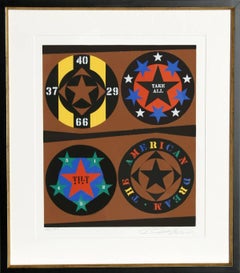
The Golden Future of America (Sheehan, 92), 1976
Silkscreen on Arches paper
Signed and dated in pencil, lower right; numbered 13/175, in pencil, lower left. Also bears printers blind stamp
Frame included: Elegantly matted and framed in a handmade wood frame under UV plexiglass
Published by: Transworld Art, Inc., Printed by: Simca Prints Artists, Inc., New York.
Catalogue Raisonne Reference: Sheehan, 92
Measurements:
Framed
30.5 inches vertical by 25 inches horizontal by 1.5 inches
Artwork (visible)
23.5 inches vertical by 17.5 inches
Signed and dated in pencil, lower right; numbered from the edition of 175, in pencil, lower left. Also bears printers blind stamp.
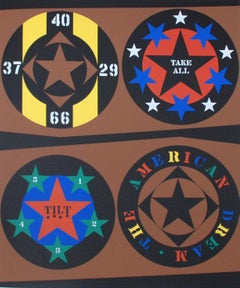
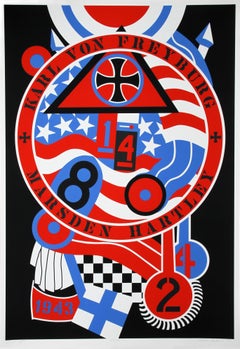
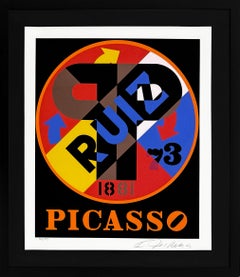
On its face, this Robert Indiana's silkscreen, based upon the eponymous painting "The Golden Future of America", is a patriotic celebration of Americana, done for the country's bicentennial year. But its looks are deceptive, as the work has a far more subversive meaning. In 2014, the Art Newspaper interviewed the artist who declared: “This one could have got me thrown into jail,” he says, pointing to The Golden Future of America, 1976, a painting with three eyes in the centre that stand for the letter “I” in CIA, FBI and IRS...." Robert Indiana invokes Benjamin Franklin as quoted, "In free governments the rulers are the servants and the people their superiors and sovereigns." The ultimate powers in a society, therefore, rest in the people themselves, and they should exercise those powers, either directly or through representatives, in every way they are competent and that is practicable. Robert Indiana’s “The Golden Future of America” exhibits the artist’s satirical view of the idea of the American Dream. The work was created in commemoration of America’s bicentennial and reflects America’s idea of the Golden Age. The artist has used Benjamin Franklin’s quotation “In free governments the rulers are servants and the people their superiors and sovereigns,” suggesting that the power should lie with the people. Through this work, Indiana is calling upon American society to assess its motivations. From an American Portrait 1776 - 1976. Portfolio published in honor of, and to celebrate the American Bicentennial.
ROBERT INDIANA BIOGRAPHY
Robert Indiana has developed his own formula for pop art combining sign letting with hard edge treatment in strong billboard colors. Many of his slogans, including his famous Love paintings and frequent use of the words die, kill, and hug, have been seen as a satirical challenge to the naïve optimism of the American dream. Similarly, “The Golden Future of America,” which was created in commemoration of America’s bicentennial, provides a satire on the impact the idea of a Golden Age has on both contemporary society and for the constructors of the U.S. constitution. As a result, the work can be perceived as a satire forcing the U.S. society to look at its underlying motivations, materialism, and vacant spirituality at a moment when the country is celebrating its birth. Signed and numbered from the edition of 175.
Robert Indiana was born Robert Clark in New Castle, Indiana on September 13, 1928. Adopted as an infant, he spent his childhood moving frequently throughout his namesake state. His artistic talent was evident at an early age, and its recognition by a first grade teacher encouraged his decision to become an artist. In 1942, Indiana moved to Indianapolis in order to attend Arsenal Technical High School, known for its strong arts curriculum. After graduating he spent three years in the U.S. Air Force and then studied at the Art Institute of Chicago, the Skowhegan School of Sculpture and Painting in Maine, and the Edinburgh College of Art in Scotland.
In 1956, two years after moving to New York, Indiana met Ellsworth Kelly, and upon his recommendation took up residence in Coenties Slip, once a major port on the southeast tip of Manhattan. There he joined a community of artists that would come to include Kelly, Agnes Martin, James Rosenquist, and Jack Youngerman. The environment of the Slip had a profound impact on Indiana’s work, and his early paintings include a series of hard-edge double ginkgo leaves inspired by the trees which grew in nearby Jeannette Park. He also incorporated the ginkgo form into his nineteen-foot mural Stavrosis (1958), a crucifixion pieced together from forty-four sheets of paper that he found in his loft. It was upon completion of this work that Indiana adopted the name of his native state as his own.
Indiana, like some of his fellow artists, scavenged the area’s abandoned warehouses for materials, creating sculptural assemblages from old wooden beams, rusted metal wheels, and other remnants of the shipping trade that had thrived in Coenties Slip. While he created hanging works such as Jeanne d’Arc (1960–62) and Wall of China (1960–61), the majority were freestanding constructions which Indiana called “herms” after the sculptures that served as boundary markers at crossroads in ancient Greece and Rome. The discovery of nineteenth-century brass stencils led to the incorporation of brightly colored numbers and short emotionally charged words into these sculptures as well as canvases, and became the basis of his new painterly vocabulary.