Want more images or videos?
Request additional images or videos from the seller
1 of 16

Robert Motherwell
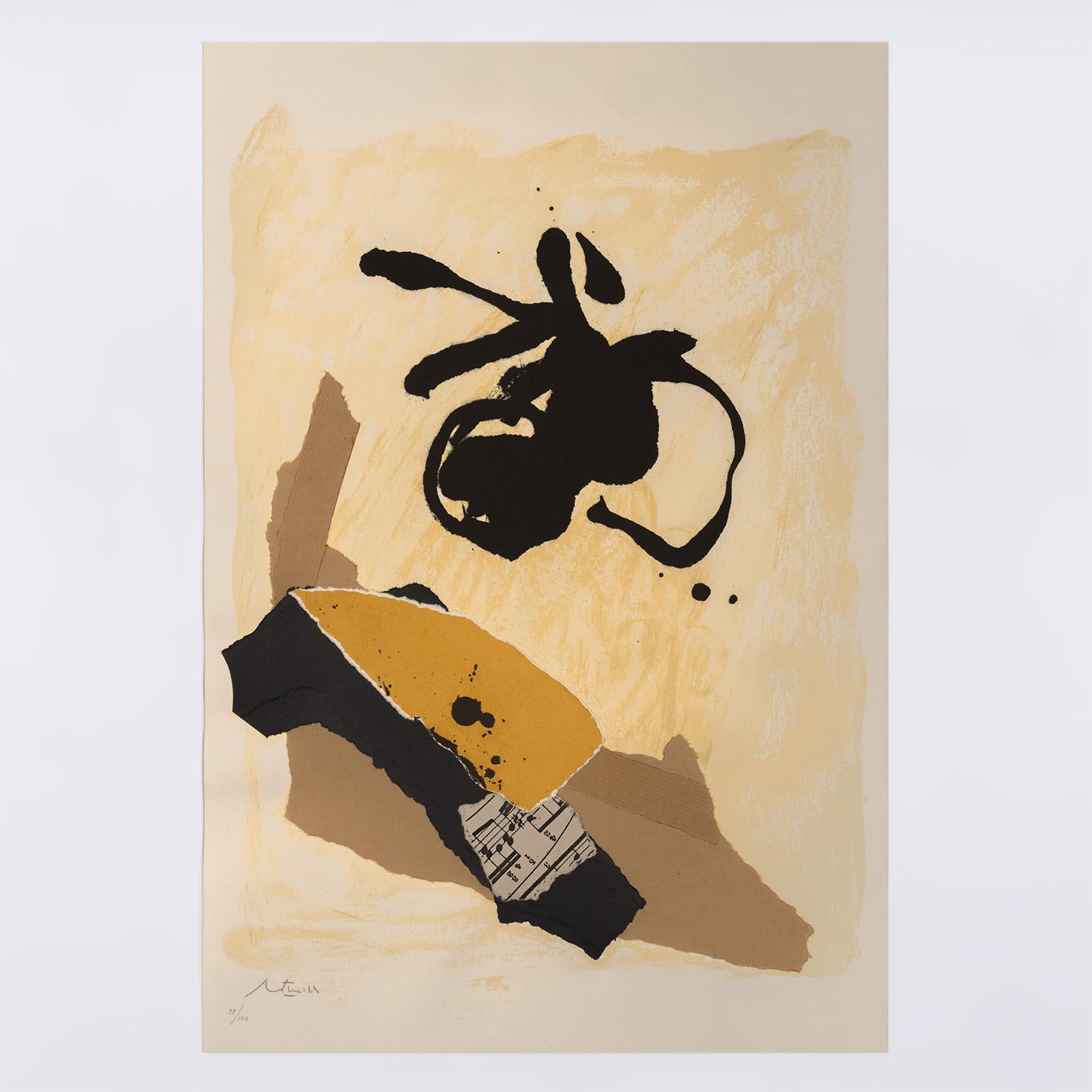
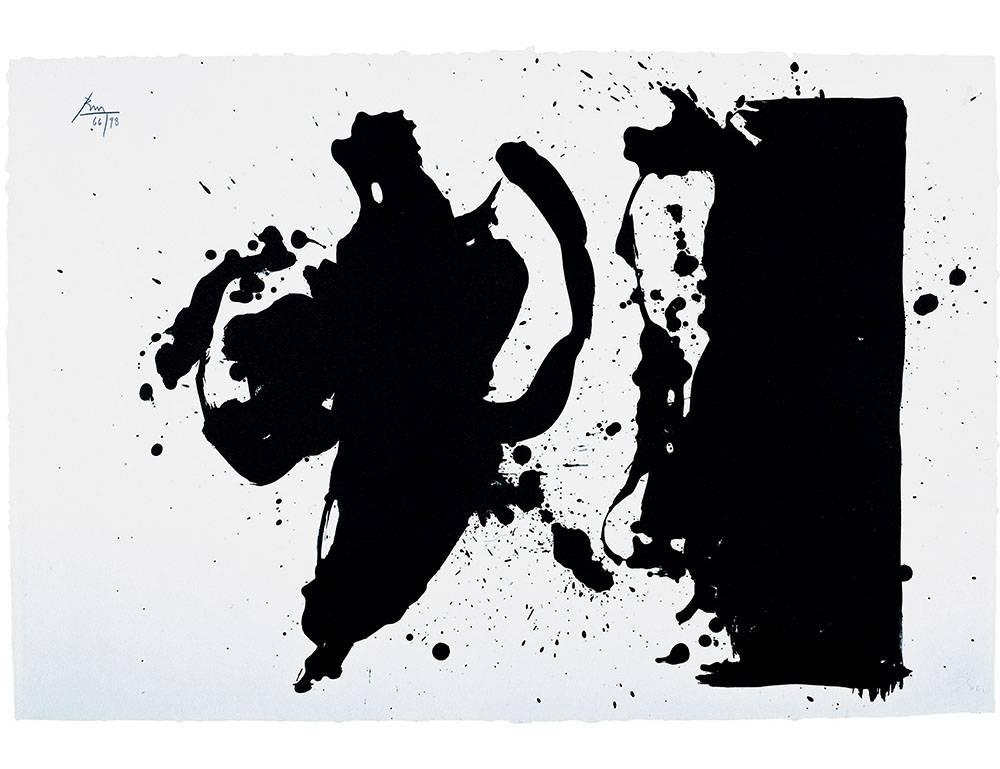
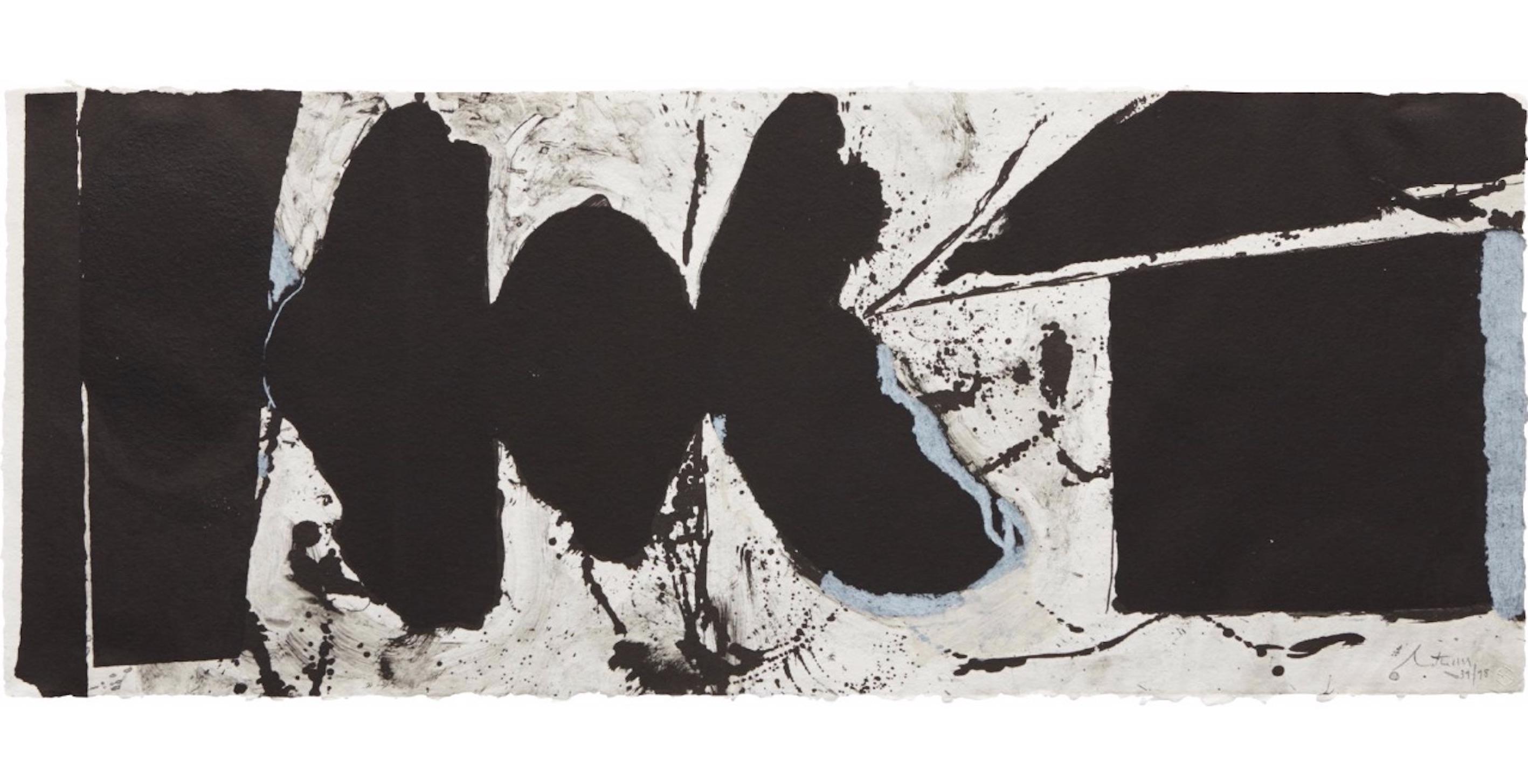
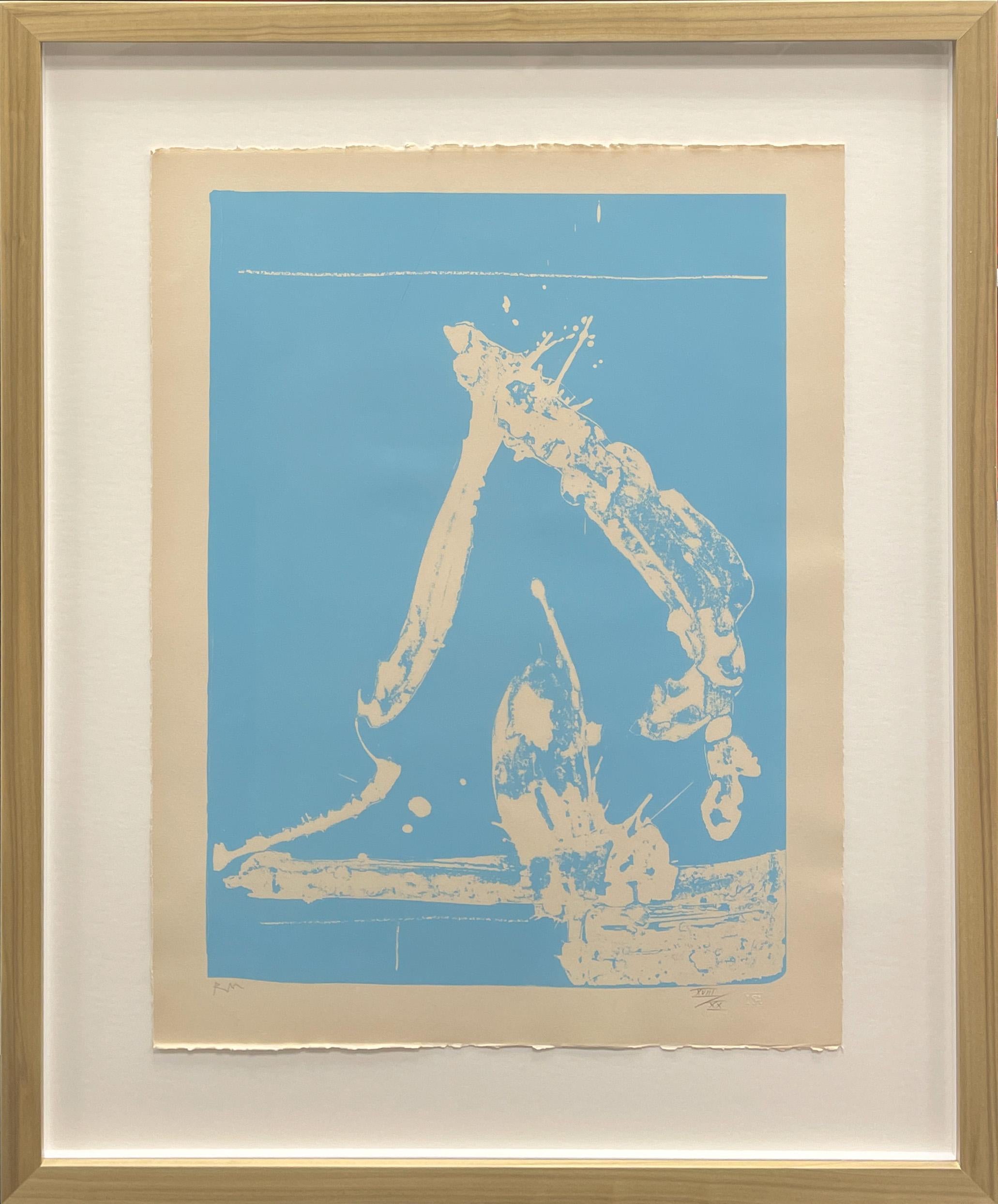
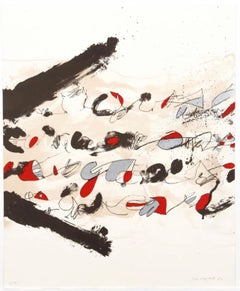
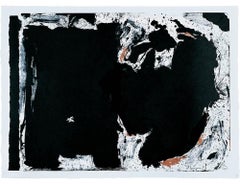
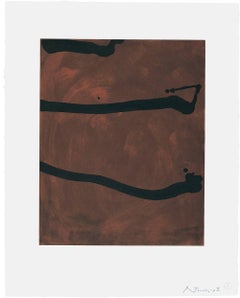
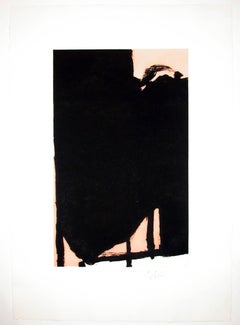
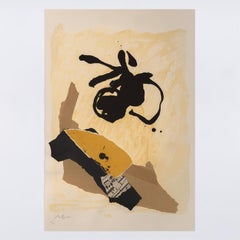
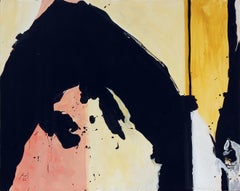
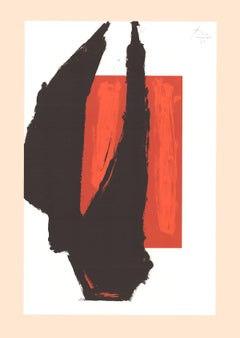
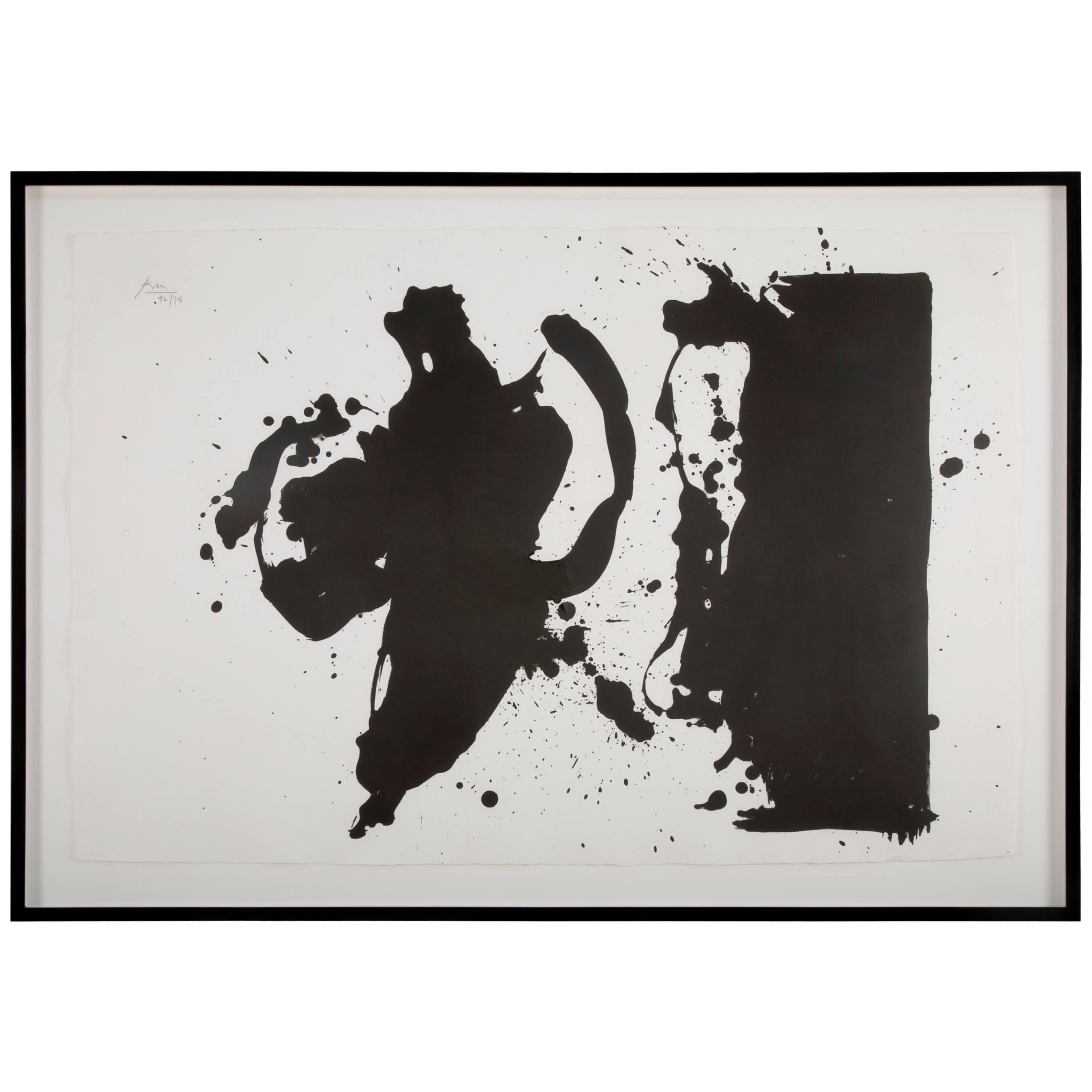
Large Robert Motherwell Lithograph Abstract Expressionist Lament for Lorca 1982

1982

$28,000
£21,105.53
€24,685.61
CA$39,631.28
A$40,350.40
CHF 23,238.19
MX$486,191.16
NOK 269,680.66
SEK 272,091.12
DKK 184,514.74

About the Item

Robert Motherwell (1915 – 1991) Lament for Lorca 1982 lithograph in colors on white Tyler Graphics Ltd. (TGL) handmade paper Printed with full margins; initialed and numbered 30/52 in pencil, lower right. Dimensions: 44 x 61 in. sheet (111.8 x 154.9 cm) Framed 48 x 65 (102 x 165cm). Signature: Hand signed "RM" in pencil lower right Numbered in pencil lower right; workshop chop mark lower right; Edition 52 (plus Proofs) Publisher: Tyler Graphics Ltd., Bedford Village, New York Printer: Roger Campbell, Lee Funderburg, and Kenneth Tyler Provenance: bears label from Gump's verso with original price of 29,000$, Private Century City collection. Literature: Tyler Graphics: Catalogue Raisonne 1974-1985. Kenneth E. Tyler. NY: Abbeville Press, 1987, p. 247.; 413: RM32 Belknap 254. Robert Motherwell was an American abstract expressionist painter, printmaker, and editor of The Dada Painters and Poets: an Anthology. He was one of the youngest of the New York School, which also included Willem de Kooning, Jackson Pollock, and Mark Rothko. Between 1932 and 1937, Motherwell briefly studied painting at California School of Fine Arts, San Francisco and received a BA in philosophy from Stanford University. At Stanford, Motherwell was introduced to modernism through his extensive reading of symbolist and other literature, especially Mallarmé, James Joyce, Edgar Allan Poe, and Octavio Paz. This passion stayed with Motherwell for the rest of his life and became a major theme of his later paintings and drawings. At the age of 20, Motherwell took a grand tour of Europe, accompanied by his father and sister. They began in Paris, France then traveled to Amalfi, Italy. The next stops were Switzerland, Germany, The Netherlands and London, England. The group ended their tour in Motherwell, Scotland. Later at Harvard, Motherwell studied under Arthur Oncken Lovejoy and David Wite Prall. He spent a year in Paris to research the writings of Eugène Delacroix, where he met American composer Arthur Berger who advised him to continue his education at Columbia University, under Meyer Schapiro. In 1939, Lance Wood Hart, then a professor of drawing and painting at the University of Oregon, invited Motherwell to join him in Eugene, Ore., to assist in teaching his classes for a full semester. In 1940, Motherwell moved to New York to study at Columbia University, where he was encouraged by Meyer Schapiro to devote himself to painting rather than scholarship. Schapiro introduced the young artist to a group of exiled Parisian Surrealists (Max Ernst, Duchamp, Masson) and arranged for Motherwell to study with Kurt Seligmann. The time that Motherwell spent under the influence of Surrealism proved to be influential to his artistic process. After a 1941 voyage with Roberto Matta to Mexico—on a boat where he met Maria Emilia Ferreira y Moyeros, an actress and his future wife—Motherwell decided to make painting his primary vocation. The sketches Motherwell made in Mexico later evolved into his first important paintings, such as The Little Spanish Prison (1941) and Pancho Villa, Dead and Alive (1943). Roberto Matta introduced Motherwell to the concept of "automatic" drawing or automatism, which the Surrealists used to tap into their unconscious. The concept had a lasting effect on Motherwell, further augmented by his meeting with the artist Wolfgang Paalen. Motherwell's encounter with Paalen prompted him to prolong his stay in Mexico for several months, in order to collaborate with him. Motherwell's noted Mexican Sketchbook visually reflects the resulting change: while the first drawings are influenced by Matta and Yves Tanguy, later drawings associated with Motherwell's time with Paalen show more plane graphic cadences and details distinguished from the earlier period. Paalen also introduced Motherwell to André Breton, via a letter. Motherwell's seminal trip to Mexico has been described as a little-known but important factor in the history and aesthetics of abstract expressionism. In 1991, shortly before his death, Motherwell remembered a "conspiracy of silence" regarding Paalen's innovative role in the genesis of abstract expressionism. Upon return from Mexico Motherwell spent time developing his creative principle based on automatism: "What I realized was that Americans potentially could paint like angels but that there was no creative principle around, so that everybody who liked modern art was copying it. Arshile Gorky was copying Picasso. Pollock was copying Picasso. De Kooning was copying Picasso. I mean I say this unqualifiedly. I was painting French intimate pictures or whatever. And all we needed was a creative principle, I mean something that would mobilize this capacity to paint in a creative way, and that's what Europe had that we hadn't had; we had always followed in their wake. And I thought of all the possibilities of free association—because I also had a psychoanalytic background and I understood the implications—might be the best chance to really make something entirely new which everybody agreed was the thing to do." Thus, in the early 1940s, Robert Motherwell played a significant role in laying the foundations for the new movement of abstract expressionism (or the New York School): "Matta wanted to start a revolution, a movement, within Surrealism. He asked me to find some other American artists that would help start a new movement. It was then that William Baziotes and I went to see Pollock and de Kooning and Hans Hofmann and Gerome Kamrowski and Peter Busa and several other people. And if we could come with something. Peggy Guggenheim who liked us said that she would put on a show of this new business. And so I went around explaining the theory of automatism to everybody because the only way that you could have a movement was that it had some common principle. It sort of all began that way." From the mid-1940s, Motherwell became the leading spokesman for avant-garde art in America. His circle came to include William Baziotes, David Hare, Barnett Newman, and Mark Rothko, with whom he eventually started the Subjects of the Artist School (1948–1949). In 1949 Motherwell divorced Maria and in 1950 he married Betty Little, with whom he had two daughters. Motherwell was a member of the editorial board of the Surrealist magazine VVV and a contributor to Wolfgang Paalen's journal DYN, which was edited from 1942 to 1944 in six issues. He also edited Paalen's collected essays Form and Sense in 1945 as the first issue of Problems of Contemporary Art. In 1948 Motherwell executed the image which would prove to be the germ of the Elegies to the Spanish Republic, one of his best known series of works. During 1947–48, Motherwell collaborated with the art critic Harold Rosenberg and others to produce Possibilities, an art review. During the latter year Motherwell created an image incorporating Rosenberg's poem "The Bird for Every Bird" meant for inclusion in the review's second issue. In 1948, Motherwell, William Baziotes, Barnett Newman, David Hare, and Mark Rothko founded the Subjects of the Artist School at 35 East 8th Street. Well-attended lectures were open to the public with speakers such as Hans Jean Arp, John Cage and Ad Reinhardt. The school failed financially and closed in the spring of 1949. Throughout the 1950s Motherwell taught painting at Hunter College in New York and at Black Mountain College in North Carolina. Cy Twombly, Robert Rauschenberg and Kenneth Noland studied under and were influenced by Motherwell. At this time, he was a prolific writer and lecturer, and in addition to directing the influential Documents of Modern Art Series, he edited The Dada Painters and Poets: An Anthology, which was published in 1951. From 1954 to 1958, during the break-up of his second marriage, he worked on a small series of paintings which incorporated the words Je t'aime, expressing his most intimate and private feelings. His collages began to incorporate material from his studio such as cigarette packets and labels, becoming records of his daily life. He was married for a third time, from 1958 to 1971, to fellow abstract painter Helen Frankenthaler. Because Frankenthaler and Motherwell were both born into wealth and known During the 1960s, Motherwell exhibited widely in both America and Europe and in 1965 he was given a major retrospective exhibition at the Museum of Modern Art; this show subsequently traveled to Amsterdam, London, Brussels, Essen, and Turin. In 1962, Motherwell and Frankenthaler spent the summer at the artists' colony at Provincetown, Massachusetts, where the coastline inspired the Beside the Sea series of 64 paintings, the oil paint splashed with full force imitating the sea crashing on the shore in front of his studio. The 1963 untitled oil on canvas painting in the collection of the Honolulu Museum of Art exemplifies this stage in the artist's career. In 1964, Motherwell created a mural-sized painting entitled Dublin 1916, with Black and Tan, which is in the Governor Nelson A. Rockefeller Empire State Plaza Art Collection in Albany, N.Y. The size and content suggest that Motherwell intended to create a monument to heroism in the tradition of the Pablo Picasso masterpiece, Guernica. The late 1960s saw Motherwell using Gauloises packets and cartons in many collages, including an extensive series with the packets surrounded by bright red acrylic painting, often with incised lines in the painted areas. In 1972 Motherwell married the artist-photographer Renate Ponsold and moved to Greenwich, Connecticut, where they lived in a carriage house with a hayloft aerie, a barn and a guest cottage adjoining a large studio. Motherwell set up different studios for different modes of production (painting, collage, printmaking) During the 1970s, he had retrospective exhibitions in several European cities, including Düsseldorf, Stockholm, Vienna, Paris, Edinburgh, and London. In 1977, Motherwell was given a major mural commission for the new wing of the National Gallery of Art in Washington, D.C. In 1983, a major retrospective exhibition of Motherwell's work, organized by Douglas G. Schultz, was held at the Albright-Knox Art Gallery in Buffalo, New York. From 1983 to 1985, this exhibition was subsequently shown at major museums, Los Angeles County Museum of Art San Francisco Museum of Modern Art, Seattle Art Museum, Corcoran Gallery of Art, and Solomon R. Guggenheim Museum. Another retrospective was shown in Mexico City, Monterey, and Fort Worth, Texas, in 1991. In 1985, Motherwell was awarded the Edward Macdowell Medal. In 1988, Motherwell worked with the publisher Andrew Hoyem of Arion Press on a limited edition of the modernist novel Ulysses, by James Joyce. Motherwell produced 40 lithographs for the project. Motherwell died in Provincetown, Massachusetts on July 16, 1991. On his death, Clement Greenberg, champion of the New York School, left in little doubt his esteem for the artist, commenting that "although he is underrated today, in my opinion he was one of the very best of the abstract expressionist painters". The Dedalus Foundation was set up by Robert Motherwell in 1981 to foster public understanding of modern art and modernism through its support of research, education, publications, and exhibitions. On July 20, 1991, several hundred people attended a memorial service for Motherwell on the beach outside his Provincetown home. Among them were the writer Norman Mailer and the photographer Joel Meyerowitz, both Provincetown summer residents. Speakers included the poet Stanley Kunitz, who read a poem that was a favorite of Motherwell's, William Butler Yeats's Sailing to Byzantium. Others in attendance included family members, friends, other artists, and Senator Howard Metzenbaum, an acquaintance of Motherwell's. Several major exhibitions of Motherwell's work have been held. Peggy Guggenheim's Art of this Century Gallery, New York (1944). Bennington College, Bennington, Vermont (1957) Galerie Heinz Berggruen, Paris, France (1961) Pasadena Art Museum, California (1962) Smith College Museum of Art (1963) The Phillips Collection, Washington, D.C. (1965) The Museum of Modern Art, MoMA, New York (1965) The Museum of Fine Arts, Houston, Texas (1972–73, traveled) David Mirvish Gallery, Toronto, Ontario, Canada (1973) Princeton University Art Museum, New Jersey (1973) Museo de Arte Moderna, Mexico City, Mexico (1975) Stadtisches Kunsthalle, Düsseldorf, Germany (1976) Musée d'art moderne de la ville de Paris, France (1977) Royal Academy of Art, London, England (1978) The William Benton Museum of Art, University of Connecticut, Storrs (1979) Fundación Juan March, Madrid, Spain (1980) Albright-Knox Art Gallery, Buffalo, New York (1983, traveled) Walker Art Center, Minneapolis, Minnesota (1985) Museo Rufino Tamayo, Mexico City, Mexico (1991–92, traveled) Fundació Antoni Tàpies, Barcelona, Spain (1996–97, traveled) Museum Morsbroich, Leverkusen, Germany (2004–05) Robert Motherwell. Three Poems by Octavio Paz, Museo de Arte Abstracto Español, Cuenca Spain (2008-09) Art Gallery of Ontario, Canada (2011) Motherwell and the Poets (Octavio Paz and Rafael Alberti), Fundación Juan March Madrid (2012) Robert Motherwell: Lyric Suite, the Metropolitan Museum of Art (2015) Robert Motherwell: Pure Painting, Modern Art Museum of Fort Worth, (2023)
  • Creator:
    Robert Motherwell (1915-1991, American)
  • Creation Year:
    1982
  • Dimensions:
    Height: 48 in (121.92 cm)Width: 65 in (165.1 cm)Depth: 2 in (5.08 cm)
  • Medium:
  • Movement & Style:
  • Period:
  • Condition:
    In original frame, frame has light wear. framed under acrylic, minor toning to edges of paper. please see photos.
  • Gallery Location:
    Surfside, FL
  • Reference Number:
    1stDibs: LU38217434022

More From This Seller

View All
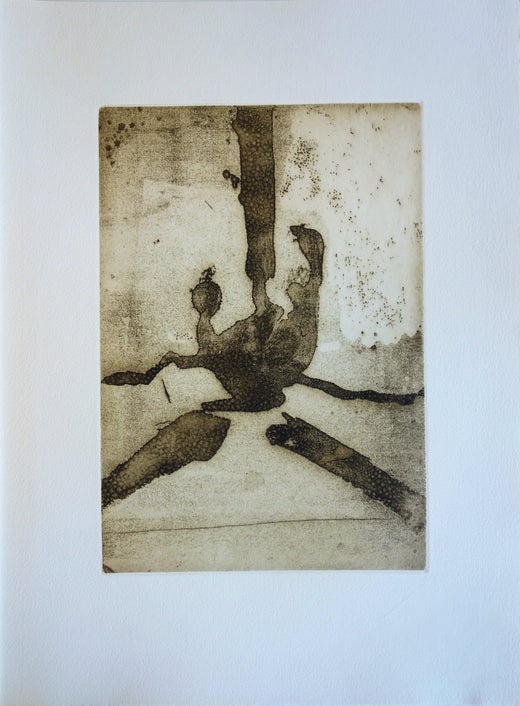
Antoni Tapies Post Modern Abstract Expressionist Aquatint

Antoni Tapies Post Modern Abstract Expressionist Aquatint

By Antoni Tàpies

Located in Surfside, FL

Size includes frame. There is a plate impression at the image that leads me to believe this is an aquatint. Antoni Tàpies i Puig, 1st Marquis of Tàpies (Catalan: 13 December 1923 – ...

Category

20th Century Abstract Expressionist Abstract Prints

Materials

Etching, Aquatint

Emil Schumacher Limited Edition Serigraph Terraraph Print Abstract Art Informel

Emil Schumacher Limited Edition Serigraph Terraraph Print Abstract Art Informel

By Emil Schumacher 1

Located in Surfside, FL

Heavily textured abstract print in a serigraph and terragraph technique. It has a raised texture to the surface, A beautiful piece. This listing is for the one print, the cover justification sheet and the photograph are just included for provenance. This is from the limited edition of 100. Hand signed and numbered on colophon page. (They are not signed and numbered on each print) Arches paper. Dimensions: 15.75 X 15.25 These have a texture that feels like a painting. Done in Jaffa Israel based on the Hebrew Bible. Jewish, Judaica interest. Emil Schumacher is among the best-known exponents of Art Informel in Germany. His painting style, which he initially developed in the 1950s under the influence of Wols, is marked by dark, brownish black or brilliant thick red colours and a graffiti like sign language that endow the pictures the expressive character of old cracked masonry. Emil Schumacher (29 August 1912 in Hagen, Westfalen – 4 October 1999 in San José, Ibiza) was a German artist and painter. He was an important representative of abstract expressionism in post-war Germany. As an 18-year-old, Emil Schumacher undertakes a four-week-long bicycle tour to Paris, France. 1932–1935: Studies graphic design at the School of Applied Arts in Dortmund intending to become a graphic designer in advertising. 1935–1939: Independent artist without participating in exhibits. He undertakes study trips by bicycle to the Netherlands and Belgium. 1939–1945: Service obligation as draftsman in an arms factory, the Akkumulatoren–Werke of Hagen. Since 1945: Immediately after end of war, new start as independent artist. 1947: First solo exhibit in the Studio für neue Kunst. Co-founder of the artist group Junger Westen. 1954: Participates in the Willem Sandberg exhibition Deutsche Kunst nach 45 (German Art after 1945) at the Stedelijk Museum Amsterdam: for the first time after World War II, Contemporary German Art is shown abroad. 1955: Participates in the exhibition Peintures et sculptures non-figuratives en Allemagne d’aujourd’hui in Paris. This is the first time, 10 years after the war's end, that René Drouin shows contemporary German art at the Cercle Volney in France. 1956: While searching for new media and materials, Schumacher creates his first 'Tastobjekte' (tactile objects). Conrad von Soest Preis (Conrad-von-Soest Award), Münster, Germany. 1958: Travels to Spain, Italy and Tunisia. Participates in the XXIX. Venice Biennale, Italy. 1958–1960: Professorship at the Hochschule für bildende Künste Hamburg (University of Fine Arts) in Hamburg, Germany. 1959: Participates in the documenta II in Kassel, Germany, as well as the V. São Paulo Art Biennial, Brazil. First solo exhibit in New York at the Samuel M. Kootz Gallery. 1962: Travels to Libya and Tunisia. Summer stay in Anguillara, Lago di Bracciano, Italy. 1963: Solo exhibit as German contribution to the VII. São Paulo Art Biennial, Brazil. Travels to Brazil, Argentina, Uruguay, Peru and Bolivia. Once again summer stay in Anguillara, paintings that originated during the stay are shown in the Galeria La Medusa in Rome. 1964: Participates in the documenta III in Kassel, Germany. 1965: Travels through Yugoslavia, to Montenegro, the Herzegovina, and Bosnia. 1966–77: Professorship at the Academy of Fine Arts, Karlsruhe. 1967–68: Guest professorship at the Minneapolis School of Art, Minneapolis, USA. In Minneapolis, a series of works on paper are created. This series called Minneapolis Suite was exhibited at the Lefebre Gallery in New York and at the Galerie de Montréal in Montréal, Canada. Extensive travels through the USA. 1969: Winter stay on the Island of Djerba in Tunisia. Here, the Djerba gouaches were created over the course of the following years. 1971: Since 1971, frequent stays on Ibiza during spring and summer. 1974: Autumn stay in Cunardo, Lago Maggiore where the first ceramic works are created in Ceramica Ibis. 1983: Travels to Morocco where Suite Maroc, encompassing 36 pages, is created. 1985: Guest of Honor of the German Academy of Rome, Villa Massimo, Italy. 1988: In October 1988, a 10-day stay in Iraq. Design and creation of a 20 m long ceramic wall mural in the new building of the Landtag of North Rhine-Westphalia. 1991: Guest professorship at the Concorso Superiore Internazionale del Disegno of the Fondazione Antonio Ratti, Como, Italy. 1996: Schumacher designs a 20 m long and 3 m high mosaic wall for the Colosseo (Rome Metro) in Rome, Italy. 1998: Commission for mural in the Reichstag building, Berlin (executed in 1999). 1999: Member of the Academy of the Arts of Saxony (Sächsische Akademie der Künste), Dresden, Germany. Publication of the Israeli book 'GENESIS' with 18 Serigraphies in the edition Har-El, Jaffa/ Jerusalem / Israel. Awards 1948: Kunstpreis junger westen from the city of Recklinghausen, Germany. 1955 Art award from the city of Iserlohn, Germany. 1958: Karl Ernst Osthaus Preis (Karl-Ernst-Osthaus Award), 1958: Guggenheim Award (National Section), New York. 1959: Award from the Japanese Cultural Minister in celebration of the V. International Art Exhibition, Tokyo. 1962: Premio Cardazzo, XXX Venice Biennale, Italy. 1962: First prize silver medal, Bang Danh-Du Award in celebration of the 1st International Arts Exhibition, Saigon, Vietnam. 1963: Großer Kunstpreis (Great Art Award) of North Rhine-Westphalia, Düsseldorf, Germany. 1966: Prize of the Governor of Tokyo, in celebration of the 5th International Biennale Exhibition of Prints, Tokyo, 1968: Member of the Academy of Arts Berlin, Germany. 1974: Award of the city of Ibiza in celebration of the Graphic-Biennial 1974. 1978: August Macke Prize of the city of Meschede 1983: Receives Grand Cross of Merit with Star from the Order of Merit of the Federal Republic of Germany. French art critic Michel Tapié named the influential European movement that during the 1950s paralleled Abstract Expressionism in the U.S, Art Informel. Art Informel is and expressionist, artist-oriented abstraction rooted in the works of Wassily Kandinsky, Paul Klee, Jean Dubuffet, and Tachiste and Surrealist automatism. A style primarily of painting that developed in 1945/46 as reaction to geometric abstraction prevailing in post war Paris in the following of the École de Paris. Informel painting emphasises the spontaneous act of painting, the unconscious side of artistic creativity. The process of painting is often more important than what comes out of it. Informel is an international style and can be subdivided into various schools. Tachism [French: "tache" = blot], Action painting, Abstract Expressionism and Art Brut [French = "raw art"] are also considered Informel. By that definition, leading exponents of Informel in the US were Jackson Pollock and Willem de Kooning and in France Wols, Jean Fautrier and Jean Dubuffet. In Germany Informel was at its height in the 1950s and 1960s. The leading exponents of German Informel are Hans Hartung, Emil Schumacher, Karl Fred Dahmen, K.O. Götz, Gerhard Hoehme...

Category

20th Century Abstract Expressionist Abstract Prints

Materials

Screen

Abstract Latin American Art Spanish Catalan Lithograph Josep Guinovart New York

Abstract Latin American Art Spanish Catalan Lithograph Josep Guinovart New York

By Josep Guinovart Bertrán

Located in Surfside, FL

Guinovart, Josep (Spanish/Catalan, 1927-2007), Untitled Abstract, 1984, lithograph on paper, hand signed, dated and marked E.A. (artist's proof) in pencil at bottom, full sheet 26.75 x 22 inches, unframed. Josep Guinovart (1927 –2007) was a Spanish Catalan painter most famous for his informalist or abstract expressionist work. In 1941, he began to work as a decorator. Three years later, he started his studies at the Escuela de Artes y Oficios de la Llotja (Art School of La Llotja) where he stayed until 1946. He first exhibited his work in 1948 in Galerías Syla in Barcelona. In 1951, he produced his first engravings entitled 'Homage to Federico García Lorca'. Two years later, he was awarded a grant from the French Institute to study in Paris for nine months. Here he discovered the cubist works of Henri Matisse and Pablo Picasso and travelled to Belgium, Holland and Germany. On his return to Barcelona and after a period working as an illustrator and set designer, around 1957 he began moving towards abstract art. His work is highly unconventional and usually on a large scale, using a wide range of materials, three-dimensional objects and organic substances such as eggshell, earth and straw. In 1962, he illustrated a book of poetry entitled Posies by Joan Salvat-Papasseit for the Ariel Editorial. He won many accolades for his work throughout the 1970s and 80s, including Spain's National Award for Plastic Arts in 1982. In 1994, a museum foundation dedicated to his art was inaugurated in Agramunt, his mother's birthplace to which he always felt a special attachment. In 2006 he designed the winery Mas Blanch i Jové in La Pobla de Cérvoles (Lleida) and created The Artists' Vineyard, a project intended to mix sculptures and other art works from different artists in the middle of a vineyard. The Artists' Vineyard was inaugurated after his death in 2010 with the unveiling of his sculpture The Countryside Organ: a music instrument, 6 meters height, for the wind to sing the vines. This winery also displays the 10.5 meters work In Vino Veritas...

Category

1980s Abstract Abstract Prints

Materials

Lithograph

Large Format Modernist Abstract Lithograph Silkscreen Print Woman Artist

Large Format Modernist Abstract Lithograph Silkscreen Print Woman Artist

By Lydia Dona

Located in Surfside, FL

1982-84 Hunter College, New York (M.F.A.) 1978-80 School of Visual Arts, New York 1973-77 Bezalel Academy of Art, Jerusalem (B.F.A.) American, born...

Category

1980s Abstract Expressionist Abstract Prints

Materials

Lithograph, Screen

Emil Schumacher Limited Edition Serigraph Terraraph Print Abstract Art Informel

Emil Schumacher Limited Edition Serigraph Terraraph Print Abstract Art Informel

By Emil Schumacher 1

Located in Surfside, FL

Heavily textured abstract print in a serigraph and terragraph technique. It has a raised texture to the surface, A beautiful piece. This listing is for the one print, the cover justification sheet and the photograph are just included for provenance. This is from the limited edition of 100. Hand signed and numbered on colophon page. (They are not signed and numbered on each print) Arches paper. Dimensions: 15.75 X 15.25 These have a texture that feels like a painting. Done in Jaffa Israel based on the Hebrew Bible. Jewish, Judaica interest. Emil Schumacher is among the best-known exponents of Art Informel in Germany. His painting style, which he initially developed in the 1950s under the influence of Wols, is marked by dark, brownish black or brilliant thick red colours and a graffiti like sign language that endow the pictures the expressive character of old cracked masonry. Emil Schumacher (29 August 1912 in Hagen, Westfalen – 4 October 1999 in San José, Ibiza) was a German artist and painter. He was an important representative of abstract expressionism in post-war Germany. As an 18-year-old, Emil Schumacher undertakes a four-week-long bicycle tour to Paris, France. 1932–1935: Studies graphic design at the School of Applied Arts in Dortmund intending to become a graphic designer in advertising. 1935–1939: Independent artist without participating in exhibits. He undertakes study trips by bicycle to the Netherlands and Belgium. 1939–1945: Service obligation as draftsman in an arms factory, the Akkumulatoren–Werke of Hagen. Since 1945: Immediately after end of war, new start as independent artist. 1947: First solo exhibit in the Studio für neue Kunst. Co-founder of the artist group Junger Westen. 1954: Participates in the Willem Sandberg exhibition Deutsche Kunst nach 45 (German Art after 1945) at the Stedelijk Museum Amsterdam: for the first time after World War II, Contemporary German Art is shown abroad. 1955: Participates in the exhibition Peintures et sculptures non-figuratives en Allemagne d’aujourd’hui in Paris. This is the first time, 10 years after the war's end, that René Drouin shows contemporary German art at the Cercle Volney in France. 1956: While searching for new media and materials, Schumacher creates his first 'Tastobjekte' (tactile objects). Conrad von Soest Preis (Conrad-von-Soest Award), Münster, Germany. 1958: Travels to Spain, Italy and Tunisia. Participates in the XXIX. Venice Biennale, Italy. 1958–1960: Professorship at the Hochschule für bildende Künste Hamburg (University of Fine Arts) in Hamburg, Germany. 1959: Participates in the documenta II in Kassel, Germany, as well as the V. São Paulo Art Biennial, Brazil. First solo exhibit in New York at the Samuel M. Kootz Gallery. 1962: Travels to Libya and Tunisia. Summer stay in Anguillara, Lago di Bracciano, Italy. 1963: Solo exhibit as German contribution to the VII. São Paulo Art Biennial, Brazil. Travels to Brazil, Argentina, Uruguay, Peru and Bolivia. Once again summer stay in Anguillara, paintings that originated during the stay are shown in the Galeria La Medusa in Rome. 1964: Participates in the documenta III in Kassel, Germany. 1965: Travels through Yugoslavia, to Montenegro, the Herzegovina, and Bosnia. 1966–77: Professorship at the Academy of Fine Arts, Karlsruhe. 1967–68: Guest professorship at the Minneapolis School of Art, Minneapolis, USA. In Minneapolis, a series of works on paper are created. This series called Minneapolis Suite was exhibited at the Lefebre Gallery in New York and at the Galerie de Montréal in Montréal, Canada. Extensive travels through the USA. 1969: Winter stay on the Island of Djerba in Tunisia. Here, the Djerba gouaches were created over the course of the following years. 1971: Since 1971, frequent stays on Ibiza during spring and summer. 1974: Autumn stay in Cunardo, Lago Maggiore where the first ceramic works are created in Ceramica Ibis. 1983: Travels to Morocco where Suite Maroc, encompassing 36 pages, is created. 1985: Guest of Honor of the German Academy of Rome, Villa Massimo, Italy. 1988: In October 1988, a 10-day stay in Iraq. Design and creation of a 20 m long ceramic wall mural in the new building of the Landtag of North Rhine-Westphalia. 1991: Guest professorship at the Concorso Superiore Internazionale del Disegno of the Fondazione Antonio Ratti, Como, Italy. 1996: Schumacher designs a 20 m long and 3 m high mosaic wall for the Colosseo (Rome Metro) in Rome, Italy. 1998: Commission for mural in the Reichstag building, Berlin (executed in 1999). 1999: Member of the Academy of the Arts of Saxony (Sächsische Akademie der Künste), Dresden, Germany. Publication of the Israeli book 'GENESIS' with 18 Serigraphies in the edition Har-El, Jaffa/ Jerusalem / Israel. Awards 1948: Kunstpreis junger westen from the city of Recklinghausen, Germany. 1955 Art award from the city of Iserlohn, Germany. 1958: Karl Ernst Osthaus Preis (Karl-Ernst-Osthaus Award), 1958: Guggenheim Award (National Section), New York. 1959: Award from the Japanese Cultural Minister in celebration of the V. International Art Exhibition, Tokyo. 1962: Premio Cardazzo, XXX Venice Biennale, Italy. 1962: First prize silver medal, Bang Danh-Du Award in celebration of the 1st International Arts Exhibition, Saigon, Vietnam. 1963: Großer Kunstpreis (Great Art Award) of North Rhine-Westphalia, Düsseldorf, Germany. 1966: Prize of the Governor of Tokyo, in celebration of the 5th International Biennale Exhibition of Prints, Tokyo, 1968: Member of the Academy of Arts Berlin, Germany. 1974: Award of the city of Ibiza in celebration of the Graphic-Biennial 1974. 1978: August Macke Prize of the city of Meschede 1983: Receives Grand Cross of Merit with Star from the Order of Merit of the Federal Republic of Germany. French art critic Michel Tapié named the influential European movement that during the 1950s paralleled Abstract Expressionism in the U.S, Art Informel. Art Informel is and expressionist, artist-oriented abstraction rooted in the works of Wassily Kandinsky, Paul Klee, Jean Dubuffet, and Tachiste and Surrealist automatism. A style primarily of painting that developed in 1945/46 as reaction to geometric abstraction prevailing in post war Paris in the following of the École de Paris. Informel painting emphasises the spontaneous act of painting, the unconscious side of artistic creativity. The process of painting is often more important than what comes out of it. Informel is an international style and can be subdivided into various schools. Tachism [French: "tache" = blot], Action painting, Abstract Expressionism and Art Brut [French = "raw art"] are also considered Informel. By that definition, leading exponents of Informel in the US were Jackson Pollock and Willem de Kooning and in France Wols, Jean Fautrier and Jean Dubuffet. In Germany Informel was at its height in the 1950s and 1960s. The leading exponents of German Informel are Hans Hartung, Emil Schumacher, Karl Fred Dahmen, K.O. Götz, Gerhard Hoehme...

Category

20th Century Abstract Expressionist Abstract Prints

Materials

Screen

You May Also Like

Lament for Lorca

Lament for Lorca

By Robert Motherwell

Located in London, GB

Lithograph on white Tyler Graphics Ltd. (TGL) handmade paper 44x61 in (111.8x154.9cm) Edition of 52

Category

1980s Abstract Expressionist Abstract Prints

Materials

Color, Lithograph

Untitled

Untitled

By Robert Motherwell

Located in London, GB

Brushed aquatint, lift-ground etching and aquatint on German Etching paper 71.8 x 56.5 cms (28 1/4 x 22 1/4 ins) Edition of 32

Category

1970s Abstract Abstract Prints

Materials

Etching, Aquatint

Elegy Fragment II

Elegy Fragment II

By Robert Motherwell

Located in London, GB

Aquatint, lift-ground etching and aquatint on Georges Duchene Hawthorne of Larroque handmade paper 87.6 x 61 cm (34 1/2 x 24 inches) Edition of 52

Category

1980s Abstract Abstract Prints

Materials

Etching, Aquatint

Carpeta

Carpeta

By Robert Motherwell

Located in Toronto, Ontario

Robert Motherwell (1915-1991), alongside Jackson Pollock, Mark Rothko, and Willem de Kooning, made up the quartet of abstract painters that radically defined Modern painting in Ameri...

Category

1980s Abstract Expressionist Abstract Prints

Materials

Lithograph

Untitled

Untitled

By Robert Motherwell

Located in London, GB

Robert Motherwell (1915-1991) Untitled 1990 Acrylic and coloured pencil on panel 40.6 x 50.8 cms (16 x 20 ins) RM13143 P1195 The composition of this painting is based on the left ...

Category

1990s Abstract Expressionist Abstract Paintings

Materials

Acrylic, Panel, Color Pencil

Art Chicago (No Text) Lithograph Print, Abstract, 1981, Unframed

Art Chicago (No Text) Lithograph Print, Abstract, 1981, Unframed

By Robert Motherwell

Located in Brooklyn, NY

Originally produced for the 1981 art show at Navy Pier in Chicago, these posters were part of an estimated edition size of about 2,000. The cropped version is particularly rare, as i...

Category

1980s Abstract Prints and Multiples

Materials

Lithograph