Want more images or videos?
Request additional images or videos from the seller
1 of 18

Robert Zakanitch
Huge Post Minimalist Pattern and Decoration Abstract Lithograph Robert Zakanitch

1978

$2,200
£1,663.27
€1,941.68
CA$3,130.49
A$3,175.32
CHF 1,813.20
MX$38,454.19
NOK 21,345.76
SEK 21,274.92
DKK 14,514.19

About the Item

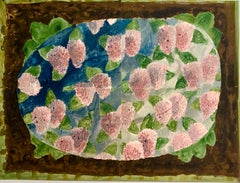
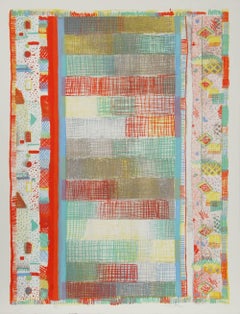
Robert Rahway Zakanitch (American b. 1935), Lilies, Blue and Orange, Hand signed and dated 78 in pencil at the lower right, and inscribed Artists Proof with edition notation AP 6/6 at the lower left. Dimensions: Framed 42.5 X 59 X 2 in. Approximate sight size 40.5 x 57.5 inches. Accompanied by provenance documentation indicating the print was purchased directly from the artist in 1986 for $3,000. A large-format color screenprint, silkscreen on paper featuring a vibrant arrangement of lilies and floral motifs rendered in layered bands of saturated hues. The composition combines abstracted organic patterns in blue, orange, red, and green, exemplifying Zakanitchs involvement in the Pattern and Decoration movement of the 1970s. Robert Zakanitch (born 1935) is an American painter and was one of the founders of the Pattern and Decoration movement. His work is held in the collection of the Philadelphia Museum of Art, Museum of Modern Art, Whitney Museum of American Art, among others. Robert Zakanitch was born in 1935 in Elizabeth, New Jersey and grew up in Rahway. He lived and worked in New York City. At the time of his June 3 through September 17, 2017 exhibition in the Hudson River Museum, he had recently moved his residence and studio to Yonkers, New York In the late 1960s he began experimenting with Color Field painting but would go on to be one of the founders of the Pattern and Decoration movement in the mid 1970s. While working in the Color Field he was strict to adhering to an abstract style inspired by Minimalism until he learned about decorative imagery. He kept the same color schemes and structures, but incorporated floral motif and a more painterly style. He was one of the original painters of the Pattern and Decoration movements of the 1970s. (along with Cynthia Carlson, Brad Davis, Mary Grigoriadis, Joyce Kozloff, Robert Kushner, Kim MacConnel, Sonya Rapoport, Miriam Schapiro and Valerie Jaudon) The group began exhibiting together in 1976 in "Ten Approaches to the Decorative" at the Alessandra Gallery in New York, followed by "Pattern Painting" in 1977 at PS1 in Long Island City, Queens. Subsequently, over fifty group exhibitions featuring the founding artists were held in museums and galleries in Europe and the U.S. including the National Gallery of Art in Washington, D.C., the Art Institute of Chicago, Palais des Beaux Arts, Brussels, Louisiana Museum of Modern Art in Humlebaek, Denmark, the Neue Galerie, in Aachen, Germany, the Pori Art Museum, the Mayor Gallery in London, Modern Art Oxford, and the Hudson River Museum in Yonkers, New York. In 2012 the "Conceptual Abstraction" exhibition of 1991 at the Sidney Janis Gallery, a survey of twenty contemporary abstract painters, organized by Carroll Janis and Jaudon, was revisited at the Hunter College Galleries in New York City and curated by Joachim Pissarro and Pepe Karmel. Among the participants were Ross Bleckner, Peter Halley, Sherrie Levine, Philip Taaffe and Peter Schuyff.
  • Creator:
    Robert Zakanitch (1935, American)
  • Creation Year:
    1978
  • Dimensions:
    Height: 42.5 in (107.95 cm)Width: 59 in (149.86 cm)
  • Medium:
  • Movement & Style:
  • Period:
  • Condition:
    Please see photos, this shows well but has some minor issues including light foxing and some toning in margins. This will be shipped unframed rolled in a sturdy wide tube. This can be shipped framed for 250$.
  • Gallery Location:
    Surfside, FL
  • Reference Number:
    1stDibs: LU38217403432

More From This Seller

View All
Pietro Consagra Italian Mod Abstract Expressionist Forma, Art Brut Lithograph

Pietro Consagra Italian Mod Abstract Expressionist Forma, Art Brut Lithograph

By Pietro Consagra

Located in Surfside, FL

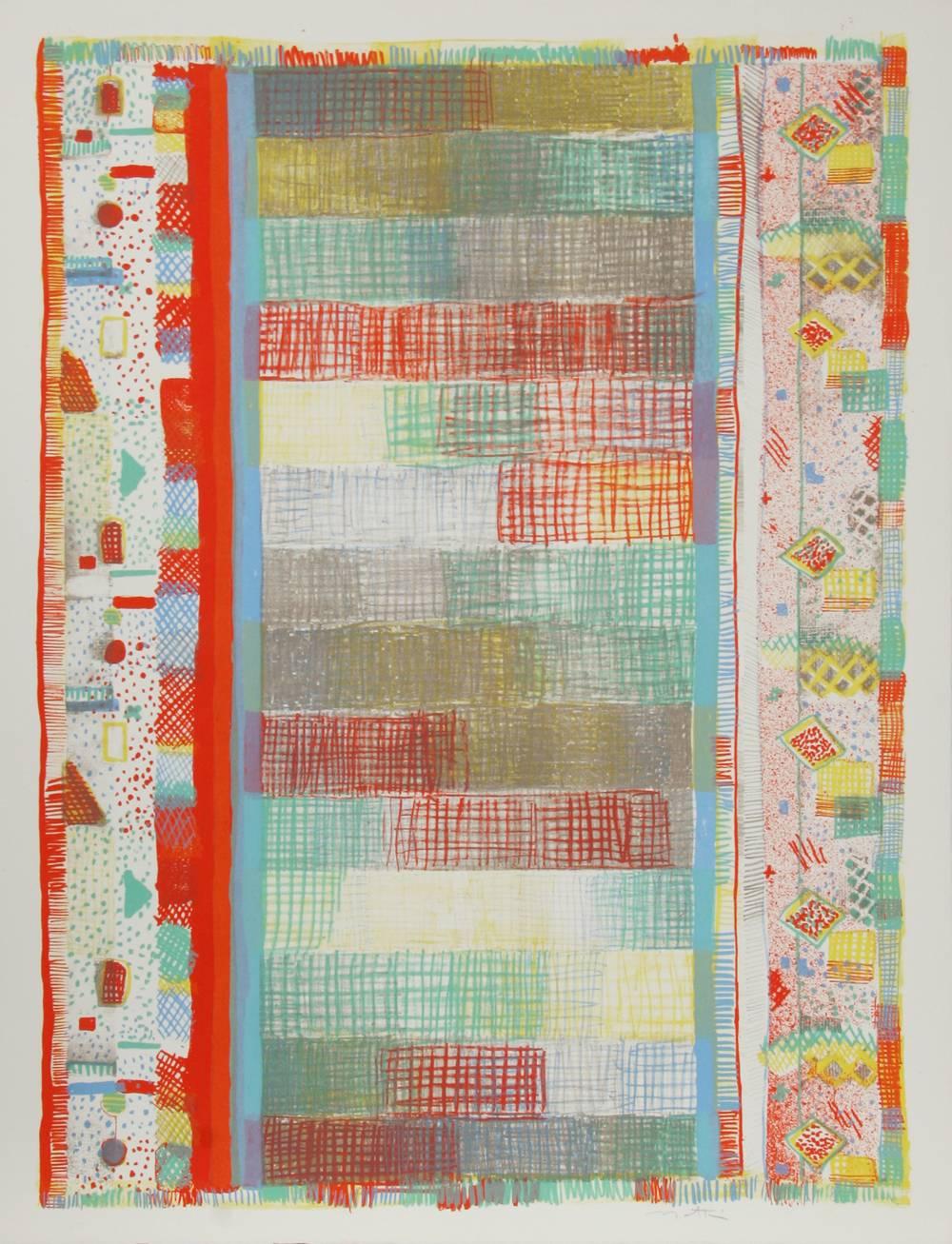
Pietro Consagra (Italian, 1920-2005). Hand signed in pencil and numbered limited edition color lithograph on Magnani paper. Embossed stamp with limited edition numbers in pencil to lower left, and having artist pencil signature to lower right. (from a limited edition of 80 with 15 artist's proofs) Published by Stamperia 2RC, Rome Italy and Marlborough Gallery, Rome, Italy. Abstract Modernist work in colors, produced in the style of the Forma art movement of Postwar Italy, of which the artist was a prominent member. Pietro Consagra (1920 – 2005) was an Italian Post war artist working in painting, printmaking and sculpture. In 1947 he was among the founding members of the Forma 1 group of artists, proponents of structured abstraction. (similar to the Art Informel and Art Brut in France and the Brutalist artists) Consagra was born on 6 October 1920 in Mazara del Vallo, in the province of Trapani in south-western Sicily, to Luigi Consagra and Maria Lentini. From 1931 he enrolled in a trade school for sailors, studying first to become a mechanic, and later to become a captain. In 1938 he moved to Palermo, where he enrolled in the liceo artistico; despite an attack of tuberculosis, he graduated in 1941, and in the same year signed up at the Accademia di Belle Arti, where he studied sculpture under Archimede Campini. After the Invasion of Sicily and the Allied occupation of Palermo in 1943, Consagra found work as a caricaturist for the American Red Cross club of the city; he also joined the Italian Communist Party. Early in 1944, armed with a letter of introduction from an American officer, he travelled to Rome. There he came into contact with the Sicilian artist Concetto Maugeri, and through him with Renato Guttuso, who was also Sicilian and who introduced him to the intellectual life of the city and to other postwar artists such as Leoncillo Leonardi, Mario Mafai and Giulio Turcato. Consagra signed up at the Accademia di Belle Arti di Roma in September 1944 and studied sculpture there under Michele Guerrisi, but left before completing his diploma. In 1947, with Carla Accardi, Ugo Attardi, Piero Dorazio, Mino Guerrini, Achille Perilli, Antonio Sanfilippo and Giulio Turcato, Consagra started the artist's group Forma 1, which advocated both Marxism and structured abstraction. Steadily Consagra's work began to find an audience. Working primarily in metal, and later in marble and wood, his thin, roughly carved reliefs, began to be collected by Peggy Guggenheim and other important patrons of the arts. He showed at the Venice Biennale eleven times between 1950 and 1993, and in 1960 won the sculpture prize at the exhibition. During the 1960s he was associated with the Continuità group, an offshoot of Forma I, and in 1967 taught at the School of Arts in Minneapolis. Large commissions allowed him to begin working on a more monumental scale, and works of his were installed in the courtyard of the Foreign Ministry in Rome and in the European Parliament, Strasbourg. His work is found in the collections of The Tate Gallery, London, in Museo Cantonale d'Arte of Lugano and the Museum of Modern Art, Paris, and the National Gallery of Art in Washington, D.C.. Consagra returned to Sicily where he sculpted a number of significant works during the 1980s. With Senator Ludovico Corrao, he helped created an open-air museum in the new town of Gibellina, after the older town had been destroyed in the earthquake of 1968. Consagra designed the gates to the town's entrance, the building named "Meeting" and the gates to the cemetery, where he was later buried. In 1952 Consagra published La necessità della scultura ("the need for sculpture"), a response to the essay La scultura lingua morta ("sculpture, a dead language"), published in 1945 by Arturo Martini. Other works include L'agguato c'è ("the snare exists", 1960), and La città frontale ("the frontal city", 1969). His autobiography, Vita Mia, was published by Feltrinelli in 1980. In 1989 a substantial retrospective exhibition of work by Consagra was shown at the Galleria Nazionale d'Arte Moderna in Rome; in 1993 a permanent exhibition of his work was installed there. In 1991 his work was shown in the Hermitage Museum in St. Petersburg. In 2002 the Galerie der Stadt Stuttgart opened a permanent exhibition of his work. He was one of ten artists invited by Giovanni Carandente, along with David Smith, Alexander Calder, Arnaldo Pomodoro, Lynn Chadwick, and Beverly Pepper, to fabricate works in Italsider factories in Italy for an outdoor exhibition, "Sculture nella città", held in Spoleto during the summer of 1962. He was included in the The 1962 International Prize for Sculpture the jury included Argan, Romero Brest and James Johnson Sweeney the former director of the Solomon R. Guggenheim Museum in New York. The participants included Louise Nevelson and John Chamberlain for the United States; Lygia Clark for Brazil; Pietro Consagra, Lucio Fontana, Nino Franchina, and Gió Pomodoro for Italy; Pablo Serrano for Spain; and Eduardo Paolozzi, William Turnbull, and Kenneth Armitage for England. Gyula Kosice, Noemí Gerstein...

Category

1960s Abstract Expressionist Abstract Prints
Materials

Lithograph

Pietro Consagra Italian Mod Abstract Expressionist Forma Art Informel Lithograph

Pietro Consagra Italian Mod Abstract Expressionist Forma Art Informel Lithograph

By Pietro Consagra

Located in Surfside, FL

Pietro Consagra (Italian, 1920-2005). Hand signed in pencil and numbered limited edition color lithograph on Magnani paper. Embossed stamp with limited edition numbers in pencil to lower left, and having artist pencil signature to lower right. (from a limited edition of 80 with 15 artist's proofs) Published by Stamperia 2RC, Rome Italy and Marlborough Gallery, Rome, Italy. Abstract Modernist work in colors, produced in the style of the Forma art movement of Postwar Italy, of which the artist was a prominent member. Pietro Consagra (1920 – 2005) was an Italian Post war artist working in painting, printmaking and sculpture. In 1947 he was among the founding members of the Forma 1 group of artists, proponents of structured abstraction. (similar to the Art Informel and Art Brut in France and the Brutalist artists) Consagra was born on 6 October 1920 in Mazara del Vallo, in the province of Trapani in south-western Sicily, to Luigi Consagra and Maria Lentini. From 1931 he enrolled in a trade school for sailors, studying first to become a mechanic, and later to become a captain. In 1938 he moved to Palermo, where he enrolled in the liceo artistico; despite an attack of tuberculosis, he graduated in 1941, and in the same year signed up at the Accademia di Belle Arti, where he studied sculpture under Archimede Campini. After the Invasion of Sicily and the Allied occupation of Palermo in 1943, Consagra found work as a caricaturist for the American Red Cross club of the city; he also joined the Italian Communist Party. Early in 1944, armed with a letter of introduction from an American officer, he travelled to Rome. There he came into contact with the Sicilian artist Concetto Maugeri, and through him with Renato Guttuso, who was also Sicilian and who introduced him to the intellectual life of the city and to other postwar artists such as Leoncillo Leonardi, Mario Mafai and Giulio Turcato. Consagra signed up at the Accademia di Belle Arti di Roma in September 1944 and studied sculpture there under Michele Guerrisi, but left before completing his diploma. In 1947, with Carla Accardi, Ugo Attardi, Piero Dorazio, Mino Guerrini, Achille Perilli, Antonio Sanfilippo and Giulio Turcato, Consagra started the artist's group Forma 1, which advocated both Marxism and structured abstraction. Steadily Consagra's work began to find an audience. Working primarily in metal, and later in marble and wood, his thin, roughly carved reliefs, began to be collected by Peggy Guggenheim and other important patrons of the arts. He showed at the Venice Biennale eleven times between 1950 and 1993, and in 1960 won the sculpture prize at the exhibition. During the 1960s he was associated with the Continuità group, an offshoot of Forma I, and in 1967 taught at the School of Arts in Minneapolis. Large commissions allowed him to begin working on a more monumental scale, and works of his were installed in the courtyard of the Foreign Ministry in Rome and in the European Parliament, Strasbourg. His work is found in the collections of The Tate Gallery, London, in Museo Cantonale d'Arte of Lugano and the Museum of Modern Art, Paris, and the National Gallery of Art in Washington, D.C.. Consagra returned to Sicily where he sculpted a number of significant works during the 1980s. With Senator Ludovico Corrao, he helped created an open-air museum in the new town of Gibellina, after the older town had been destroyed in the earthquake of 1968. Consagra designed the gates to the town's entrance, the building named "Meeting" and the gates to the cemetery, where he was later buried. In 1952 Consagra published La necessità della scultura ("the need for sculpture"), a response to the essay La scultura lingua morta ("sculpture, a dead language"), published in 1945 by Arturo Martini. Other works include L'agguato c'è ("the snare exists", 1960), and La città frontale ("the frontal city", 1969). His autobiography, Vita Mia, was published by Feltrinelli in 1980. In 1989 a substantial retrospective exhibition of work by Consagra was shown at the Galleria Nazionale d'Arte Moderna in Rome; in 1993 a permanent exhibition of his work was installed there. In 1991 his work was shown in the Hermitage Museum in St. Petersburg. In 2002 the Galerie der Stadt Stuttgart opened a permanent exhibition of his work. He was one of ten artists invited by Giovanni Carandente, along with David Smith, Alexander Calder, Arnaldo Pomodoro, Lynn Chadwick, and Beverly Pepper, to fabricate works in Italsider factories in Italy for an outdoor exhibition, "Sculture nella città", held in Spoleto during the summer of 1962. He was included in the The 1962 International Prize for Sculpture the jury included Argan, Romero Brest and James Johnson Sweeney the former director of the Solomon R. Guggenheim Museum in New York. The participants included Louise Nevelson and John Chamberlain for the United States; Lygia Clark for Brazil; Pietro Consagra, Lucio Fontana, Nino Franchina, and Gió Pomodoro for Italy; Pablo Serrano for Spain; and Eduardo Paolozzi, William Turnbull, and Kenneth Armitage for England. Gyula Kosice, Noemí Gerstein...

Category

1960s Abstract Expressionist Abstract Prints
Materials

Lithograph

Abstract Latin American Art Spanish Catalan Lithograph Josep Guinovart New York

Abstract Latin American Art Spanish Catalan Lithograph Josep Guinovart New York

By Josep Guinovart Bertrán

Located in Surfside, FL

Guinovart, Josep (Spanish/Catalan, 1927-2007), Untitled Abstract, 1984, lithograph on paper, hand signed, dated and marked E.A. (artist's proof) in pencil at bottom, full sheet 26.75 x 22 inches, unframed. Josep Guinovart (1927 –2007) was a Spanish Catalan painter most famous for his informalist or abstract expressionist work. In 1941, he began to work as a decorator. Three years later, he started his studies at the Escuela de Artes y Oficios de la Llotja (Art School of La Llotja) where he stayed until 1946. He first exhibited his work in 1948 in Galerías Syla in Barcelona. In 1951, he produced his first engravings entitled 'Homage to Federico García Lorca'. Two years later, he was awarded a grant from the French Institute to study in Paris for nine months. Here he discovered the cubist works of Henri Matisse and Pablo Picasso and travelled to Belgium, Holland and Germany. On his return to Barcelona and after a period working as an illustrator and set designer, around 1957 he began moving towards abstract art. His work is highly unconventional and usually on a large scale, using a wide range of materials, three-dimensional objects and organic substances such as eggshell, earth and straw. In 1962, he illustrated a book of poetry entitled Posies by Joan Salvat-Papasseit for the Ariel Editorial. He won many accolades for his work throughout the 1970s and 80s, including Spain's National Award for Plastic Arts in 1982. In 1994, a museum foundation dedicated to his art was inaugurated in Agramunt, his mother's birthplace to which he always felt a special attachment. In 2006 he designed the winery Mas Blanch i Jové in La Pobla de Cérvoles (Lleida) and created The Artists' Vineyard, a project intended to mix sculptures and other art works from different artists in the middle of a vineyard. The Artists' Vineyard was inaugurated after his death in 2010 with the unveiling of his sculpture The Countryside Organ: a music instrument, 6 meters height, for the wind to sing the vines. This winery also displays the 10.5 meters work In Vino Veritas...

Category

1980s Abstract Abstract Prints

Materials

Lithograph

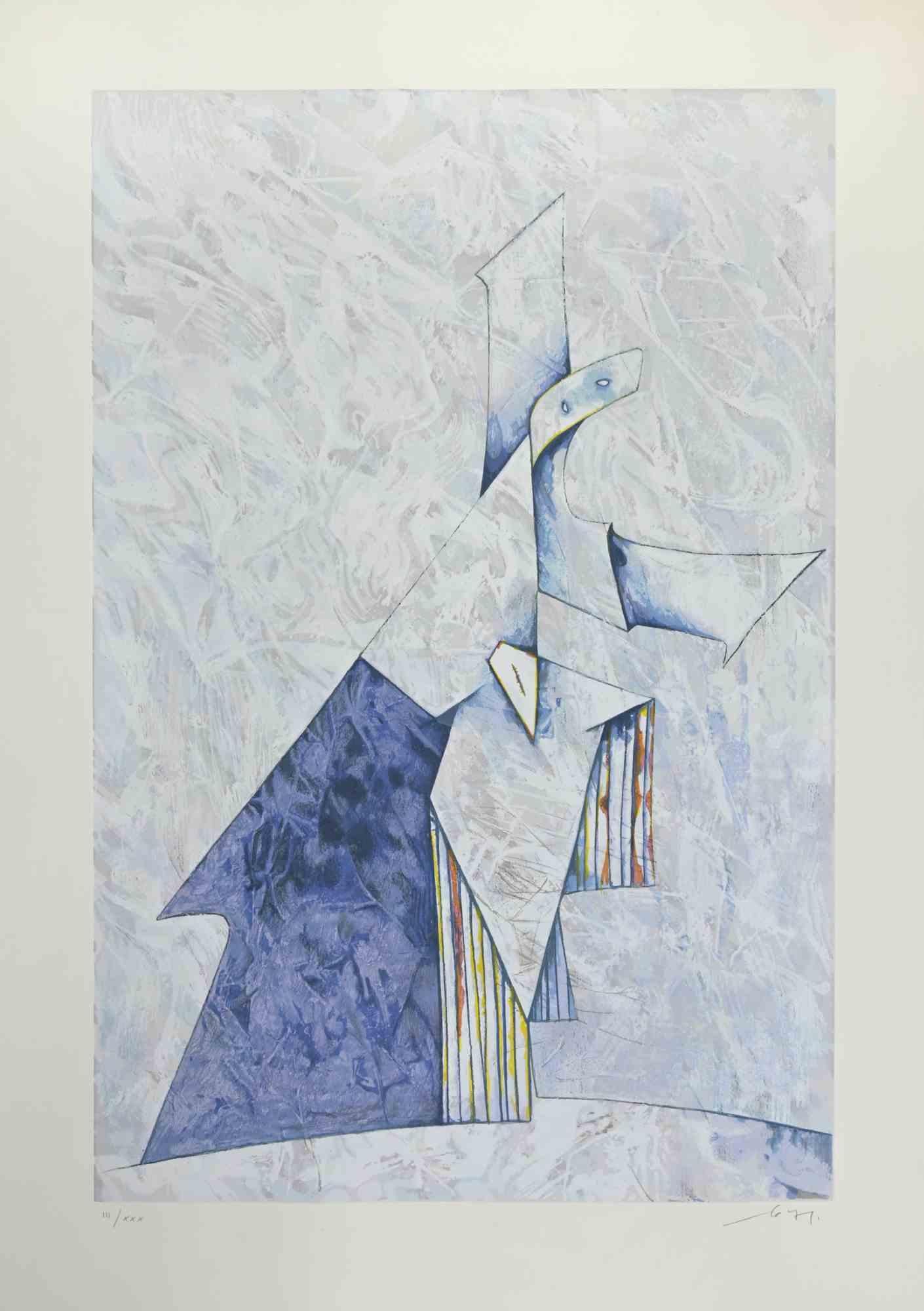
Pietro Consagra Italian Mod Abstract Expressionist Forma, Art Brut Lithograph

Pietro Consagra Italian Mod Abstract Expressionist Forma, Art Brut Lithograph

By Pietro Consagra

Located in Surfside, FL

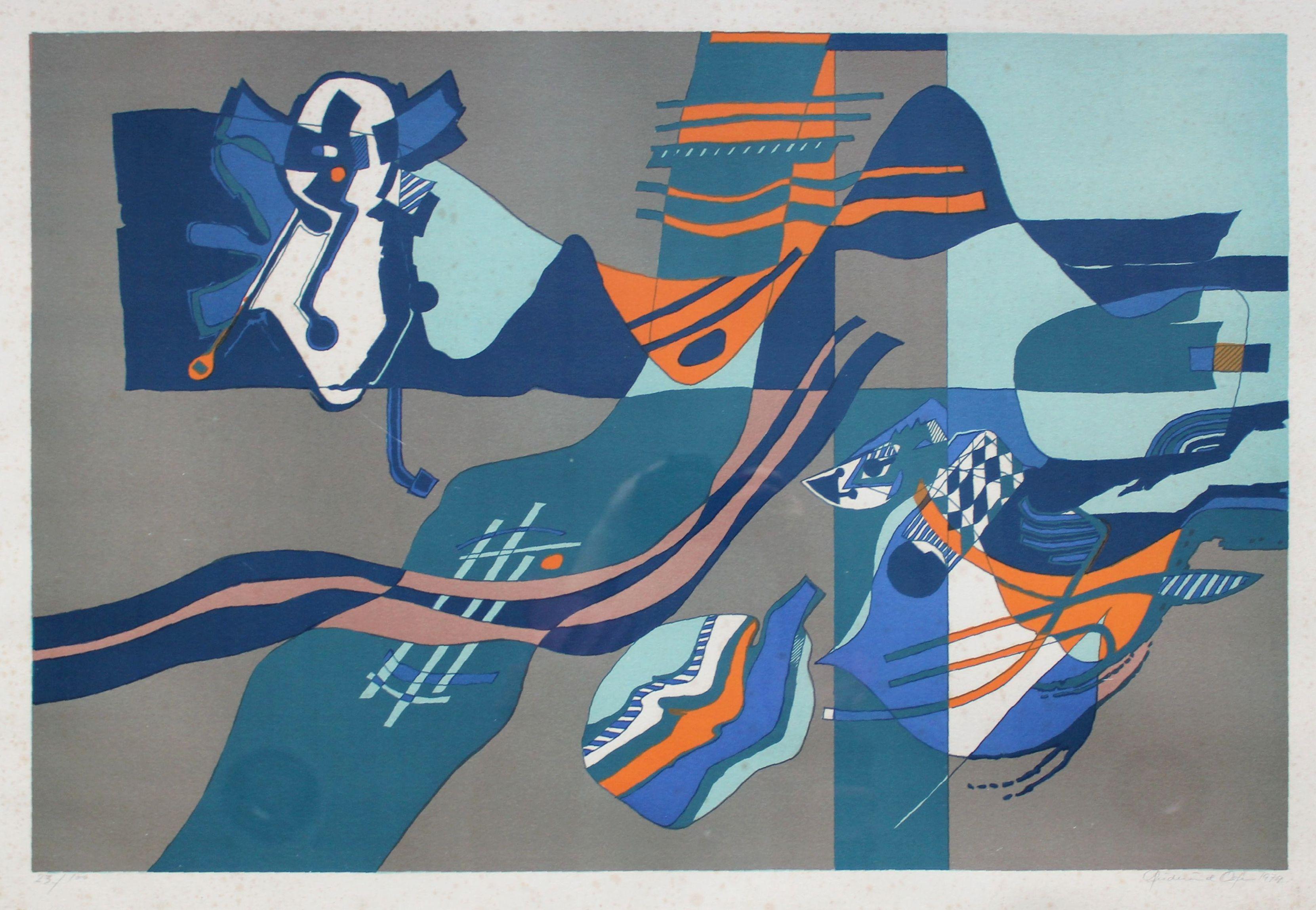
Pietro Consagra (Italian, 1920-2005). Hand signed in pencil and numbered limited edition color lithograph on Magnani paper. Embossed stamp with limited edition numbers in pencil to lower left, and having artist pencil signature to lower right. (from a limited edition of 80 with 15 artist's proofs) Published by Stamperia 2RC, Rome Italy and Marlborough Gallery, Rome, Italy. Abstract Modernist work in colors, produced in the style of the Forma art movement of Postwar Italy, of which the artist was a prominent member. Pietro Consagra (1920 – 2005) was an Italian Post war artist working in painting, printmaking and sculpture. In 1947 he was among the founding members of the Forma 1 group of artists, proponents of structured abstraction. (similar to the Art Informel and Art Brut in France and the Brutalist artists) Consagra was born on 6 October 1920 in Mazara del Vallo, in the province of Trapani in south-western Sicily, to Luigi Consagra and Maria Lentini. From 1931 he enrolled in a trade school for sailors, studying first to become a mechanic, and later to become a captain. In 1938 he moved to Palermo, where he enrolled in the liceo artistico; despite an attack of tuberculosis, he graduated in 1941, and in the same year signed up at the Accademia di Belle Arti, where he studied sculpture under Archimede Campini. After the Invasion of Sicily and the Allied occupation of Palermo in 1943, Consagra found work as a caricaturist for the American Red Cross club of the city; he also joined the Italian Communist Party. Early in 1944, armed with a letter of introduction from an American officer, he travelled to Rome. There he came into contact with the Sicilian artist Concetto Maugeri, and through him with Renato Guttuso, who was also Sicilian and who introduced him to the intellectual life of the city and to other postwar artists such as Leoncillo Leonardi, Mario Mafai and Giulio Turcato. Consagra signed up at the Accademia di Belle Arti di Roma in September 1944 and studied sculpture there under Michele Guerrisi, but left before completing his diploma. In 1947, with Carla Accardi, Ugo Attardi, Piero Dorazio, Mino Guerrini, Achille Perilli, Antonio Sanfilippo and Giulio Turcato, Consagra started the artist's group Forma 1, which advocated both Marxism and structured abstraction. Steadily Consagra's work began to find an audience. Working primarily in metal, and later in marble and wood, his thin, roughly carved reliefs, began to be collected by Peggy Guggenheim and other important patrons of the arts. He showed at the Venice Biennale eleven times between 1950 and 1993, and in 1960 won the sculpture prize at the exhibition. During the 1960s he was associated with the Continuità group, an offshoot of Forma I, and in 1967 taught at the School of Arts in Minneapolis. Large commissions allowed him to begin working on a more monumental scale, and works of his were installed in the courtyard of the Foreign Ministry in Rome and in the European Parliament, Strasbourg. His work is found in the collections of The Tate Gallery, London, in Museo Cantonale d'Arte of Lugano and the Museum of Modern Art, Paris, and the National Gallery of Art in Washington, D.C.. Consagra returned to Sicily where he sculpted a number of significant works during the 1980s. With Senator Ludovico Corrao, he helped created an open-air museum in the new town of Gibellina, after the older town had been destroyed in the earthquake of 1968. Consagra designed the gates to the town's entrance, the building named "Meeting" and the gates to the cemetery, where he was later buried. In 1952 Consagra published La necessità della scultura ("the need for sculpture"), a response to the essay La scultura lingua morta ("sculpture, a dead language"), published in 1945 by Arturo Martini. Other works include L'agguato c'è ("the snare exists", 1960), and La città frontale ("the frontal city", 1969). His autobiography, Vita Mia, was published by Feltrinelli in 1980. In 1989 a substantial retrospective exhibition of work by Consagra was shown at the Galleria Nazionale d'Arte Moderna in Rome; in 1993 a permanent exhibition of his work was installed there. In 1991 his work was shown in the Hermitage Museum in St. Petersburg. In 2002 the Galerie der Stadt Stuttgart opened a permanent exhibition of his work. He was one of ten artists invited by Giovanni Carandente, along with David Smith, Alexander Calder, Arnaldo Pomodoro, Lynn Chadwick, and Beverly Pepper, to fabricate works in Italsider factories in Italy for an outdoor exhibition, "Sculture nella città", held in Spoleto during the summer of 1962. He was included in the The 1962 International Prize for Sculpture the jury included Argan, Romero Brest and James Johnson Sweeney the former director of the Solomon R. Guggenheim Museum in New York. The participants included Louise Nevelson and John Chamberlain for the United States; Lygia Clark for Brazil; Pietro Consagra, Lucio Fontana, Nino Franchina, and Gió Pomodoro for Italy; Pablo Serrano for Spain; and Eduardo Paolozzi, William Turnbull, and Kenneth Armitage for England. Gyula Kosice, Noemí Gerstein...

Category

1960s Abstract Expressionist Abstract Prints
Materials

Lithograph

You May Also Like

Colorful Abstract Expressionist Lithograph by Robert Natkin

Colorful Abstract Expressionist Lithograph by Robert Natkin

By Robert Natkin

Located in Long Island City, NY

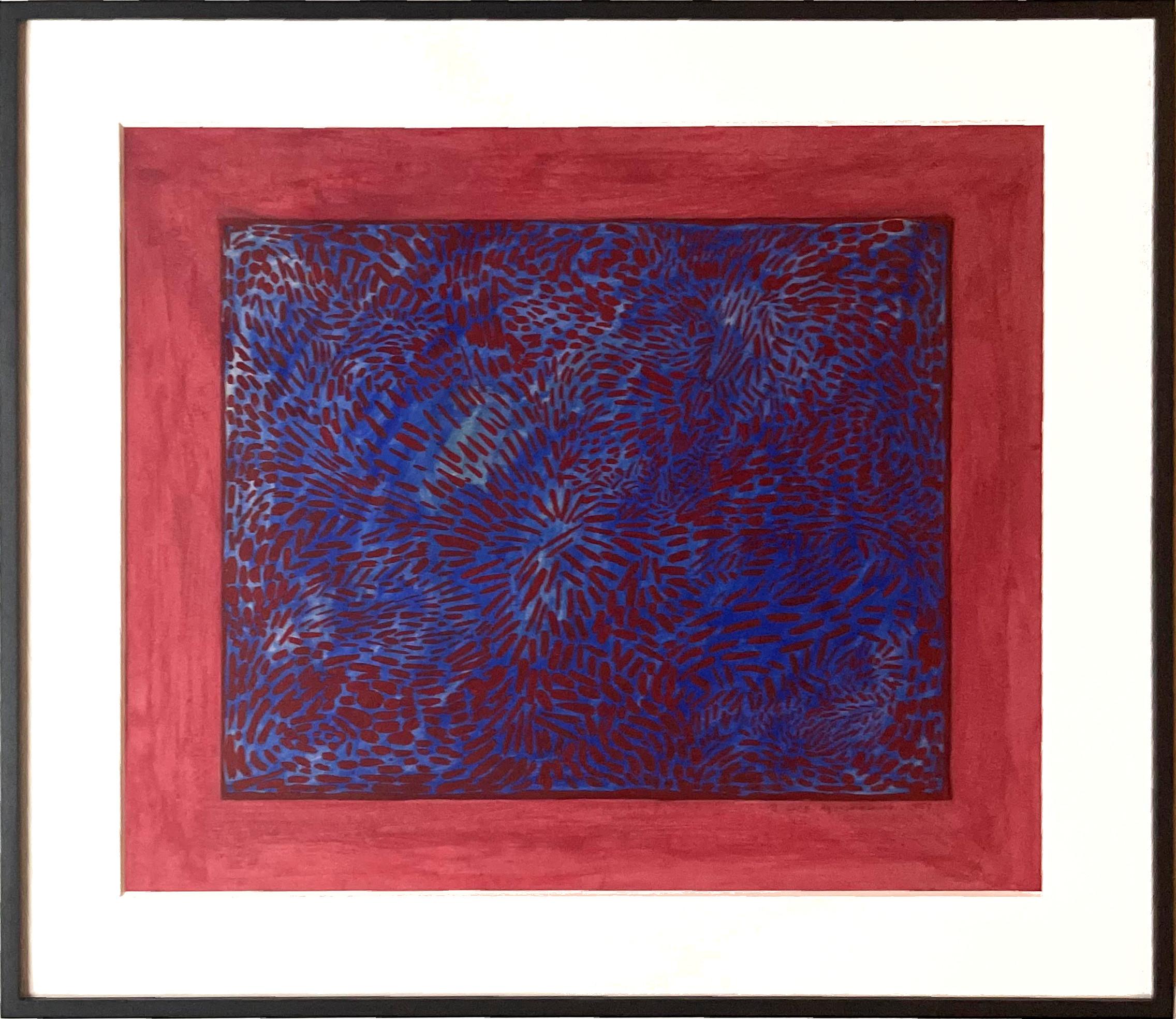
Artist: Robert Natkin, American (1930 - 2010) Title: Untitled - V Year: circa 1977 Medium: Lithograph, Signed in Pencil Size: 31 in. x 24 in. (78.74 cm x 60.96 cm)

Category

1970s Abstract Expressionist Abstract Prints
Materials

Lithograph

Abstract Composition - Screen Print by Giulio Turcato - 1970s

Abstract Composition - Screen Print by Giulio Turcato - 1970s

By Giulio Turcato

Located in Roma, IT

Abstract Composition is a colored screen print realized by the contemporary artist  Giulio Turcato in 1970s. Hand-signed in pencil on the lower right. Numbered on the lower left ma...

Category

1970s Abstract Abstract Prints

Materials

Screen

Untitled Abstract Screen Print, Signed, Edition 64/100, 1970s

Untitled Abstract Screen Print, Signed, Edition 64/100, 1970s

By Piero Dorazio

Located in Roma, IT

Untitled is an original contemporary artwork realized by Piero Dorazio in 1970s. A mixed colored screen print. Hand signed by the artist on the lower right margin. Good conditions ...

Category

1970s Abstract Abstract Prints

Materials

Screen

1970s Italian Signed Modern Abstract Painting by Riccardo Licata

1970s Italian Signed Modern Abstract Painting by Riccardo Licata

By Riccardo Licata

Located in Roma, IT

Important watercolour on paper 'Untitled' by the great Italian artist Riccardo Licata. Dated and signed at lower right "74 Licata". This work is representative at the highest level ...

Category

Mid-20th Century Abstract Abstract Paintings

Materials

Paper, Watercolor

Abstract - Screen Print by Giulio Turcato - 1970s

Abstract - Screen Print by Giulio Turcato - 1970s

By Giulio Turcato

Located in Roma, IT

Abstraction is a colored screen print realized by the contemporary artist Giulio Turcato in 1970s. Hand-signed in pencil on the lower right. Numbered on the lower left margin, edit...

Category

1970s Abstract Abstract Prints

Materials

Paper, Screen