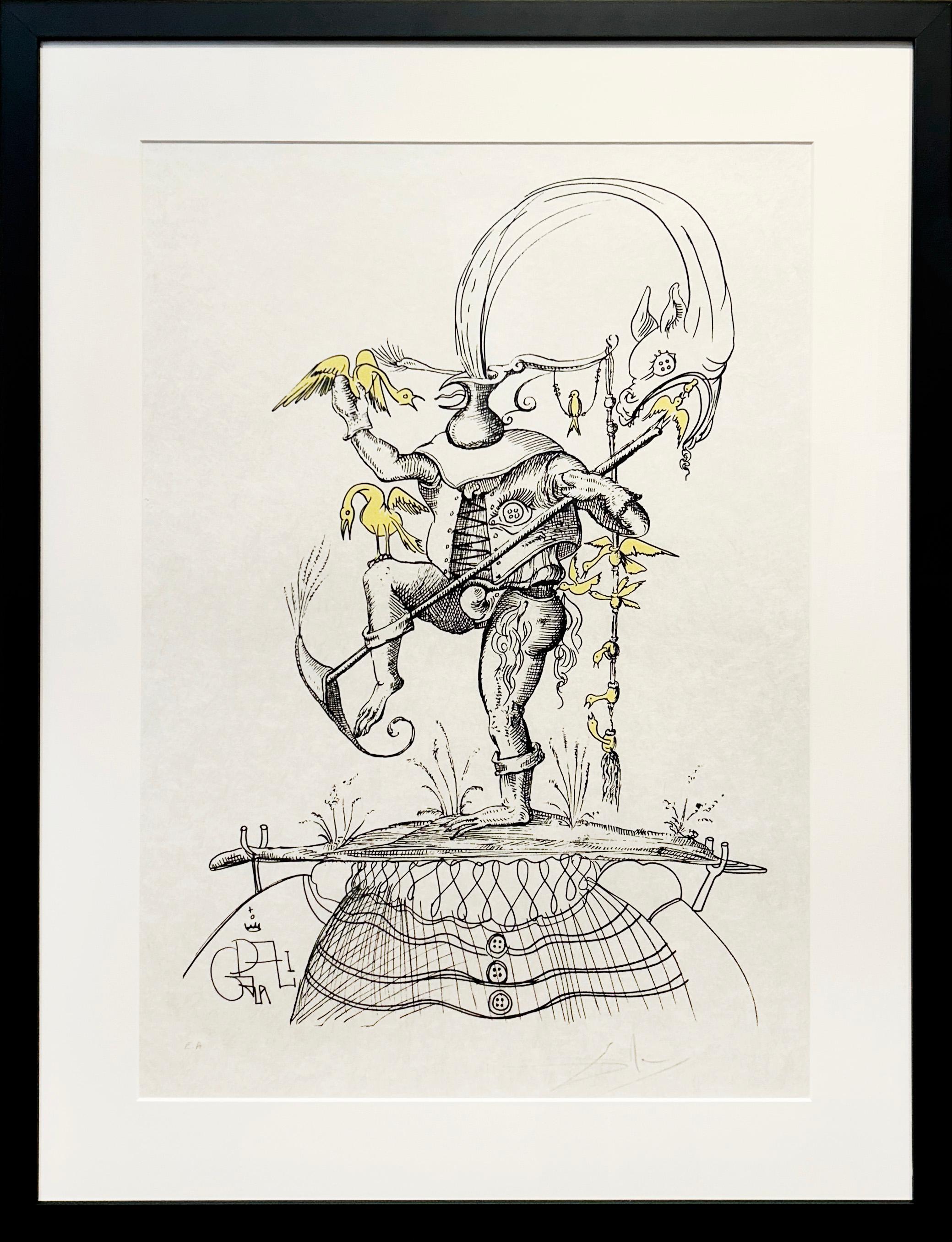
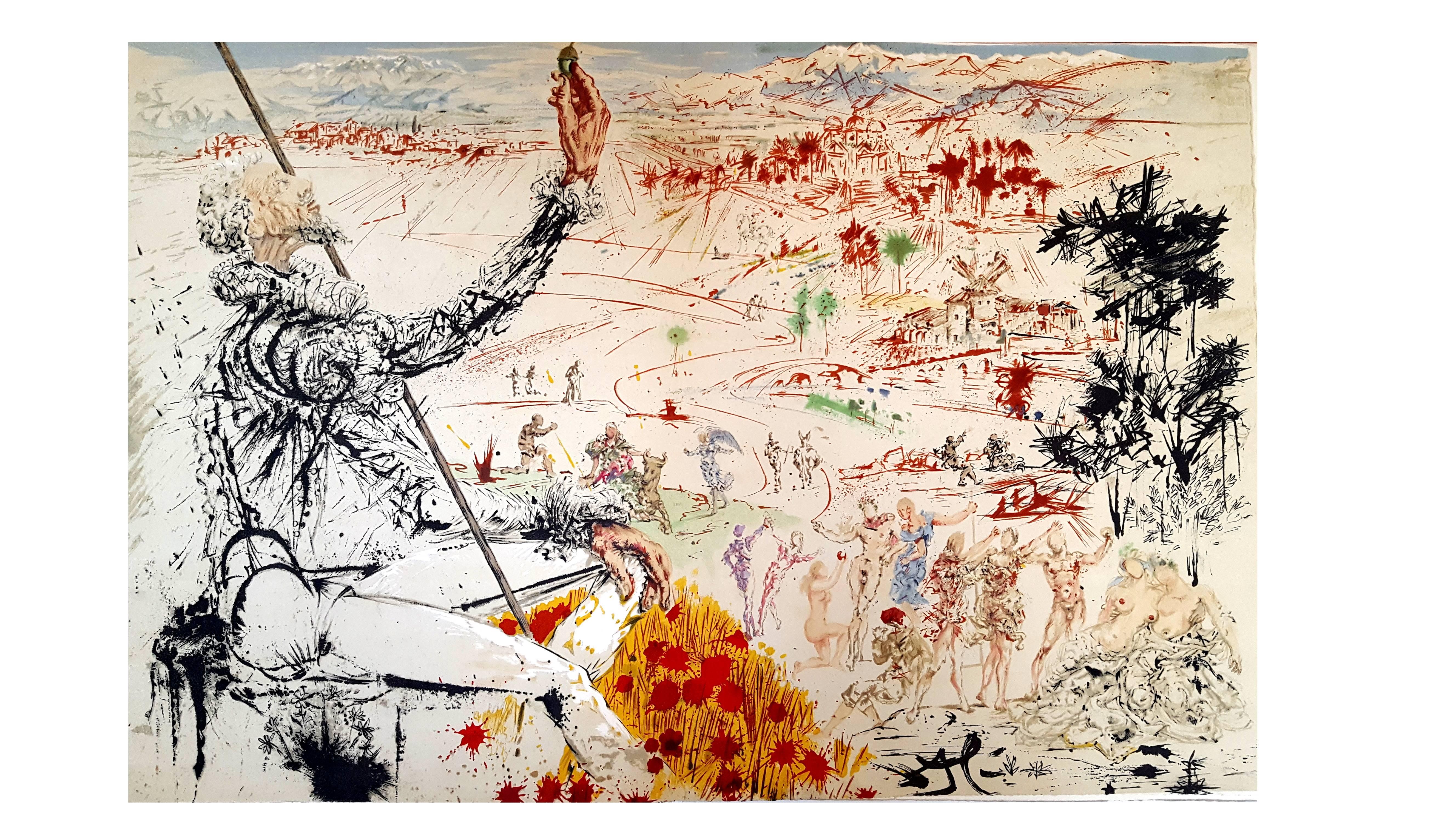
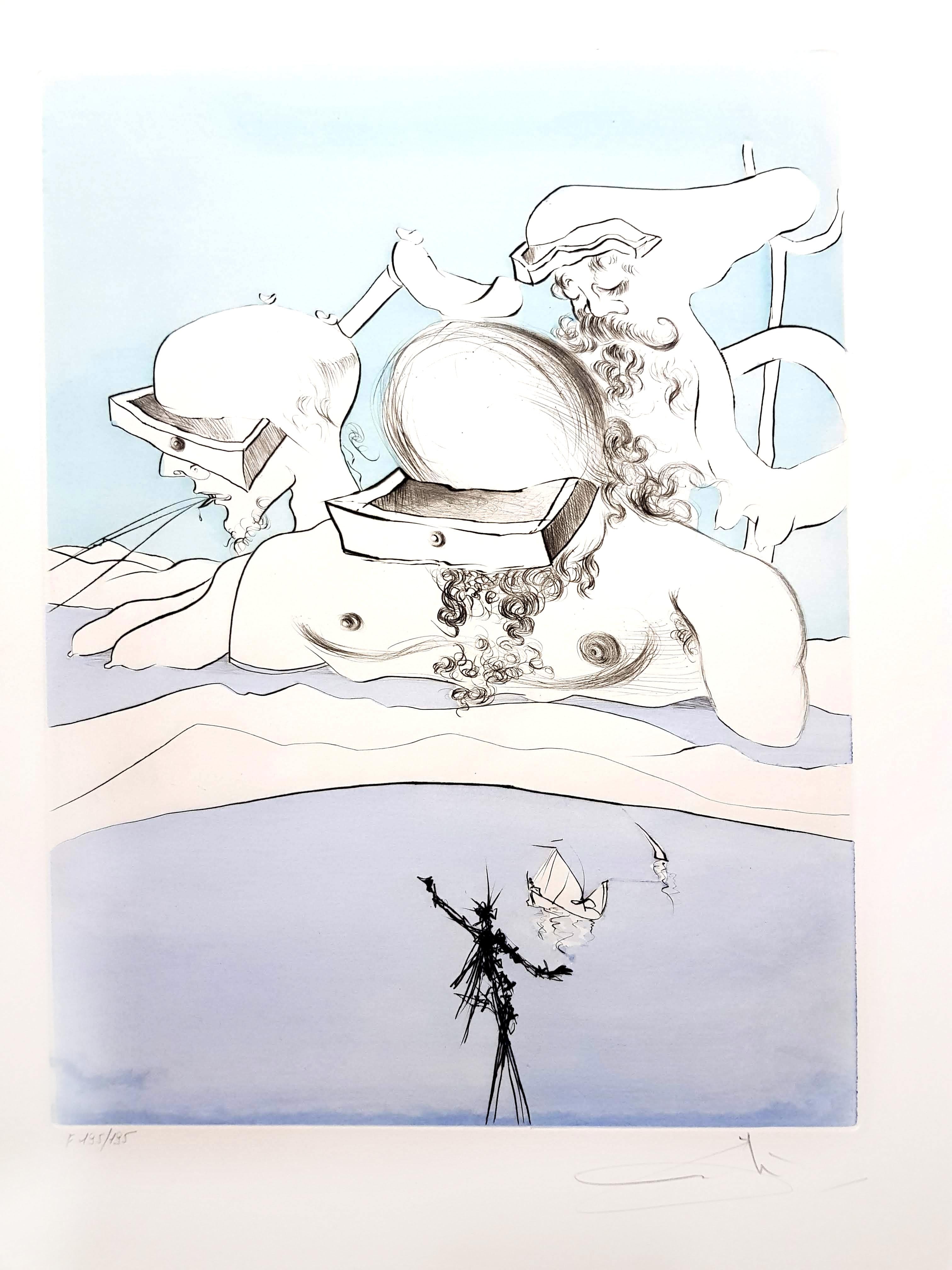
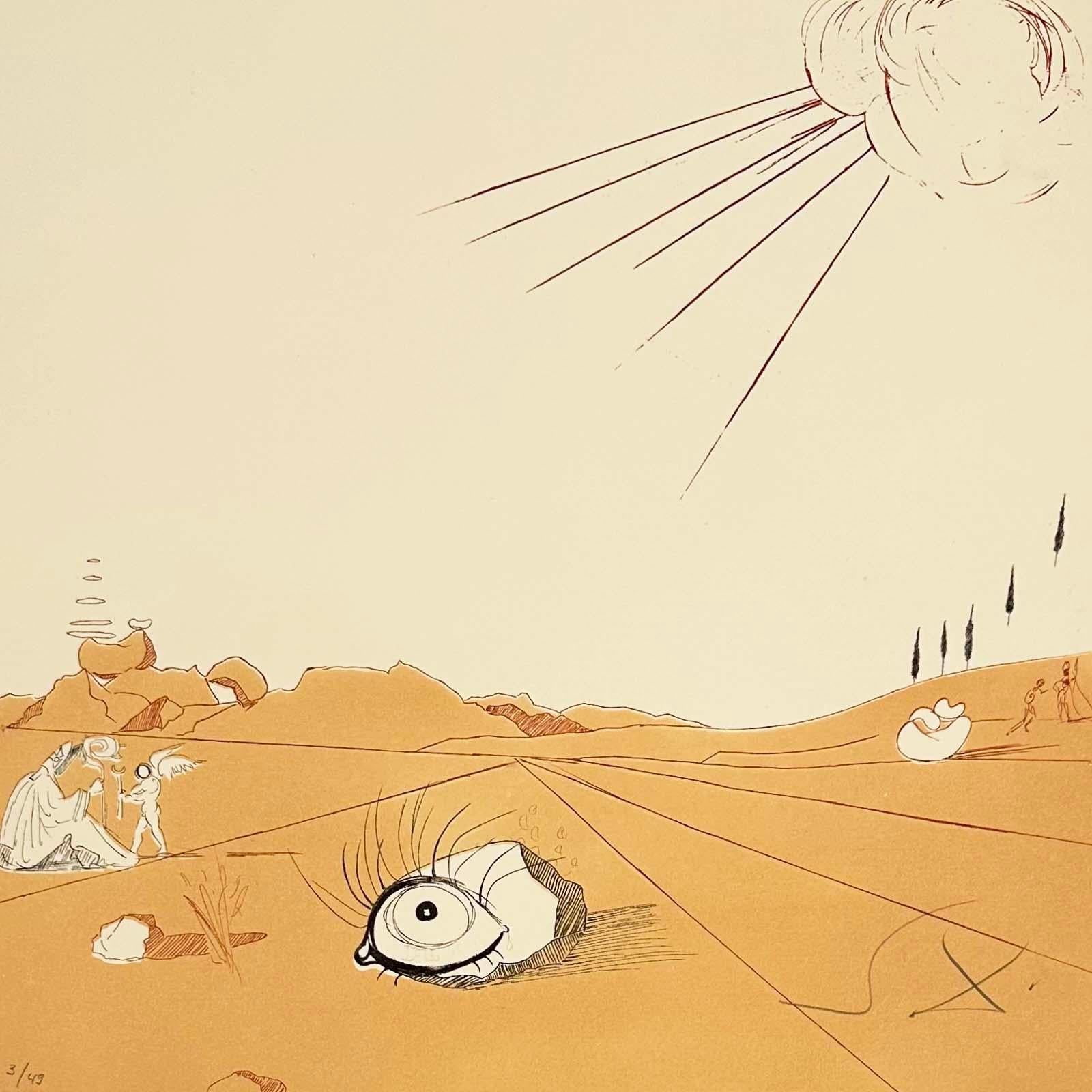
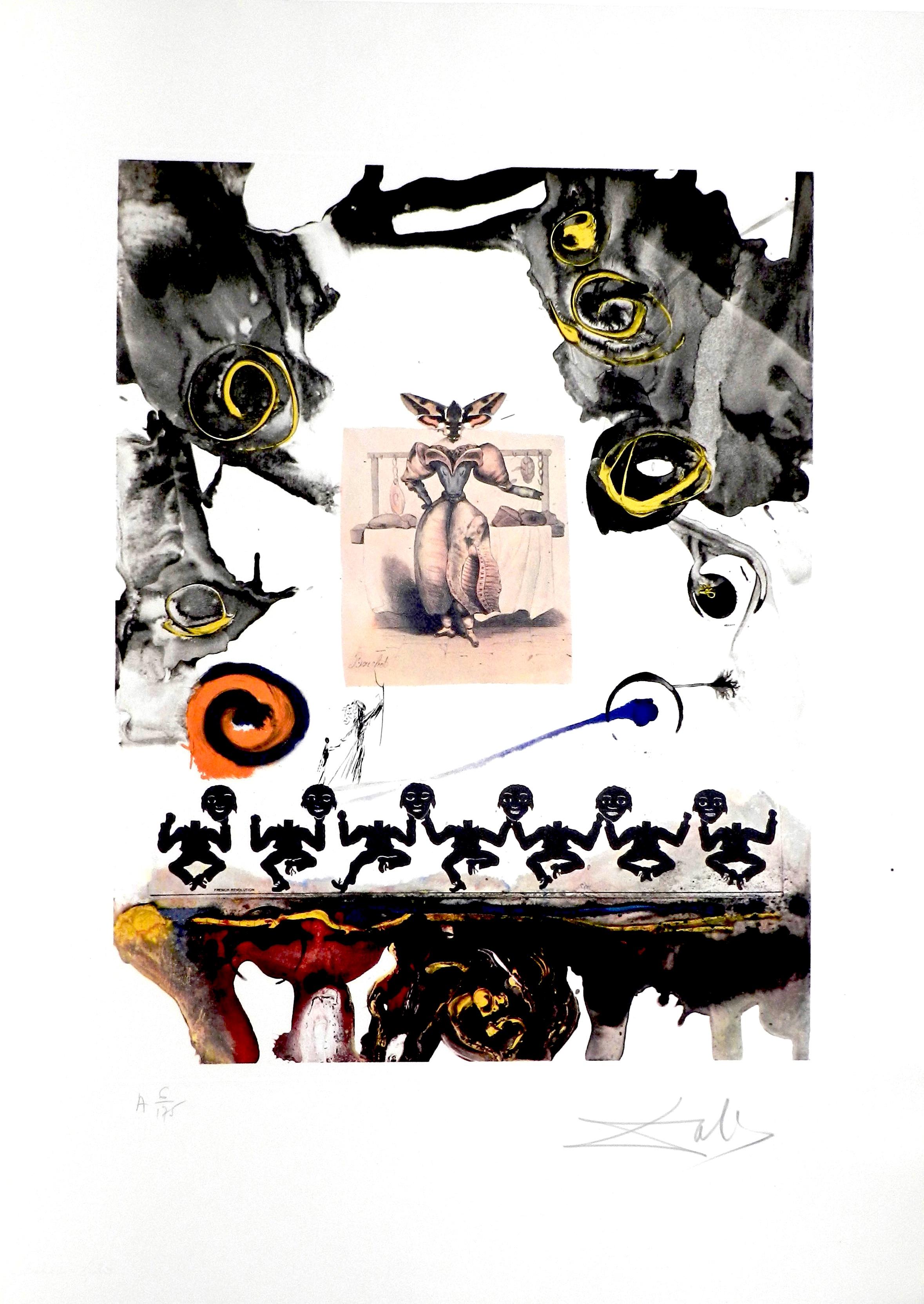
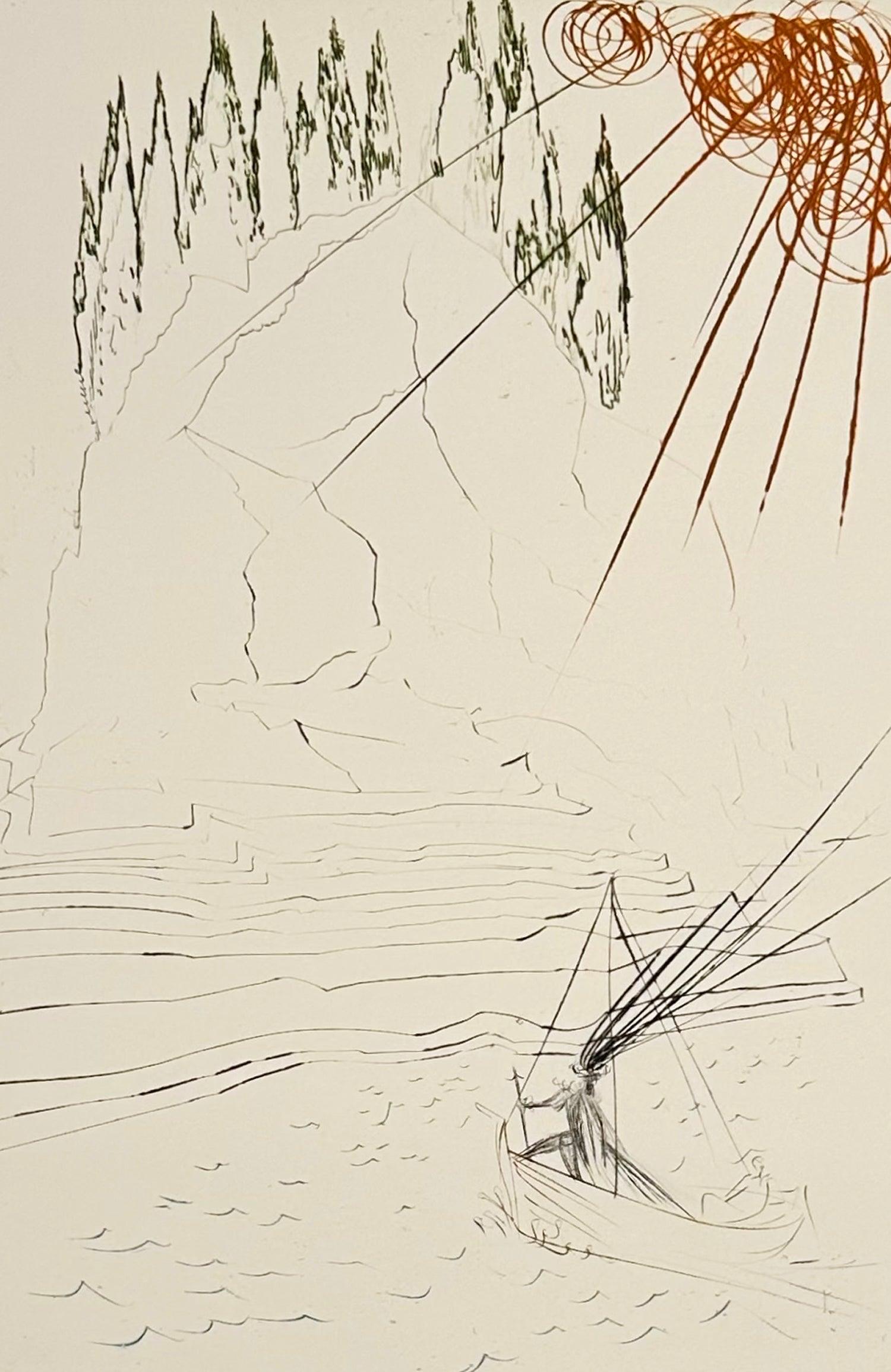
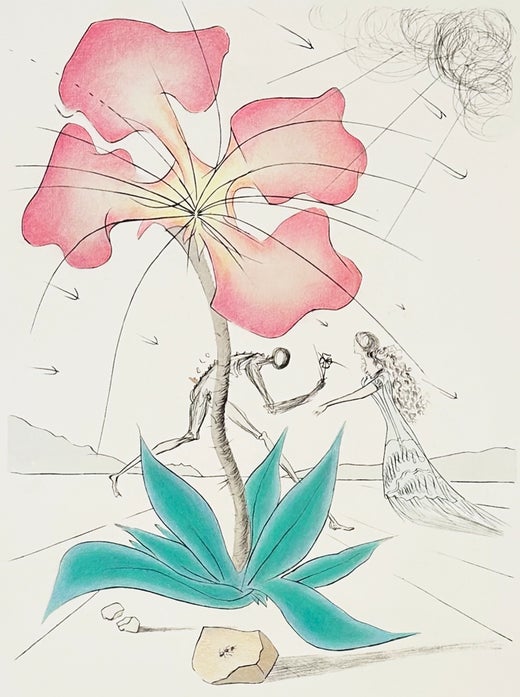
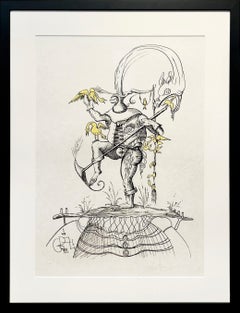
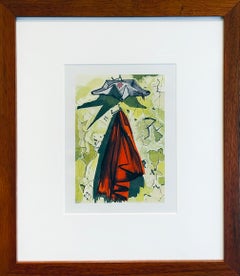
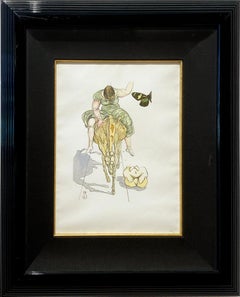
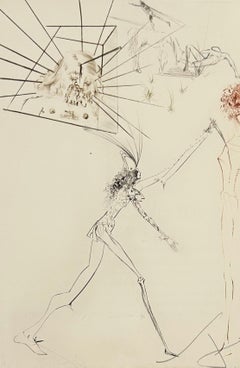
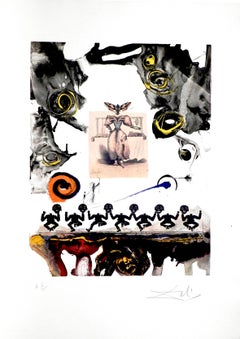
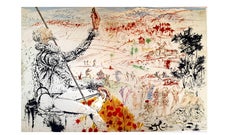
This exquisite engraving by Salvador Dali (1904–1989), titled Sans titre (Untitled), from the folio Le Tricorne (The Three-Cornered Hat), originates from the 1958 edition published by Editions du Rocher, Monaco; printed by Ateliers Rigal, Paris, December 20, 1958. The composition reflects Dali’s extraordinary command of classical engraving combined with his visionary Surrealist imagination, where theatrical narrative, symbolic gesture, and meticulous line converge in a dramatic interpretation inspired by Spanish cultural traditions.
Executed as an engraving on papier d'Auvergne, filigrane au Tricorne, specialement fabrique feuille a feuille a la main par les Moulins a papier du Val de Laga, Richard-de-Bas, a Ambert paper, this work measures 12.087 x 10.079 inches (30.70 x 25.60 cm), overall; 8.46 x 5.91 inches (21.49 x 15.01 cm), image. Signed in the plate and unnumbered as issued.
Artwork Details:
Artist: Salvador Dali (1904–1989)
Title: Sans titre (Untitled), from Le Tricorne (The Three-Cornered Hat)
Medium: Engraving on papier d'Auvergne, filigrane au Tricorne, specialement fabrique feuille a feuille a la main par les Moulins a papier du Val de Laga, Richard-de-Bas, a Ambert paper
Dimensions: 12.087 x 10.079 inches (30.70 x 25.60 cm), overall; 8.46 x 5.91 inches (21.49 x 15.01 cm), image
Inscription: Signed in the plate and unnumbered as issued
Date: 1958
Publisher: Editions du Rocher, Monaco
Printer: Ateliers Rigal, Paris
Catalogue raisonne references: Field, Albert, and Salvador Dali. The Official Catalog of the Graphic Works of Salvador Dali. S. Dali Archives, 1996, illustration 59-1; Michler, Ralf, et al. Salvador Dali : Catalogue Raisonne of Prints. Prestel, 1994, illustration 1018-1037.
Condition: Well preserved, consistent with age and medium
Provenance: From the folio Le Tricorne (The Three-Cornered Hat), 1958
Notes:
Excerpted from the folio (translated from French), Printing was completed on December 20, 1958 on the presses of Imprimerie Rigal in Paris for Editions du Rocher, Monaco. There were printed CCLX examples on papier d'Auvergne, watermarked au Tricorne, specially manufactured sheet by sheet by hand by the Moulins a papier du Val de Laga, Richard-de-Bas, at Ambert (France). CXX examples, numbered from I to CXX, including: From I to X, the color separation of one plate, a suite of the illustrations in color, and a suite in black of the thirteen plates which permit a line engraved with the burin on copper; the color separations and suites printed on Chine. From XI to XX, a suite of the illustrations in color and a suite in black of the copper plates, suites printed on Hollande. From XXI to XXX, a suite in black of the copper plates printed on the paper of the work. CXL examples, numbered in Roman numerals from I to CXL, reserved for the members of the Nouveau Cercle Parisien du Livre. For the Nouveau Cercle Parisien du Livre there were also printed: Ten suites on Chine of the color separation of one of the plates, ten suites on Chine of the illustrations in color, ten suites in black on Chine of the thirteen plates which permit a line engraved with the burin on copper, ten suites in color on Hollande of the illustrations, ten suites in black on Hollande of the copper plates, ten suites in black of the copper plates on the paper of the work. In addition, XXX examples hors commerce were printed, marked HC I to HC XXX, reserved for the publisher and his collaborators.
About the Publication:
Le Tricorne (The Three-Cornered Hat), published in Monaco in 1958 by Editions du Rocher and printed in Paris by Ateliers Rigal, represents a significant twentieth century illustrated art edition that united literary narrative, theatrical imagery, and masterful printmaking. The publication was conceived within the tradition of the French and European livre d'artiste, where artist, publisher, and printer collaborated to produce refined editions combining original graphic works with carefully structured typography and fine materials. The engravings created by Salvador Dali for the publication draw inspiration from Spanish cultural themes and dramatic spectacle, echoing the folkloric and theatrical elements associated with the legendary story of The Three-Cornered Hat. Printed on handmade papier d'Auvergne watermarked au Tricorne and produced in carefully tiered examples that included special suites and deluxe impressions, the edition reflects the continued vitality of European bibliophile publishing during the mid twentieth century. Through its combination of literature, original engraving, and exceptional craftsmanship, Le Tricorne stands as an important example of the modern illustrated folio intended for collectors, institutions, and libraries devoted to the preservation of fine art printmaking and artist illustrated editions.
About the Artist:
Salvador Dali (1904–1989) was a Spanish painter, draughtsman, printmaker, sculptor, designer, filmmaker, and writer whose astonishing technical virtuosity, theatrical imagination, and psychologically charged dream imagery established him as one of the most celebrated and recognizable artists of the twentieth century and one of the defining figures of the Surrealist movement. Born in Figueres in Catalonia, Spain, Dali demonstrated exceptional artistic talent at an early age and later studied at the Real Academia de Bellas Artes de San Fernando in Madrid, where he absorbed the traditions of Renaissance draftsmanship, Spanish Golden Age painting, and the radical visual innovations transforming modern European art. During this formative period he became aware of the revolutionary achievements of Pablo Picasso, whose Cubist experiments reshaped modern painting, while also engaging with the poetic symbolism of Joan Miro, the experimental photography of Man Ray, the conceptual provocations of Marcel Duchamp, the sculptural investigations of Alberto Giacometti and Alexander Calder, and the spiritual abstraction of Wassily Kandinsky. In the late 1920s Dali moved to Paris and joined the Surrealist circle led by Andre Breton, quickly distinguishing himself through his extraordinary technical skill and his ability to translate psychoanalytic ideas into unforgettable visual form. It was during this period that he developed the paranoiac-critical method, a process intended to access the subconscious through controlled irrational associations, enabling him to create images that shift between multiple interpretations and symbolic meanings. Through this method he produced some of the most iconic works of modern art, including The Persistence of Memory, The Great Masturbator, and Soft Construction with Boiled Beans, paintings that introduced imagery such as melting clocks, distorted landscapes, and dreamlike spaces rendered with the precision of Old Master painting. Throughout his prolific career Dali worked across painting, sculpture, printmaking, jewelry design, photography, theater, literature, and film, collaborating with figures such as Luis Bunuel on the landmark Surrealist film Un Chien Andalou, designing the dream sequence for Alfred Hitchcock’s film Spellbound, and even producing experimental animation with Walt Disney. Dali also became one of the twentieth century’s most prolific printmakers, producing extensive bodies of etchings, lithographs, and illustrated works that brought Surrealist imagery to collectors worldwide. His flamboyant public persona and instantly recognizable mustache made him a cultural icon, yet beneath the spectacle lay a disciplined artist deeply informed by art history, drawing inspiration from Renaissance and Baroque masters such as Leonardo da Vinci, Raphael, Velazquez, and Vermeer while pushing painting toward psychological and symbolic exploration. Dali’s imaginative universe influenced generations of artists across many disciplines, including Andy Warhol, Jeff Koons, Damien Hirst, Matthew Barney, and numerous contemporary painters, photographers, filmmakers, and designers exploring dream imagery, hyperrealism, symbolism, and the subconscious mind. Today his works are held in many of the world’s leading museum collections, including the Museo Nacional Centro de Arte Reina Sofia in Madrid, the Salvador Dali Museum in St. Petersburg, Florida, the Museum of Modern Art in New York, the Centre Pompidou in Paris, the Tate in London, and the Art Institute of Chicago. Salvador Dali’s paintings, sculptures, drawings, and graphic works remain among the most recognizable and widely collected works of twentieth century art, and the highest auction record for a painting by Salvador Dali is Portrait de Paul Eluard (1929), which sold for 21,671,500 GBP at Sotheby’s London on February 10, 2011, confirming his lasting importance in the international art market and the continuing demand for his visionary works among collectors worldwide.
Salvador Dali Sans titre Le Tricorne 1958 engraving surrealist print.