Vito Acconci
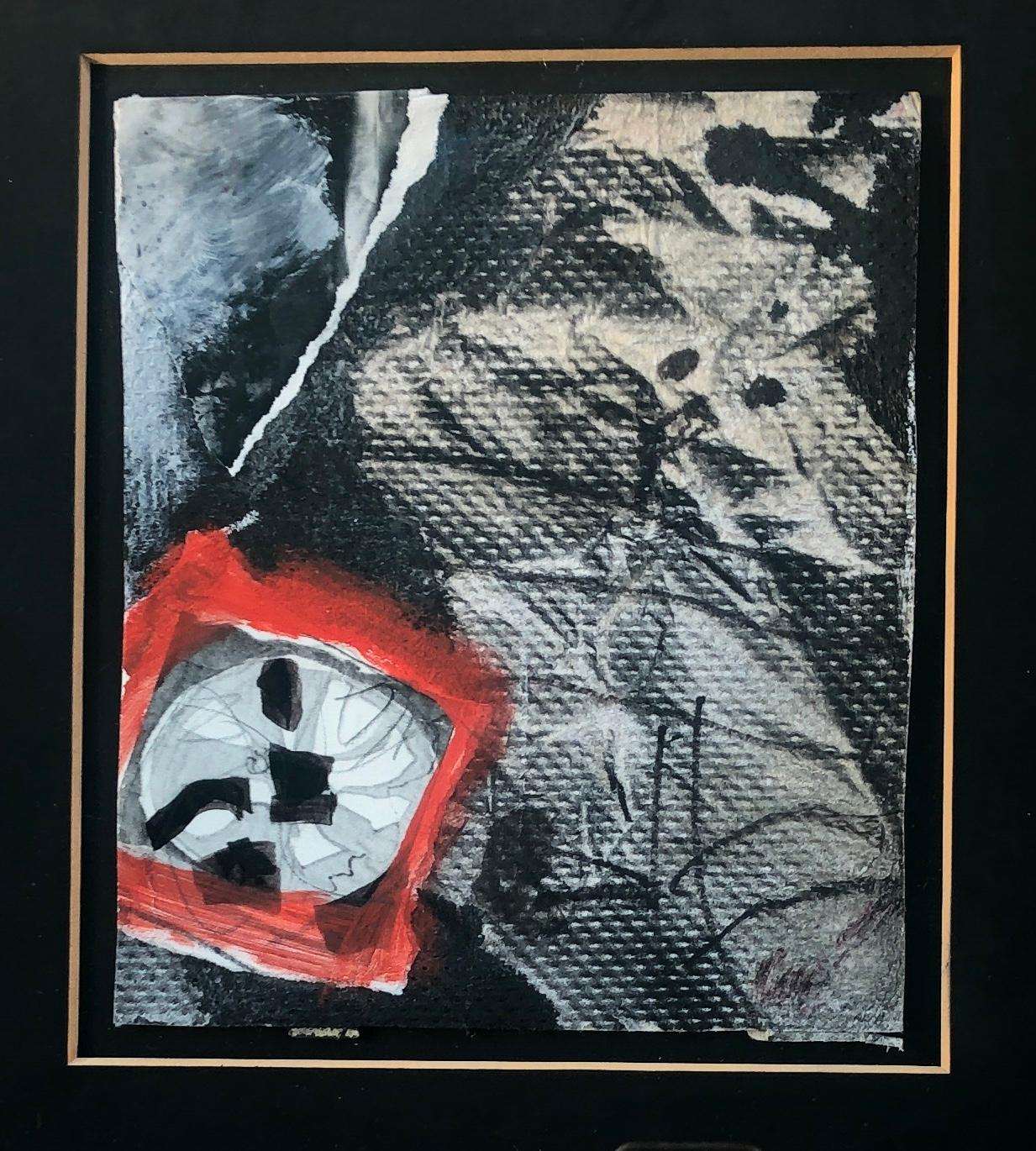
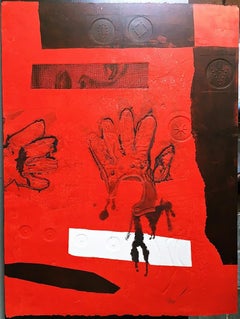
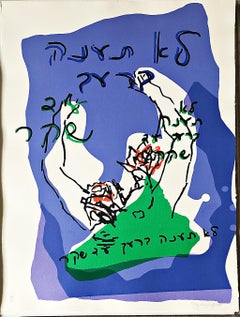
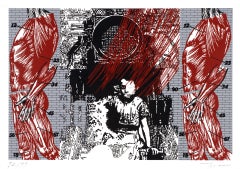
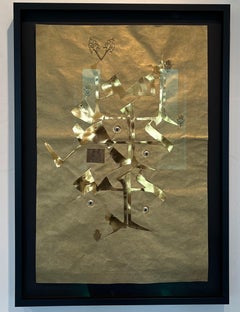
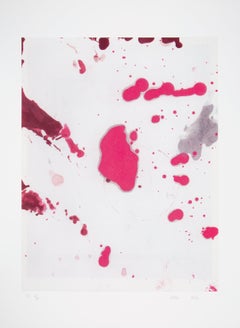
Thou Shalt Not Commit Adultery (The Seventh Commandment), 1987
3 Color Lithograph with Collage with Rives paper
Hand signed and numbered 6/84 on the front
Also bears the embossed numerals VII (for the 7th Commandment)
Printed by James Miller and Maurice Sanchez at Derriere L'Etoile Studio.
Unframed
"Thou Shalt Not Commit Adultery" is so iconic, that when Acconci died in 2017, the Jewish Museum tweeted out the image of this work - The Seventh Commandment.
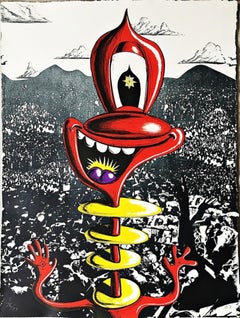
This rare Vito Acconci mixed media work on paper was created as part of the 1987 portfolio "The Ten Commandments", in which ten top Jewish American artists were each invited to choose an Old Testament commandment to interpret in contemporary lithographic form. (The "Chosen" artists were, in order of Commandment: Kenny Scharf, Joseph Nechvatal, Gretchen Bender, April Gornik, Robert Kushner, Nancy Spero, Vito Acconci, Jane Dickson, Judy Rifka and Richard Bosman.) Lisa Liebmann, who wrote the introduction to the collection, observed: "...The image has, for most of us, replaced the word..." With respect to the present work she writes, "THE SEVENTH COMMANDMENT against adultery is "in fashion" once again today, though ten years ago conjugal fidelity seemed more like pleasant or happenstance for a happy few, or merely the unsophisticated condition of those lacking opportunity and imagination. Vito Acconci's paean to lust, a state of lapse which he's always believed in, now seems at once poignant - an old fashioned enthusiasm inextricably bound to guilt which is also out of fashion - and unexpectedly radical - propaganda for Eros, currently threatened with ex-communication. .."
VITO ACCONCI BIOGRAPHY
Vito Acconci was born in 1940 in the Bronx, New York. He earned a BA with a major in literature from Holy Cross College in Worcester, Massachusetts, in 1962. Two years later, he completed an MFA in writing at the University of Iowa in Iowa City. After returning to New York, he went on to develop a diverse body of work in poetry, criticism, performance art, sound, film and video, photography, and sculpture.
In the second half of the 1960s, Acconci’s work was centered on poetry and language. In 1969 he began using photography to document various actions, such as jumping, bending, and falling, that he executed in order to understand how his body moved in space. Also in 1969 he performed Following Piece, in which he followed passersby on the street until they entered private spaces. From 1969 to 1974 he continued to explore movement in space, using film and video and adding text panels to his photographs documenting his actions. Some of his performances questioned the nature of gender; other works interjected the private realm into public space. During the 1970 exhibition Information at the Museum of Modern Art in New York, for example, he had his mail forwarded to the museum and went there every day to open it. In Seedbed (1972), he masturbated, he claimed, under a temporary floor at the Sonnabend Gallery in New York, while visitors walked overhead and heard him speaking. In the second half of the 1970s, some of Acconci’s works were comprised solely of his speech on audiotape, and many of his performances forced strangers to interact with one another.
In the late 1970s, Acconci began making sculptures referencing architecture and furniture. From 1980 on, some of his sculptures demanded viewer participation: to complete pieces shaped like simple houses, for example, viewers pulled ropes that erected the four walls. Subsequent works, most installed outdoors, were meant to be sat on or played upon. The scale of Acconci’s sculptures continued to grow, until he was making public art on a grand scale. From the late 1980s, the artist worked with Acconci Studio, located in Brooklyn, New York. This collaborative group, which included designers in addition to Acconci, developed several public artworks and architectural projects annually. On his own and with Acconci Studio, Acconci produced works for several college campuses and for airports in Philadelphia and San Francisco. Personal Island, designed for Zwolle, the Netherlands (1994), and Island in the Mur, for Graz, Austria (2003), float in bodies of water; the latter includes a theater and a playground.
Acconci taught at numerous institutions, among them the California Institute of the Arts in Valencia, Nova Scotia College of Art & Design in Halifax, San Francisco Art Institute, School of the Art Institute of Chicago, School of Visual Arts in New York, University of North Carolina at Chapel Hill, and Yale University in New Haven.
Following his first solo show in 1969, at the Rhode Island School of Design in Providence, Acconci participated in numerous exhibitions. Retrospectives have been organized by the Stedelijk Museum in Amsterdam (1978) and the Museum of Contemporary Art in Chicago (1980). Print retrospectives have been mounted by Landfall Press in New York (1990) and the Gallery of Art at the University of Missouri in Kansas City (1994). Acconci’s achievements have been recognized with fellowships from the National Endowment for the Arts (1976, 1980, 1983, and 1993), John Simon Guggenheim Memorial Foundation (1979), and American Academy in Rome (1986). He also received the International Sculpture Center’s Lifetime Achievement Award (1997) and two New York City Art Commission Awards for Excellence in Design (1999 and 2004). He was a finalist for the Hugo Boss Prize in 2000. Acconci died on April 27, 2017, in New York.
-Courtesy Guggenheim Museum