Want more images or videos?
Request additional images or videos from the seller
1 of 9

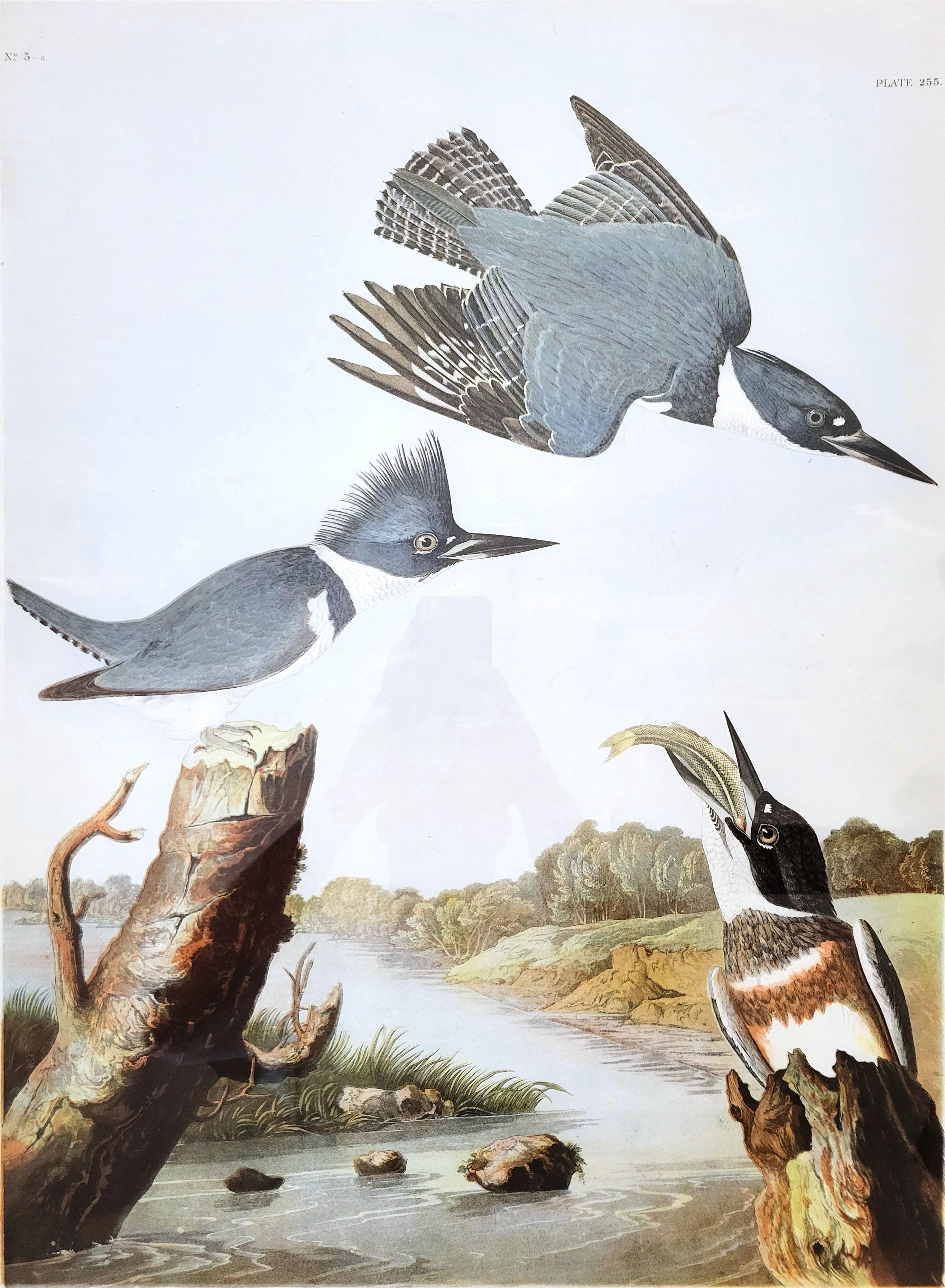
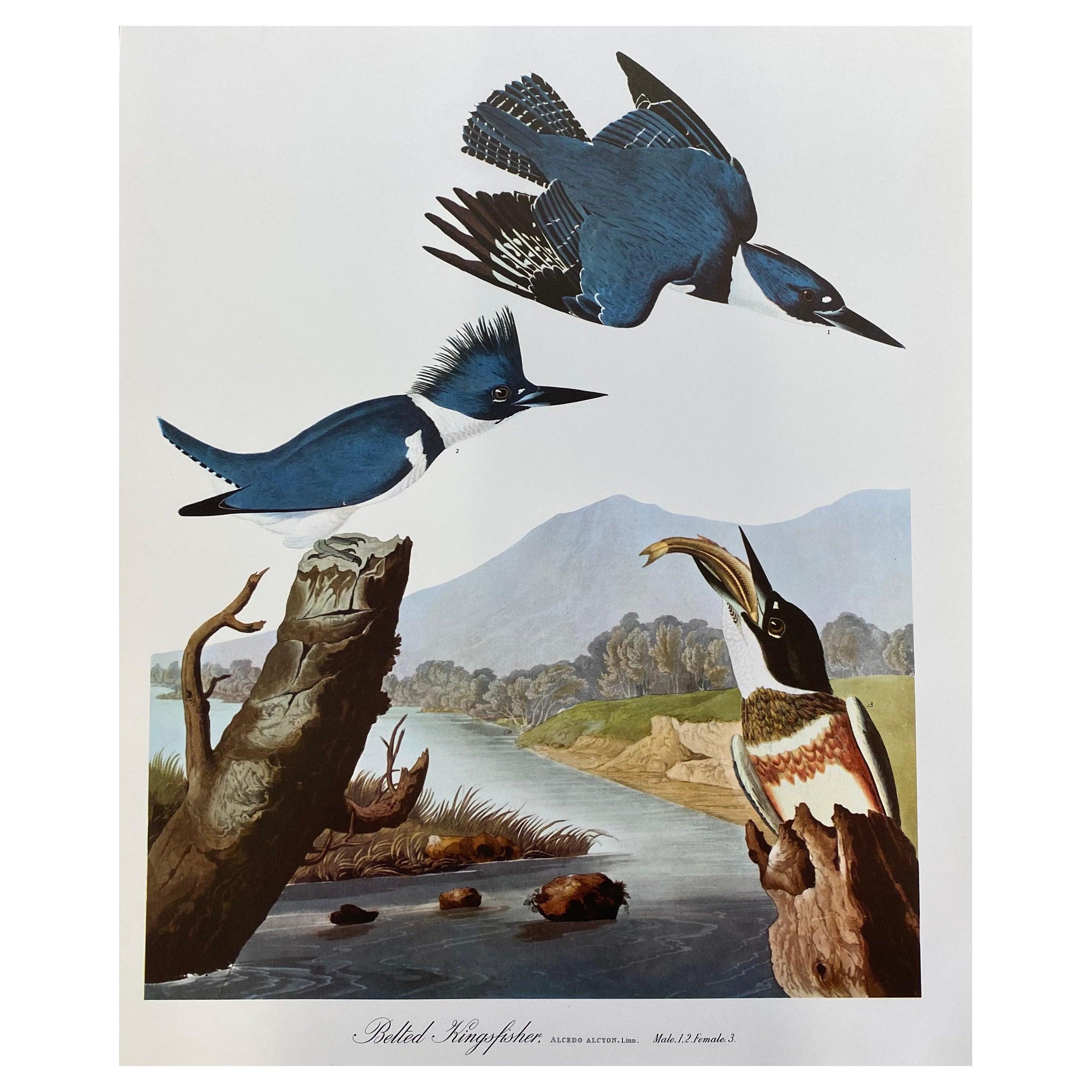
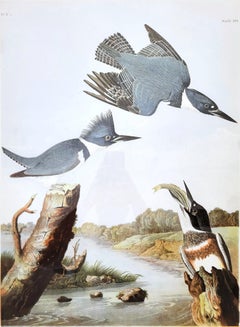
Large Classical Bird Color Print after John James Audubon - Belted Kingfisher

20th century

$150.32
$186.4120% Off
£108
£13520% Off
€128.70
€160.9620% Off
CA$207.31
CA$258.8020% Off
A$209.82
A$263.5620% Off
CHF 120.30
CHF 151.2920% Off
MX$2,544.82
MX$3,180.3020% Off
NOK 1,399.08
NOK 1,753.4120% Off
SEK 1,424.13
SEK 1,777.5020% Off
DKK 962.08
DKK 1,203.3720% Off

About the Item

Classical Bird print, after John James Audubon, printed by Harry N. Abrams, Publishers, New York unframed, 17 x 14 inches color print on paper condition: very good provenance: from a private collector here in the UK. FREE SHIPPING WORLDWIDE A very beautiful color print after the original series by John James Audubon, 'Birds of America'. The work will make wonderful interior decoration for many different themes of interiors - either on its own - or perhaps part of a gallery wall presentation. We have several other bird prints available from this series - so please view our other items for sale.
  • Creation Year:
    20th century
  • Dimensions:
    Height: 17 in (43.18 cm)Width: 14 in (35.56 cm)
  • Movement & Style:
  • After:
    After John James Audubon
  • Period:
  • Condition:
  • Gallery Location:
    Cirencester, GB
  • Reference Number:
    1stDibs: LU50939652912

More From This Seller

View All
Large Classical Bird Color Print after John James Audubon, Belted Kingfisher

Large Classical Bird Color Print after John James Audubon, Belted Kingfisher

Located in Cirencester, Gloucestershire

Classical Bird print, after John James Audubon, printed by Harry N. Abrams, Publishers, New York unframed, 17 x 14 inches color print on paper condition: very good provenance: from...

Category

20th Century Victorian Animal Prints

Materials

Acrylic

Large Classical Bird Color Print after John James Audubon - Broad Winged Hawk

Large Classical Bird Color Print after John James Audubon - Broad Winged Hawk

By After John James Audubon

Located in Cirencester, Gloucestershire

Classical Bird print, after John James Audubon, printed by Harry N. Abrams, Publishers, New York unframed, 17 x 14 inches color print on paper condition: very good provenance: from...

Category

20th Century Victorian Animal Prints

Materials

Color

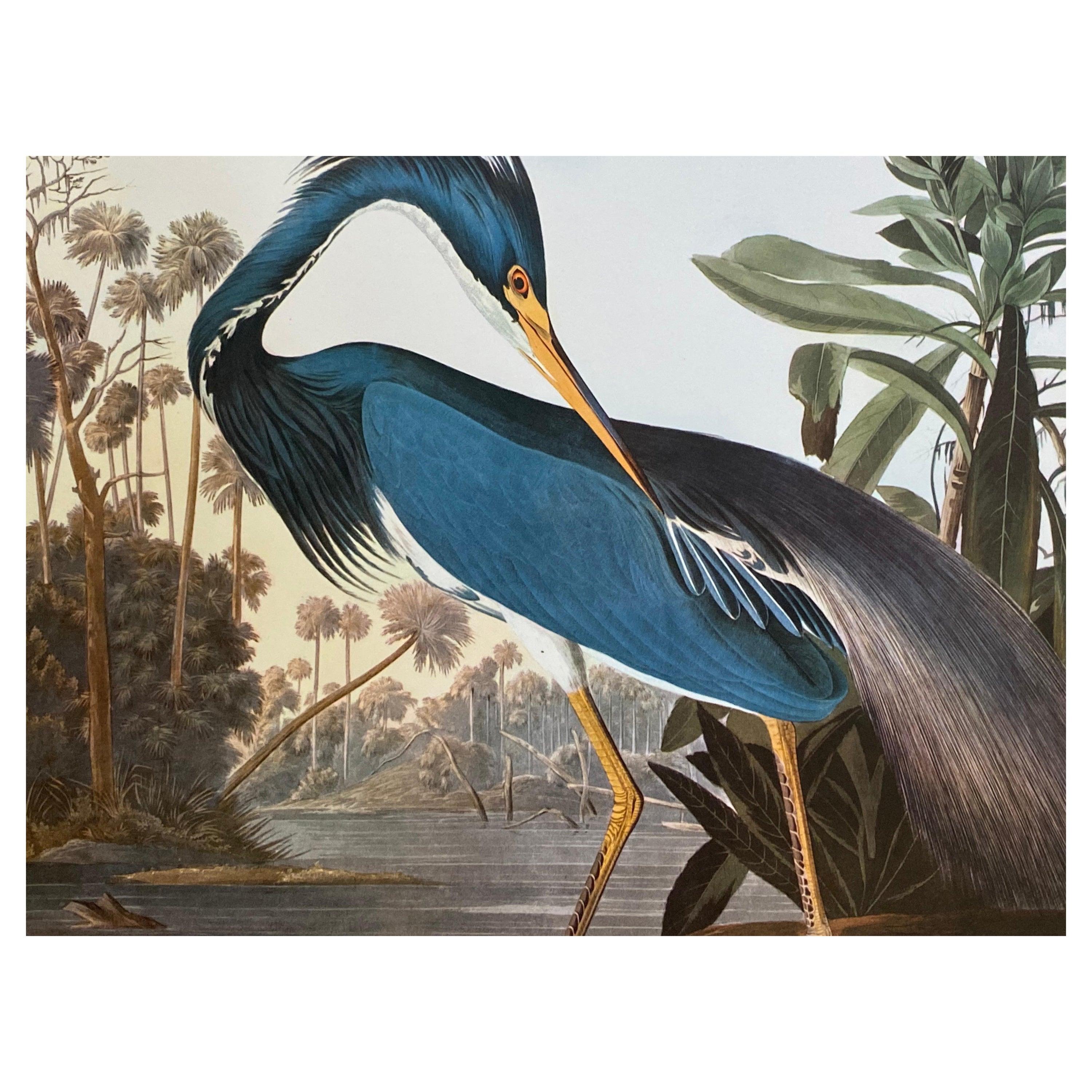
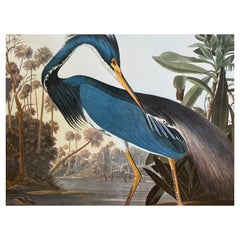
Large Classical Bird Color Print After John James Audubon, Louisiana Heron

Large Classical Bird Color Print After John James Audubon, Louisiana Heron

Located in Cirencester, Gloucestershire

Classical Bird print, after John James Audubon, printed by Harry N. Abrams, Publishers, New York unframed, 17 x 14 inches color print on paper Condition: very good Provenance: from...

Category

20th Century Victorian Animal Prints

Materials

Acrylic

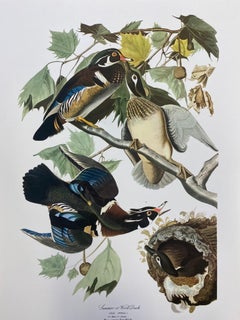
Large Classical Bird Color Print after John James Audubon - Summer or Woodduck

Large Classical Bird Color Print after John James Audubon - Summer or Woodduck

By After John James Audubon

Located in Cirencester, Gloucestershire

Classical Bird print, after John James Audubon, printed by Harry N. Abrams, Publishers, New York unframed, 17 x 14 inches color print on paper condition: very good provenance: from...

Category

20th Century Victorian Animal Prints

Materials

Color

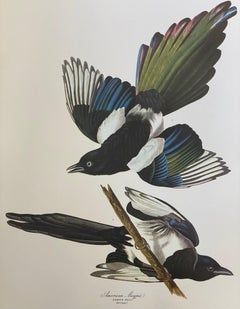
Large Classical Bird Color Print after John James Audubon - American Magpie

Large Classical Bird Color Print after John James Audubon - American Magpie

By After John James Audubon

Located in Cirencester, Gloucestershire

Classical Bird print, after John James Audubon, printed by Harry N. Abrams, Publishers, New York unframed, 17 x 14 inches color print on paper condition: very good provenance: from...

Category

20th Century Victorian Animal Prints

Materials

Color

You May Also Like

Majestic Hunter: The American Belted Kingfisher in Its Natural Habitat, 1749

Majestic Hunter: The American Belted Kingfisher in Its Natural Habitat, 1749

Located in Langweer, NL

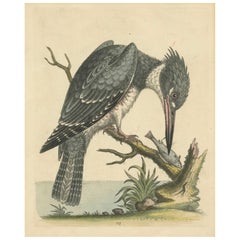
Original hand-colored antique bird print showing an American Kingfisher from the book "A Natural History of Uncommon Birds" (1743-1751) by George Edwards. This hand-colored engraving showcases the bird perched on a branch, holding a fish in its beak. The kingfisher is characterized by its distinctive plumage, with a slate-blue back and wings, a speckled tail, and a prominent crest on its head. Its body is white underneath with some pinkish hues near the breast. The bird's sharp beak is shown spearing a fish, emphasizing its hunting prowess. The surrounding environment includes a simple background with water and vegetation, highlighting the bird's natural habitat. This illustration is part of an increasingly rare and treasured collection of natural history artwork from the 18th century. George Edwards (1694–1773) was an English naturalist and ornithologist who is often referred to as the "father of British ornithology." His most famous work, "A Natural History of Uncommon Birds" (1743-1751), and its continuation "Gleanings of Natural History" (1758-1764), contain detailed illustrations and descriptions of many bird species, many of which were little known or newly discovered at the time. Edwards' work is highly regarded for its accuracy, artistry, and contribution to the field of ornithology. About George Edwards: 1. **Early Life and Career**: - Born in Stratford, Essex, Edwards was apprenticed to a tradesman in London. However, he developed an interest in natural history and began studying birds, insects, and other animals. - He spent some time traveling in Europe, studying various collections of natural history specimens. 2. **Publications**: - **"A Natural History of Uncommon Birds" (1743-1751)**: This work is a collection of 210 hand-colored engravings of birds. It is known for its meticulous attention to detail and accuracy in depicting bird species. - **"Gleanings of Natural History" (1758-1764)**: This series continued the work started in "A Natural History of Uncommon Birds" and included additional birds as well as other animals. - His publications also included detailed observations and descriptions, making them valuable not only for their artistic merit but also for their scientific content. 3. **Artistic and Scientific Contributions**: - Edwards was known for his ability to combine artistic skill with scientific precision. His illustrations often depicted birds in lifelike poses and settings, showing their natural behaviors. - He collaborated with and was influenced by other naturalists and illustrators of his time, such as Carl Linnaeus and Mark Catesby. - Edwards' works were used by Linnaeus in the development of his system of taxonomy. 4. **Legacy**: - George Edwards' contributions to ornithology and natural history have had a lasting impact. His detailed and accurate illustrations helped to advance the study of birds and influenced subsequent generations of naturalists and artists. - His books remain highly prized by collectors and are considered important historical documents in the field of natural history. ### "A Natural History of Uncommon Birds" and Its Importance: - **Illustrations**: Each illustration in Edwards' work was carefully hand-colored, and the engravings were often accompanied by descriptive text that included observations about the birds' habitats, behaviors, and physical characteristics. - **Scientific Accuracy**: Edwards took great care to ensure the accuracy of his depictions, often working from specimens he had observed firsthand. - **Influence**: The work was well-received in its time and remains a significant reference for ornithologists and historians. It contributed to a greater understanding and appreciation of bird species from around the world. Overall, George Edwards' work represents a critical intersection of art and science during the Enlightenment period, capturing the beauty and diversity of the natural world while contributing to the scientific knowledge of his time. ------------- The bird depicted is a Belted Kingfisher...

Category

Antique 1740s Prints

Materials

Paper

Florida Cormorant /// John James Audubon Ornithology Bird Art Natural History

Florida Cormorant /// John James Audubon Ornithology Bird Art Natural History

By John James Audubon

Located in Saint Augustine, FL

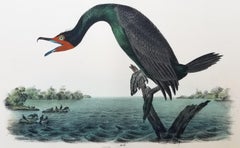
Artist: John James Audubon (American, 1785-1851) Title: "Florida Cormorant" (Plate 417, No. 84) Portfolio: The Birds of America (First Royal Octavo Edition) Year: 1840-1844 Medium: Original Hand-Colored Lithograph on wove paper Limited edition: approx. 1,200 Printer: John T. Bowen, Philadelphia, PA Publisher: John James Audubon and J.B. Chevalier, New York, NY and Philadelphia, PA Sheet size: 6.5" x 10.44" Image size: 3.75" x 6.25" Reference: Ayer/Zimmer page 22; Bennett page 5; McGill/Wood page 208; Nissen No. IVB 51; Reese No. 34; Sabin No. 2364; Tyler App. I Condition: Some minor discoloration upper center in margin. In excellent condition with strong colors Notes: Provenance: private collection - Cleveland, OH. Lithography and hand-coloring by American artist John T. Bowen (1801-c.1856). Comes from Audubon's famous seven volume portfolio "The Birds of America", (First Royal Octavo Edition) (1840-1844), which consists of 500 hand-colored lithographs. Based on a composition painted in the Florida Keys on April 26, 1832, Audubon's forty-seventh birthday. The double-crested cormorant (Nannopterum auritum) is a member of the cormorant family of water birds. It is found near rivers and lakes and in coastal areas and is widely distributed across North America, from the Aleutian Islands in Alaska down to Florida and Mexico. Measuring 70–90 cm (28–35 in) in length, it is entirely black except for a bare patch of orange-yellow facial skin and some extra plumage that it exhibits in the breeding season when it grows a double crest in which black feathers are mingled with white. Five subspecies are recognized. It mainly eats fish and hunts by swimming and diving. Its feathers, like all cormorants, are not waterproof, and it must dry them out after spending time in the water. Once threatened by the use of DDT, the numbers of this bird have increased markedly in recent years. To make 'The Birds of America' more affordable and widely available, in 1839 John James Audubon began the first octavo edition, a smaller version of the folio which was printed and hand-colored by J. T. Bowen in Philadelphia. Employing a new invention, the camera lucida, the images were reduced in size, rendered in intermediate drawings by John James Audubon and his son John Woodhouse, and then drawn onto lithographic stones. These miniatures exhibit a remarkable amount of attention to quality and detail, as well as a meticulous fidelity to the larger works. Some compositional changes were made in order to accommodate the smaller format. Like the Havell edition, John James Audubon’s first...

Category

1840s Victorian Animal Prints

Materials

Watercolor, Lithograph
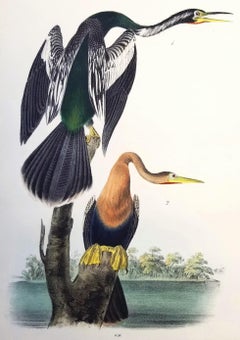
American Anhinga - Snake Bird /// John James Audubon Ornithology Natural History

American Anhinga - Snake Bird /// John James Audubon Ornithology Natural History

By John James Audubon

Located in Saint Augustine, FL

Artist: John James Audubon (American, 1785-1851) Title: "American Anhinga - Snake Bird" (Plate 420, No. 84) Portfolio: The Birds of America (First Royal Octavo Edition) Year: 1840-1844 Medium: Original Hand-Colored Lithograph on wove paper Limited edition: approx. 1,200 Printer: John T. Bowen, Philadelphia, PA Publisher: John James Audubon and J.B. Chevalier, New York, NY and Philadelphia, PA Sheet size: 10" x 6.69" Image size: 6.63" x 4.63" Reference: Ayer/Zimmer page 22; Bennett page 5; McGill/Wood page 208; Nissen No. IVB 51; Reese No. 34; Sabin No. 2364; Tyler App. I Condition: Minor toning to sheet and some faint discoloration in margins. Old glue staining along right binding edge as normal. It is otherwise in very good condition with strong colors Notes: Provenance: private collection - Cleveland, OH. Lithography and hand-coloring by American artist John T. Bowen (1801-c.1856). Comes from Audubon's famous seven volume portfolio "The Birds of America", (First Royal Octavo Edition) (1840-1844), which consists of 500 hand-colored lithographs. The preceding 1836 Havell edition of this work has a different title: "Black-bellied Darter", (Plate: CCCXVI - 396, No. 64). Based on a drawing inscribed "New Orleans 1822 - redrawn ... 1836". This conspicuous bird had various names including "water turkey" and "Bec à Lancette". The Anhinga, sometimes called snakebird, darter, American darter, or water turkey, is a water bird of the warmer parts of the Americas. The word anhinga comes from a'ñinga in the Brazilian Tupi language and means "devil bird" or "snake bird". To make 'The Birds of America' more affordable and widely available, in 1839 John James Audubon began the first octavo edition, a smaller version of the folio which was printed and hand-colored by J. T. Bowen in Philadelphia. Employing a new invention, the camera lucida, the images were reduced in size, rendered in intermediate drawings by John James Audubon and his son John Woodhouse, and then drawn onto lithographic stones. These miniatures exhibit a remarkable amount of attention to quality and detail, as well as a meticulous fidelity to the larger works. Some compositional changes were made in order to accommodate the smaller format. Like the Havell edition, John James Audubon’s first...

Category

1840s Victorian Animal Prints

Materials

Watercolor, Lithograph