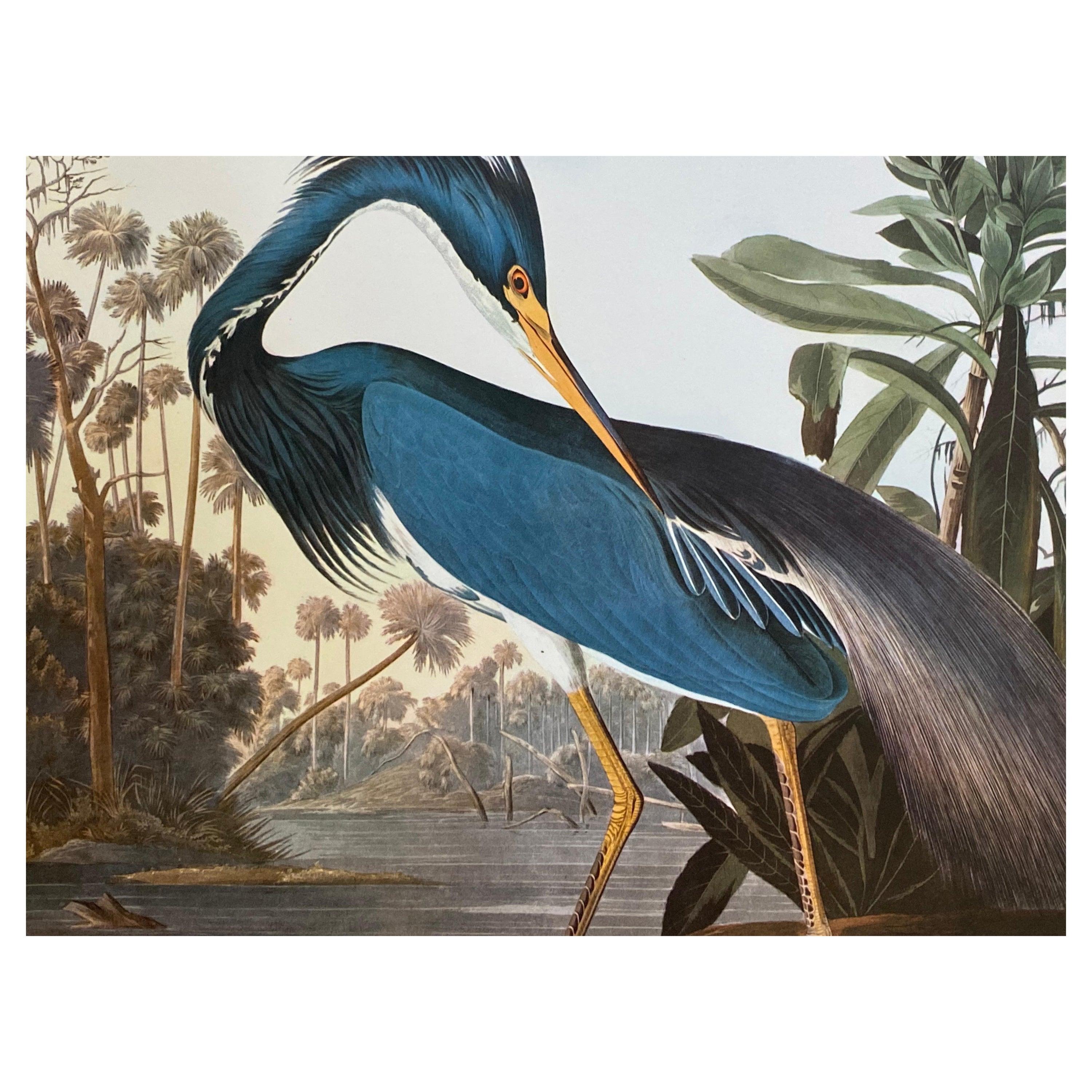
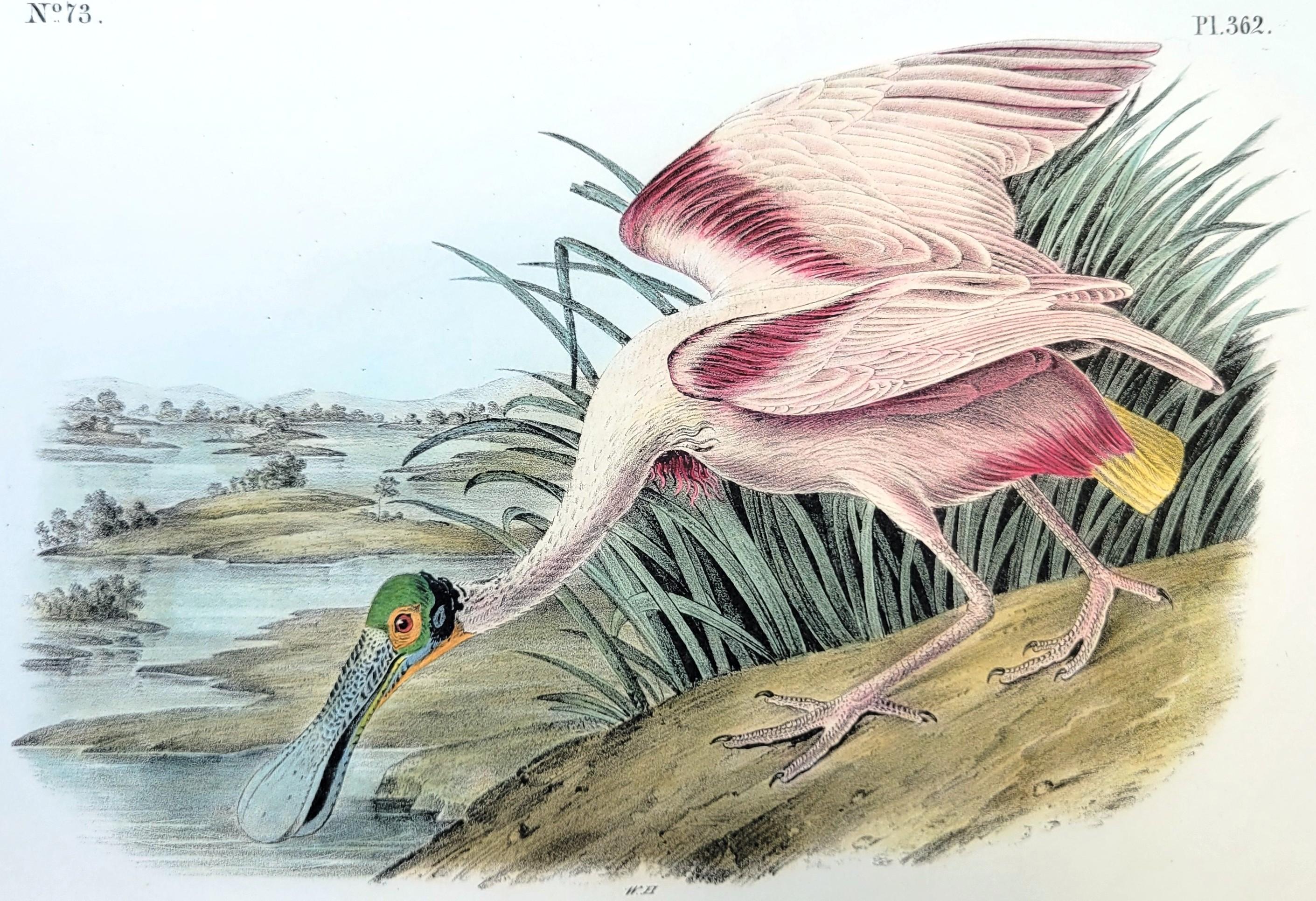
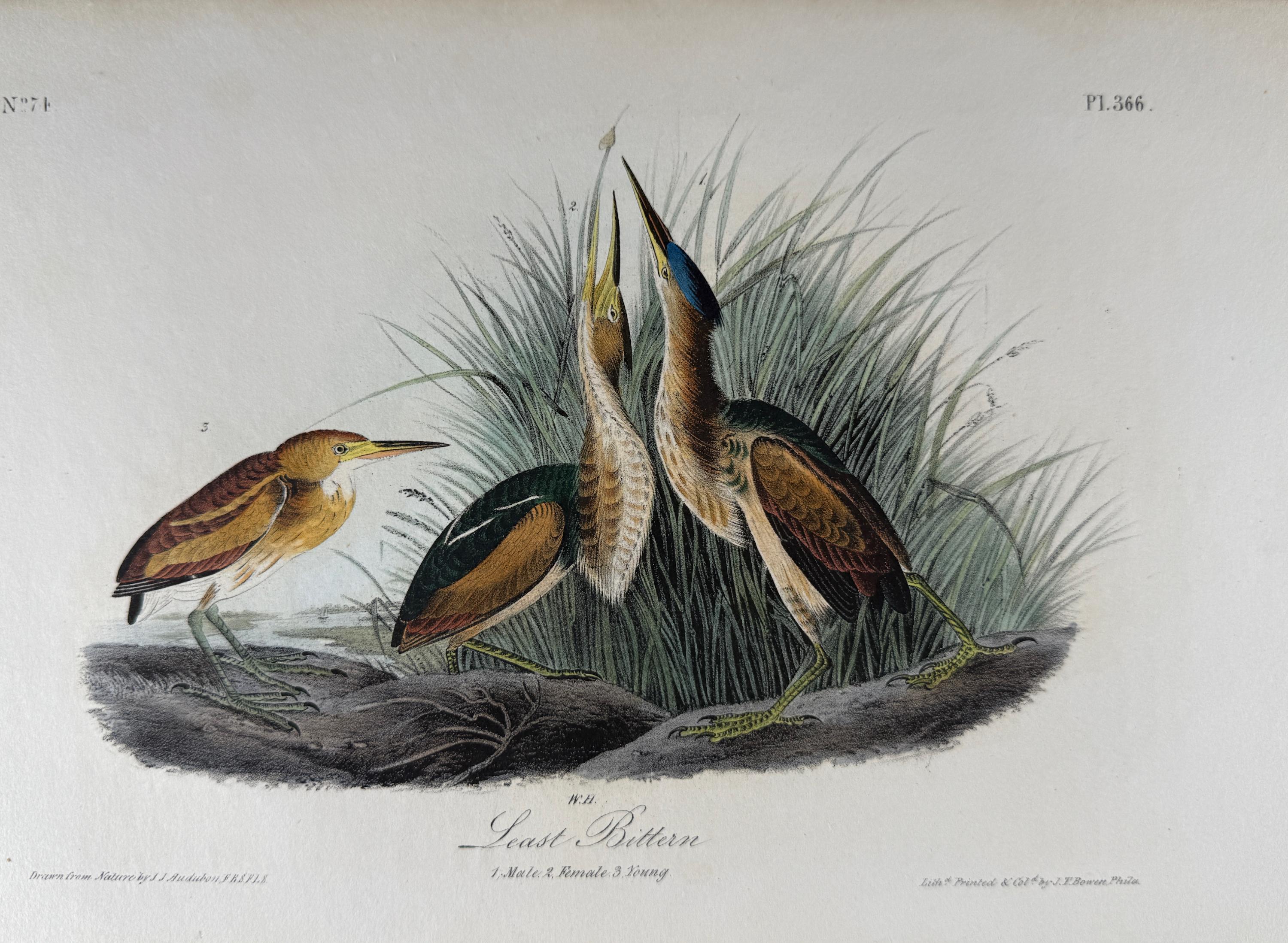
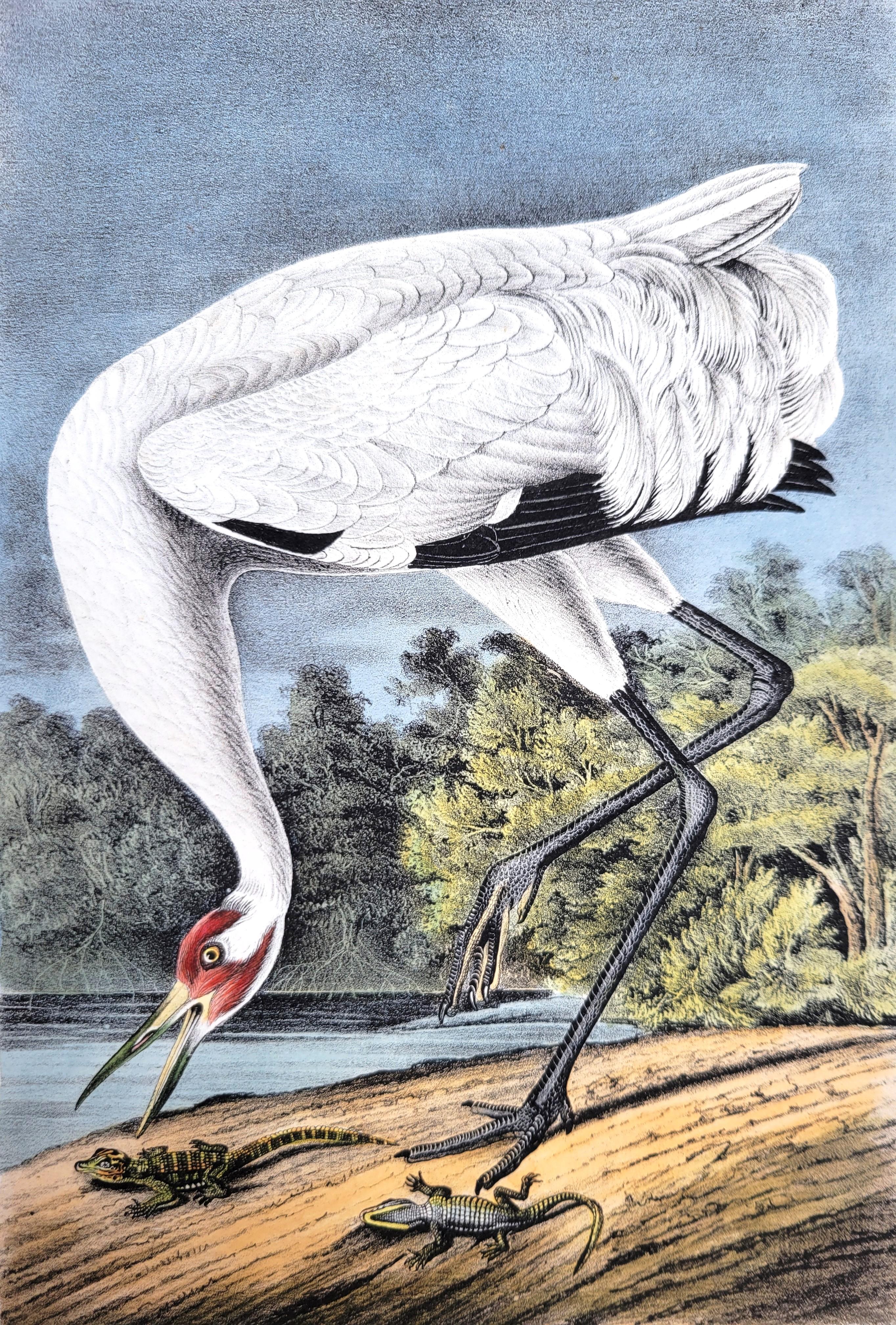
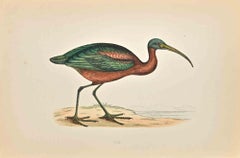
Artist: John James Audubon (American, 1785-1851)
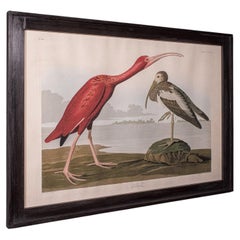
Title: "Scarlet Ibis" (Plate CCCXCVII - 397; part No. 80)
Portfolio: The Birds of America (Havell Edition)
Year: 1837
Medium: Original Hand-Colored Engraving with Aquatint on double-elephant folio, J. Whatman paper
Limited edition: approx. 180
Printer: Robert Havell Jr., London, England
Publisher: John James Audubon, London, England
Sheet size: 24.75" x 38.07"
Platemark size: 21.63" x 29.19"
Image size: 19.5" x 27.38"
Reference: "Fine Bird Books" page 57; McGill/Wood page 209; Nissen No. IVB 49; Ayer/Zimmer page 18-21; Copenhagen/Anker No. 17, 18; Ellis/Mengel No. 96; McGill/Wood page 207, 209
Condition: Recent professional restoration to tearing in right margin and a few surface abrasions. The sheet is mounted to archival Rives BFK paper. In very good condition
Rare
Notes:
Provenance: private collection - Cincinnati, OH. Engraved, printed, and hand-colored by English artist Robert Havell Jr. (1793-1878). Comes from Audubon's monumental four volume portfolio "The Birds of America", (Havell Edition) (1827-1838), which consists of 435 hand-colored, life-size engravings, with each sheet originally measuring about 39" x 26". "J. Whatman 1837" watermark upper left.
Based on a composition probably painted in England, c. 1837, using South American specimens.
"It was supposed by Wilson, and since his time by others, that this brilliantly coloured Ibis is not uncommon in the southern parts of the United States. This opinion however is quite erroneous, and I have found the Scarlet Ibis less numerous than even the Glossy Ibis; indeed I have not met with more than three individuals in a state of liberty, in the whole range of the United States. These birds occurred at Bayou Sara, in Louisiana, on the 3d of July, 1821. They were travelling in a line, in the manner of the White Ibis, above the tops of the trees. Although I had only a glimpse of them, I saw them sufficiently well to be assured of their belonging to the present species, and therefore I have thought it proper to introduce it into our Fauna. Wilson's figure, I believe, was taken from a living specimen, not however procured within the limits of the United States, and which was kept for some time in Peale's Museum in Philadelphia. My drawing of the adult male, and that of the immature bird, were made from specimens also procured beyond our limits. It is said that the habits of this bird are very similar to those of the White Ibis, of which I have given you a long account; but, as I have not had opportunities of observing them, I judge it better to abstain from offering any remarks on this subject." - 'Ornithological Biography', (Vol. V), page 62 - John James Audubon
The scarlet ibis, sometimes called red ibis, is a species of ibis in the bird family Threskiornithidae. It inhabits tropical South America and part of the Caribbean. In form, it resembles most of the other twenty-seven extant species of ibis, but its remarkably brilliant scarlet coloration makes it unmistakable.
"The Birds of America" (Havell Edition) - In Edinburgh, the Scottish engraver W. H. Lizars began to produce the very first plates for Birds of America. However, after the completion of only ten plates, Lizars' colorists went on strike, and Audubon was forced to continue his pursuit of an engraver. Audubon's dream finally found fruition with Robert Havell, a renowned London engraver. The portfolio of 'Birds of America', consisting of 435 hand-colored engravings, took twelve years, from 1826 to 1838, to complete. Havell also retouched Lizars' original efforts, adding aquatint to the engraving, and on those ten plates the Havell name appears alongside that of the Scottish engraver's. There were 176 recorded subscribers to the 'Birds of America' series and it is known that a handful of extra Audubon books were produced as well. Of the approximate 180 complete sets produced, more than 100 have never been broken and remain in permanent public museum and institution collections. Thus, only about 80 examples possibly exist on the open market in private hands today.
Biography:
John James Audubon (April 26, 1785, Les Cayes, Saint-Domingue (later Haiti) – January 27, 1851 (aged 65) Manhattan, New York, U.S.), born Jean-Jacques Audubon, was an American ornithologist, naturalist, and painter. He was notable for his expansive studies to document all types of American birds and for his detailed illustrations that depicted the birds in their natural habitats. His major work, a color-plate book entitled The Birds of America (1827–1839), is considered one of the finest ornithological works ever completed. Audubon identified 25 new species.
Robert Havell Jr. (25 November 1793 – 11 November 1878) was the principal engraver of Audubon's Birds of America, perhaps the most significant natural history publication of all time. His aquatint engraving of all but the first ten plates of John James Audubon's Birds of America is now recognized as a significant artistic achievement in its own right and an essential component of the success of Birds of America. He and Audubon became close friends and associates during their lengthy collaboration. In 1839 Havell went to America at the invitation of Audubon, first residing in Brooklyn. He settled in Ossining on the Hudson River and later moved to Tarrytown, New York, living there from 1857 through his remaining years. Although Havell continued to work in aquatint and engraving (primarily city panoramas), he devoted most of his attention to painting the countryside of the Hudson River valley. He traveled frequently in a homemade horse-drawn trailer, sketching and taking notes and translating his sketches into larger oils. Robert Havell Jr. is considered a member of the Hudson River School of American painters. He died in 1878 and is buried in Sleepy Hollow Cemetery in Tarrytown.