Academic Animal Prints

ACADEMIC STYLE

During the Renaissance, the first European fine art academies were established in Italy and would guide the style and standards of visual culture in the following centuries. Academic art became dominant across the continent in the 17th century, with artists coming together to offer instruction in this style of painting and sculpture

The academic art period represented a significant change from the previous era when painters, sculptors and other artists were part of guilds and seen more as artisans than purveyors of culture. While patronage from the elite and the church remained pivotal, young artists were able to support themselves for the first time through academic exhibitions and an independent marketplace. The leading academies included the French Académie Royale de Peinture et de Sculpture founded in Paris in 1648 (which became the Académie des Beaux-Arts after the French Revolution) and the London Royal Academy of Arts formed in 1768 under the inaugural leadership of painter Joshua Reynolds

Academy students sketched drawings based on prints, sculptures and, finally, live models. Movements including neoclassicism and romanticism were particularly popular in these art schools and institutions where the influence of Raphael and Nicolas Poussin was prominent. Beaux Arts architecture and furniture design drew on these movements, too, and, as they also originated at the Académie des Beaux-Arts, the disciplines share common ground with academic painting and sculpture.

Although academic art was a major shift for artistic status when it began, by the middle of the 19th century it was viewed as stodgy and resistant to new ideas, with the subject matter of artists such as William-Adolphe Bouguereau and Jean-Léon Gérôme generally limited to allegorical or mythological themes. Impressionism, realism and the other movements that engaged with contemporary issues that followed were direct reactions to the academic tradition, although it continued to inform the avant-garde as artists like Gustav Klimt and Pablo Picasso started their practices as academic realists.  

Find a collection of academic paintings, sculptures, prints and more art on 1stDibs. 

to
1
8
1
3
1
1
Overall Width
to
Overall Height
to
2,034
1,821
310
281
238
151
103
82
67
60
46
40
20
2
2
2
1
1
1
3
5
5
1
1
2
2
3
10
3
1
8
7
3
3
2
2
2
2
1
1
1
1
1
1
1
1
1
1
5
3
3
2
2
5
3
10
4
Style: Academic
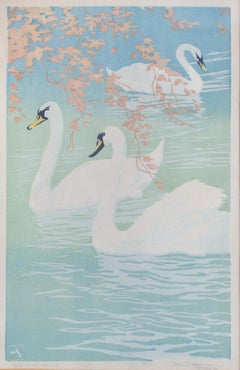
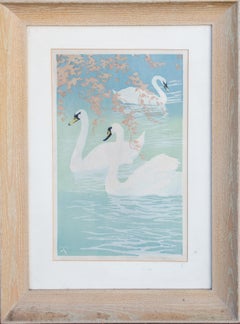
Swans Woodblock by Hans Neumann, 1913

Swans Woodblock by Hans Neumann, 1913

By Hans Neumann

Located in New York, NY

Hans Neumann (German, 1873 - 1957) Schwäne (Swans), 1913 Woodblock Sight: 17 x 11 in. Framed: 25 3/4 x 19 in. Signed & inscribed bottom, artist monogram lower left This outstanding ...

Category

1910s Academic Animal Prints

Materials

Woodcut

Three Gould Hand-colored Lithographs from Birds of Australia and New Zealand

Three Gould Hand-colored Lithographs from Birds of Australia and New Zealand

By John Gould

Located in Alamo, CA

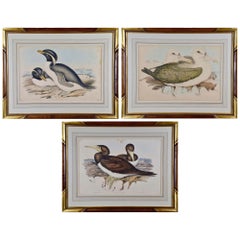
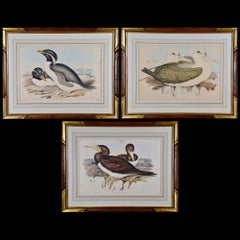
Three hand-colored lithographs from John Gould's seven volume book "The Birds of Australia", which included New Zealand, depicting: pairs of "Eudyptes Chrysocome" (New Zealand Rock-hopper Crested Penguins), "Diomedea O Thalassarche Cauta" (Australian Shy Albatross) and "Sula Fusca" (Brown Gannets). These beautiful sea bird prints are presented in identical very attractive brown wood frames, embellished with gold highlights in the corners and gold inner trim, along with light cream-colored French mats, each with a medium cream-colored band and a gold highlight line. There is scattered spotting. There is a small tear in the lower right corner of the penguin lithograph...

Category

1840s Academic Animal Prints

Materials

Lithograph

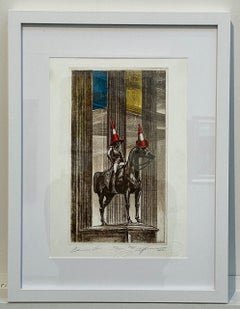
Duke of Wellington
Duke of Wellington

Duke of Wellington

Located in Edinburgh, GB

Duke of Wellington by Vladislav Khristenko Size of the image - 25 x 15 cm Size of the list - 34 x 22.5 cm Size in frame - 42 x 32 cm Etching and aquatint on paper #15 from edition ...

Category

2010s Academic Animal Prints

Materials

Paper, Etching, Aquatint

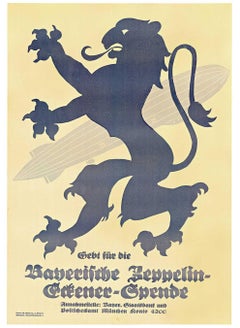
Original 1925 Zeppelin "Bayerische Zeppelin Eckene-Spende" vintage air travel

Original 1925 Zeppelin "Bayerische Zeppelin Eckene-Spende" vintage air travel

Located in Spokane, WA

Original German poster: Bayerische Zeppelin-Eckener Spende. 1925. (Bavarian Zeppelin-Eckener donation). Printer: M. Grunst, München. Condition: Grade A. Archival linen-back...

Category

1920s Academic Animal Prints

Materials

Lithograph

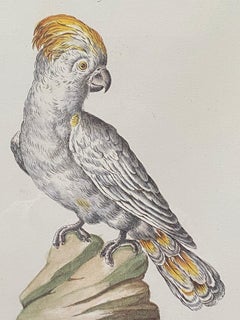
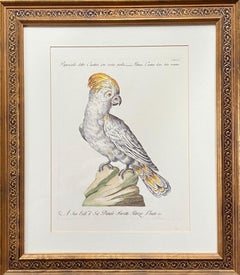
“Yellow Crested Parrot”

“Yellow Crested Parrot”

Located in Southampton, NY

Hand colored copper plate engraving from “The History of Birds. Plate 117 published in 1776.. “Yellow Created Parrot” Dedicated to Daniele Farsetti, a well known art collector Veni...

Category

Late 18th Century Academic Animal Prints

Materials

Engraving

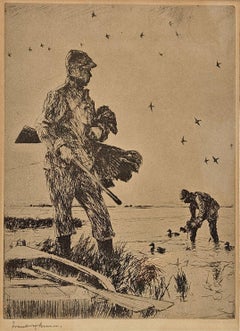
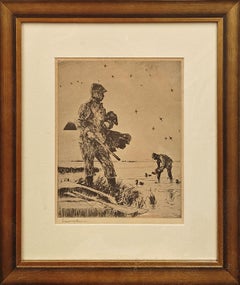
"Winter Wildfowling" Frank Weston Benson, Hunting Scene, Outdoors, Marshes

"Winter Wildfowling" Frank Weston Benson, Hunting Scene, Outdoors, Marshes

By Frank Weston Benson

Located in New York, NY

Frank Weston Benson Winter Wildfowling, 1927 Signed lower left Etching on paper Image 8 1/2 x 7 inches Born in Salem, Massachusetts, a descendant of a long line of sea captains, Benson first studied art at Boston’s Museum School where he became editor of the student magazine. In 1883, Benson enrolled at the Académie Julian in Paris where artists such as Bouguereau, Lefebvre, Constant, Doucet and Boulanger taught students from all over Europe and America. It was Boulanger who gave Benson his highest commendation. “Young man,” he said, “Your career is in your hands . . . you will do very well.” Benson’s parents gave him a present of one thousand dollars a twenty-first birthday and told him to return home when it ran out. The money lasted long enough to provide Benson with two years of schooling in Paris, a summer at the seaside village of Concarneau in Brittany and travel in England. Upon returning to America, Benson opened a studio on Salem’s Chestnut Street and began painting portraits of family and friends. An oil of his wife, Ellen Perry Peirson, dressed in her wedding gown is representative of this period. It demonstrates not only the academic techniques he learned at the Academie Julian but also his own growing emphasis on the effects of light. And yet, despite all the technical mastery displayed in the work, the painting exudes the warmth that existed between model and artist. More than a likeness, it is a study in serenity. Perhaps it was of a work such as this that Benson was thinking when he said, “The more a painter knows about his subject, the more he studies and understands it, the more the true nature of it is perceived by whoever looks at it, even though it is extremely subtle and not easy to see or understand. A painter must search deeply into the aspects of a subject, must know and understand it thoroughly before he can represent it well.” Following a brief stint as an instructor at the Portland, Maine, Society of Art, Benson was appointed as instructor of antique drawing at the Museum School in Boston in the spring of l889. Benson’s long association with the school was particularly fruitful. Under the leadership of Edmund Tarbell and Benson the Museum School became a national and internationally recognized institution. The students won numerous prizes, enrollment tripled, a new school building was erected and visiting delegations from other schools sought the secret of their success. Benson cherished his role as teacher and was held in high esteem by his students, many of whom called him “Cher Maitre.” Reminiscing about his long career with the school Benson once said, “I may have taught many students, but it was I who learned the most.” In 1890, Benson won the Hallgarten Prize at the National Academy in New York. It was the first of a long series of awards, that earning for him the sobriquet “America’s Most Medalled Painter.” In the early years of his career, Benson’s studio works were mostly portraits or paintings of figures set in richly appointed interiors. Young women in white stretch their hands out towards the glow of an unseen fire; girls converse on an antique settee in a room full of objets d’arts; his first daughter, Eleanor, poses with her cat. Works of this sort, together with a steady influx of portrait commissions, earned Benson both renown and financial rewards, yet it was in his outdoor works that gave Benson his greatest pleasure. In the latter half of the 1890s, Benson summered in Newcastle, on New Hampshire’s short stretch of seacoast. It was here, in 1899, that Benson made his first foray into impressionism with Children in the Woods and The Sisters, the latter a sun-dappled study of his two youngest daughters, Sylvia and Elisabeth. This painting was one of the first works that Benson hung at an exhibition with nine friends. The resignation of these ten illustrious artists rocked the American art establishment but, the catalogue for their first exhibition was titled, simply, “Ten American Painters.” When, in 1898, the three Bostonians and seven New Yorkers began to exhibit their best work in exquisitely arranged small shows, the group (dubbed by newspapers, “The Ten” ) quickly became known as the American Impressionists, a bow to the style of their French predecessors. The Ten’s annual shows soon became an eagerly awaited part of the annual exhibition calendar and were always well reviewed. Held annually in New York City, the group’s yearly exhibitions usually traveled to Boston and were occasionally seen in other cities. Benson’s association with other members of the group such as Childe Hassam, Thomas Dewing, William Merrit Chase and J. Alden Weir, only reinforced his growing emphasis on the tenets of Impressionism. As he later said to his daughter Eleanor, “I follow the light, where it comes from, where it goes.” The principles of Impressionism began to dominate Benson’s work by 1901, the year that the Bensons first summered on the island of North Haven in Maine’s Penobscot Bay. His summer home “Wooster Farm,” which they rented and finally bought in 1906, became the setting for some of Benson’s best known work and there, it seemed, he found endless inspiration. Benson’s sparkling plein-air paintings of his children–Eleanor, George, Elisabeth and Sylvia–capture the very essence of summer and have been widely reproduced: In The Hilltop, George and Eleanor watch the sailboat races from the headland near their house. As a boy, Benson dreamed of being an ornithological illustrator. In mid-life, he returned to the wildfowl and sporting subjects that had remained his lifelong passion. Using etching and lithography, watercolor, oil and wash, Benson portrayed the birds observed since childhood and captured scenes of his hunting and fishing expeditions. Together with his two brothers-in-law, Benson bought a small hunting retreat on a hill overlooking Cape Cod’s Nauset Marsh. Here, in the late 1890s, he began experimenting with black and white wash drawings. These paintings became so popular that Benson was not able to keep up with the demand. He turned to an art publishing company to have several made into it intaglio prints; twelve wash drawings are known to have been reproduced in this manner. At least two of them were given as gifts to associate members of the Boston Guild of artists, of which Benson was a founding member. Benson was also an avid fisherman and his salmon fishing expeditions to Canada’s Gaspé Peninsula where one of the high points of his summer. There, in 1921, he began the first in a series of watercolors that would eventually over 500 works. Benson’s watercolors conveyed the joy and beauty of a sportsman’s life whether in a painting of a hunter setting out decoys, a flock of ducks coming in for a landing or a grouse flushed from cover. The critics favorably compared Benson’s watercolors to those of Homer. “The love of the almost primitive wilderness which appears in many of Homer’s landscapes and the swift, sure touch with which he suggests rather than describes–these also characterize Benson’s work,” one critic wrote. “The solitude of the northern woods is very much like Homer’s.” Like the wash drawings before them, Benson’s watercolors proved...

Category

1920s Academic Animal Prints
Materials

Paper, Etching

19th century color lithograph beetles nature forest tree leaves animal signed

19th century color lithograph beetles nature forest tree leaves animal signed

By Louis Prang

Located in Milwaukee, WI

"Stag Beetle & Longicorn Beetle" is an original color lithograph by Louis Prang. It depicts two forest-dwelling beetles. The artist signed the piece in the stone lower left. It was published by Selmar Hess in New York. 8" x 5" art 19 3/8" x 16" framed Louis Prang (March 12, 1824 – September 14, 1909) was an American printer, lithographer, publisher, and Georgist. He is sometimes known as the "father of the American Christmas card". Prang's early activities in the US publishing architectural books and making leather goods were not very successful, and he began to make wood engravings for illustrations in books. In 1851 he worked for Frank Leslie, art director for Gleason's Pictorial Drawing-Room Companion, and later with John Andrew. In 1851, he married Rosa Gerber, a Swiss woman he had met in Paris in 1846. In 1856, Prang and a partner created a firm, Prang and Mayer, to produce lithographs. The company specialized in prints of buildings...

Category

1880s Academic Animal Prints

Materials

Lithograph

Related Items
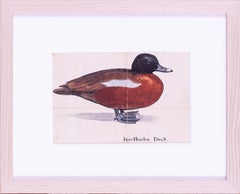
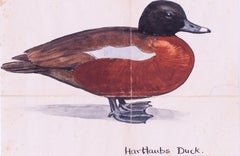
'Hart Laubs Duck' by British ornithologist Sir Peter Markham Scott

'Hart Laubs Duck' by British ornithologist Sir Peter Markham Scott

Located in Petworth, West Sussex

Sir Peter Markham Scott CH CBE DSC FRS FZS Hart Laubs Duck Watercolour on paper 4.3/8 x 6.1/2 in. (11.2 x 16.5 cm.) Provenance: Painted by Scott as a visual record for a bird spotte...

Category

20th Century Academic Animal Prints

Materials

Paper, Watercolor

Vintage MOMA Francesco Clemente Museum of Modern Art 1986 dream myth poster

Vintage MOMA Francesco Clemente Museum of Modern Art 1986 dream myth poster

By Francesco Clemente

Located in New York, NY

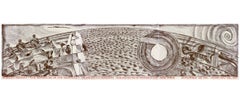
This three-part work spanning 10 feet was printed from the plates of Francesco Clemente’s mythological landscape Untitled A on the occasion of the 1986 MoMA, New York show of Clement...

Category

1980s Academic Animal Prints

Materials

Lithograph, Offset

A La Queue (Join the Queue)  Naughty Dogs of Paris by O'Klein

A La Queue (Join the Queue) Naughty Dogs of Paris by O'Klein

By Boris O'Klein

Located in Paonia, CO

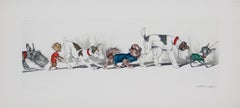
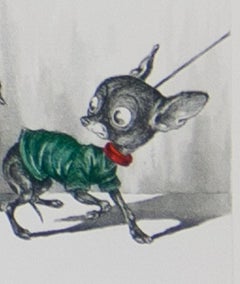
A La Queue (Join the Queue) original etching from the series Naughty Dogs of Paris showing a line of five dogs of various breeds trailing a small Chihuahua on a leash who is turning her head towards the queue. This original etching is in excellent condition, hand signed by the artist and published by Sidney Lucas. paper size 13.75 x 29.25 image size 8.50 x 24 Boris O'Klein ( 1893-1985 ) immigrated to France from Russia with his family when he was a young boy. He settled in Paris after World War I and became a prolific artist well known for his watercolors and etchings of dogs getting into mischief. His images are often risque and are considered very humorous. They have been referred to as the Naughty or Dirty Dogs of Paris.

Category

1930s Academic Animal Prints

Materials

Etching

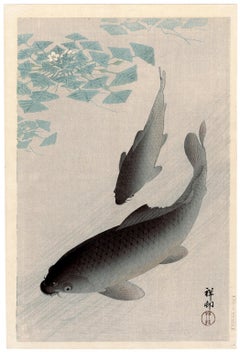
'Carp and Water Chestnut' — Showa lifetime impression

'Carp and Water Chestnut' — Showa lifetime impression

By Ohara Koson

Located in Myrtle Beach, SC

Ohara Koson (1877-1945), 'Carp and Water Chestnut', color woodblock print, 1926. A fine impression, with fresh colors, on cream Japan paper; the full sheet, in excellent condition. Signed 'Koson' with the artist’s red seal 'Koson'. Published by Watanabe Shozaburo. With the Watanabe 'C' seal in the lower right margin, indicating a lifetime impression printed between 1929-1942. Image size 13 1/2 x 7 1/4 inches (343 x 184 mm); sheet size 14 1/2 x 7 1/2 inches (368 x 191 mm). Archivally sleeved, unmatted. Literature: 'Crows, Cranes, and Camellias: The Natural World of Ohara Koson', Newland, Amy R.: Jan Perree & Robert Schaap, Leiden: Hotei Publishing, 2001. S39.1, pl 169. Collections: National Museum of Asian Art (Smithsonian), Smart Museum of Chicago (University of Chicago). In Japanese art, the carp represents good luck and good fortune. ABOUT THE ARTIST Koson Ohara...

Category

1920s Academic Animal Prints
Materials

Woodcut

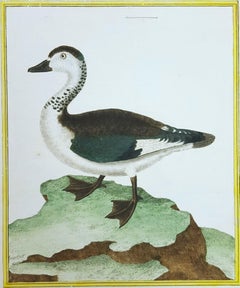
Sacelle male, de la cote de Coromandel /// Ornithology Martinet Bird Animal Art

Sacelle male, de la cote de Coromandel /// Ornithology Martinet Bird Animal Art

By François Nicolas Martinet

Located in Saint Augustine, FL

Artist: François-Nicolas Martinet (French, 1731-1800) Title: "Sacelle male, de la cote de Coromandel" (Plate 949) Portfolio: Histoire Naturelle Des Oiseaux *Signed by Martinet in the...

Category

1770s Academic Animal Prints
Materials

Watercolor, Laid Paper, Engraving, Intaglio

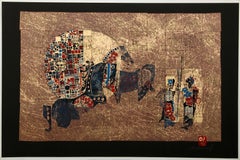
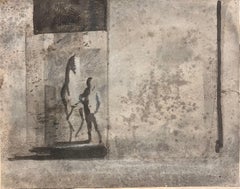
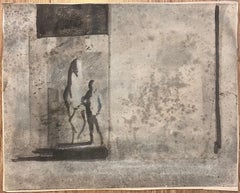
Original French Abstract Study of a Horse and Figure in a Stable

Original French Abstract Study of a Horse and Figure in a Stable

By Robert Ladou

Located in Cirencester, Gloucestershire

Title: Original French Abstract Study of a Horse and Figure in a Stable Artist: Robert Ladou (French, 1929-2014) Medium: Watercolor on paper Size: 12 (Height) x 14.75 (Width) Signed...

Category

20th Century Academic Animal Prints

Materials

Watercolor

Previously Available Items
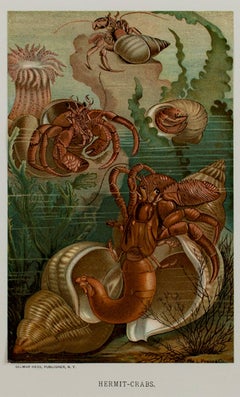
"Hermit-Crabs, " Original Color Lithograph Seafloor Print by Louis Prang

"Hermit-Crabs, " Original Color Lithograph Seafloor Print by Louis Prang

By Louis Prang

Located in Milwaukee, WI

"Hermit Crabs" is an original color lithograph by Louis Prang. It depicts some underwater sea creatures. The artist signed the piece in the stone lower right. It was published by Selmar Hess in New York. 9 1/8" x 5" art 19 1/2" x 16" framed Louis Prang (March 12, 1824 – September 14, 1909) was an American printer, lithographer, publisher, and Georgist. He is sometimes known as the "father of the American Christmas card". Prang's early activities in the US publishing architectural books and making leather goods were not very successful, and he began to make wood engravings for illustrations in books. In 1851 he worked for Frank Leslie, art director for Gleason's Pictorial Drawing-Room Companion, and later with John Andrew. In 1851, he married Rosa Gerber, a Swiss woman he had met in Paris in 1846. In 1856, Prang and a partner created a firm, Prang and Mayer, to produce lithographs. The company specialized in prints of buildings...

Category

1880s Academic Animal Prints
Materials

Lithograph

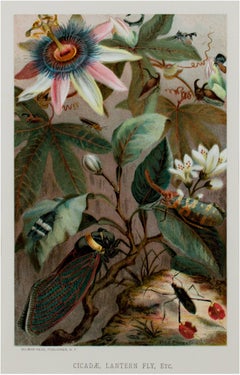
"Cicadae, Lantern Fly, Etc., " original color lithograph by Louis Prang

"Cicadae, Lantern Fly, Etc., " original color lithograph by Louis Prang

By Louis Prang

Located in Milwaukee, WI

"Cicadae, Lantern Fly, Etc." is an original color lithograph by Louis Prang. It depicts exotic flowers, plants, and insects. The artist signed the piece in the stone lower right. It was published by Selmar Hess in New York. 8 1/8" x 5" art 19 1/2" x 16" framed Louis Prang (March 12, 1824 – September 14, 1909) was an American printer, lithographer, publisher, and Georgist. He is sometimes known as the "father of the American Christmas card". Prang's early activities in the US publishing architectural books and making leather goods were not very successful, and he began to make wood engravings for illustrations in books. In 1851 he worked for Frank Leslie, art director for Gleason's Pictorial Drawing-Room Companion, and later with John Andrew. In 1851, he married Rosa Gerber, a Swiss woman he had met in Paris in 1846. In 1856, Prang and a partner created a firm, Prang and Mayer, to produce lithographs. The company specialized in prints of buildings...

Category

1880s Academic Animal Prints
Materials

Lithograph

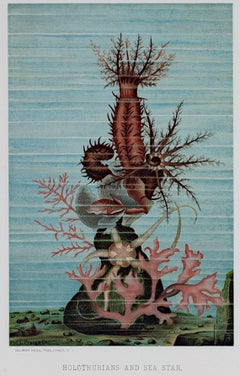
"Holothurians and Sea Star, " Original Color Lithograph by Louis Prang

"Holothurians and Sea Star, " Original Color Lithograph by Louis Prang

By Louis Prang

Located in Milwaukee, WI

"Holothurians and Sea Star" is an original color lithograph by Louis Prang. It depicts some underwater sea creatures. The artist signed the piece in the stone lower left. It was published by Selmar Hess in New York. 7 3/4" x 5" art 19 3/8" x 16" framed Louis Prang (March 12, 1824 – September 14, 1909) was an American printer, lithographer, publisher, and Georgist. He is sometimes known as the "father of the American Christmas card". Prang's early activities in the US publishing architectural books and making leather goods were not very successful, and he began to make wood engravings for illustrations in books. In 1851 he worked for Frank Leslie, art director for Gleason's Pictorial Drawing-Room Companion, and later with John Andrew. In 1851, he married Rosa Gerber, a Swiss woman he had met in Paris in 1846. In 1856, Prang and a partner created a firm, Prang and Mayer, to produce lithographs. The company specialized in prints of buildings...

Category

1880s Academic Animal Prints
Materials

Lithograph

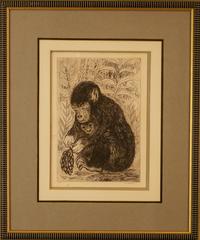
The mother and her baby

The mother and her baby, 1970-80

Sold

H 21.26 in W 18.12 in D 1.58 in

The mother and her baby

Located in Nice, FR

Lithographie 1/10

Category

Late 20th Century Academic Animal Prints
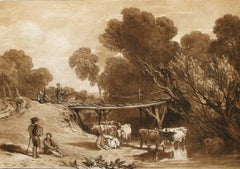
Bridge and Cows.
Bridge and Cows.

Bridge and Cows.

By J.M.W. Turner

Located in Plano, TX

Bridge and Cows. Published by J.M.W. Turner c. June, 1807. Etching and mezzotint. Finberg 2.iii or iv/v. Series: Liber Studiorum. 8 1/8 x 11 3/8 (sheet 11 1/2 x 16 3/4). Drawn and et...

Category

Early 1800s Academic Animal Prints
Materials

Etching, Mezzotint

Academic animal prints for sale on 1stDibs.
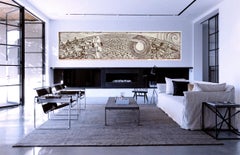
Find a wide variety of authentic Academic animal prints available for sale on 1stDibs. Works in this style were very popular during the 21st Century and Contemporary, but contemporary artists have continued to produce works inspired by this movement. Many Pop art paintings were created by popular artists on 1stDibs, including John James Audubon, George Edwards, Hoi Lebadang, and George Cruikshank. Frequently made by artists working with Lithograph, and Engraving and other materials, all of these pieces for sale are unique and have attracted attention over the years. Not every interior allows for large Academic animal prints, so small editions measuring 4.93 inches across are also available. Prices for animal prints made by famous or emerging artists can differ depending on medium, time period and other attributes. On 1stDibs, the price for these items starts at $50 and tops out at $4,200, while the average work sells for $60.