Cubist Animal Prints

CUBIST STYLE

Inspired by the nontraditional ways Postimpressionists like Paul Cézanne and Georges Seurat depicted the world, Pablo Picasso and Georges Braque pioneered an even more abstract style in which reality was fragmented into flat, geometric forms. Cubism majorly influenced 20th-century Western art as it radically broke with the adherence to composition and linear perspectives that dated back to the Renaissance. Its watershed moments are considered Picasso’s 1907 Les Demoiselles d’Avignon, in which nude figures are fractured into angular shapes, and Georges Braque’s 1908 painting show, which prompted a critic to describe his visual reductions as “cubes.”

Although Cubism was a revolutionary art movement for European culture, it was informed by African masks and other tribal art. Its artists, which included Fernand Léger, Alexander Archipenko, Marcel Duchamp, Juan Gris and Jean Metzinger, experimented with compressing space and playing with the tension between solid and void forms in their work. While their subjects were often conventional, such as still lifes, nudes and landscapes, they were distorted without any illusion of realism.

Cubist art evolved through different distinct phases. In Analytic Cubism, from 1908 to 1912, figures or objects were “analyzed” into pieces that were reassembled in paintings and sculptures, as if presenting the same subject matter from many perspectives at once. The palette was usually monochromatic and muted, giving attention to the overlapping planes. Synthetic Cubism, dating from 1912 to 1914, moved to brighter colors and a further flattening of images. This unmooring from formal ideas of art would shape numerous styles that followed, from Dada to Surrealism.

Find a collection of authentic Cubist paintings, prints and multiples, sculptures and more art on 1stDibs.

to
10
8
10
11
3
1
Overall Width
to
Overall Height
to
2,045
1,822
308
280
240
151
103
82
67
60
46
40
20
2
5
5
3
2
1
34
1
1
3
8
10
1
1
1
20
13
11
6
4
4
4
4
3
3
2
2
2
2
1
1
1
1
1
1
1
1
25
5
4
4
2
8
6
23
11
Style: Cubist
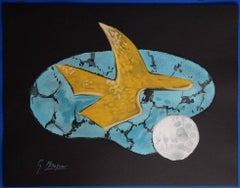
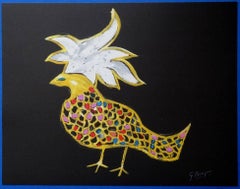
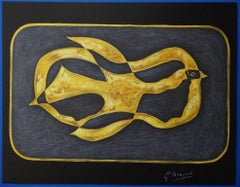
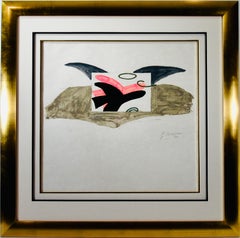
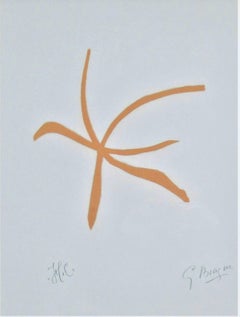
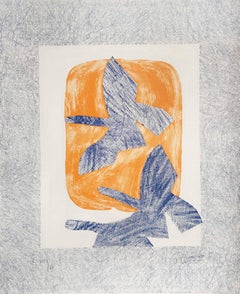
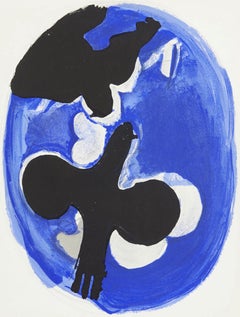
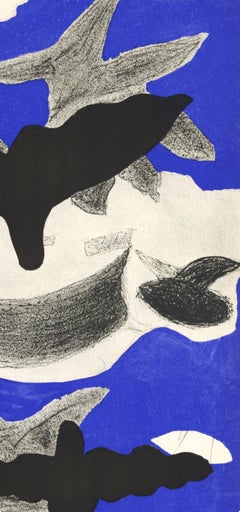
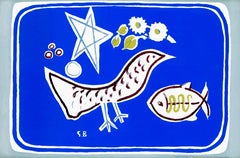
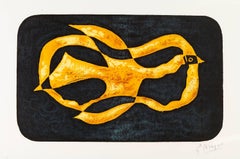
Bird of the Moon - lithograph - 399 copies

Bird of the Moon - lithograph - 399 copies

By Georges Braque

Located in Paris, IDF

Georges BRAQUE Bird of the Moon Lithograph (Art-Litho workshop) Printed signature in the plate On Arches vellum 18 x 23" INFORMATION: Limited edition of 399 copies unumbered - Ed...

Category

Late 20th Century Cubist Animal Prints

Materials

Lithograph

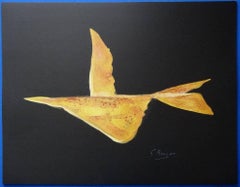
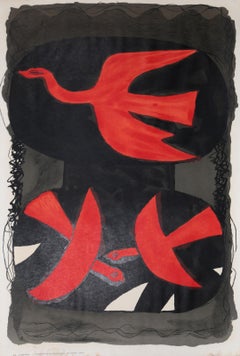
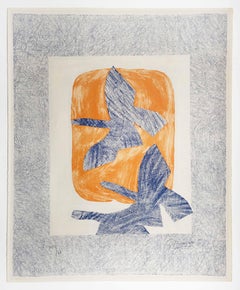
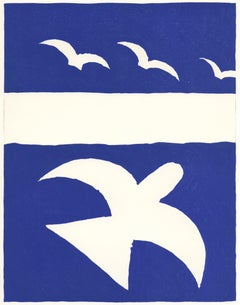
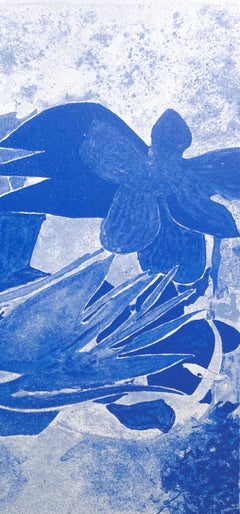
Phoenix : Bird in Fire - Lithograph - Limited /399 copies

Phoenix : Bird in Fire - Lithograph - Limited /399 copies

By Georges Braque

Located in Paris, IDF

after Georges BRAQUE Phoenix : Bird in Fire Lithograph (Art-Litho workshop) Printed signature in the plate On Arches vellum 18 x 23" (58 x 45 cm) INFORMATION: Limited edition of 3...

Category

Late 20th Century Cubist Animal Prints

Materials

Lithograph

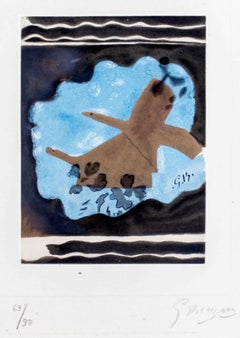
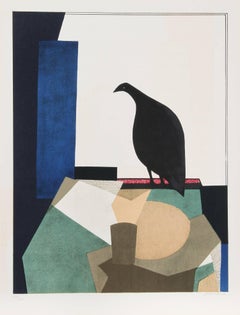
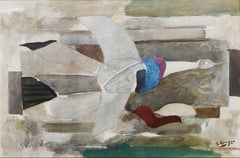
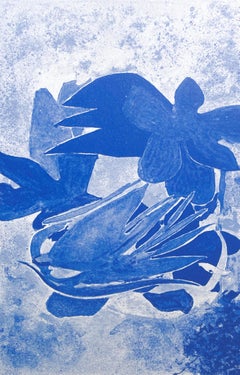
Migration Etching by Georges Braque, Signed Cubist Edition, 1962

Migration Etching by Georges Braque, Signed Cubist Edition, 1962

By Georges Braque

Located in Roma, IT

" Migration " is an etching realized by  Georges Braque  in 1962. The print is hand signed and numbered. This is an edition of 90 prints. Bibliography: D. Vallier,  Braque : l'oeuvre gravé: catalogue raisonné , Flammarion, Paris 1982, p.241, n.72. Georges Braque  (1882-1963) was a French Fauve painter who began to rethink his own painting style after admiring Picasso’s  Les Demoiselles...

Category

1960s Cubist Animal Prints

Materials

Etching

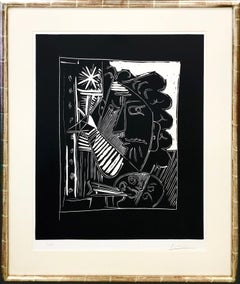
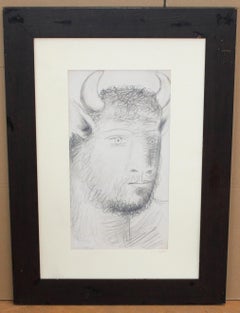
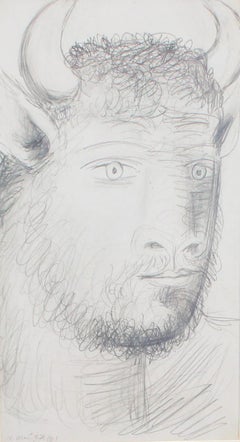
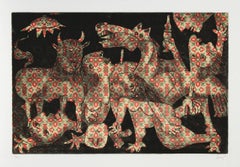
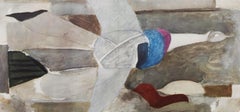
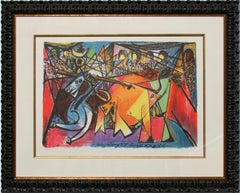
Tete de Minotaur Lithograph, Cubist Style, Framed, 1990 Edition

Tete de Minotaur Lithograph, Cubist Style, Framed, 1990 Edition

Located in Sant Celoni, ES

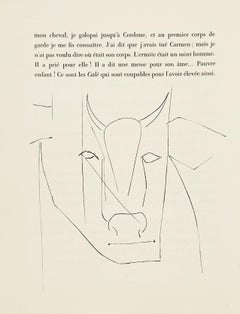
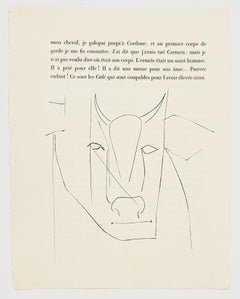
Reproducción integral del formato original en facsímil del boceto número 19 preparatorio del Guernica. Fechado en plancha 10-Mai-37 (II). Pertenece a una edición limitada por Saler...

Category

1990s Cubist Animal Prints

Materials

Lithograph

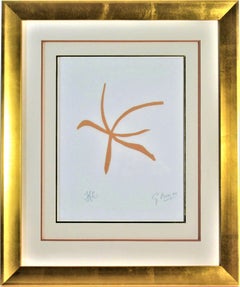
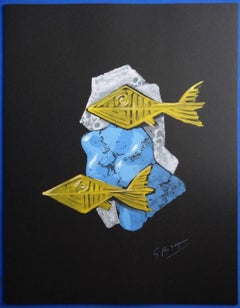
Lettera Amorosa
Lettera Amorosa

Lettera Amorosa

By George Braque

Located in San Francisco, CA

This artwork titled "Lettera Amorosa" 1963, is an original color lithograph on Japan nacre paper by renown French artist Georges Braque, 1882-1963. It is hand signed and numbered 42/...

Category

Mid-20th Century Cubist Animal Prints

Materials

Lithograph

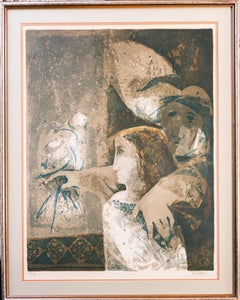
"Gray with Dove" 54/100 Cubist Mother Child Bird Blue Earth Tones Peaceful

"Gray with Dove" 54/100 Cubist Mother Child Bird Blue Earth Tones Peaceful

By Alvar Sunol Munoz-Ramos

Located in Austin, TX

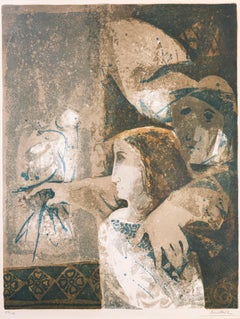
Page size: 27 x 20 in. Frame size: 32 x 25 in. Signed in pencil, bottom right: "ALVAR" Numbered in pencil, bottom left "54/100" A dreamy, abstract litograph in misty blues, grays, w...

Category

Mid-20th Century Cubist Animal Prints

Materials

Archival Paper, Lithograph

Baj Chez Picasso 2, Cubist Aquatint Etching by Enrico Baj

Baj Chez Picasso 2, Cubist Aquatint Etching by Enrico Baj

By Enrico Baj

Located in Long Island City, NY

Artist: Enrico Baj, Italian (1924 - 2003) Title: Baj Chez Picasso 2 Year: 1969 Medium: Aquatint Etching, Signed and numbered in pencil Edition: 86/100 Image Size: 15 x 22 inches...

Category

1960s Cubist Animal Prints

Materials

Etching, Aquatint

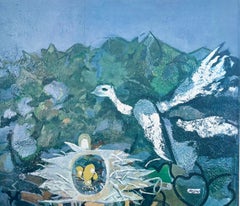
After Georges Braque - Antiborée - Lithograph

After Georges Braque - Antiborée - Lithograph

Located in Collonge Bellerive, Geneve, CH

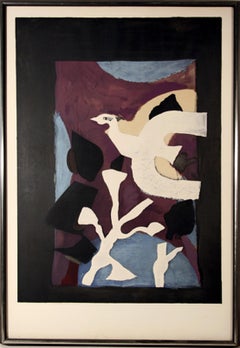
Lithograph after Georges Braque. Signed in the plate Edition of 150 Dimensions: 76 x 117 cm Bibliography: « Les Métamorphoses de Braque» of Heger de Loewenfeld and Raphaël de Cuttoli , Editions FAC, Paris, 1989. In 1961 Georges Braque decided with his laidary friend Heger de Loewenfeld to pick up certain of his works to in order to create artworks, this beautiful litograph is one of them. Héméra in the Mythology: In Greek mythology Hemera was the personification of day and one of the Greek primordial deities. She is the goddess of the daytime and, according to Hesiod, the daughter of Erebus and Nyx (the goddess of night). Hemera is remarked upon in Cicero's De Natura Deorum, where it is logically determined that Dies (Hemera) must be a god, if Uranus is a god. The poet Bacchylides states that Nyx and Chronos are the parents, but Hyginus in his preface to the Fabulae mentions Chaos as the mother/father and Nyx as her sister. She was the female counterpart of her brother and consort, Aether (Light), but neither of them figured actively in myth or cult. Hyginus lists their children as Uranus, Gaia, and Thalassa (the primordial sea goddess), while Hesiod only lists Thalassa as their child. The father of Cubism Three Cubist that distinguishes art historian periods were initiated and developed by Georges Braque: The Cubist Cézanne (1907-1909), Executive (1909-1912) and synthetic (1912-1922). Post-Impressionist and fawn, Braque no longer adheres to the contingency of a decorative way or the other. Cézanne’s paintings exhibited at the Grand Palais during the retrospective of 1907 are a revelation: Cézanne sought and invented a pictorial language. In his footsteps, Braque went to the South with the reasons of the Master. He returned with Estaque landscapes and surprising Ciotat it keeps Cezanne geometric model and retains the “passages” continuity from one surface to another to create the sensation of “turning around” of the object represented. But he wants to go after the consequences of the vision of Cezanne. In his paintings Houses in L’Estaque (1908) it simplifies the volumes of houses, neglects detail by removing doors and windows: the plastic rhythm that builds the table. Large Nude , a masterpiece of the period, can be considered the first work of Cézanne cubism . Systematizing and deepening Braque discoveries open the door analytical cubism. In 1909, his painting became more cerebral than sensual. The pattern is recreated in the two-dimensionality of the canvas, leaving aside any illusionistic perspective. In Still Life with Violin, objects are analyzed facets according to their characteristic elements, each facet referring to a particular view of the object. There are so many facets of points selected view: Table reflects the knowledge of the object and the ubiquity of the eye. Moreover, Braque is looking for the essence of the objects in the world rather than their contingency, which explains the absence of light source and use of muted colors (gray, ocher), contingent aspects of the object . But formal logic has stepped facets, erased any anecdote to the object and ultimately led to his painting a hermetic more marked on the edge of abstraction (see the series of Castle Roche-Guyon ). Braque, anxious to keep the concrete and refusing at all costs that the logic of Cubism takes the paintings to abstract, reintroduced signs of reality in his paintings in 1912 marks the beginning of Synthetic Cubism. Historians speak of “signs of real” rather than reality because what interests Braque, this is not to put reality into a table, but to create a painting which, by its language, refers to the real. To do this, he invented two major techniques XX th century inclusions and contributions. The inclusions consist of painting objects that have no real depth, materials (wallpaper in Nature morte aux playing cards faux wood is a pictorial inclusion) or letters (calligraphic inclusion in Portuguese ), made first brush and a few months later stencil. Contributions are defined in contrast with the collage on canvas of foreign materials: glued or sand paper, sawdust, etc.. Regarding the collages, Braque used for the first time in September 1912 a piece of adhesive paper imitating faux wood Compote...

Category

1950s Cubist Animal Prints
Materials

Lithograph

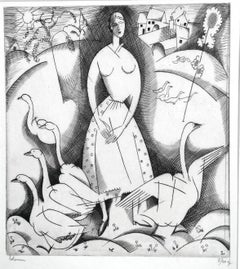
La Fille aux Oies

La Fille aux Oies

By Jean-Emile Laboureur

Located in New York, NY

Jean-Emile Laboureur (1877-1943), La Fille aux Oies, engraving, 1916, signed in pencil lower left, numbered (4/40) lower right and inscribed “imp,” also titled lower left margin edge...

Category

1910s Cubist Animal Prints

Materials

Engraving

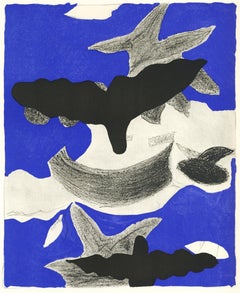
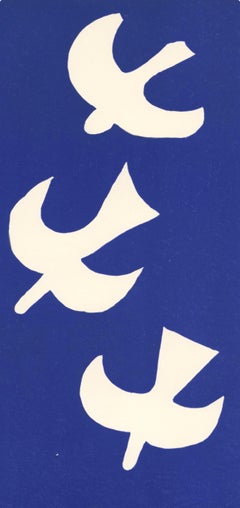
Birds in Flight - French Cubism Bird

Birds in Flight - French Cubism Bird

By Georges Braque

Located in London, GB

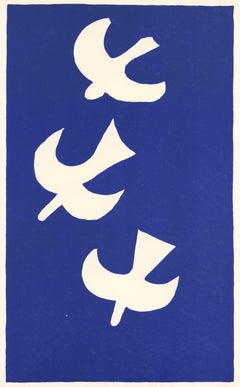
This original lithograph in colours is hand signed in pencil by the artist "G. Braque" at the lower right margin. It is also hand numbered in pencil 75 from the edition of 75, at the...

Category

1960s Cubist Animal Prints

Materials

Lithograph

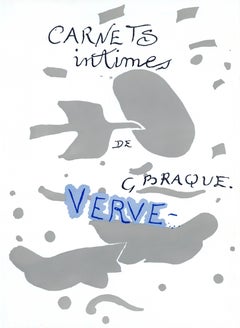
Georges Braque, Untitled, from The Transparent Words, 1955

Georges Braque, Untitled, from The Transparent Words, 1955

By Georges Braque

Located in Southampton, NY

This exquisite lithograph by Georges Braque (1882–1963), titled Sans titre (Untitled), from Les Paroles Transparentes (The Transparent Words), originates from the May 11, 1955 issue ...

Category

1950s Cubist Animal Prints
Materials

Lithograph

Cubist animal prints for sale on 1stDibs.
Find a wide variety of authentic Cubist animal prints available for sale on 1stDibs. Works in this style were very popular during the 20th Century, but contemporary artists have continued to produce works inspired by this movement. If you’re looking to add animal prints created in this style to introduce contrast in an otherwise neutral space in your home, the works available on 1stDibs include elements of orange and other colors. Many Pop art paintings were created by popular artists on 1stDibs, including Pablo Picasso, (after) Pablo Picasso, (after) Georges Braque, and Georges Braque. Frequently made by artists working with Lithograph, and Paper and other materials, all of these pieces for sale are unique and have attracted attention over the years. Not every interior allows for large Cubist animal prints, so small editions measuring 14.77 inches across are also available. Prices for animal prints made by famous or emerging artists can differ depending on medium, time period and other attributes. On 1stDibs, the price for these items starts at $270 and tops out at $39,500, while the average work sells for $2,036.