Want more images or videos?
Request additional images or videos from the seller
1 of 3

André Lambert
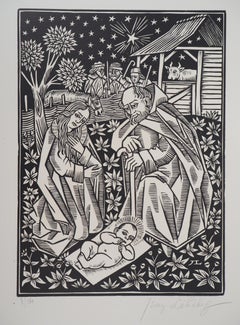
Adoration of the Magi Nativity Scene —Christmas

1910

$325List Price

You May Also Like

Adoration of the Magi / - The Rider of the Sun -

Adoration of the Magi / - The Rider of the Sun -

Located in Berlin, DE

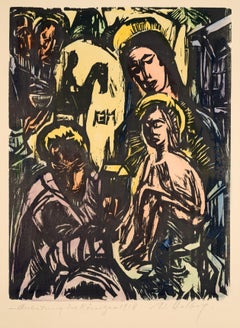
Walter Helbig (1878 Falkenstein - 1968 Ascona), Adoration of the Magi, 1918. Hand-colored linocut, 30 cm x 22.5 cm (depiction), 50 cm x 35 cm (sheet size), signed “W.[alter] Helbig” in pencil lower right, inscribed “Adoration of the Magi” lower left and dated “1918”. Below this a handwritten dedication “with heartfelt Christmas greetings”. - Paper somewhat darkened and with slight creases, thumbtack holes in the corners - The Rider of the Sun - The 'apocalypse' of World War I brought about a return to sacred art. Walter Helbig belonged to the circle of the 'Brücke' and the 'Blauer Reiter'. With his reinterpretation of religious themes in an expressionist formal language, Helbig shaped an avant-garde neo-sacred art. This is symbolically expressed in the silhouette of the rider against the sun-like yellow background. It refers to the awakening initiated by the Blue Riding, which is now linked back to the sacred. The rider and horse "look" at Mary and the Christ Child, who occupy the entire field. Opposite them are the three kings, the eldest of whom kneels before Christ and offers him a gold-filled casket. The expressionist lines give rise to a tower that rises into the "sun", so that the gift has become a Gothic church, expressing the hope that the fallen world will be resurrected in the name of Christ. This dimension of meaning is emphasized by the magical effect of the color scheme. About the artist In 1895, Walter Helbig began studying at the Dresden Academy of Art, where he became friends with the future Brücke artist Otto Müller, with whom he lived in Dresden from 1903 to 1905. While studying in Italy from 1897 to 1899, he met Arnold Böcklin and Adolf von Hildebrand. After completing his studies, he first worked for Otto Gussmann, painting churches. From 1905 to 1909 he worked as a freelance painter in Hamburg. In 1909, through the mediation of Otto Müller, Helbig made the acquaintance of artists from the 'Brücke'. In 1910 he exhibited at the founding exhibition of the Berlin 'Neue Sezession'. In the same year, he moved to Switzerland, where, together with Hans Arp and Oscar Lüthy, he founded the 'Moderne Bund' in Weggis, to which Cuno Amiet and Giovanni Giacometti also belonged. At the second exhibition of the 'Moderne Bund' in Zurich in 1911, Henri Matisse and Robert Delaunay were represented alongside artists from the 'Blauer Reiter'. In 1913, Helbig traveled to Paris with Arp and Lüthy. After the dissolution of the 'Moderne Bund', Helbig was represented at the first Dada exhibition in Zurich in 1914. In 1919, he joined the Berlin 'Novembergruppe'. After the devastation of World War I, Helbig turned increasingly to religious themes in his work. In 1924, like many other artists of his time, he moved to Ascona for financial reasons, where he became a naturalized citizen in 1938. There he founded the artists' association "The Great Bear", to which Marianne von Werefkin...

Category

1910s Expressionist Figurative Prints

Materials

Paper

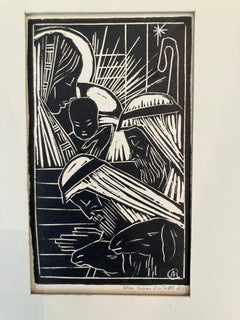
Allan Rohan Crite Adoration of the Magi

Allan Rohan Crite Adoration of the Magi

By Allan Rohan Crite

Located in San Francisco, CA

Allan Rohan Crite: 1910-2007. Well, listed African-American artist mostly associated with the Boston area. He was known in his time as the Deen of African-American artist. He chronic...

Category

1930s American Realist Figurative Prints

Materials

Linocut, Woodcut

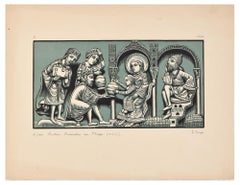
Adoration des Mages - Original Woodcut Print by I. Sage - 1926

Adoration des Mages - Original Woodcut Print by I. Sage - 1926

By Isidore Sage

Located in Roma, IT

Adoration des Mages is an original artwork realized by Isidore Sage in the first decades in 1926. Original colored xylograph on paper. Image dimensions: 13 x 24 cm. Titled and numbe...

Category

1920s Modern Figurative Prints

Materials

Woodcut

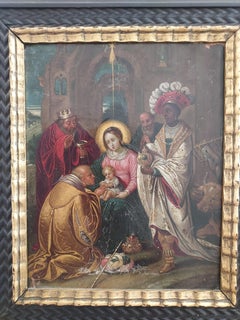
The Adoration of the Magi . Flemish School

The Adoration of the Magi . Flemish School, 1600

$4,712

H 6.7 in W 5.52 in D 0.4 in

The Adoration of the Magi . Flemish School

Located in Pasadena, CA

Oil on cupper and wooden panel . Our tender representation is from the second half of the 17th century , follower of Cornelis de Baellieur School. The adoration of the Magi flemish s...

Category

Early 1600s Flemish School Figurative Paintings

Materials

Oil

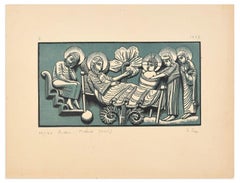
Nativité - Original Woodcut Print by I. Sage - 1927

Nativité - Original Woodcut Print by I. Sage - 1927

By Isidore Sage

Located in Roma, IT

Nativité is an original artwork realized by Isidore Sage in 1927. Original Xilograph on paper. Hand-signed in pencil on the lower right: I. Sage; titled and numbered on the lower...

Category

1920s Modern Figurative Prints

Materials

Woodcut

Stunning Masterpiece: "Adoration of the Magi" - A Rare Gem on Cotognino Alabaste

Stunning Masterpiece: "Adoration of the Magi" - A Rare Gem on Cotognino Alabaste

Located in Madrid, ES

Elevate your collection with this breathtaking oil painting, "Adoration of the Magi," skillfully rendered on a magnificent 51x40 cm Cotognino Alabaster panel. This extraordinary piec...

Category

Antique 16th Century Paintings

Materials

Onyx

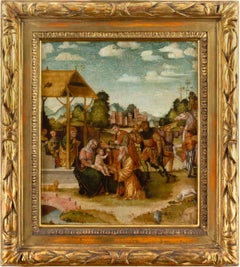
Mid-16th-Century Romagnola School The Adoration Of The Magi, Nativity

Mid-16th-Century Romagnola School The Adoration Of The Magi, Nativity

Located in Cheltenham, GB

This exquisite early 16th-century Italian panel captures one of Christianity’s most cherished moments - the Adoration of the Magi. Painted around 1530, this panel belongs to a moment...

Category

16th Century Renaissance Figurative Paintings

Materials

Oil, Panel

Birth of Jesus, Fine c.1900 German Nativity Chromolithograph (Original)

Birth of Jesus, Fine c.1900 German Nativity Chromolithograph (Original)

Located in Langweer, NL

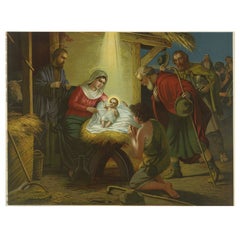
The Nativity, c.1900 German Chromolithograph “The Birth of Jesus” (Printed in Germany) This beautiful early 20th-century German chromolithograph of “The Birth of Jesus” is a richly detailed devotional scene showing the Nativity as it appeared in the finest German religious prints of the period. Produced around 1900–1920 by a major German devotional press, the work exemplifies the warmth, luminous colour, and emotional clarity that made these chromolithographs treasured in Catholic households across Europe and the Americas. The composition presents the Virgin Mary and Joseph watching over the Christ Child, who lies upon a bed of straw illuminated by a radiant divine beam. Shepherds kneel and bow in reverence, offering homage with humble gestures and simple gifts, while others approach from the right carrying lambs. The soft modelling of the figures, the golden haloes, the warm earth tones of the stable interior, and the vivid reds and greens of the shepherds’ garments all reflect the layered stone-colour technique of true chromolithography. Each hue is built from multiple ink plates, creating the velvety gradients and luminous highlights that distinguish authentic chromolithographs from later reproductions. Along the lower left margin, multilingual titles identify the subject for international distribution: “Die Geburt Jesu. The Birth of Jesus. La Nativité. La nascita di Gesù. El nacimiento de Jesús…” This multilingual caption is typical of German religious publishers who exported devotional art worldwide during the early 20th century. The imprint “Printed in Germany” further confirms its origin in one of the major German chromolithographic centres such as Munich, Dresden, or Cologne, all of which specialised in high-quality Catholic imagery during this period. This piece is unquestionably an original chromolithograph, not a modern reproduction. The print displays the characteristic stone-layered pigment structure, stippled textures, and warm matte surface associated with genuine chromolithographic production. The natural toning of the paper, the crisp plate text, and the nuanced colour transitions further confirm its authenticity. These Nativity scenes were often framed near family altars and are now increasingly sought after for both devotional use and interior display. Condition Report: Very good condition. Colours bright and unfaded. Minor edge toning and small handling traces consistent with age. No tears, losses, creases, or repairs. Caption and imprint line remain sharp and fully legible. Best displayed in a gilded or walnut frame to enhance the golden haloes and warm palette of the stable scene. A cream or ivory mat will complement the tender atmosphere and highlight the luminous tones. A slim black frame with a wide mat offers a modern gallery presentation while preserving the devotional character. Technique: Chromolithograph Maker: German Devotional Press, printed in Germany, c.1900 nativity birth of jesus die geburt jesu adoration of the shepherds holy family christ child virgin mary st joseph shepherds catholic art religious art devotional print chromolithograph german chromolithograph printed in germany antique lithograph early 20th century religious print christian iconography christmas art epiphany art holy family scene fine chromolitho religious ephemera antique christian art...

Category

Early 20th Century German Prints

Materials

Paper

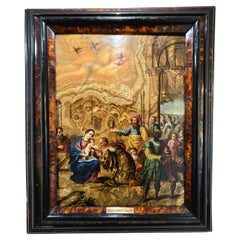
Antique painting. "Kings from all over the world in Bethlehem". Christian scene.

Antique painting. "Kings from all over the world in Bethlehem". Christian scene.

Located in Berlin, DE

Huge and very decorative castle painting. Antique oil painting. Probably 18th century. "Kings from all over the world in Bethlehem". Christian scene. Canvas relined. Big, heavy fr...

Category

18th Century Old Masters Figurative Paintings

Materials

Canvas, Oil

More From This Seller

View All
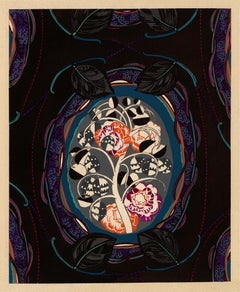
'Variations 20' — French Art Deco, Habd-Applied Pochoir Original

'Variations 20' — French Art Deco, Habd-Applied Pochoir Original

By Edouard Benedictus

Located in Myrtle Beach, SC

Edouard Benedictus, 'Variations, plate 20' from the portfolio 'Variations Quatre-Vingt-Six Motifs Décoratifs en Vingt Planches', color pochoir, edition not stated, 1923. Signed in th...

Category

1920s Art Deco Figurative Prints

Materials

Stencil

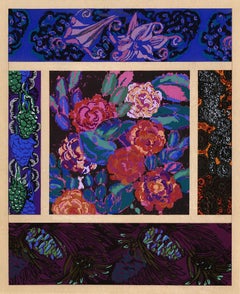
'Variations 9' — French Art Deco, Hand-Applied Pochoir Original

'Variations 9' — French Art Deco, Hand-Applied Pochoir Original

By Edouard Benedictus

Located in Myrtle Beach, SC

Edouard Benedictus, 'Variations, plate 9' from the portfolio 'Variations Quatre-Vingt-Six Motifs Décoratifs en Vingt Planches', color pochoir, edition not stated, 1923. Signed in the...

Category

1920s Art Deco Figurative Prints

Materials

Stencil

'Venus'  — German Expressionism

'Venus' — German Expressionism

By Karl Michel

Located in Myrtle Beach, SC

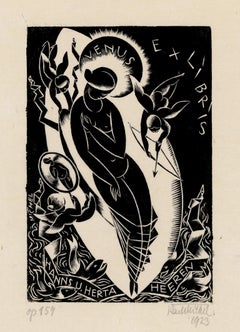
Karl Michel, 'Venus, Ex Libris - Hanns U. Herta Heeren', woodcut, 1923, edition not stated but small. Signed, dated, and numbered 'op.154' in pencil. Signed in the block, lower left. A fine impression, on cream Japan paper, with full margins (15/16 to 2 11/16 inches), in good condition. Printed by the artist. Matted to museum standards (unframed). . Translation: Venus Ex Libris for Hanns and Herta Heeren. Image size 5 15/16 x 4 inches (156 x 102 mm); sheet size 9 5/8 x 6 inches (245 x 152 mm). ABOUT THE ARTIST Karl Michel (1889-1984) was a noted graphic designer and expressionist printmaker during Germany's pre-Nazi Weimar Republic (1919-1933). Michel’s work was the subject of a feature article in the influential German graphic design magazine Das Plakat (The Poster) in 1920. An anti-war advocate, Michel created a suite of 12 wood engravings depicting his impressions of the humanitarian toll of WWII entitled ‘Humanitas’ (Humanity). The German publishing house Greifenverlag published the series in a reduced folio of unsigned prints. Michel’s graphic work is held in the permanent collections of the Auckland War Memorial Museum (New Zealand), Frederikshavn Kunstmuseum & Exlibrissamling (Denmark), Museum of Applied Arts (Budapest), The Robert Gore Rifkind Center for German Expressionist Studies at the Los Angeles County Museum of Art, and the German Expressionism...

Category

1920s Expressionist Figurative Prints

Materials

Woodcut

'Chinoiserie' — Mid-Century Modernism

'Chinoiserie' — Mid-Century Modernism

By Edward August Landon

Located in Myrtle Beach, SC

Edward Landon 'Chinoiserie', color serigraph, 1947, edition 50, Ryan 36. Signed in pencil in the image, lower right. Titled, dated, and annotated '4 COLORS – EDITION 50' in the scree...

Category

Mid-20th Century American Modern Abstract Prints

Materials

Screen