Want more images or videos?
Request additional images or videos from the seller
1 of 5

Bernard Picart
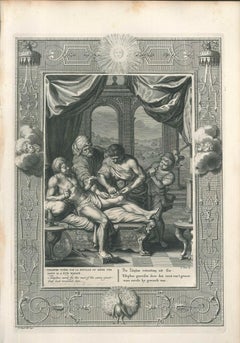
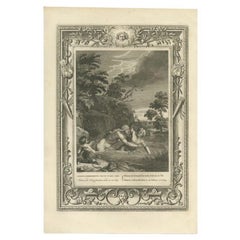
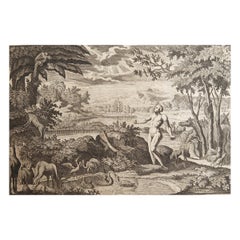
Salmacis et Hermaphrodite - Etching by Bernard Picart - 1742

1742

$565.15
£418.31
€480VAT Included
CA$787.33
A$800.79
CHF 457.91
MX$9,686.23
NOK 5,365.13
SEK 5,363.84
DKK 3,660.04

About the Item

Black and white etching on wire rod paper, representing the Greek myth of Salmacis and Hermaphroditus. Wonderful plate with very fresh impression and a beautiful use of chiaroscuro, from the volume “Le Temple des Muses”, published in Amsterdam in 1742 by Zacharias Chatelain. Capture (under the image) and author inscribed: "B. Picart del. 1731" under the frame engraved, on the lower-left margin. In excellent conditions, except for a usual light yellowing of the margins and some light vertical folds on the right margin in correspondence of the binding a little black ink stain on the lower margin and the inscription lightly discolored. The engraved image is in perfect conditions. Le Temple des Muses was an illustrated book of Ovid's more popular fables and other Greek myths published in 1733 in Dutch (Tempel der Zanggodinnen), in 1738 in English, and in 1742 in French by Zacharias Chatelain. The engravings had captions in four languages: French, English, German, and Dutch. The wonderful sixty plates engraved by Bernard Picart were a sort of fashionable mythological compendium, useful in the eighteenth century, when the fascination with Greek and Roman antiquity followed the systematic excavation of the ruins at Pompeii and Herculaneum in southern Italy; and after 1750 a neoclassical style dominated all artistic fields. Bernard Picart (Paris, 1673 – Amsterdam, 1733) French engraver best known for his book-illustrations, including the Bible and Ovid. His most famous work is Cérémonies et coutumes religieuses de tous les peuples du monde, published from 1723 to 1743 and was defined: "an immense effort to record the religious rituals and beliefs of the world in all their diversity as objectively and authentically as possible" by Jonathan I. Israel.
  • Creator:
    Bernard Picart (1673 - 1733, French)
  • Creation Year:
    1742
  • Dimensions:
    Height: 17.96 in (45.6 cm)Width: 11.26 in (28.6 cm)Depth: 0.04 in (1 mm)
  • Medium:
  • Movement & Style:
  • Period:
    1740-1749
  • Framing:
    Framing Options Available
  • Condition:
    Insurance may be requested by customers as additional service, contact us for more information.
  • Gallery Location:
    Roma, IT
  • Reference Number:
    Seller: M-959191stDibs: LU65036839832

More From This Seller

View All
La Nymphe Echo - Etching by B. Picart - 1742

La Nymphe Echo - Etching by B. Picart - 1742

By Bernard Picart

Located in Roma, IT

Black and white etching on wire rod paper, representing the Greek myth of the nymph Echo. Wonderful plate with fresh impression and a beautiful use of chiaroscuro, from the volume “...

Category

1740s Old Masters Figurative Prints

Materials

Etching

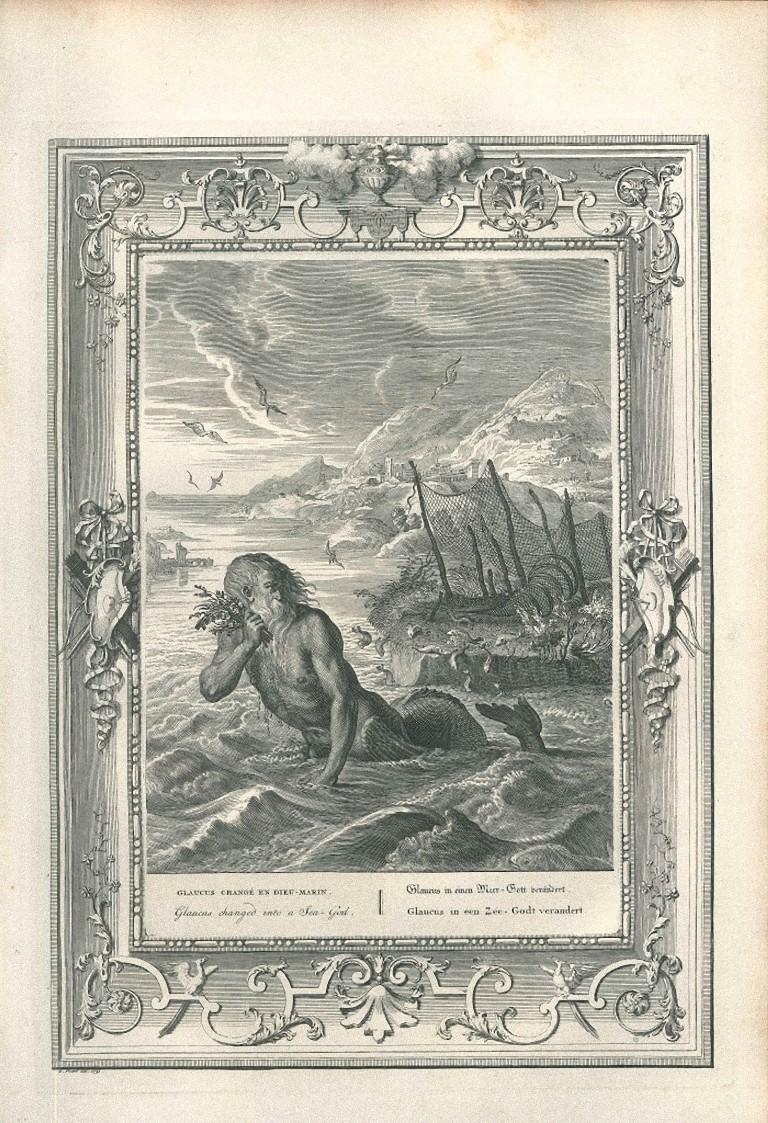
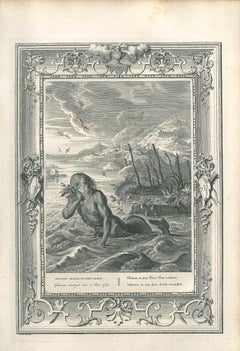
Glaucus, from "Le Temple des Muses" - Etching by B. Picart - 1742

Glaucus, from "Le Temple des Muses" - Etching by B. Picart - 1742

By Bernard Picart

Located in Roma, IT

Black and white etching on wire rod paper, representing the Greek myth of Glaucus. Wonderful plate with very fresh impression and an elegant line, from the volume “Le Temple des Mus...

Category

1740s Old Masters Figurative Prints

Materials

Etching

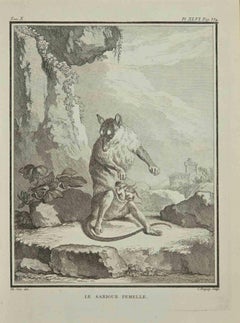
Le Sarigue - Etching by Jean Charles Baquoy - 1771

Le Sarigue - Etching by Jean Charles Baquoy - 1771

By Jean Charles Baquoy

Located in Roma, IT

Le Sarigue is an etching realized by Jean Charles Baquoy in 1771. It belongs to the suite "Histoire Naturelle de Buffon". The Artist's signature is engraved lower right. Good cond...

Category

1770s Modern Figurative Prints

Materials

Etching

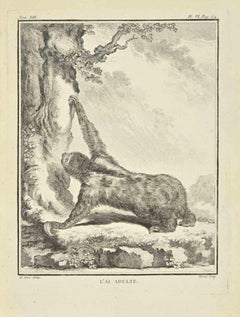
L'Al Adulte - Etching by Jacques Baron - 1771

L'Al Adulte - Etching by Jacques Baron - 1771

By Jacques Baron

Located in Roma, IT

L'Al Adulte is an etching realized by Jacques Baron in 1771. The artwork Belongs to the suite "Histoire naturelle, générale et particulière avec la description du Cabinet du Roi". P...

Category

1770s Modern Figurative Prints

Materials

Etching

You May Also Like

Antique Print of Salmacis and Hermaphroditus by Picart, 1733

Antique Print of Salmacis and Hermaphroditus by Picart, 1733

Located in Langweer, NL

Antique print titled 'Salmacis & Hermaphrodite (..)'. This print depicts Salmacis and Hermaphroditus united in one body. Hermaphroditus was the child of Aphrodite and Hermes. To conceal his birth, Aphrodite placed her son in the care of the nymphs of Mount Ida. On a hunting quest he arrived at the banks of a lake and was spotted by the nymph of the lake, Salmacis, who immediately fell in love with him. The boy resisted her physical advances until the nymph cried out begging the gods that they may never be seperated. Immediately their bodies were united as one, containing no sex...

Category

Antique 18th Century Prints

Materials

Paper

Agenor and Cadmus, Ovid's Metamorphoses, French Classical engraving, 1768

Agenor and Cadmus, Ovid's Metamorphoses, French Classical engraving, 1768

By Binet after Charles Monnet (1732-1808)

Located in Melbourne, Victoria

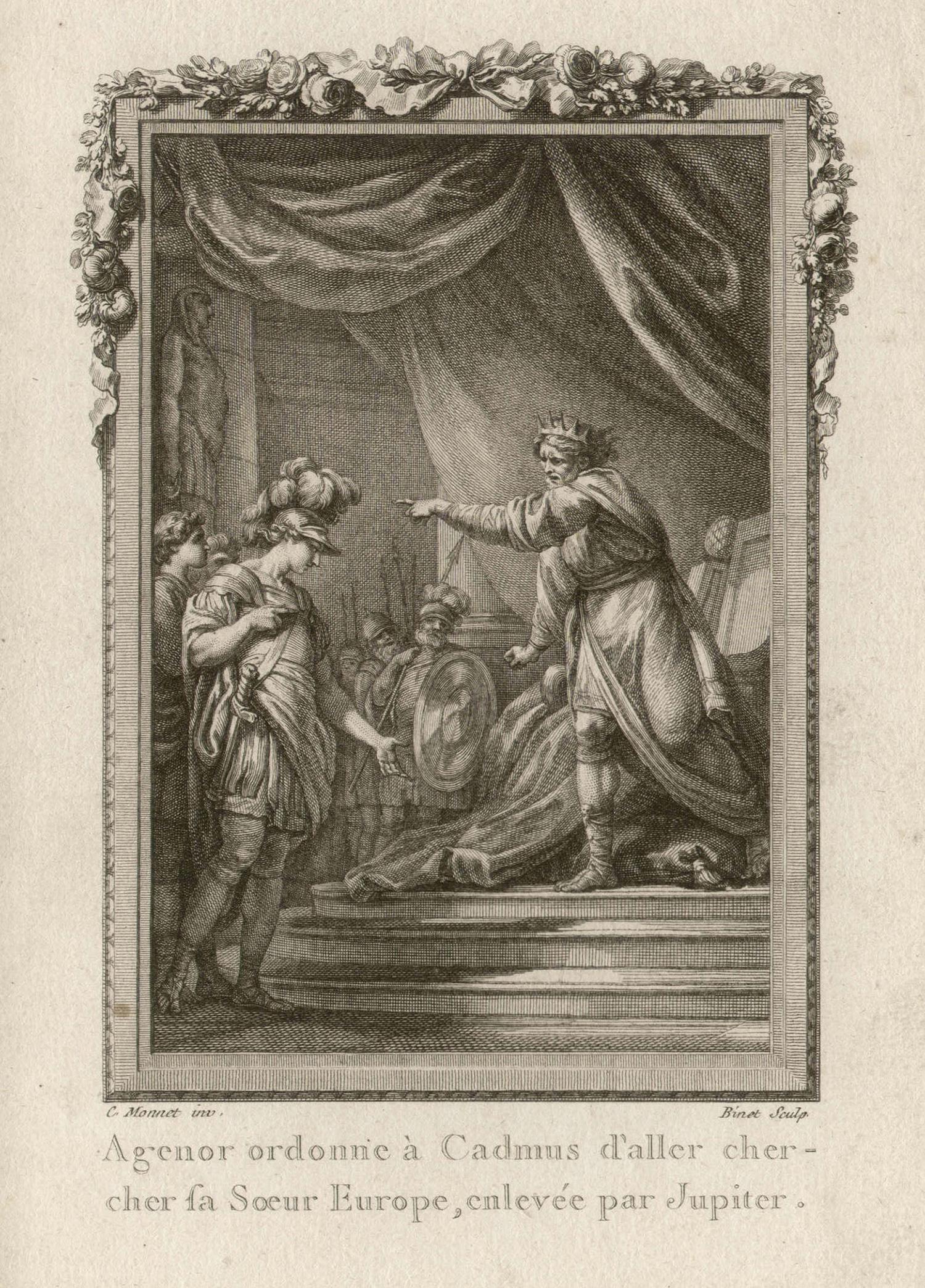
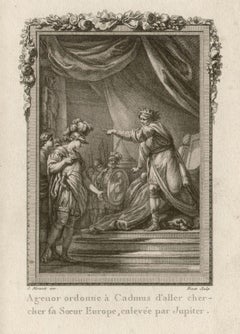
Copper-line engraving by Binet after Charles Monnet (1732-1808). Agenor tells Cadmus to go and look for his sister Europae. From 'Les Metamorphoses d'...

Category

Mid-18th Century Naturalistic Figurative Prints

Materials

Engraving

Classical Mythological Figures Engraving, Montfaucon Antiquité Expliquée 1721

Classical Mythological Figures Engraving, Montfaucon Antiquité Expliquée 1721

Located in Langweer, NL

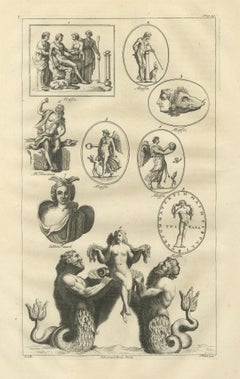
Classical Mythological Figures Engraving, Montfaucon Antiquité Expliquée 1721 This original early eighteenth-century copper engraving originates from Bernard de Montfaucon’s monumental antiquarian publication L’Antiquité expliquée et représentée en figures, published in Paris in 1721. Widely regarded as one of the most important scholarly works of the Enlightenment, Montfaucon’s encyclopedic study systematically documented the art, mythology, and material culture of the ancient world, laying essential foundations for modern archaeology and art history. The plate presents a carefully arranged compilation of mythological and sculptural studies derived from ancient sources. Multiple vignettes depict classical figures, relief fragments, and symbolic motifs recorded from antique sculptures, gems, and coins. The composition functions almost as a visual catalogue, comparing different representations of mythological subjects collected from prominent European antiquarian collections, including references to works associated with scholars such as Maffei and other early collectors of classical antiquities. At the bottom of the composition, two triton-like sea beings with human torsos and serpent tails raise a nude female figure above the waves, evoking marine mythology connected to nereids, sea deities, or allegorical representations of Venus emerging from the sea. Surrounding studies include winged figures, sculptural heads, medallions, and mythological scenes rendered with remarkable clarity. Montfaucon’s analytical approach—placing multiple related images together for comparison—reflects the Enlightenment ambition to classify and interpret antiquity through visual evidence. The engraving demonstrates the refined precision of early eighteenth-century Parisian copperplate engraving, characterized by delicate linework, balanced spacing, and restrained tonal shading. Beyond its scholarly significance, the plate possesses strong decorative appeal, combining classical imagery with an elegant graphic structure that suits both traditional and contemporary interiors. This original antique engraving is offered unframed, allowing flexibility to select a frame appropriate to the intended interior or collection setting. Condition: Good antique condition with age-related toning and light paper discoloration consistent with early eighteenth-century prints...

Category

Antique 1720s British Prints

Materials

Paper

Classical Antiquities Engraving, Sepulchrum des Nasonii, Montfaucon 1721

Classical Antiquities Engraving, Sepulchrum des Nasonii, Montfaucon 1721

Located in Langweer, NL

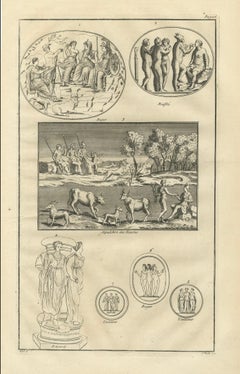
Classical Antiquities Engraving, Sepulchrum des Nasonii, Montfaucon 1721 This original early eighteenth-century copper engraving presents a scholarly compilation of classical antiquities drawn from ancient Roman artworks, engraved gems, and sculptural sources. The plate originates from Bernard de Montfaucon’s influential publication *L’Antiquité expliquée et représentée en figures*, published in Paris in 1721, one of the most important antiquarian works of the Enlightenment and a cornerstone in the development of archaeology and classical art history. The composition assembles multiple mythological and archaeological subjects arranged in a structured, comparative format typical of Montfaucon’s method. At the center appears a detailed scene labeled “Sepulchrum des Nasonii,” referring to the celebrated Tomb of the Nasonii located along the Via Flaminia in Rome, an important Roman funerary monument known for its painted mythological decorations. The engraving records figures, animals, and pastoral imagery derived from ancient wall paintings, offering eighteenth-century scholars and collectors access to monuments that were otherwise difficult to study directly. Surrounding vignettes reproduce imagery taken from antique cameos, engraved gems, and sculptural fragments. Oval compositions depict mythological figures and allegorical scenes, while the lower section includes a classical statue and medallion studies attributed to antiquarian sources associated with collectors and scholars such as Maffei and Vaillant. These references reflect Montfaucon’s ambition to synthesize knowledge gathered from Europe’s major antiquities collections into a single visual encyclopedia. Executed with refined precision, the engraving demonstrates the clarity and balance characteristic of Parisian copperplate engraving of the early 1700s. Fine linework and careful tonal shading translate sculptural and painted sources into a harmonious graphic composition. Today, plates from Montfaucon’s work are appreciated both for their scholarly significance and for their elegant decorative qualities, making them highly suitable for libraries, study interiors, or contemporary gallery walls seeking classical visual depth. This original antique engraving is offered unframed, allowing flexibility to select a frame that best complements the intended interior. Condition: Good antique condition with age-related toning and light discoloration consistent with early eighteenth-century paper. Minor edge wear and handling marks mainly confined to the margins. Plate impression visible. Blank verso. Framing tips: A dark walnut, gilt, or ebonized frame with a generous ivory mat enhances the academic and neoclassical character of the engraving. For modern interiors, a slim black gallery frame with wide mat spacing provides a refined museum-style presentation. Technique: Copper engraving Maker: Bernard de Montfaucon, France, Paris, 1721 Keywords: Montfaucon engraving, Antiquité expliquée, Sepulchrum des Nasonii, Roman antiquities print, classical archaeology engraving, antique mythological engraving, 18th century copperplate engraving, French antiquarian print, Roman tomb illustration, Via Flaminia Rome print...

Category

Antique 1720s British Prints
Materials

Paper

Original Antique Print after Jan Luyken, Amsterdam, Genesis II, 1724

Original Antique Print after Jan Luyken, Amsterdam, Genesis II, 1724

Located in St Annes, Lancashire

Wonderful copper-plate engraving after Jan Luyken Published by Marten Schagen, Amsterdam. 1724 Text on verso The measurement given is the paper size.

Category

Antique 1720s Dutch Renaissance Prints

Materials

Paper