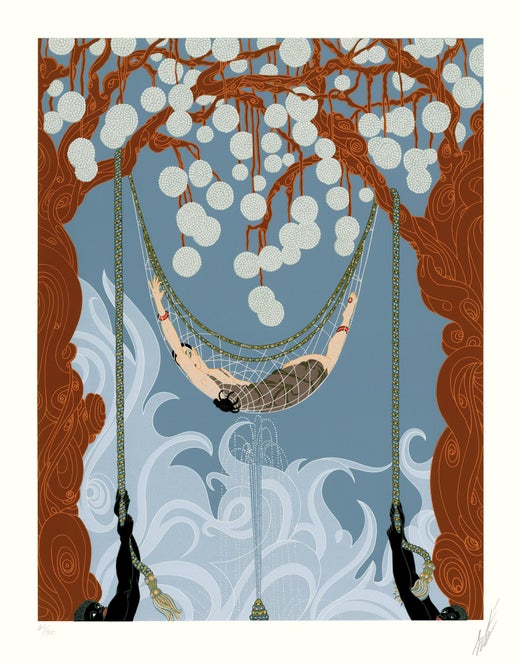
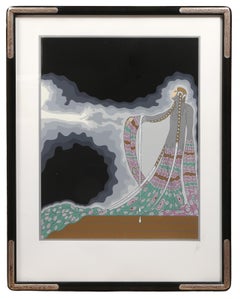
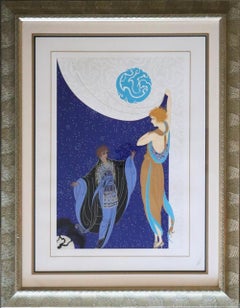
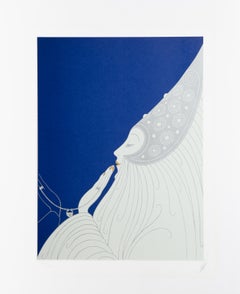
Erté, Romain de Tirtoff, 'Spider Web', serigraph, edition 300, 1980. Signed and numbered 65/300, in pencil. A superb impression, with fresh, rich colors and silver and gold metallic inks (in the spider web, fountain, and roles). Printed on cream wove paper by Circle Fine Art, Chicago, with their blindstamp in the lower left sheet corner; the full sheet with wide margins (2 1/2 to 3 inches). Barely visible toning to the paper within a previous, generous mat opening, slight skinning to the top sheet margin, verso (not showing recto) where previously hinged, otherwise in excellent condition. Archivally sleeved, unmatted,
Image size 17 1/16 x 13 inches (433 x 330 mm); sheet size 22 5/8 x 18 inches (575 x 457 mm).
Accompanied by a gallery signed guarantee of authenticity.
ABOUT THE IMAGE
Created late in Erté's career, 'Spider Web' is a masterful synthesis of the artist's lifelong fascination with elegance, fantasy, and decorative design. The composition presents a reclining female figure suspended within a delicate web-like hammock beneath a fantastical flowering canopy. Below, stylized attendants pull the ropes supporting the web, transforming the scene into a dreamlike theatrical spectacle.
While 'Spider Web' is immediately admired for its decorative richness and elaborate Art Deco elegance, the composition also invites a deeper symbolic reading. Particularly compelling is the ambiguity of the central figure's condition. She appears neither captive nor free, but serenely suspended in a state of reverie. Like the enchanted heroines of classical mythology and fairy tales, she occupies a world removed from ordinary experience, inviting viewers to contemplate themes of desire, illusion, and transformation. This fusion of visual splendor and narrative suggestion distinguishes 'Spider Web' from many of Erté's graphic compositions. At once theatrical fantasy and symbolic allegory, 'Spider Web' exemplifies Erté's ability to transform decorative art into a sophisticated and evocative vision of enchantment.
ABOUT THE ARTIST
Born in St. Petersburg, Russia, as Romain de Tirtoff (1892-1990), Erté adopted a pseudonym derived from the French pronunciation of his initials, "R.T.," to distance his artistic career from his aristocratic family's expectations. After moving to Paris in 1912, he quickly became one of the defining figures of the Art Deco movement. His elegant designs for fashion, theater, opera, film, and illustration helped shape the visual language of the 1920s and 1930s.
Erté's long association with Harper's Bazaar produced more than 200 cover designs and established his international reputation. His work is celebrated for its refined linearity, theatrical imagination, luxurious ornamentation, and sophisticated depiction of the female figure. During the final decades of his life, Erté experienced a major revival of interest, creating highly sought-after limited-edition serigraphs, bronzes, and graphic suites that introduced his Art Deco aesthetic to a new generation of collectors.
Today, Erté is widely regarded as one of the most influential decorative artists of the twentieth century, and his works are represented in numerous museums including the collections of the Metropolitan Museum of Art, Museum of Modern Art, Smithsonian Institution, Victoria and Albert Museum, and Los Angeles County Museum of Art, reflecting his enduring influence on the worlds of fashion, theater, design, and the Art Deco movement.