Want more images or videos?
Request additional images or videos from the seller
1 of 7

George Caleb Bingham
In a Quandary, Mississippi Raftmen Playing Cards

1852

You May Also Like

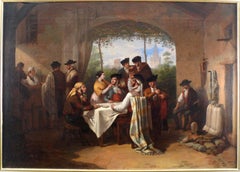
19th Century historical genre oil painting of a three men playing cards

19th Century historical genre oil painting of a three men playing cards

Located in Nr Broadway, Worcestershire

Johann Hamza Austrian, (1848-1927) The Losing Hand Oil on panel, signed Image size: 13.75 inches x 10.75 inches Size including frame: 19.25 inches x 16.25 inches A well-executed g...

Category

19th Century Figurative Paintings

Materials

Oil, Panel

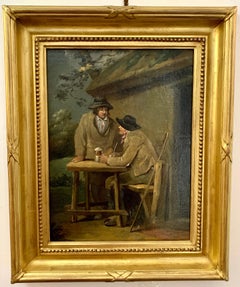
19th Century English Antique, Two Country farmers drinking beer in a landscape

19th Century English Antique, Two Country farmers drinking beer in a landscape

By George Morland

Located in Woodbury, CT

Attributed to George Morland. 19th Century English Antique, Two Country farmers drinking beer in a landscape. Wonderful early 19th-century original oil on canvas. A classic 'Morland' composition as the painter was a big fan of English Pub scenes...

Category

Early 1800s Old Masters Figurative Paintings

Materials

Canvas, Oil

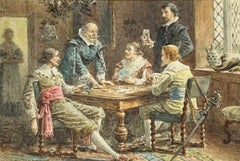
Cavaliers in Tavern Interior Playing Cards Fine Victorian Watercolor Painting

Cavaliers in Tavern Interior Playing Cards Fine Victorian Watercolor Painting

By George Goodwin Kilburne

Located in Cirencester, Gloucestershire

'A Game of Cards' George Goodwin Kilburne (1839-1924) British watercolor on board, framed framed: 10 x 11 inches board: 9.5 x 10.5 inches Provenance: private collection, England Cond...

Category

19th Century Victorian Figurative Paintings

Materials

Watercolor

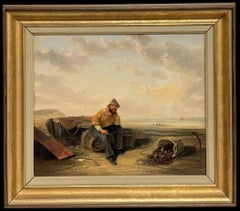
English 19th Century Coastal Fisherman Resting Beside Boats Nets & Lobster Pots

English 19th Century Coastal Fisherman Resting Beside Boats Nets & Lobster Pots

Located in Cirencester, Gloucestershire

Coastal Fisherman Resting Beside Boats, Nets and Lobster Pots Attributed to William Roxby Beverley (British, 1810–1889) Oil on canvas, framed Framed: 13.5 x 16 inches Canvas: 11 x 12...

Category

19th Century Victorian Landscape Paintings

Materials

Oil

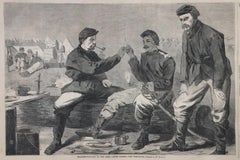
THANKSGIVING IN CAMP

Winslow HomerTHANKSGIVING IN CAMP, 1864

$175Sale Price|53% Off

H 9.25 in W 14 in

THANKSGIVING IN CAMP

By Winslow Homer

Located in Santa Monica, CA

AFTER - WINSLOW HOMER (1836-1910) THANKSGIVING IN THE ARMY - After Dinner: the Wishbone, 1864 Original wood engraving as published by Harpers Weekly December 3, 1864, after a drawing by Winslow Homer. Image 9 3/4" x 14, Sheet 10 3.\/4 x 15 3/4" . Generally good condition, a small stain in the upper right margin. Homer contributed drawings to Harper's Weekly from 1857 to 1875. They were converted to wood engravings by Harper's craftsman and published in Harper's Weekly. Although after his original drawings, they are now accepted as an important part of his body of work by museums and collectors. They were very large editions. As such, they occur often in the marketplace. Harper's published during the Civil War years as this was, were widely read and kept as people followed the war first hand and its aftermath over the years continuing today as both Homer and Civil War collectables

Category

1860s American Realist Figurative Prints

Materials

Woodcut

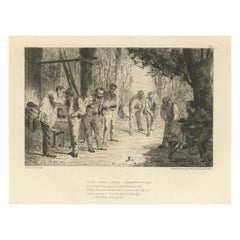
L'Ouvrier (The Worker) Playing Boules by Eugène Henri Millet, Published in 1873

L'Ouvrier (The Worker) Playing Boules by Eugène Henri Millet, Published in 1873

Located in Langweer, NL

Title: L'Ouvrier (The Worker) by Eugène Henri Millet, Published by Alfred Cadart (1873) Description: This etching, titled *L'Ouvrier* (The Worker), was created by Eugène Henri Mille...

Category

Antique 1870s Prints

Materials

Paper

18th Century by Paolo Monaldi Peasants Playing Cards Oil on Canvas

18th Century by Paolo Monaldi Peasants Playing Cards Oil on Canvas

Located in Milano, Lombardia

Paolo Monaldi (Rome, Italy, 1710-1779) Title: Peasants playing cards Medium: Oil on canvas Dimensions: Without frame 31 x 40.5 cm - with frame 43.5 x 52 cm Carved and gilded wooden f...

Category

18th Century Italian School Landscape Paintings

Materials

Canvas, Cotton Canvas, Oil

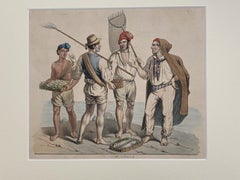
Neapolitan Fishermen  - Original Gouache - 19th Century

Neapolitan Fishermen - Original Gouache - 19th Century

Located in Roma, IT

Neapolitan Fishermen is an original modern artwork realized by Anonymous Artist of thr XIX Century. Original gouache. Hand-signed on the lower center corner: "LeDoux". The work is...

Category

19th Century Modern Figurative Prints

Materials

Gouache

More From This Seller

View All
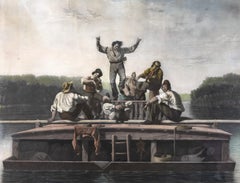
The Jolly Flat Boat Men

The Jolly Flat Boat Men

By George Caleb Bingham

Located in Missouri, MO

The Jolly Flat Boat Men, 1847 After George Caleb Bingham (American, 1811-1879) Engraved by Thomas Doney (French, active New York 1844-1849) Engraving with Hand-Coloring Published by The American Art-Union, New York (1838-1851) Printed by Powell and Co. 18 x 24 inches 32 x 38 inches with frame In 1847, the American Art-Union purchased Bingham’s painting "The Jolly Flat Boat Men" (1846; National Gallery of Art) directly from the artist. The subscription-based organization, founded in 1838 as the Apollo Association, boasted nearly ten-thousand members at this date. For an annual fee of five dollars, each received a large reproductive engraving and was entered in a lottery to win original artworks exhibited at the Art-Union’s Free Gallery. Aimed at educating the public about contemporary American art, the organization developed an impressive distribution network that reached members in every state. The broad circulation of the Art-Union's print helped to establish Bingham's reputation and made his river scene famous. Born in Augusta County, Virginia in the Shenandoah River Valley, George Caleb Bingham became known for classically rendered western genre, especially Missouri and Mississippi River scenes of boatmen bringing cargo to the American West and politicians seeking to influence frontier life. One of his most famous river genre paintings was The Jolly Flatboatmen completed in several versions in 1846. This first version of this painting is in the Manoogian Collection at the National Gallery of Art. Fame resulted for this work when it was exhibited in New York at the American Art Union whose organizers made an engraving of 10,000 copies and distributed it to all of their members. Paintings such as Country Politician (1849) and County Election (1852) and Stump Speaking (1854) reflected Bingham's political interests. In 1819, as an eight-year old, he moved to Boon's Lick, Missouri with his parents and grandfather who had been farmers and inn keepers in the Shenandoah Valley near Rockingham, Virginia. Reportedly as a child there, he took every opportunity to escape supervision to travel the River and watch the marine activity. His father died in 1827, when his son was sixteen years old. His mother had encouraged his art talent, but art lessons were not easily obtainable. In order to earn money, he apprenticed to a cabinet maker but determined to become an artist. By 1835, he had a modest reputation as a frontier painter and successfully charged twenty dollars per portrait in St. Louis. "His portraits had become standard decorations in prosperous Missouri homes." (Samuels 46). In 1836, he moved to Natchez, Mississippi and there had the same kind of career, only was able to charge forty dollars per portrait. He remained largely self taught until 1837, when he, age 26 and using the proceeds from his portraiture, studied several months at the Pennsylvania Academy of the Fine Arts. He later said that he learned much of his atmospheric style and classically balanced composition by copying paintings in collections in St. Louis and Philadelphia and that among his most admired painters were Thomas Cole, John Vanderlyn, and William Sidney Mount. Between 1856 and 1859, Bingham traveled back and forth to Dusseldorf, Germany, where he studied the work of genre painters. Some critics think these influences were negative on his work because during that time period, he abandoned his luminist style that had brought him so much public affirmation. Bingham credited Chester Harding (1792-1866) as being the earliest and one of the most lasting influences on his work. Harding,a leading portraitists when Bingham was a young man, had a studio in Franklin, near Bingham's home town. In 1822, when Bingham was ten years old, he watched Harding finish a portrait of Daniel Boone. Bingham recalled that watching Harding with the Boone portrait was a lasting inspiration and that it was the first time he had ever seen a painting in progress. Harding suggested to Bingham that he begin doing portraiture by finding subjects in the river men, which, of course, opened the subject matter that established fame and financial success for Bingham. Harding also encouraged Bingham to copy with paint engravings. He later painted two portraits of Boone but, contrary to the assertions of some scholars, he did not do Boone portraits in the company of Harding. Bingham's portraits of Boone are not located, but one of them, a wood signboard for a hotel in Boonville circa 1828 to 1830, showed a likeness of Boone in buckskin dress...

Category

1840s Hudson River School Figurative Prints
Materials

Engraving

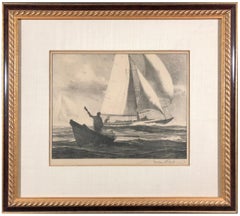
Work and Play

Work and Play

By Gordon Grant

Located in Missouri, MO

Gordan Hope Grant (1875-1962) "Work and Play" Lithograph Signed in Pencil Lower Right Image Size: 9 x 11.5 inches Framed Size: approx 18 x 20.5 inches Born in San Francisco, Gordon Grant is known for his etchings and paintings of marine subjects. He also painted portraits, streets, harbors, beaches and marines, and was an illustrator, whose work included pulp fiction* for Popular Detective magazine in the 1930s. Skilled with watercolor, Grant was honored many times by the American Watercolor Society*. Memberships included the Society of Illustrators*, Salmagundi Club*, Allied Artists of America*, New York Society of Painters, and American Federation of Artists*. At age 13, he was sent to Scotland for schooling, and the four-month sail around Cape Horn remained a permanent influence on his career. He studied art in Heatherly and at the Lambeth School of Art* in London, and then in 1895, he became a staff artist for the San Francisco Examiner. The next year, he took the same type of job for the New York World and covered the Boer War for Harper's Weekly. He also worked for Puck magazine...

Category

Mid-20th Century American Realist Figurative Prints

Materials

Lithograph

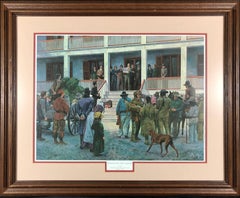
Announcing the Charter for the First Bank in the Missouri Territory 1813

Announcing the Charter for the First Bank in the Missouri Territory 1813

By Mort Künstler

Located in Missouri, MO

Publisher's Print Image Size: approx 24 x 30 inches Framed Size: approx 31 x 37 inches Known for his Civil War genre paintings, Mort Kunstler studied art at Brooklyn College, U.C.L.A., and Pratt Institute in Brooklyn. He became a successful illustrator in New York and received assignments including numerous book and magazine publishers. He was affiliated with the National Geographic Magazine, and through their assignments of historical subject matter, learned the value of accuracy by working with historians. He also did illustrations for The Saturday Evening Post, Newsweek, and Argosy. In the early 1970s, his work began attracting the attention of collectors. His first paintings were primarily Western subject matter, and from 1977 he has had nine one-man shows at the Hammer Gallery in New York City. In 1982, he had a commission from CBS to do a painting for the television mini series "Blue and Gray," and this activity directed his attention to the Civil War. A painting, The High Water Mark, was very correct in its details and was unveiled on July 2, 1988 at the Gettysburg National Military Park in celebration of the anniversary of the battle. He has also completed an official U.S. postal stamp commemorating the Buffalo Soldiers...

Category

20th Century Realist Figurative Prints

Materials

Color

A View of St. Louis

A View of St. Louis

By John Stobart

Located in Missouri, MO

John Stobart "St. Louis, A View Through the Arches of the Eads Bridge" 1979 Color Lithograph 32.5 x 37.5 inches framed Signed in Pencil and Numbered 221/75...

Category

1970s American Realist Landscape Prints

Materials

Lithograph

St. Louis, Gateway to the West

St. Louis, Gateway to the West

By John Stobart

Located in Missouri, MO

John Stobart "St. Louis, Gateway to the West" Color Lithograph 30 x 42 inches framed Signed in Pencil and Numbered 434/750

Category

1970s American Realist Landscape Prints

Materials

Lithograph

Preparing the Trick

Preparing the Trick

By John George Brown

Located in Missouri, MO

Canvas Size: approx 26.5 x 18 Framed Size: approx 30 x 22 inches Born into a poor family in Durham, England, John George Brown (1831-1913) earned a reputation as one of 19th-century...

Category

Late 19th Century American Realist Figurative Paintings

Materials

Canvas, Oil