Want more images or videos?
Request additional images or videos from the seller
1 of 2

Gianfrancesco Pivati
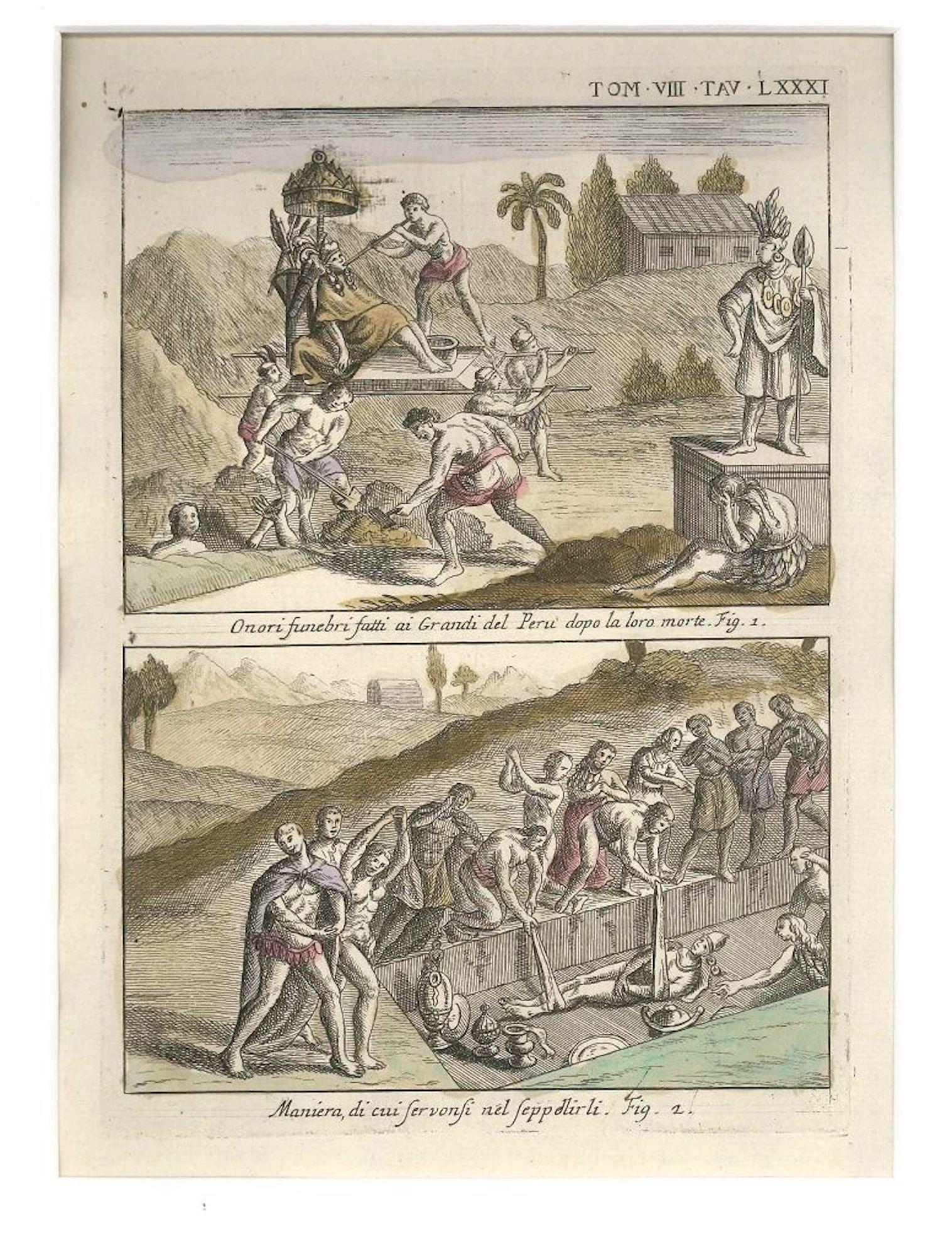
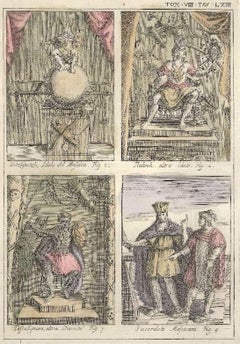
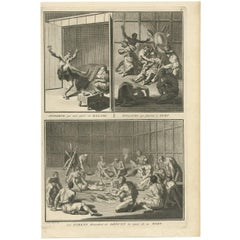
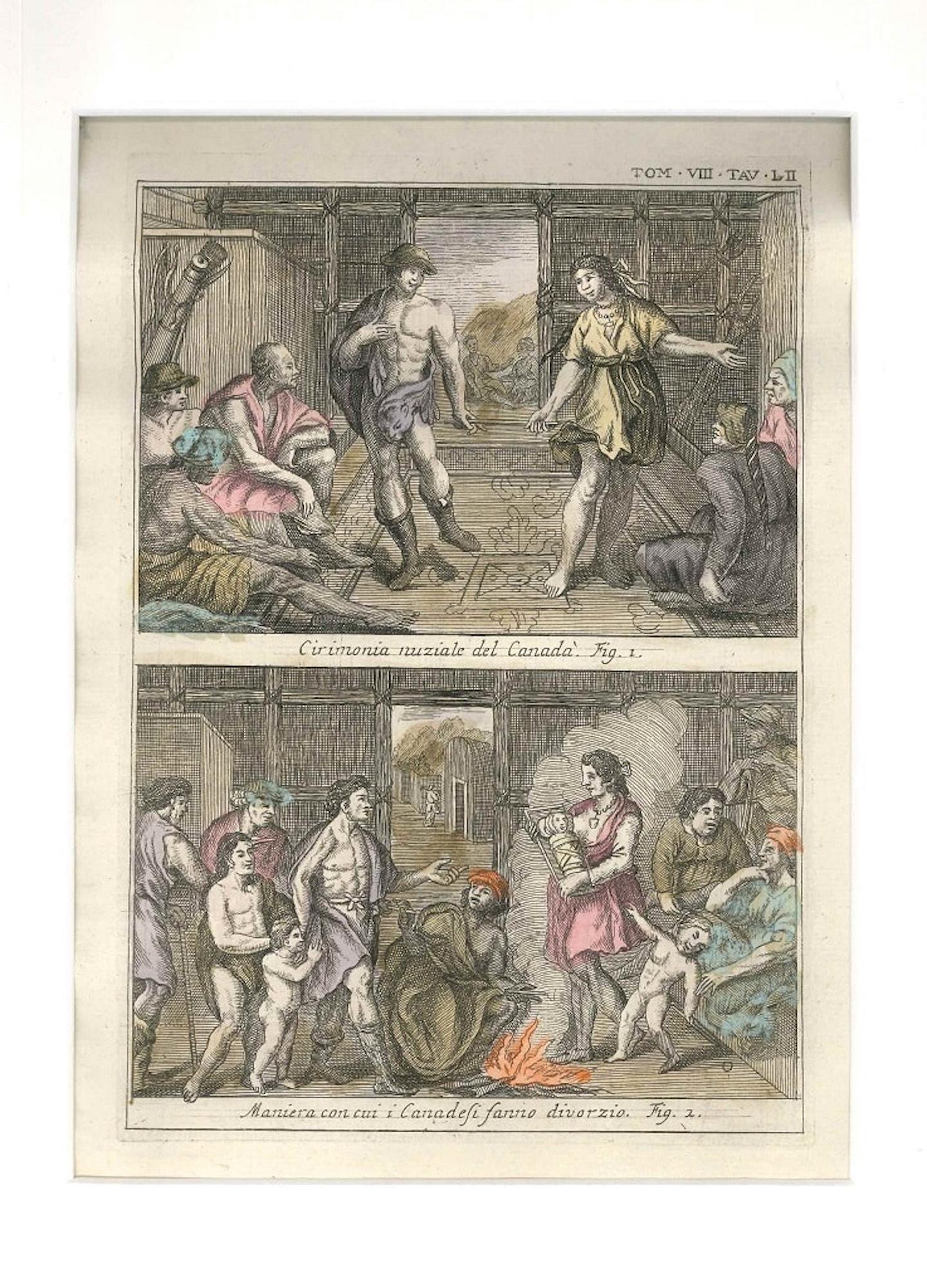
How the American Indigenous Deal with Death - Etching by G. Pivati - 1746/1751

1746-1751

$356.38
£262.24
€300
CA$493.62
A$494.89
CHF 286.79
MX$6,047.20
NOK 3,323.45
SEK 3,393.80
DKK 2,287.26

About the Item

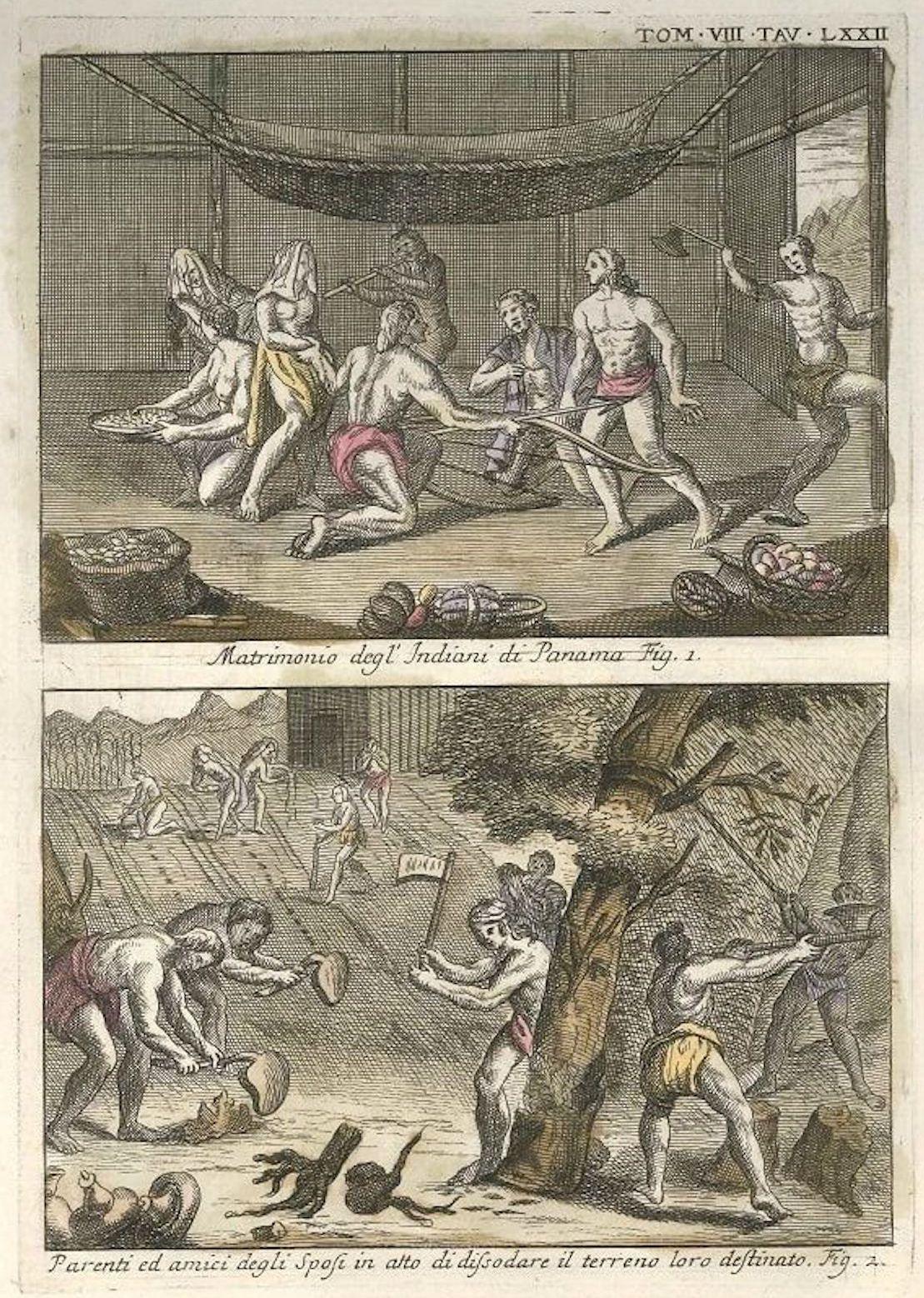
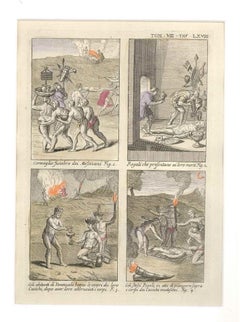
Image dimensions: 25.5 x 18 cm. How the American indigenous deals with Death is a fine etching, hand-watercolored, realized by the engraver Gianfrancesco Pivati. This original print, representing three pictures with captures about how the American indigenous deals with Death and Desease, is from the series New Scientific and Curious Dictionary concerning the Sacred and the Profane, Tome VIII, Plate LI, published by Benedetto Milocco in Venice in 1746-1751, concerning the Uses and Costumes, Religious Rites of people. Perfect conditions, including passepartout (49 x 34 cm). Gianfrancesco Pivati Pivati's New Dictionary is a bold contribution to Italian cultural debate in the mid-18th century. The wide, useful, and interesting knowledge it contains is often taken from Hebrew, Greek, Latin, French, Spanish and English, as well as Italian. “The subjects treated are well researched and generally presented in a simple, direct style (…)”. Pivati’s liberal voice was out of the chorus in the context of the rigid conformity predominating throughout the Italian peninsula. “He appears to be committed to Reason and Science as opposed to simple Faith, but he tries to avoid any direct challenge to the dogmatic teachings of the Church”. Reference: Silvano Garafalo, in: Frank Kafker, Notable Encyclopedias, Oxford 1981.
  • Creator:
    Gianfrancesco Pivati (1680 - 1784, Italian)
  • Creation Year:
    1746-1751
  • Dimensions:
    Height: 14.77 in (37.5 cm)Width: 9.38 in (23.8 cm)Depth: 0.04 in (1 mm)
  • Medium:
  • Movement & Style:
  • Period:
    1740-1749
  • Condition:
    Insurance may be requested by customers as additional service, contact us for more information.
  • Gallery Location:
    Roma, IT
  • Reference Number:
    Seller: M-947111stDibs: LU65034974422

More From This Seller

View All
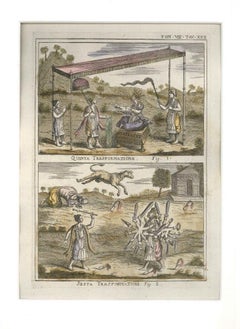
Transformations - Etching by G. Pivati - 1746-1751

Transformations - Etching by G. Pivati - 1746-1751

By Gianfrancesco Pivati

Located in Roma, IT

Image dimensions: 25.5 x 18 cm. Transformations is a fine etching, hand-watercolored, realized by the engraver Gianfrancesco Pivati. This original print, representing the "fifth an...

Category

1740s Old Masters Figurative Prints

Materials

Etching

You May Also Like

Native Civilians of America -- "De L'Amerique" Published Frankfurt / 1683

Native Civilians of America -- "De L'Amerique" Published Frankfurt / 1683

By Alain Manesson Mallet

Located in Soquel, CA

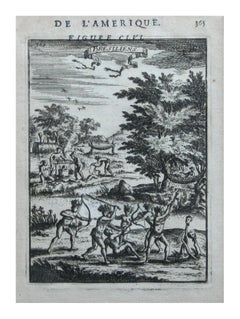
Wonderful etching, originally page 365 in a book De L'amerique by Alain Manesson Mallet, circa 1683, depicts the artist's concept of the appearance and activities of the native occupants of America in graphic detail. Unsigned. Displayed in a black and giltwood frame. Image, 6.5"H x 4.5"L. 1683 Manesson Mallet "Bresiliens" Amerindians, Indigenous Native Brazilians, Brazil, South America, Antique Print...

Category

1680s Realist Figurative Prints

Materials

Paper, Ink, Woodcut

Two Engravings of an Florida King of the Indians in America, 1722

Two Engravings of an Florida King of the Indians in America, 1722

Located in Langweer, NL

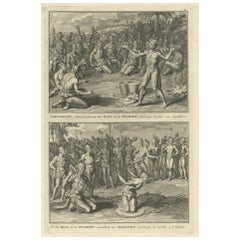
Antique print titled 'Ceremonie, observée par un des Rois de la Floride (..)'. Two images on one sheet. 1. A ceremony that takes place before they set...

Category

Antique 1770s Prints

Materials

Paper

Antique Print of Indians from Canada by B. Picart, 1723

Antique Print of Indians from Canada by B. Picart, 1723

Located in Langweer, NL

Antique print of a juggler, trying to cure a sick person, the mourning of the slaves and the relatives, asking the deceased for the cause of his death. This print originates from 'Na...

Category

Antique Early 18th Century Prints

Materials

Paper

Classical Antiquities Engraving, Sepulchrum des Nasonii, Montfaucon 1721

Classical Antiquities Engraving, Sepulchrum des Nasonii, Montfaucon 1721

Located in Langweer, NL

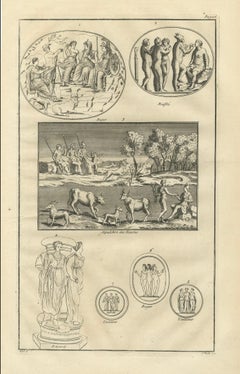
Classical Antiquities Engraving, Sepulchrum des Nasonii, Montfaucon 1721 This original early eighteenth-century copper engraving presents a scholarly compilation of classical antiquities drawn from ancient Roman artworks, engraved gems, and sculptural sources. The plate originates from Bernard de Montfaucon’s influential publication *L’Antiquité expliquée et représentée en figures*, published in Paris in 1721, one of the most important antiquarian works of the Enlightenment and a cornerstone in the development of archaeology and classical art history. The composition assembles multiple mythological and archaeological subjects arranged in a structured, comparative format typical of Montfaucon’s method. At the center appears a detailed scene labeled “Sepulchrum des Nasonii,” referring to the celebrated Tomb of the Nasonii located along the Via Flaminia in Rome, an important Roman funerary monument known for its painted mythological decorations. The engraving records figures, animals, and pastoral imagery derived from ancient wall paintings, offering eighteenth-century scholars and collectors access to monuments that were otherwise difficult to study directly. Surrounding vignettes reproduce imagery taken from antique cameos, engraved gems, and sculptural fragments. Oval compositions depict mythological figures and allegorical scenes, while the lower section includes a classical statue and medallion studies attributed to antiquarian sources associated with collectors and scholars such as Maffei and Vaillant. These references reflect Montfaucon’s ambition to synthesize knowledge gathered from Europe’s major antiquities collections into a single visual encyclopedia. Executed with refined precision, the engraving demonstrates the clarity and balance characteristic of Parisian copperplate engraving of the early 1700s. Fine linework and careful tonal shading translate sculptural and painted sources into a harmonious graphic composition. Today, plates from Montfaucon’s work are appreciated both for their scholarly significance and for their elegant decorative qualities, making them highly suitable for libraries, study interiors, or contemporary gallery walls seeking classical visual depth. This original antique engraving is offered unframed, allowing flexibility to select a frame that best complements the intended interior. Condition: Good antique condition with age-related toning and light discoloration consistent with early eighteenth-century paper. Minor edge wear and handling marks mainly confined to the margins. Plate impression visible. Blank verso. Framing tips: A dark walnut, gilt, or ebonized frame with a generous ivory mat enhances the academic and neoclassical character of the engraving. For modern interiors, a slim black gallery frame with wide mat spacing provides a refined museum-style presentation. Technique: Copper engraving Maker: Bernard de Montfaucon, France, Paris, 1721 Keywords: Montfaucon engraving, Antiquité expliquée, Sepulchrum des Nasonii, Roman antiquities print, classical archaeology engraving, antique mythological engraving, 18th century copperplate engraving, French antiquarian print, Roman tomb illustration, Via Flaminia Rome print...

Category

Antique 1720s British Prints
Materials

Paper

Birth and Naming Rituals of the Banians – Rare 1734 Indian Custom Engraving

Birth and Naming Rituals of the Banians – Rare 1734 Indian Custom Engraving

Located in Langweer, NL

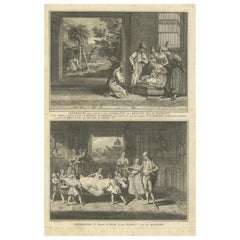
Title: Birth and Naming Rituals of the Banians – Antique 1734 Engraving of Indian Customs Description: This rare and evocative copperplate engraving, published in 1734 as part of 'T...

Category

Antique 1730s Prints

Materials

Paper

18th Century Ethnological Engravings of Peruvians and Ecuadorians

18th Century Ethnological Engravings of Peruvians and Ecuadorians

Located in Langweer, NL

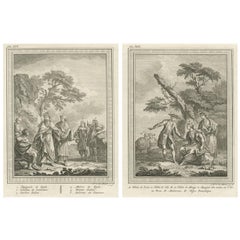
Title: 18th Century Ethnological Engravings of Peruvians and Ecuadorians Description: These two 18th-century engravings, printed in 1756, are detailed depictions of the social and cultural life in Peru and Ecuador during the colonial era. Created by Quentin-Pierre Chedel (1705–1762), they are part of Histoire générale des voyages by Antoine François Prévost, a monumental collection that documented the world's exploration and cultural encounters. First Engraving (Residents of Peru): This print illustrates the residents of Lima, Peru, highlighting the various social classes and ethnic groups present in the region during the colonial period. The detailed engraving captures: A. Femme de Lima en Habit de Ville – A woman from Lima in formal city dress, representing the elite of society. B. Femme en Habit de Ménage – A woman in household dress, typical of a middle or upper-class domestic attire. C. Espagnol vêtu comme on l’est au Pérou – A Spanish man dressed as one would in Peru, showing the influence of Spanish colonial fashion on local attire. D. Mulatresse – A woman of mixed African and European descent, reflecting the diverse ethnic makeup of colonial Peru. E. Nègre Domestique – A domestic servant of African descent, showcasing the role of enslaved individuals in colonial households. The scene is set in a lush, natural landscape, with attention to the differences in social standing and attire. Second Engraving (Residents of Quito, Ecuador): The second engraving, although similar in style, depicts residents of Quito, Ecuador, and provides an ethnological view of the city’s diverse inhabitants. The composition shows: 1. Espagnole de Quito – A Spanish woman of high status, dressed elegantly, representing the colonial upper class in Quito. 2. Indienne de Distinction – An Indigenous woman of notable status, likely representing the local nobility or important community figures. 3. Barbier Indien – An Indigenous barber, reflecting the occupational diversity and social roles of the Indigenous population in colonial society. 4. Métive de Quito – A Métis woman from Quito, showing the mixed-race population that emerged during the colonial era. 5. Paysan Indien – An Indigenous farmer, indicating the essential role of agriculture and rural labor in the economy of colonial Ecuador. 6. Indienne du Commun – A common Indigenous woman, dressed in traditional attire, representing the majority of the Indigenous population. Like the first engraving, this print captures the varied ethnic and social dynamics in a colonial society, with figures placed in a landscape setting, emphasizing the connection between people and their environment. These engravings are not only artistic representations but also important historical records of colonial Latin America...

Category

Antique Mid-18th Century French Prints

Materials

Paper