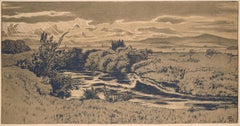
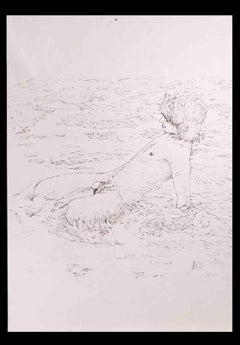
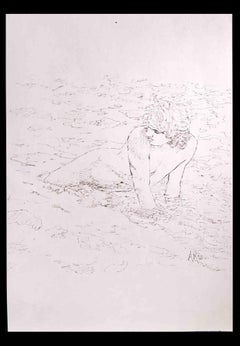
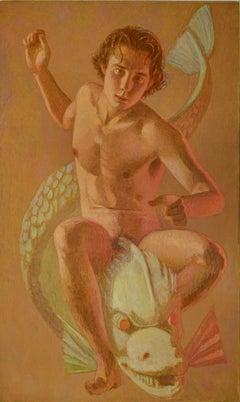
Hans Thoma (1839 Bernau - 1924 Karlsruhe), Boy at the source, 1897. Algraph on strong wove paper after a drawing from 1897, published by Breitkopf und Härtel in Leipzig as ‘Zeitgenössisches Kunstblatt Nr. 144’, 36 cm x 45 cm (image), 40 cm x 50 cm (sheet size), signed and dated on the left in the rock, signed and dated on the lower right below the image. With publisher's sticker on the reverse
- Corners somewhat bumped and slight crease at bottom right, otherwise in very good condition
- Elixir of Life -
A naked boy discovers a spring in a forest thicket and marvels at the water flowing out of a dark cave. Hans Thoma, always concerned with deeper meanings in his paintings, creates an allegory inspired by Philipp Otto Runge's Romanticism and depictions of springs. The young man's nakedness symbolizes the vulnerability of human existence. Lost in the thicket of life, he hopelessly searches for meaning. Suddenly, he discovers the spring, his external and internal elixir of life.
About the artist
After failing to complete his apprenticeship as a lithographer, painter and clockmaker, Hans Thoma trained as an autodidact painter. In 1859 he won a scholarship to the Karlsruhe Art School, where he became a student of Wilhelm Schirmer and Ludwig Des Coudres. After graduating in 1866, Thoma spent time in Basel and Düsseldorf. He met Otto Scholderer, with whom he traveled to Paris in 1868. There he was impressed by the art of Gustave Courbet and the Barbizon School. After his works were rejected by the Karlsruhe Kunstverein, Thoma moved to Munich in 1870, where he was close to the Leibl circle. Wilhelm Trüber worked for a time in Thoma's studio in Munich. In 1874 he made the first of a series of trips to Italy with the painter Albert Lang, where he met Hans von Marées and Adolph von Hildebrand and became friends with Arnold Böcklin, whose art made a lasting impression on Thoma. On his return to Munich, Thoma became a student of Cella Berteneder, whom he married in 1877.
Thoma traveled to England in 1879 at the invitation of art collector Charles Minoprio. Over the years, Minoprio acquired more than 60 oil paintings by Thoma and organized the first exhibition of his art abroad in Liverpool in 1884. Thoma had lived in Frankfurt since 1878. The following year, the Frankfurter Kunstverein organized the first solo exhibition of his work. After a trip to the Netherlands, Thoma moved to Kronberg im Taunus in 1899, where the Kronberg painters' colony was based. That same year he was appointed professor at the Karlsruhe Art School and director of the Karlsruhe Kunsthalle. In 1901, together with Wilhelm Süs, Hans Thoma founded the Grand Ducal Majolica Manufactory in Karlsruhe, for which he supplied designs from then on.
Thoma was now at the height of his artistic fame. The 1909 edition of Meyer's Großes Konversations-Lexikon noted that Thoma had become one of the German people's favorite painters. On the occasion of his 80th birthday in 1919, Ernst Oppler and Lovis Corinth organized a large celebration. After Thoma's death, the Berlin National Gallery dedicated a major exhibition to him in 1922, and the Basel Kunsthalle in 1924.
GERMAN VERSION
Hans Thoma (1839 Bernau - 1924 Karlsruhe), Knabe am Quell, 1897. Algraphie auf kräftigem Velin nach einer Zeichnung von 1897, bei Breitkopf und Härtel in Leipzig als ‚Zeitgenössisches Kunstblatt Nr. 144‘ erschienen, 36 cm x 45 cm (Darstellung), 40 cm x 50 cm (Blattgröße), links im Felsen mit Signet und Jahreszahl, rechts unten mit Namenszug und Datierung versehen, unter der Darstellung handsigniert. Rückseitig mit Verlagsaufkleber
- Ecken etwas bestoßen und rechts unten mit leichten Knickspuren, ansonsten in sehr gutem Zustand
- Lebenselixier -
Ein nackter Junge hat im Walddickicht eine Quelle entdeckt und lässt das aus einer dunklen Höhle entströmende Wasser staunend durch seine Hände rinnen. Hans Thoma, dem es in seinen Bildern stets um einen tieferen Sinn geht, kreiert hier eine Allegorie, die von der Romantik eines Philipp Otto Runge und seiner Quellendarstellung inspiriert wurde. Der in seiner Nacktheit für die bloße schutzbedürftige Existenz des Menschen einstehende Jüngling hat sich heillos im Dickicht des Lebens verloren, wo er, inmitten schierer Ausweglosigkeit, unvermittelt auf die Quelle stößt, die sein äußerliches wie innerliches Lebenselixier ist.
zum Künstler
Nachdem er Lehren als Lithograph, Anstreicher und Uhrschildmaler abgebrochen hatte, bildete sich Hans Thoma autodidaktisch als Kunstmaler. Dies brachte ihm 1859 ein Stipendium für die Kunstschule in Karlsruhe ein, wo er Schüler von Wilhelm Schirmer und Ludwig Des Coudres wurde. Nach Abschluss des Studiums, 1866, hielt sich Thoma in Basel und Düsseldorf auf. Er lernte Otto Scholderer kennen, mit dem er 1868 nach Paris reiste. Dort beeindruckten ihn die Kunst Gustave Courbets und die Schule von Barbizon. Nach der Ablehnung seiner Werke im Karlsruher Kunstverein wurde Thoma 1870 in München ansässig, wo er dem Leibl-Kreis nahestand. In München arbeitete Wilhelm Trüber zeitweise in Thomas Atelier. 1874 erfolgte zusammen mit dem Maler Albert Lang die erster einer Reihe von Italienreisen, auf der er Hans von Marées und Adolph von Hildebrand kennenlernte und mit Arnold Böcklin Freundschaft schloss, dessen Kunst Thoma nachhaltig beeindruckte. Nach seiner Rückkehr nach München wurde Cella Berteneder Thomas Schülerin, die er 1877 ehelichte.
Auf Einladung des Kunstsammlers Charles Minoprio reiste Thoma 1879 nach England. Im Laufe der Jahre erwarb Minoprio mehr als 60 Ölbilder Thomas und veranstaltete 1884 die erste Auslandsausstellung seiner Kunst in Liverpool. Ab 1878 lebte Thoma in Frankfurt. Im Folgejahr zeigte der Frankfurter Kunstverein die erste Einzelausstellung seiner Werke. Nach einer Reise in die Niederlande zog Thoma 1899 nach Kronberg im Taunus, wo die Kronberger Malerkolonie ansässig war. Im selben Jahr wurde er zum Professor der Karlsruher Kunstschule und zum Direkter der Karlsruher Kunsthalle berufen. 1901 war Hans Thoma mit Wilhelm Süs Gründer der Großherzoglichen Majolika-Manufaktur Karlsruhe, für die er fortan Entwürfe lieferte.
Thoma stand nun auf dem Höhepunkt seines künstlerischen Ruhmes. Meyers Großes Konversations-Lexikon stellt in der 1909 erschienen Auflage fest, Thoma sei zu einem Lieblingsmaler des deutschen Volkes geworden. Anlässlich des 80. Geburtstags, 1919, organisierten Ernst Oppler und Lovis Corinth eine große Feierlichkeit. Nachdem Thoma verstorben war, widmete ihm die Berliner Nationalgalerie 1922 und die Basler Kunsthalle 1924 eine große Werkschau.