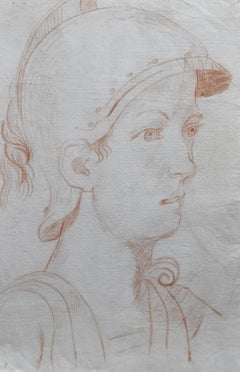
Want more images or videos?
Request additional images or videos from the seller
1 of 9

Jean-Baptiste Pater
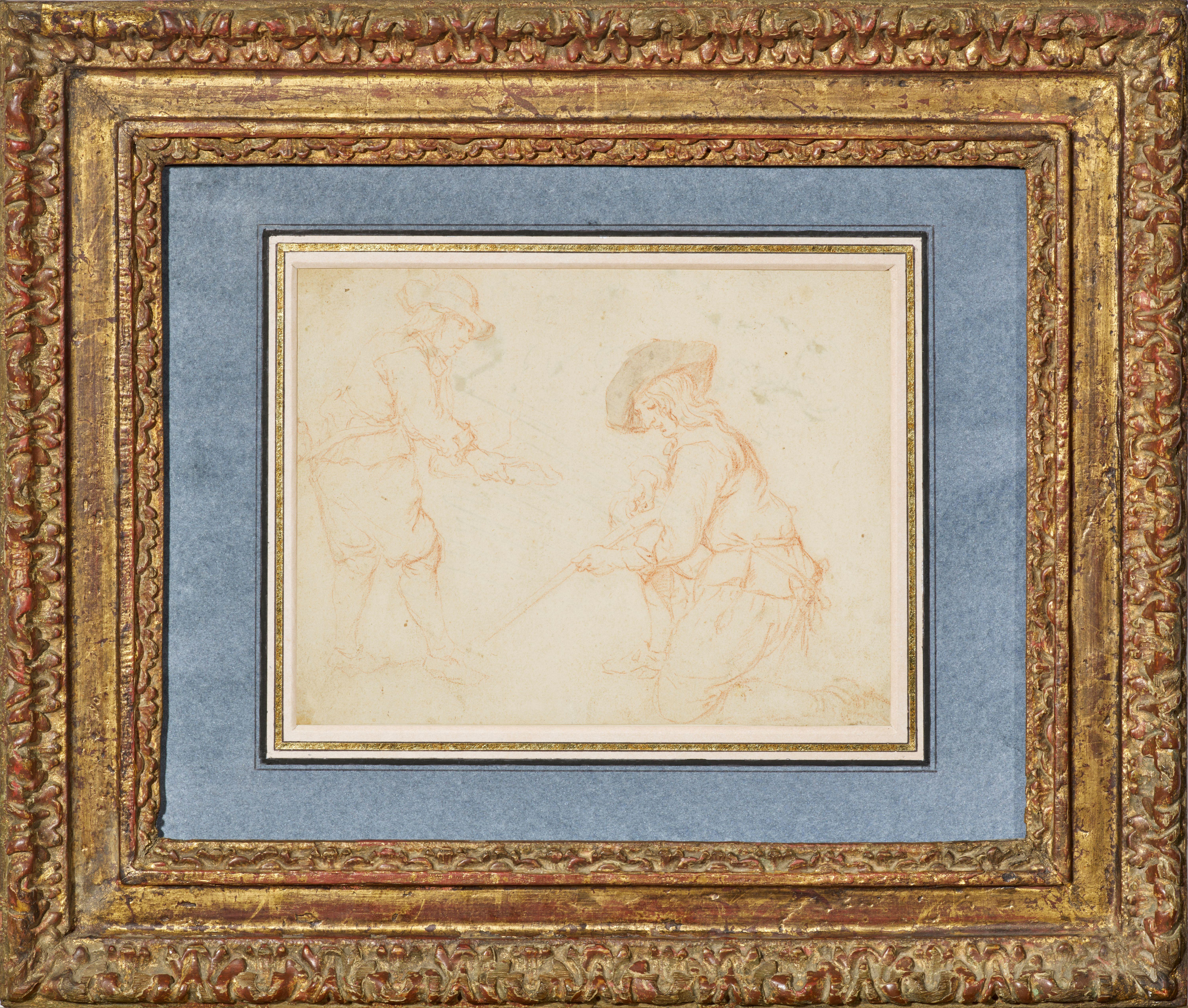
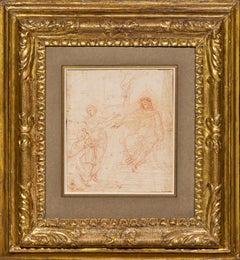
Two military studies, a preparatory red chalk drawing by Jean-Baptiste Pater

1720-1730

$14,272.30
£10,472.02
€12,000VAT Included
CA$19,772.39
A$19,958.62
CHF 11,468.28
MX$241,922.52
NOK 132,739.57
SEK 135,585.98
DKK 91,497.39

About the Item

As Florence Ingersoll-Smouse wrote in 1921 in her book devoted to Jean-Baptiste Pater, "a painter of the Fête galante, Pater is interesting both by his intimacy with Watteau, to whom many of his works are still attributed, and by his own value as an artist.” This sanguine, full of life and spontaneity, is typical of the preparatory studies made by the painter to be used later in the composition of his paintings. 1. Jean-Baptiste Pater, pupil and disciple of Antoine Watteau Antoine Pater, Jean-Baptiste's father, belonged to the petty bourgeoisie of Valenciennes where he worked as a merchant-sculptor. His brother Jacques was a local painter who was probably involved in his nephew's training. Born on December 29, 1695, Jean-Baptiste Pater was first trained with Jean-Baptiste Guider, a local painter whose death in 1711 was probably the reason for Jean-Baptiste’s departure alongside Watteau, who was visiting Valenciennes. Watteau's difficult character led to their separation in 1713. Back in Valenciennes, Jean-Baptiste Pater encountered difficulties with the powerful Corporation of Saint-Luke (to which he refused to belong) which forced him to return to Paris in 1718. He reconciled with Watteau shortly before his death (on July 18th 1721), inherited the commissions that Watteau had been unable to fulfil and completed some of his paintings. Pater was accepted by the Académie Royale in 1725 but did not produce his reception painting The soldier’s revels until three years later. Throughout his brief career (he died at the age of forty on July 25th 1736), he mainly had a clientele of amateurs and received only one royal commission, shortly before his death. 2. Description of the drawing and related artworks Pater had adopted his master Watteau's method of composition. His study drawings were carefully glued in a notebook and were used to animate his compositions. His paintings sometimes suffer from a somewhat artificial composition, since the figures seem to be pasted one next to the other. This point has also been made about Watteau’s. The theme of military scenes (which was at the time included in the genre of Fêtes galantes!) was one of Pater’s favourite subjects. Together with the Bathing Women, it constitutes the most personal aspect of his art. It is also one of the themes that distinguishes him most from Watteau: unlike the military scenes in which Watteau expresses the soldiers’ distress, everything is cheerful with Pater. We are in a resolutely theatrical universe in which a strong feminine presence removes all gloom... The two figures we are presenting were quickly sketched on what appears to be a note sent to the artist - traces of writing can be seen on the back of the sheet, which was unfortunately glued on heavy paper. They were reused in two of the painter's compositions, both of which depict The March of the Troops. The figure on the left, which represents a soldier in three-quarter view, leaning slightly towards his long rifle with its butt on the ground, can be found in a painting at the Gemäldegalerie in Berlin. The figure on the right of our sanguine, which represents a soldier clutching his rifle with his folded arms, evokes one of the figures in a painting at the Metropolitan Museum in New York. 3. Framing This red chalk is framed in a large Louis XV style gilded frame. Main bibliographic reference : Florence Ingersoll-Smouse - Pater - Les Beaux-Arts Paris 1921
  • Creator:
    Jean-Baptiste Pater (1695 - 1736, French)
  • Creation Year:
    1720-1730
  • Dimensions:
    Height: 6.19 in (15.73 cm)Width: 7 in (17.78 cm)
  • Medium:
  • Movement & Style:
  • Period:
    1720-1729
  • Condition:
    Red chalk on paper 6 3/16’’x 7’’ (157 x 178 mm) - Framed 16 2/3’’ x 17 5/8’’ (42.3 x 44.7 cm) Inscribed in brown ink in the left margin "Mr. pater peintre" Gilded frame in the Louis XV style.
  • Gallery Location:
    PARIS, FR
  • Reference Number:
    1stDibs: LU1568211290042

More From This Seller

View All
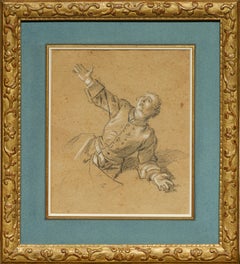
Study of a Fate at mid-body, a red chalk attributed to Giovanni da San Giovanni

Study of a Fate at mid-body, a red chalk attributed to Giovanni da San Giovanni

Located in PARIS, FR

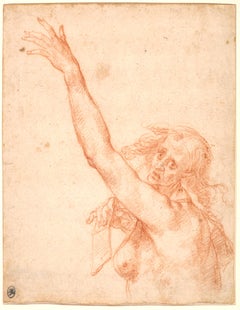
This spectacular red chalk drawing depicts an elderly woman, her eyes bulging, her hand stretched out towards the sky. This disturbing character, who seems close to dementia, and the elongation of her arm with its Mannerist overtones, plunge us into the Florentine artistic milieu of the first half of the 17th century. The proximity of this drawing to some characters in the fresco in the Pitti Palace representing The Muses, Poets and Philosophers chased from Parnassus, the last masterpiece of Giovanni da San Giovanni, leads us to propose an attribution to this artist and a dating of around 1635-1636. 1. Giovanni da San Giovanni, the painter of contradiction We take here the title of the monography dedicated to the artist by Anna Banti in 1977, which remains the reference book for this artist. The son of a notary, Giovanni Mannozzi, known as Giovanni da San Giovanni, abandoned his studies to go to Florence at the age of sixteen, where he entered the studio of Matteo Rosselli (1578 - 1650) around 1609 and enrolled in the Academy of Drawing Arts in 1612. Around 1615 he produced his first known works, mainly frescoes for the city's tabernacles. He became famous in Florence for his originality, combining an obsessive application to the study of drawing and the reading of poetry and history with a disheveled appearance. Between 1619 and 1620 he decorated the facade of the Antella Palace in Piazza Santa Croce, a decoration that still partly survives today. The death of Cosimo II in 1621 put an end to the Florentine building activity and Giovanni da San Giovanni left for Rome to find other sponsors with the painter Francesco Furini...

Category

17th Century Old Masters Nude Drawings and Watercolors
Materials

Chalk

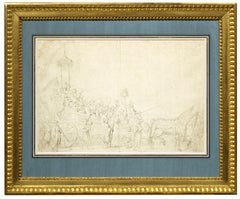
Study for « The Chinese Masquerade » by Jean-Baptiste Pierre (1714 - 1789)

Study for « The Chinese Masquerade » by Jean-Baptiste Pierre (1714 - 1789)

By Jean-Baptiste Pierre

Located in PARIS, FR

Arriving in Rome in June 1735 as a resident at the Royal Academy, Pierre was unable to attend the Winter Carnival festivities of 1735, which he nevertheless immortalised in an engrav...

Category

1730s Old Masters Figurative Drawings and Watercolors
Materials

Graphite

You May Also Like

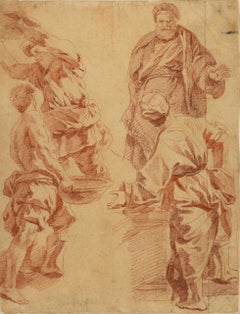
18th Century French Red Chalk Study After Jouvenet, Figures from Jouvenet

18th Century French Red Chalk Study After Jouvenet, Figures from Jouvenet

Located in Paris, Île-de-France

This refined 18th-century French red chalk study sheet presents a group of figures derived from The Feast at the House of Simon the Pharisee by Jean Jouvenet, through the intermediar...

Category

1760s Figurative Drawings and Watercolors
Materials

Chalk, Laid Paper

Le Menuet Drawing, Red Chalk on Laid Paper, Circa 1765-1770, Unsigned

Le Menuet Drawing, Red Chalk on Laid Paper, Circa 1765-1770, Unsigned

Located in Paris, Île-de-France

Attributed to Gabriel-Jacques de Saint-Aubin (Paris, 1724 – 1780) Le Menuet, circa 1765–1770 Red chalk on paper 13 3/8 x 8 1/4 in (34 x 21 cm) Verso: black chalk and red chalk Unsi...

Category

Late 18th Century Old Masters Figurative Drawings and Watercolors
Materials

Chalk, Laid Paper

1786 Pair of Red Chalk Drawings After Carracci by Ludwig Weiß, Munich Academy

1786 Pair of Red Chalk Drawings After Carracci by Ludwig Weiß, Munich Academy

Located in Epfach, DE

This rare pair of finely executed red chalk drawings was created in 1786 by Ludwig Weiß, a notable academic artist associated with the Munich Academy. Both sheets are signed and date...

Category

Antique 1780s German Rococo Drawings

Materials

Paper

Pair of Italian Old Master Drawings of Soldiers

Pair of Italian Old Master Drawings of Soldiers

Located in Bradenton, FL

18th Century Italian Old Master Drawings of Soldiers. These are fine, small illustrations done in brown ink with wash on paper that resemble Old Master figure studies, each depicting...

Category

Antique 18th Century Italian Baroque Drawings

Materials

Paper

Italian School 18th century,  An Ancient soldier in profile, red chalk on paper

Italian School 18th century, An Ancient soldier in profile, red chalk on paper

Located in Paris, FR

Italian School 18th Century An Ancient soldier in profile, red chalk on paper 35 x 23.5 cm in good condition, traces of folds in the lower right corner Framed : 46.5 x 35.5 cm This...

Category

1750s Baroque Portrait Drawings and Watercolors
Materials

Chalk