Want more images or videos?
Request additional images or videos from the seller
1 of 2

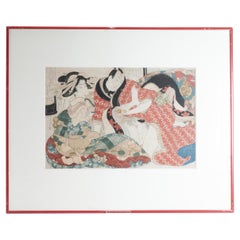
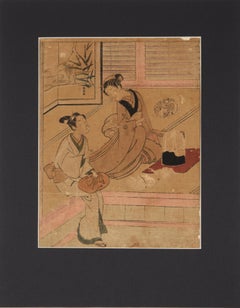
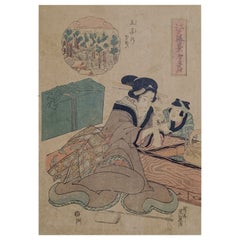
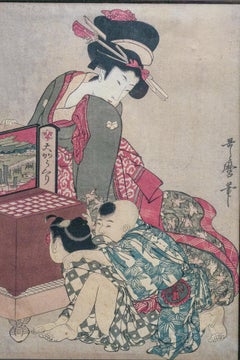
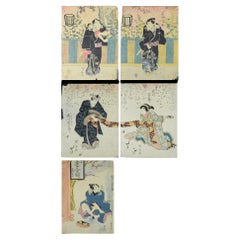
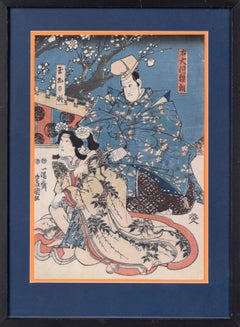
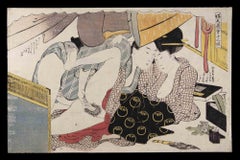
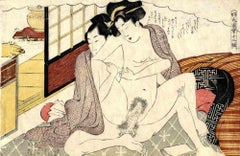
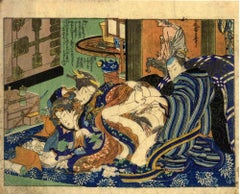
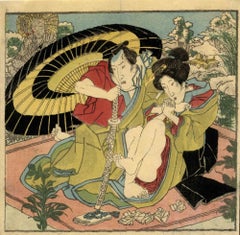
Shunga - Woodcut attr. Keisai Eisen - Mid-19th Century

Mid-19th Century

Price:$316.11
$354.39List Price

You May Also Like

Seishi Ai-oi Genji – Set of 12 Shunga works together w/astrological commentary

Seishi Ai-oi Genji – Set of 12 Shunga works together w/astrological commentary

By Utagawa Kunisada (Toyokuni III)

Located in Middletown, NY

Set of 12 woodblock prints in colors on handmade, laid mulberry paper, 6 3/4 x 10 1/4 inches (170 x 258 mm), printed in Ka-ei 4 (1851). Each print with minor handling wear, otherwise in excellent condition with bright and fresh color, and with details printed in silver ink. The images themselves contain several illusive characters indicating the publisher which are obfuscated by figures, as intended. Presented loose, as issued. A fine set. The astrological commentary print has a large and meandering blind stamp with a bird and palm frond motif. This print lists various phrases concerning the Twelve Zodiac Animals as historically counted in Japan, and appears to include erotic commentary on the traits of people born under each of the twelve signs. These Shunga images were issued in books that paralleled (in an erotic fashion...

Category

Mid-19th Century Edo Nude Prints

Materials

Ink, Handmade Paper, Woodcut

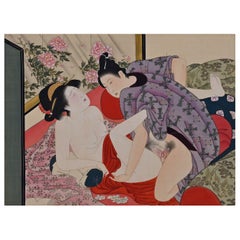
Antique Edo Period Shunga Woodblock Print by Kikukawa Eizan, 1810-1820

Antique Edo Period Shunga Woodblock Print by Kikukawa Eizan, 1810-1820

By Kikukawa Eizan

Located in Amsterdam, Noord Holland

Kikukawa Eizan (1787-1867) Dated 1810-1820. The text is about thing happening between lovers. Shunga Print Nicely framed Additional information: Material: Paper Region of Origin: Ja...

Category

Antique 19th Century Japanese Edo Prints

Materials

Paper

19th Century Japanese Shunga Hand-Scroll, Katsukawa School

19th Century Japanese Shunga Hand-Scroll, Katsukawa School

Located in Kyoto, JP

Shunga Unknown artist Meiji era, circa 1880 Hand-scroll mounted with 12 paintings Ink, pigment and gofun on silk Dimensions: Each image measures H. 23.2 cm x W. 34.4 cm (9.15” x 13.5”) The hand-scroll measures H. 28 cm x W. 540 cm (11” x 212”) A set of 12 late 19th century Japanese Shunga paintings mounted as a hand-scroll. Two of the leaves bear the signature and seal ‘Setsuzan’, although we are unable to confirm the identity of the artist using this art name. 6 of the 12 images are taken almost directly from Katsukawa Shuncho’s late 18th century woodblock series, ‘Erotic Pictures...

Category

Antique Late 19th Century Japanese Meiji Paintings and Screens

Materials

Silk

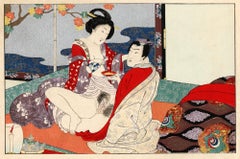
Shunga: Twelve Signs of the Zodiac - Goat

Shunga: Twelve Signs of the Zodiac - Goat

Located in Fairlawn, OH

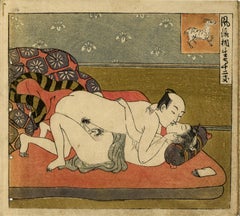
Shunga: Twelve Signs of the Zodiac - Goat Color woodcut with gauffrage (embossing) Unsigned (as usual) Format: Shikishiban Publisher: Privately produced Unusually well preserved with the fugitive blue still intact Image size: 5-1/8 x 5-3/4" Sheet size: 5 3/8 x 6 1/4" From Wikipedia, the free encyclopedia In this Japanese name, the surname is Isoda. Isoda Koryūsai (礒田 湖龍斎, 1735–1790) was a Japanese ukiyo-e print designer and painter active from 1769 to 1790. Life and career Koryūsai was born in 1735 and worked as a samurai in the service of the Tsuchiya clan. He became a masterless rōnin after the death of the head of the clan and moved to Edo (modern Tokyo) where he settled near Ryōgoku Bridge in the Yagenbori area. He became a print designer there under the art name Haruhiro in 1769, at first making samurai-themed designs. The ukiyo-e print master Harunobu died in 1770, and about that time Koryūsai began making prints in a similar style of life in the pleasure districts. Koryūsai was a prolific designer of individual prints and print series,[1] most of which appeared between 1769 and 1881. In 1782, Koryūsai applied for and received the Buddhist honour hokkyō ("Bridge of the Law") from the imperial court and thereafter used the title as part of his signature. His output slowed from this time, though he continued to design prints until his death in 1790. Works Koryūsai created a total of 2,500 known designs, or an average of four a week. According to art historian Allen Hockley, "Koryūsai may ... have been the most productive artist of the eighteenth century". The series Models for Fashion: New Designs as Fresh Young Leaves (Hinagata wakana no hatsumoyō, 1776–1781) ran for 140 prints, the longest known ukiyo-e print series of beauties. He designed at least 350 hashira-e pillar prints, numerous kachō-e bird-and-flower prints, a great number of shunga erotic prints, and others. Ninety of his nikuhitsu-ga paintings are known, making him one of the most productive painters of the period. Legacy Despite Koryūsai's productivity and popularity—both in his time and amongst later collectors—his work has attracted little scholarship. The first ukiyo-e histories written in the West in the 19th century elevated certain artists as exemplars; Koryūsai's work came to be seen as too indebted to Harunobu, who died in 1770, and inferior to that of Kiyonaga, whose peak period came in the 1880s. An example is Woldemar von Seidlitz's Geschichte des japanischen Farbenholzschnittes ("History of Japanese colour prints", 1897), the most popular of the early ukiyo-e histories, which paints Koryūsai as a successor to Harunobu and a rival of Kiyonaga in the 1770s who slipped into mediocrity and imitation of his rival by the end of the decade.[5] Interest lay mainly in the details of Koryūsai's life—a samurai who received court honours was unusual in the proletarian world of ukiyo-e. In 2021, contemporary woodblock printmaker David Bull...

Category

1770s Other Art Style Figurative Prints
Materials

Woodcut

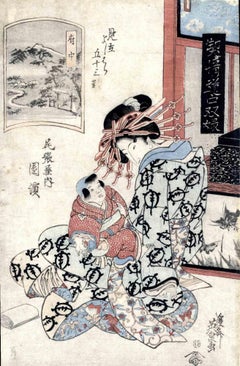
Biensennyo-ko Japanese Woodblock Print

Biensennyo-ko Japanese Woodblock Print

By Keisai Eisen

Located in Houston, TX

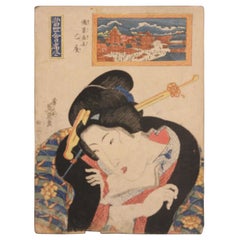
Japanese Woodblock print of a Biensennyo-ko a powder face women. Behind the women is a framed cityscape. The print is possibly from the series "Eight Favorite Things in the Modern World". The woodblock print is printed on rice paper. The print is not framed. Artist Biography: Keisai Eisen...

Category

Early 1800s Edo Portrait Prints

Materials

Woodcut

Japanese Original Woodblock Print

Suzuki HarunobuJapanese Original Woodblock Print

$624Sale Price|20% Off

H 16 in W 12 in D 1 in

Japanese Original Woodblock Print

By Suzuki Harunobu

Located in Soquel, CA

Japanese Original Woodblock Print Harunobu Suzuki (né Hozumi) (Japanese, 1724 - 1770) Presented in a black mat. Mat: 16"H x 12"W Paper: 12"H x 9"W I...

Category

18th Century Edo Figurative Prints

Materials

Ink, Rice Paper, Woodcut

Japanese Woodblock Print by Keisai Eisen 渓斎 英泉

Japanese Woodblock Print by Keisai Eisen 渓斎 英泉

Located in Norton, MA

Japanese Woodblock Print by Keisai Eisen ?? ?? (1790~1848), original and unframed. ABOUT THE ARTIST Keisai Eisen (?? ??, 1790–1848) was a Japanese u...

Category

Antique Early 19th Century Japanese Prints

Materials

Paper

"The Large Peepshow" Okarakuri Woodcut Print, Edo Style, Early 19th Century

"The Large Peepshow" Okarakuri Woodcut Print, Edo Style, Early 19th Century

By Kitagawa Utamaro 1

Located in Austin, TX

Page Size: 14.5 x 10 in. Frame Size: 22.5 x 15.5 in. The Large Peepshow (Ô-karakuri), from the series Fashionable Comparisons of Precious Children (Fûryû kodakara awase) 哥麿 筆 painte...

Category

Early 19th Century Edo Figurative Prints

Materials

Woodcut

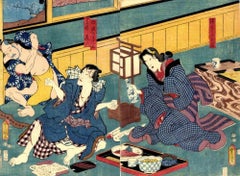
Two Actors - Japanese Woodblock by Chikanobu Yoshu

Two Actors - Japanese Woodblock by Chikanobu Yoshu

By Toyohara Chikanobu

Located in Soquel, CA

Two Actors - Japanese Woodblock by Toyohara Chikanobu (豊原周延, 1838–1912), better known to his contemporaries as Yōshū Chikanobu (楊洲周延). Colorful and expressive court scene. Two actors...

Category

1890s Edo Landscape Prints

Materials

Ink, Rice Paper, Woodcut

More From This Seller

View All
Shunga, Love Plays - Woodcut by Utagawa Kunisada - 1850s

Shunga, Love Plays - Woodcut by Utagawa Kunisada - 1850s

By Utagawa Kunisada II 2

Located in Roma, IT

Shunga, Love plays is an original artwork realized in the 1850s by Utagawa Kunisada (1786-1865). Good print with gold. Backed, restored wormholes and missing oarts, glued at upper ...

Category

1850s Modern Figurative Prints

Materials

Woodcut