Want more images or videos?
Request additional images or videos from the seller
1 of 5

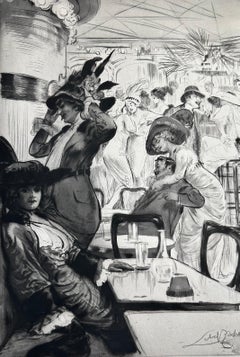
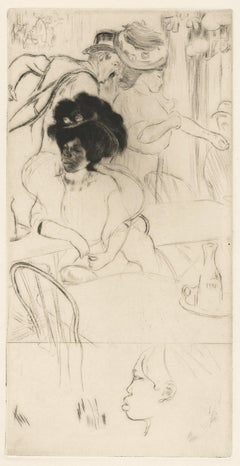
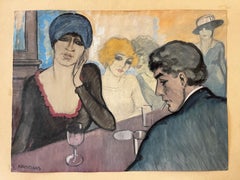
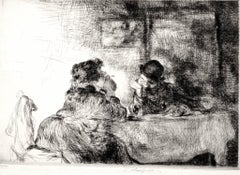
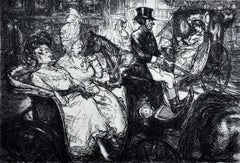
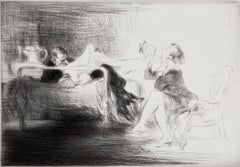
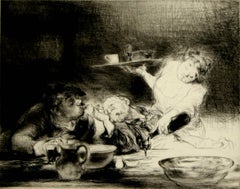
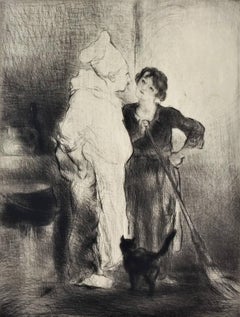
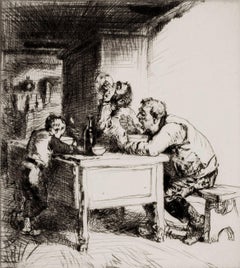
Louis Legrand
English Bar

1908

$800List Price

You May Also Like

At the bar - Original Etching Handsigned

At the bar - Original Etching Handsigned

By Almery Lobel-Riche

Located in Paris, IDF

Alméry Lobel-Riche At the bar Handsigned original engraving Signature printed in the plate Numbered /12 On parchment 31 x 22.5 cm (c. 12.2 x 8.9 inches) Excellent condition

Category

Early 20th Century Modern Nude Prints

Materials

Etching

Les Bars, selected prints

Almery Lobel-RicheLes Bars, selected prints, 1913

$480Sale Price|20% Off

H 18 in W 13.5 in

Les Bars, selected prints

By Almery Lobel-Riche

Located in Wilton, CT

6 plates from the Lobel- Riche books, Les Bars depicting pre- war Paris fashions in the bars and nightclubs.

Category

1910s Art Nouveau Figurative Prints

Materials

Etching

En passant (Passing by)

En passant (Passing by)

By Louis Legrand

Located in Fairlawn, OH

En passant (Passing by) Drypoint, 1909 Unsigned (as issued in the deluxe portfolio) From the album "Les Bars" (8 plates plus cover illustration) Edition: 30, this state with remarque Published by Gustav Pellet, Paris A very rich impression wwith burr Condition: Excellent Image/Plate size: 9 7/8 x 6 3/8 inches Reference: Arwas 391a (remarque) Exteens 277 i/II IFF 148 (portfolio) Louis Auguste Mathieu Legrand (29 September 1863 – 1951) was a French artist, known especially for his aquatint engravings, which were sometimes erotic. He was awarded the Légion d'honneur for his work in 1906. Life Legrand was born in the city of Dijon in the east of France. He worked as a bank clerk before deciding to study art part-time at Dijon's Ecole des Beaux-Arts. He won the Devosge prize at the school in 1883.[2] In 1884 Legrand studied engraving under the Belgian printmaker Félicien Rops. Legrand's artworks include etchings, graphic art and paintings. His paintings featured Parisian social life. Many were of prostitutes, dancers and bar scenes, which featured a sense of eroticism. According to the Hope Gallery, "Louis Legrand is simply one of France's finest early twentieth century masters of etching." His black and white etchings especially provide a sense of decadence; they have been compared to those of Henri de Toulouse-Lautrec, though his drawings of the Moulin Rouge, the can-can dance and the young women of Montmartre preceded Toulouse-Lautrec's paintings of similar scenes. He made over three hundred prints of the night life of Paris. They demonstrate "his remarkable powers of observation and are executed with great skill, delicacy, and an ironic sense of humor that pervades them all." Two of his satirical artworks caused him to be tried for obscenity. The first, "Prostitution" was a symbolic drawing which depicted a naked girl being grasped by a dark monster which had the face of an old woman and claws on its hands; the second, "Naturalism", showed the French novelist Émile Zola minutely studying the thighs of a woman with a magnifying glass. Defended by his friend the lawyer Eugène Rodrigues-Henriques (1853–1928), he was found not guilty in the lower court, but was convicted in the appeal court and then given a short prison sentence for refusing to pay his fine. Legrand was made famous by his colour illustrations for Gil Blas magazine's coverage of the can-can, with text by Rodrigues (who wrote under the pseudonym Erastene Ramiro). It was a tremendous success, with the exceptional quantity of 60,000 copies of the magazine being printed and instantly sold out in 1891. In 1892, at the instigation of the publishing house Dentu, Legrand made a set of etchings of his Gil Blas illustrations. The etchings were published in a book, Le Cours de Danse Fin de Siecle (The End of the Century Dance Classes). Legrand took a holiday in Brittany, which inspired him to engrave a set of fourteen lithographs of simple country life called Au Cap de la Chevre (On Goat Promontory). It was published by Gustave Pellet who became a close friend of Legrand's. Pellet eventually published a total of 300 etchings by Legrand, who was his first artist; he also published Toulouse-Lautrec and Félicien Rops among others. He did not only work in graphics; he exhibited paintings at the Paris salon of the Société Nationale des Beaux-Arts starting in 1902. In 1906 he was made a chevalier of the Légion d'honneur. Legrand died in obscurity in 1951. A retrospective exhibition was held at the Félicien Rops museum in Namur, Belgium in 2006 to celebrate his graphic art. The art collector Victor Arwas published a catalogue raisonné for the occasion. Books illustrated de Maupassant, Guy: Cinq Contes Parisiens, 1905. Poe, Edgar Alan: Quinze Histoires d'Edgar Poe...

Category

Early 1900s Art Nouveau Interior Prints

Materials

Drypoint

La Loge (The Lodge) /// Post-Impressionist Figurative French Paris People Art

La Loge (The Lodge) /// Post-Impressionist Figurative French Paris People Art

By Louis Legrand

Located in Saint Augustine, FL

Artist: Louis LeGrand (French, 1863-1951) Title: "La Loge (The Lodge)" Portfolio: Gazette des Beaux-Arts *Issued unsigned, though signed by LeGrand in the plate (printed signature) l...

Category

Early 1900s Post-Impressionist Figurative Prints

Materials

Drypoint, Etching, Intaglio

La Toilette

Louis LegrandLa Toilette, 1908

$950

H 7.88 in W 5.63 in

La Toilette

By Louis Legrand

Located in Fairlawn, OH

La Toilette Drypoint, 1908 Signed and numbered in pencil by the artist (see photos) Edition: 65 this state (35/65) Published by Gustave Pellet (1859-1919),...

Category

Early 1900s Art Nouveau Figurative Prints

Materials

Drypoint

La Negresse (The Negress)

La Negresse (The Negress)

By Louis Legrand

Located in Fairlawn, OH

La Negresse (The Negress) Etching & drypoint, 1909 Unsigned (as issued in the portfolio) From the album "Les Bars" (8 plates plus cover illustration) Editi...

Category

Early 1900s Art Nouveau Interior Prints

Materials

Etching

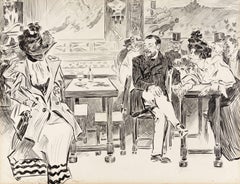
At the Black Cat

At the Black Cat

By Charles Dana Gibson

Located in Fort Washington, PA

Medium: Pen and Ink Over Graphite on Board Signature: Signed "C. D. Gibson" in lower left "At the Black Cat." Illustration for About Paris by Richard Harding Davis (New Yorker: Harp...

Category

1890s Figurative Drawings and Watercolors

Materials

Ink, Board, Pen

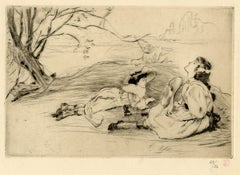
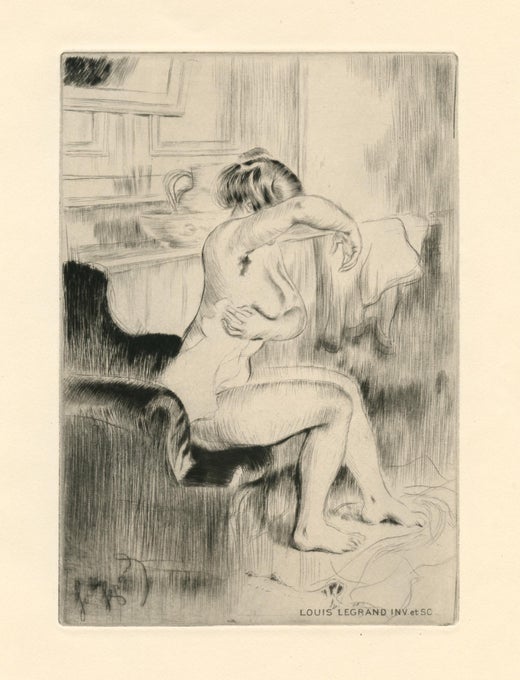
A L'Ombre (In Shadow)

A L'Ombre (In Shadow)

By Louis Legrand

Located in Fairlawn, OH

A L'Ombre (In Shadow) Etching & drypoint, 1905 Signed with the red stamp of the publisher Pellet (see photo) Edition: 50 on velin paper, signed and numbered Publisher: Gustav Pellet, Paris (his red stamp lower right, recto; Lugt 1193) Condition: Excellent Image/Plate size: 5-7/8 x 8-5/8" (14.8 x 21.8 cm.) Sheet size: 11 5/8 x 17 1/8" Reference: IFF 119 Exteens 229 Arwas 256 v/V Louis Auguste Mathieu Legrand (29 September 1863 – 1951) was a French artist, known especially for his aquatint engravings, which were sometimes erotic. He was awarded the Légion d'honneur for his work in 1906. Life Legrand was born in the city of Dijon in the east of France. He worked as a bank clerk before deciding to study art part-time at Dijon's Ecole des Beaux-Arts. He won the Devosge prize at the school in 1883.[2] In 1884 Legrand studied engraving under the Belgian printmaker Félicien Rops. Legrand's artworks include etchings, graphic art and paintings. His paintings featured Parisian social life. Many were of prostitutes, dancers and bar scenes, which featured a sense of eroticism. According to the Hope Gallery, "Louis Legrand is simply one of France's finest early twentieth century masters of etching." His black and white etchings especially provide a sense of decadence; they have been compared to those of Henri de Toulouse-Lautrec, though his drawings of the Moulin Rouge, the can-can dance and the young women of Montmartre preceded Toulouse-Lautrec's paintings of similar scenes. He made over three hundred prints of the night life of Paris. They demonstrate "his remarkable powers of observation and are executed with great skill, delicacy, and an ironic sense of humor that pervades them all." Two of his satirical artworks caused him to be tried for obscenity. The first, "Prostitution" was a symbolic drawing which depicted a naked girl being grasped by a dark monster which had the face of an old woman and claws on its hands; the second, "Naturalism", showed the French novelist Émile Zola minutely studying the thighs of a woman with a magnifying glass. Defended by his friend the lawyer Eugène Rodrigues-Henriques (1853–1928), he was found not guilty in the lower court, but was convicted in the appeal court and then given a short prison sentence for refusing to pay his fine. Legrand was made famous by his colour illustrations for Gil Blas magazine's coverage of the can-can, with text by Rodrigues (who wrote under the pseudonym Erastene Ramiro). It was a tremendous success, with the exceptional quantity of 60,000 copies of the magazine being printed and instantly sold out in 1891. In 1892, at the instigation of the publishing house Dentu, Legrand made a set of etchings of his Gil Blas illustrations. The etchings were published in a book, Le Cours de Danse Fin de Siecle (The End of the Century Dance Classes). Legrand took a holiday in Brittany, which inspired him to engrave a set of fourteen lithographs of simple country life called Au Cap de la Chevre (On Goat Promontory). It was published by Gustave Pellet who became a close friend of Legrand's. Pellet eventually published a total of 300 etchings by Legrand, who was his first artist; he also published Toulouse-Lautrec and Félicien Rops among others. He did not only work in graphics; he exhibited paintings at the Paris salon of the Société Nationale des Beaux-Arts starting in 1902. In 1906 he was made a chevalier of the Légion d'honneur. Legrand died in obscurity in 1951. A retrospective exhibition was held at the Félicien Rops museum in Namur, Belgium in 2006 to celebrate his graphic art. The art collector Victor Arwas published a catalogue raisonné for the occasion. Books illustrated de Maupassant, Guy: Cinq Contes Parisiens, 1905. Poe, Edgar Alan: Quinze Histoires d'Edgar Poe...

Category

Early 1900s Art Nouveau Landscape Prints
Materials

Etching

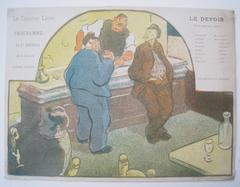
Le Devoir

Le Devoir

By Henri Gabriel Ibels

Located in New York, NY

Ibels, Henri-Gabriel.."Le Devoir", fouth programme for Le Theatre Libre. four-color lithograph, 1892-1893. 9 1/2 x 12 1/2". Ref: Artistes et Theatre d' Avant-Gardes, Programmes ...

Category

Late 19th Century Art Nouveau Figurative Prints

Materials

Lithograph

Antonius Johannes KRISTIANS (1883-1957), "At the Bar"

Antonius Johannes KRISTIANS (1883-1957), "At the Bar"

Located in Paris, FR

- Gouache on paper. - Signed at bottom left. - Around 1920. Dimensions  H : 49 cm L : 65 cm/H : 19.3 in W : 25.6 in (unframed) H : 67 cm L : 87 cm/H: 26.38 in W: 34.25 in (with frame)

Category

Early 20th Century Art Deco Figurative Paintings

Materials

Paper, Gouache

More From This Seller

View All
Chez Madame Dupont

Chez Madame Dupont

By Edmund Blampied

Located in Plano, TX

Chez Madame Dupont. 1931-32. Drypoint. Appleby 158. 8 3/16 x 11 3/4 ( 11 1/8 x 18 1/3). Edition 100, #75. A fine impression on pale cream-colored laid paper, printed on the full shee...

Category

1930s Modern Figurative Prints

Materials

Drypoint, Etching

Fifth Avenue Critics.

Fifth Avenue Critics.

By John French Sloan

Located in Plano, TX

Fifth Avenue Critics. 1909. Etching. Morse 128.x/xi. 6 x 8 (sheet 9 3/4 x 12 1/4). Edition 100 in this state (few proofs in earlier states, and a large unsigned edition printed for t...

Category

Early 1900s American Modern Figurative Prints

Materials

Etching

En Pension.

En Pension.

By Edmund Blampied

Located in Plano, TX

En Pension. 1929-30. Drypoint. Appleby 142. 8 1/2 x 12 1/8 (sheet 11 1/2 x 18 5/16). Edition 100. A rich impression printed on cream wove paper with wide margins. Signed in ink. H...

Category

1920s Modern Figurative Prints

Materials

Drypoint, Etching

Vin Rouge (Red Wine)

Vin Rouge (Red Wine)

By Edmund Blampied

Located in Plano, TX

1932. Drypoint. Appleby 167. 9 1/4 x 11 5/8 (sheet 11 3/8 x 17 15/16). Edition 100 #48. Mat line, well outside the image; otherwise excellent condition. A rich impression with drypo...

Category

1930s Modern Interior Prints

Materials

Drypoint

Below Stairs.

Below Stairs.

By Edmund Blampied

Located in Plano, TX

Below Stairs. 1930-31. Drypoint. Appleby 143. 10 1/4 x 7 3/4 (sheet 15 3/4 x 10 1/8). Edition 100, #31. A very rich, tonal impression on cream-colored laid paper. Unobtrusive soiling in the top left- and lower-left hand margins, just below the platemark; and light mat line just outside the platemark. . Signed and numbered in ink. Housed in a 20 x 16-inch archival mat, suitable for framing. A charming discussion between the chef and a scullery maid in a "Downtown Abbey...

Category

1930s Modern Figurative Prints

Materials

Drypoint, Etching

Soup

Soup

By Edmund Blampied

Located in Plano, TX

Soup. 1920. Drypoint. Appleby 65. 9 x 8 1/8 (sheet 15 x 11 9/16). Edition 100. Illlustrated: Print Collector's Quarterly 13 (1926): 85. Signed in pencil. Edmund Blampied was a painter, etcher, lithographer and sculptor. Born in 1886 to a family of three boys in St. Martin, Jersey, Blampied became interested in drawing at an early age. After visiting the studio of John Helier Lander in 1899, Blampied decided to make a career as an artist. In 1903 he went to London to attend Lambeth Art School, where he studied etching under Walter Seymour. In 1905, he joined the Daily Chronicle as an artist. In that year he was awarded a scholarship to Bolt Court Scool of Photo-engraving and Lithography. In 1912 he left the Chronicle and established his own studio. He earned a living by illustrating novels and short stories. In 1913, he had his first exhibition at the Leicester Gallery in London. The following year he married Marianne Van Abbé. During the 1920's, he became a member of the Royal Society of Painter-Etchers and Engravers. During the 1920s Blampied became a member of the Royal Society of Painters-Etchers and Engravers and exhibited in London to critical acclaim. He produced a folio of comic drawings in the 1930s which was published in New York in 1934 and another that was published in London in 1936. The Keeper of Prints and Drawings at the British Museum published a mongraph on his work. His London exhibitions were highly successful. In 1938, he moved to Bulwarks, St.Aubin in Jersey, but at the onset of the Occupation, had to relocate to Route Orange, St. Brelade. remained there throughout World War II during the German Occupation, despite the fact that his wife was Jewish. During the Occupation he designed bank...

Category

1920s Modern Figurative Prints

Materials

Drypoint, Etching