Want more images or videos?
Request additional images or videos from the seller
1 of 3

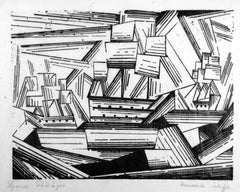
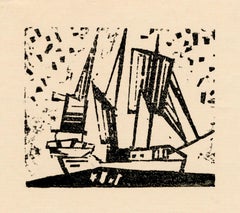
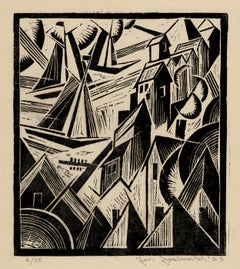
Lyonel Feininger
Ships (Three Sailing Ships)

1919

$700List Price

You May Also Like

Kreuzende Segelschiffe 2 (Cruising Sailing Ships 2)

Kreuzende Segelschiffe 2 (Cruising Sailing Ships 2)

By Lyonel Feininger

Located in New York, NY

Lyonel Feininger, “Kreuzende Segelschiffe 2 (Cruising Sailing Ships 2)” 1919, Woodcut. Prasse W175. Edition 275 unsigned for portfolio Die tunlte Jahresgabe des Kreises graphischer ...

Category

1910s Bauhaus Landscape Prints

Materials

Woodcut

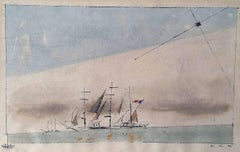
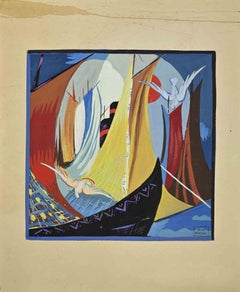
Bauhaus .  Untitled (French Barque under Staysail)

Bauhaus . Untitled (French Barque under Staysail)

By Lyonel Feininger

Located in Miami, FL

Bauhaus Iconic work by the master or Cubism and Expressionism Dalzell Hatfield Gallery, Los Angeles Bonhams, Exhibited: Moller Fine Art, "Precision ...

Category

1940s Expressionist Landscape Drawings and Watercolors

Materials

Watercolor, Pencil

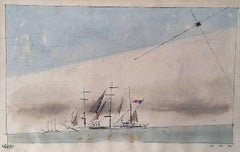
Bauhaus .  Untitled (French Barque under Staysail)

Bauhaus . Untitled (French Barque under Staysail)

By Lyonel Feininger

Located in Miami, FL

Bauhaus Iconic work by the master or Cubism and Expressionism Dalzell Hatfield Gallery, Los Angeles Bonhams, Exhibited: Moller Fine Art, "Precision ...

Category

1940s Expressionist Landscape Drawings and Watercolors

Materials

Watercolor, Pencil

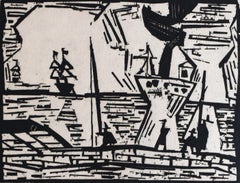
On the Quay Wall  Auf der Quaimauer, 1921

On the Quay Wall Auf der Quaimauer, 1921

By Lyonel Feininger

Located in London, GB

LYONEL FEININGER 1871-1956 1871 - New York - 1956 (American/German) Title: On the Quay Wall Auf der Quaimauer, 1921 Technique: Original Hand Signed Woodcut on Wove Paper Paper...

Category

1920s Expressionist Figurative Prints

Materials

Woodcut

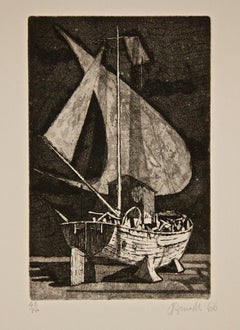
The Sailing Ship - Etching by Armando Buratti - 1966

The Sailing Ship - Etching by Armando Buratti - 1966

By Armando Buratti

Located in Roma, IT

Hand signed and numbered. Edition of 50 print. Reference: Catalogue Battisti n.36. Armando Buratti (Rome, 1924), is an italian artist and painter. His first exhibition was held in ...

Category

1960s Modern Figurative Prints

Materials

Etching

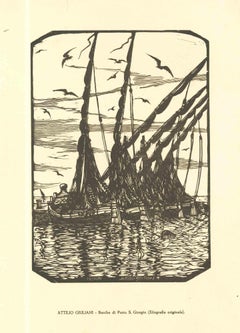
Boats  - Original Woodcut by Attilio Giuliani - 1924

Boats - Original Woodcut by Attilio Giuliani - 1924

By Attilio Giuliani

Located in Roma, IT

Boats in Porto San Giorgio is an original woodcut print realized by Attilio Giuliani in 1924. Signed and dated on plate. The artwork depicts a scene from the habour of Porto San Gio...

Category

1920s Modern Figurative Prints

Materials

Woodcut

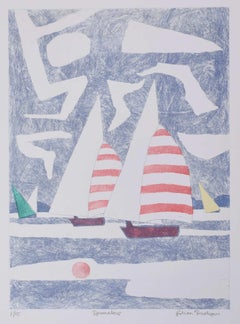
Julian Trevelyan: 'Spinnakers' sailing boats Modern British Art print

Julian Trevelyan: 'Spinnakers' sailing boats Modern British Art print

By Julian Trevelyan

Located in London, GB

We have seven of Julian Trevelyan's prints, and oil paintings by him - and other Modern British Artists. To see the others, scroll down to "More from this Seller" and below it click on "See all from this Seller" and search for "Trevelyan". Julian Trevelyan (1910-1988) Spinnakers Etching 48 x 35 cm (sheet size 68 x 55 cm) Signed in pencil and numbered 1/65. The Tate holds number 24/56 - reference P01330. Small vessels weave around two great boats with striped masts, observed by a dark sky full of geometric clouds. A red buoy...

Category

20th Century Modern Figurative Prints

Materials

Etching

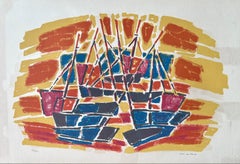
Untitled Sailboat Lithograph, Abstract Style, Signed, Mid-20th Century

Untitled Sailboat Lithograph, Abstract Style, Signed, Mid-20th Century

By Jean Le Moal

Located in Belgrade, MT

Color lithograph, pencil signed by artist, limited edition. ean Le Moal ( French, 1909-2007) was a French painter, watercolorist, and printmaker known for his colorful abstract compo...

Category

Mid-20th Century Abstract Abstract Prints

Materials

Lithograph

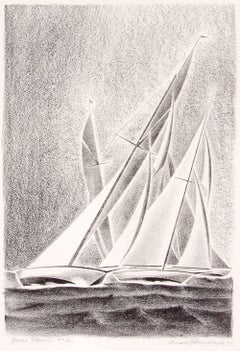
Arnold Ronnebeck 1933 Grand Lake Colorado Sailboat Race Modernist Print

Arnold Ronnebeck 1933 Grand Lake Colorado Sailboat Race Modernist Print

By Arnold Rönnebeck

Located in Denver, CO

“Yacht Races, Grand Lake, Colorado” is a rare and visually striking 1933 black-and-white lithograph by German-born American modernist Arnold Rönnebeck. This limited-edition print, nu...

Category

1930s Modern Prints and Multiples

Materials

Lithograph

Boats  - Drawing by J. Boudal - Mid-20th Century

Boats - Drawing by J. Boudal - Mid-20th Century

Located in Roma, IT

Boats is a drawing realized by Jean Boudal in the Mid-20th Century. Tempera and watercolor on paper. Good conditions with slight foxing. The artwork is realized through deft expre...

Category

Mid-20th Century Modern Figurative Drawings and Watercolors

Materials

Watercolor, Tempera

More From This Seller

View All
'Three Masted Ship, 2' – Artist's Personal Letterhead, Bauhaus Modernism

'Three Masted Ship, 2' – Artist's Personal Letterhead, Bauhaus Modernism

By Lyonel Feininger

Located in Myrtle Beach, SC

Lyonel Feininger, 'Three Masted Ship, 2 (Dreimastiges Schiff, 2)', woodcut, 1937, one of a small but unknown number of letterhead proofs; Prasse W296. Feininger estate stamp and inventory no. 'W 865' in pencil, bottom left sheet corner. Annotated 'W 296' and 'on block : 3702a' in pencil, bottom right sheet corner. A fine impression, on cream, laid, letterhead stock; hinge remains on the left and right top sheet edges, verso, in excellent condition. Very scarce. Image size 2 1/4 x 2 11/16 inches; sheet size 10 x 6 3/4 inches. Archivally sleeved, unmatted. Exhibited: 'Lyonel Feininer, Woodcuts Used As Letterheads'; Associated American Artists; Feb 4 - March 2, 1974; New York, NY. ABOUT THE ARTIST Lyonel Feininger (1871-1956) was born in New York City into a musical family—his father was a violinist and composer, his mother was a singer and pianist. He studied violin with his father, and by the age of 12, he was performing in public, but he also drew incessantly, most notably the steamboats and sailing ships on the Hudson and East Rivers, and the landscape around Sharon, Conn., where he spent time on a farm owned by a family friend. At the age of 16 he left New York to study music and art in Germany, from where his parents emigrated. Drawn more to the visual arts, he attended schools in Hamburg, Berlin, and Paris from 1887 to 1892. After completing his studies, Feininger began his artistic career as a cartoonist and illustrator, his originality leading him to great success. In 1906, after working for a dozen years in Germany, he was offered a job as a cartoonist at the Chicago Tribune, the largest circulation newspaper in the Midwest. He worked there for a year, inventing what became the standard design for the comic strip: in the words of John Carlin, “an overall pattern. . . that allowed the page to be read both as a series of elements one after the other, like language and as a group of juxtaposed images, like visual art.” His originality did not end there: he went on to become one of the great abstract painters. Like Kandinsky, music was his model, but Kandinsky only knew music from the outside—as a listener (inspired initially by Wagner, then by Schoenberg)—while Feininger knew it from the inside. He lived in Paris from 1906 to 1908, during which time he met and was influenced by the work of progressive painters Robert Delaunay and Jules Pascin, as well as that of Paul Cezanne and Vincent van Gogh. He began painting full-time, developing his distinctive Iyrical style based on Cubist and Expressionist idioms and a concern for the emotive qualities of light and color. He exhibited with the Der Blaue Reiter group in 1913, and in 1917, he had his first solo exhibition at Galerie Der Sturm in Berlin. One year after his solo exhibition, in 1918, Feininger began making woodcuts. He became enamored with the medium, producing an impressive 117 in his first year of exploring the printmaking medium. In 1919 at the invitation of the architect Walter Gropius, he was appointed the first master at the newly formed Staatliches Bauhaus in Weimar. His woodcut of a cathedral crowned...

Category

1930s Bauhaus Figurative Prints

Materials

Woodcut

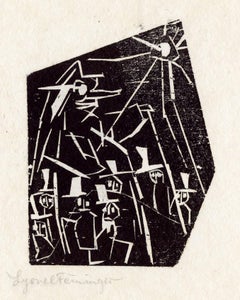
'Da - Da I' — German Expressionism, Rare

'Da - Da I' — German Expressionism, Rare

By Lyonel Feininger

Located in Myrtle Beach, SC

Lyonel Feininger, 'Da-Da I' also titled by the artist 'Der Abgott' (The Idol), woodcut, 1918, a proof impression. Prasse W91. Signed in pencil and annotated '1876', the artist’s inv...

Category

1920s Bauhaus Abstract Prints

Materials

Woodcut

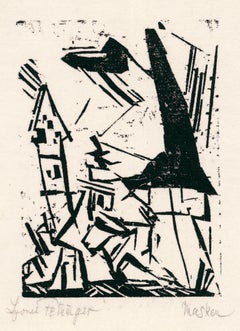
'Masken (Masks)' — German Expressionism, Bauhaus

'Masken (Masks)' — German Expressionism, Bauhaus

By Lyonel Feininger

Located in Myrtle Beach, SC

Lyonel Feininger, 'Masken (Masks)' also 'Carnival Masks', woodcut, 1920, proofs only. Prasse W193. Signed and titled in pencil. Annotated '1973', the artist’s inventory number. A fin...

Category

1920s Bauhaus Abstract Prints

Materials

Woodcut

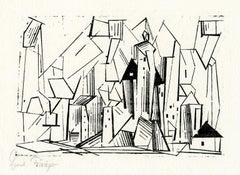
'Die Architektur' (Architecture) — Bauhaus Modernism, Signed Woodcut

'Die Architektur' (Architecture) — Bauhaus Modernism, Signed Woodcut

By Lyonel Feininger

Located in Myrtle Beach, SC

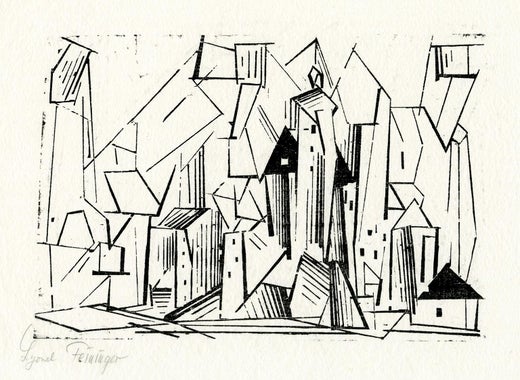
Lyonel Feininger, 'Die Architektur' (Architecture), also 'Stadtbild' (Cityscape), woodcut, edition – proofs only in 1920; 50 in 1921. Prasse W 232. Signed in pencil. A fine, richly-inked impression, on off-white Japan paper, with full margins (1 1/4 to 2 1/8 inches), in excellent condition. Matted to museum standards, unframed. Image size 6 x 8 7/8 inches (152 x 229 mm); sheet size 9 1/2 x 11 7/8 inches (241 x 302 mm). No. 11 of the portfolio 'Zwolf Holzschnitte von Lyonel Feininger', 1921. Provenance: Peter Deitsch collection; exhibited Weimar Museum, 1968. Impressions of this work are in the permanent collections of: the Busch-Reisinger Museum (Cambridge, Mass.), Bauhaus-Archiv (Germany), Hamburger Kunsthalie (Germany), Pfaizische Landesgewerbeanstalt (Germany), Kaiser Wilhelm Museum (Germany), Staatliche Graphische Sammlung (Germany), and the Philadelphia Museum of Art. ABOUT THE ARTIST Lyonel Feininger was born in New York City into a musical family—his father was a violinist and composer, his mother was a singer and pianist. He studied violin with his father, and by the age of 12, he was performing in public, but he also drew incessantly, most notably the steamboats and sailing ships on the Hudson and East Rivers, and the landscape around Sharon, Conn., where he spent time on a farm owned by a family friend. At the age of 16 he left New York to study music and art in Germany, from where his parents emigrated. Drawn more to the visual arts, he attended schools in Hamburg, Berlin, and Paris from 1887 to 1892. After completing his studies, Feininger began his artistic career as a cartoonist and illustrator, his originality leading him to great success. In 1906, after working for a dozen years in Germany, he was offered a job as a cartoonist at the Chicago Tribune, the largest circulation newspaper in the Midwest. He worked there for a year, inventing what became the standard design for the comic strip: in the words of John Carlin, “an overall pattern. . . that allowed the page to be read both as a series of elements one after the other, like language and as a group of juxtaposed images, like visual art.” His originality did not end there: he went on to become one of the great abstract painters. Like Kandinsky, music was his model, but Kandinsky only knew music from the outside—as a listener (inspired initially by Wagner, then by Schoenberg)—while Feininger knew it from the inside. He lived in Paris from 1906 to 1908, during which time he met and was influenced by the work of progressive painters Robert Delaunay and Jules Pascin, as well as that of Paul Cezanne and Vincent van Gogh. He began painting full-time, developing his distinctive Iyrical style based on Cubist and Expressionist idioms and a concern for the emotive qualities of light and color. He exhibited with the Der Blaue Reiter group in 1913, and in 1917, he had his first solo exhibition at Galerie Der Sturm in Berlin. One year after his solo exhibition, in 1918, Feininger began making woodcuts. He became enamored with the medium, producing an impressive 117 in his first year of exploring the printmaking medium. In 1919 at the invitation of the architect Walter Gropius, he was appointed the first master at the newly formed Staatliches Bauhaus in Weimar. His woodcut of a cathedral...

Category

1920s Bauhaus Landscape Prints
Materials

Woodcut

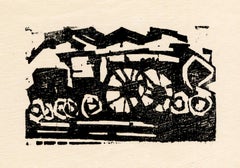
'Little Locomotive' – Artist's Personal Letterhead, Bauhaus Modernism

'Little Locomotive' – Artist's Personal Letterhead, Bauhaus Modernism

By Lyonel Feininger

Located in Myrtle Beach, SC

Lyonel Feininger, 'Little Locomotive (Kleine Lokomotive)', woodcut, 1936, one of a small but unknown number of letterhead proofs; Prasse W158. Annotated 'W 158' (Feininger catalogue number) and '1936' in pencil, in the bottom right sheet corner. A fine impression, on cream, laid letterhead stock; hinge remains on the left and right top sheet edges, verso, in excellent condition. Very scarce. Image size 2 1/4 x 3 5/16 inches; sheet size 10 x 7 inches. Archivally sleeved, unmatted. Exhibited: 'Lyonel Feininer, Woodcuts Used As Letterheads'; Associated American Artists; Feb 4 - March 2, 1974; New York, NY. Collections: Cleveland Museum of Art, Museum of Modern Art, Staatliche Museen zu Berlin (East Berlin KK). ABOUT THE ARTIST Lyonel Feininger (1871-1956) was born in New York City into a musical family—his father was a violinist and composer, his mother was a singer and pianist. He studied violin with his father, and by the age of 12, he was performing in public, but he also drew incessantly, most notably the steamboats and sailing ships on the Hudson and East Rivers, and the landscape around Sharon, Conn., where he spent time on a farm owned by a family friend. At the age of 16 he left New York to study music and art in Germany, from where his parents emigrated. Drawn more to the visual arts, he attended schools in Hamburg, Berlin, and Paris from 1887 to 1892. After completing his studies, Feininger began his artistic career as a cartoonist and illustrator, his originality leading him to great success. In 1906, after working for a dozen years in Germany, he was offered a job as a cartoonist at the Chicago Tribune, the largest circulation newspaper in the Midwest. He worked there for a year, inventing what became the standard design for the comic strip: in the words of John Carlin, “an overall pattern. . . that allowed the page to be read both as a series of elements one after the other, like language and as a group of juxtaposed images, like visual art.” His originality did not end there: he went on to become one of the great abstract painters. Like Kandinsky, music was his model, but Kandinsky only knew music from the outside—as a listener (inspired initially by Wagner, then by Schoenberg)—while Feininger knew it from the inside. He lived in Paris from 1906 to 1908, during which time he met and was influenced by the work of progressive painters Robert Delaunay and Jules Pascin, as well as that of Paul Cezanne and Vincent van Gogh. He began painting full-time, developing his distinctive Iyrical style based on Cubist and Expressionist idioms and a concern for the emotive qualities of light and color. He exhibited with the Der Blaue Reiter group in 1913, and in 1917, he had his first solo exhibition at Galerie Der Sturm in Berlin. One year after his solo exhibition, in 1918, Feininger began making woodcuts. He became enamored with the medium, producing an impressive 117 in his first year of exploring the printmaking medium. In 1919 at the invitation of the architect Walter Gropius, he was appointed the first master at the newly formed Staatliches Bauhaus in Weimar. His woodcut of a cathedral crowned...

Category

1930s Bauhaus Figurative Prints

Materials

Woodcut