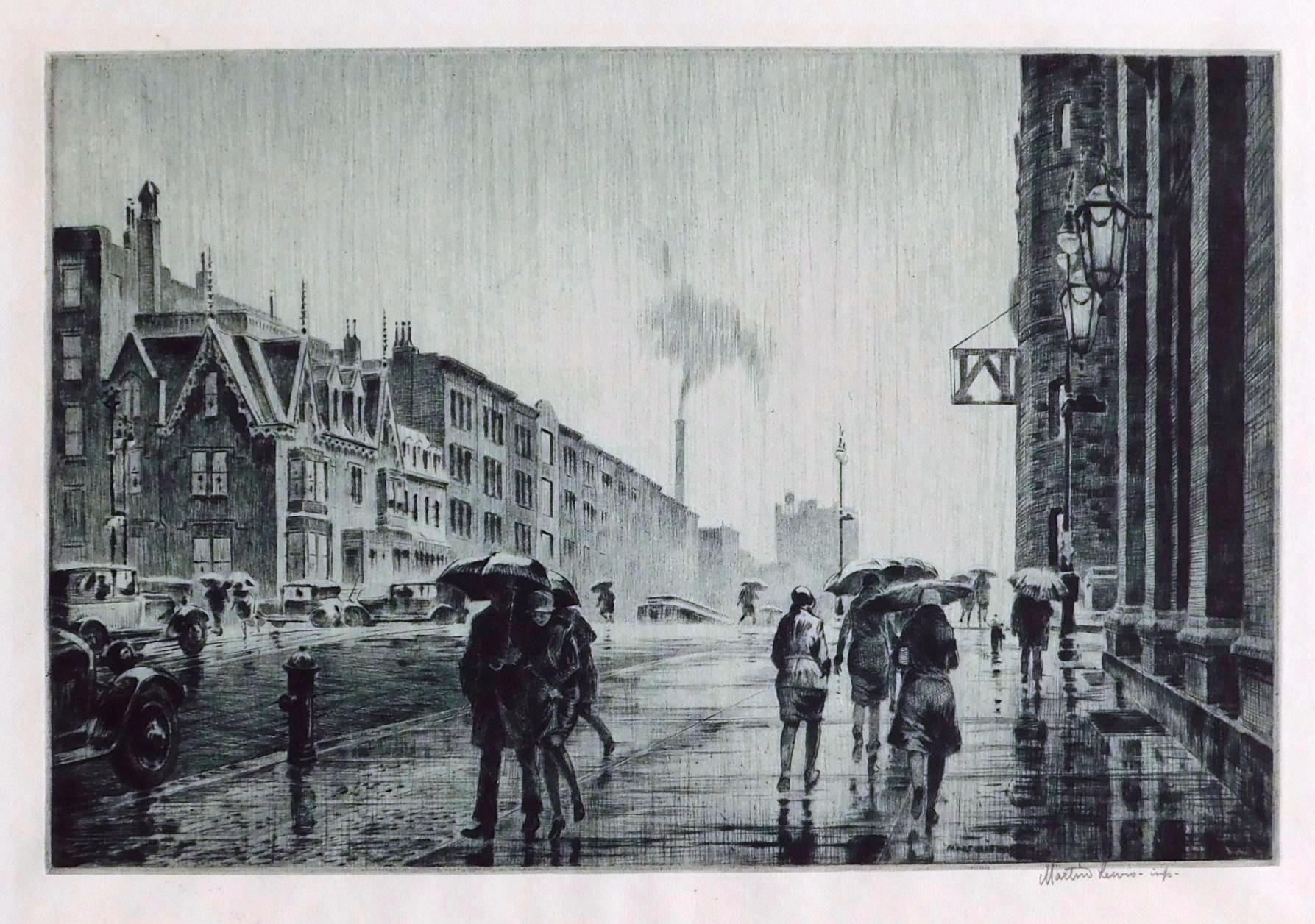
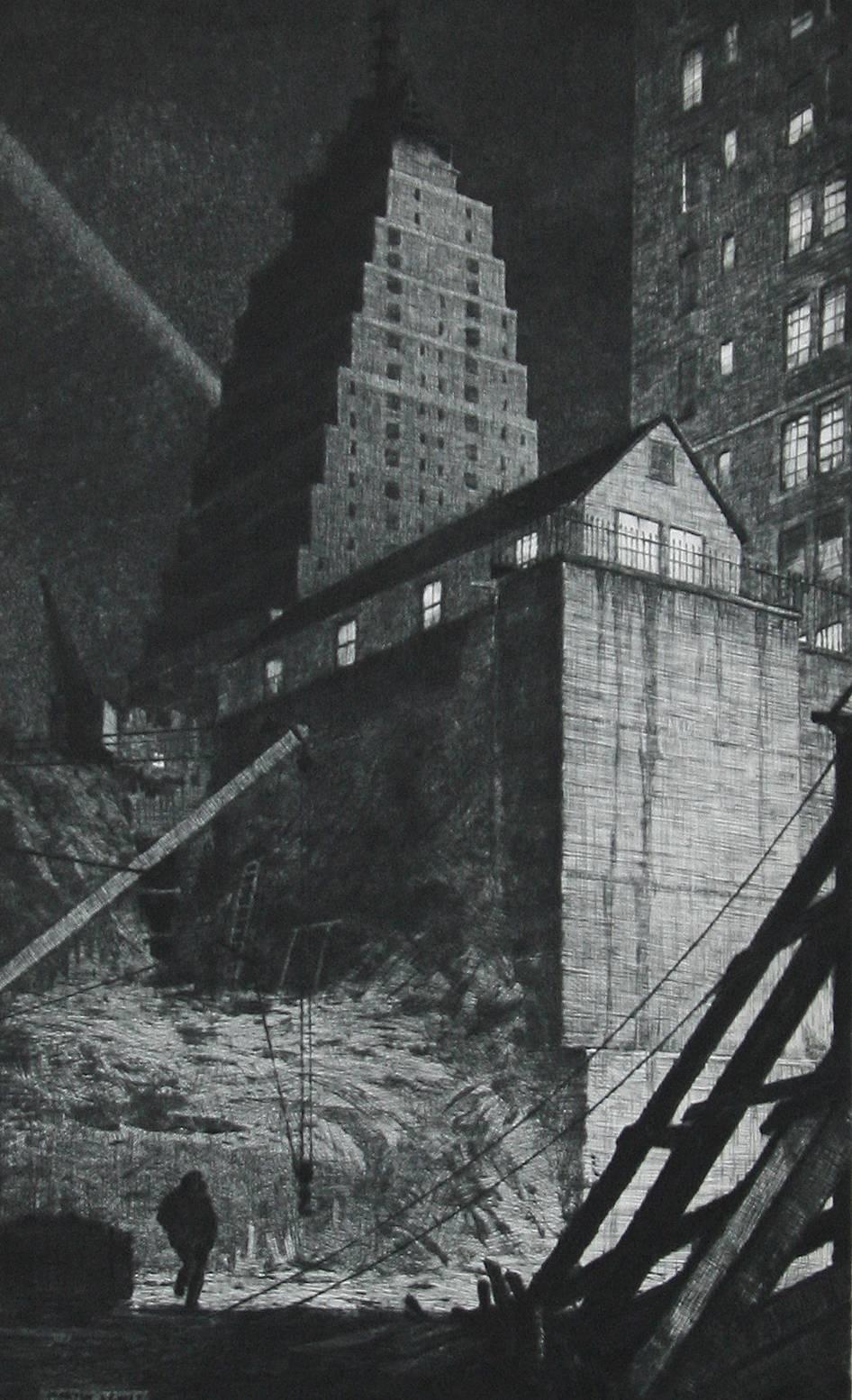
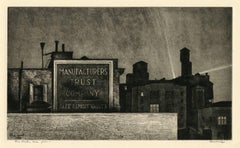
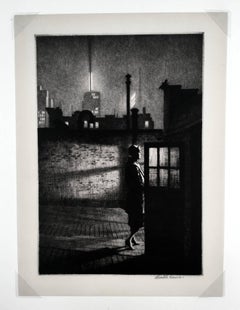
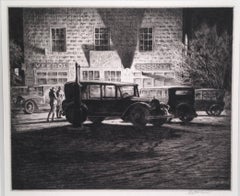
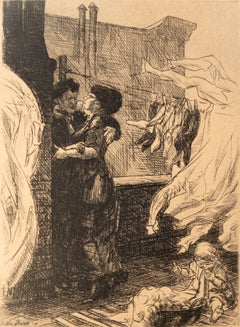
Martin Lewis, 'Little Penthouse,' drypoint, edition 84 (including 9 proofs), 1931. McCarron 91. Signed in pencil 'Martin Lewis imp.' Annotated, 'proof on Dard Hunter paper: “Peter Musik"' in pencil, in the artist's hand, lower right margin. Signed in the plate, lower left.
A superb, richly inked, velvety impression in deep black ink on cream wove paper. The full sheet with margins (1 5/8 to 2 1/2 inches); previous archival hinges verso; and remnants of masking-tape hinges at the top-left and top-right sheet corners recto; otherwise in excellent condition. The image pristine and luminous, with burr throughout.
A rare proof impression, before steel-facing, printed by the artist on handmade Dard Hunter paper. Unlike the standard editions, which were printed in collaboration with master printers under Lewis’s close supervision, this impression was printed by the artist himself. It retains a particularly rich, velvety burr and a heightened tonal immediacy—qualities that tended to diminish after his plates were steel-faced — a process which Lewis implemented for the purpose of maintaining edition faithfulness and consistency. An exceptional impression offering an intimate sense of Lewis’s extraordinary achievement in drypoint rendering and printing.
Matted to museum standards, unframed.
Image size 9 13/16 x 6 13/16 inches; sheet size 14 x 10 1/4 inches.
Little Penthouse was commissioned for inclusion in the deluxe edition of "American Etchers, Vol. XI: Martin Lewis," published in an edition of 75 by the Crafton Collection in New York and distributed by P. & D. Colnaghi in London. There were 9 proofs, apart from the published edition.
Literature and Exhibition: The American Scene: Prints from Hopper to Pollock, Stephen Coppel, The British Museum, 2008.
Impressions of this work are in the permanent collections of the following institutions: Berea College Museum, British Museum (London), Connecticut College, Detroit Institute of Arts, Gibbs Art Gallery (Carolina Art Association), Fitzwilliam Museum (Cambridge, England), Harvard University Art Museums, Minneapolis Institute of Art, Museum of Modern Art, Davidson Art Center (Wesleyan University), Yale University Art Gallery.
ABOUT THE ARTIST
“Martin Lewis is the greatest master of the drypoint medium that America has yet produced.”
— John Taylor Arms
“Lewis’s prints are among the most technically accomplished and visually compelling works in twentieth-century American printmaking...
He explored the expressive possibilities of light to an extraordinary degree, using it not only to describe form but to structure the entire composition.”
— Jane Myers McCarron, American curator and print scholar
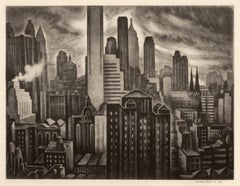
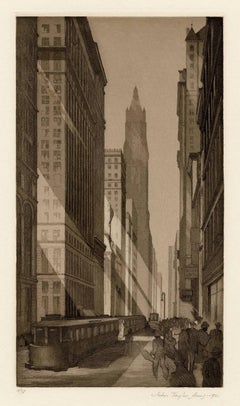
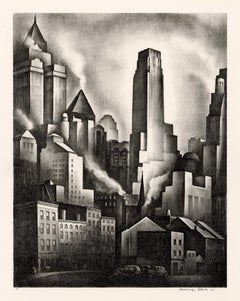
Martin Lewis (1881–1962) stands among the most accomplished American printmakers of the twentieth century, renowned for his evocative drypoints that capture the drama, solitude, and shifting luminosity of urban life—especially New York at night.
Largely self-taught, Lewis arrived in the United States in 1909, initially supporting himself through commercial illustration. His early career included a formative association with Edward Hopper, whom he met around 1915. The two artists shared a studio for a time, and Lewis introduced Hopper to the practice of etching—an exchange that would prove consequential for both. While Hopper's printmaking remained relatively limited, Lewis pursued the medium with singular focus, gradually refining a technical and expressive language that would become uniquely his own.
A pivotal period in Lewis’s development came through his travels in Japan during the 1920s. There he studied Japanese art and design firsthand, developing a lasting admiration for the compositional clarity, asymmetrical balance, and sophisticated handling of negative space characteristic of ukiyo-e woodblock prints and related traditions. While Lewis’s work remained wholly personal and Western in execution, the influence of Japanese aesthetics can be felt in his heightened sense of spatial organization, dramatic cropping, and ability to convey atmosphere through restraint as much as detail.
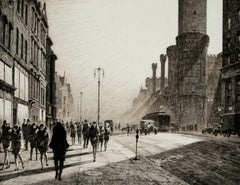
Lewis's mature work, produced primarily between the 1920s and early 1940s, centers on the interplay of light and urban space. Working primarily in drypoint, often in combination with sandground, he developed a highly controlled approach to plate preparation and tonal construction. Although he did not typically print his own editions, he worked in close collaboration with highly skilled printers, maintaining exacting control over the translation of plate to paper. Lewis's editions demonstrate a rare consistency, preserving an extended tonal range, clarity of detail, and a distinctly alive surface across impressions.
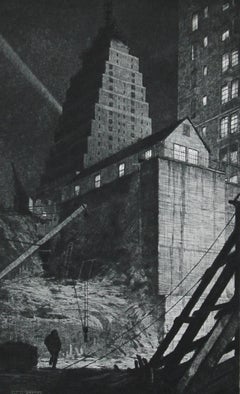
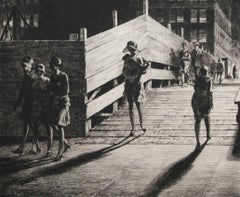
Lewis transforms ordinary urban moments into scenes of heightened visual and psychological intensity. Figures are often isolated—caught mid-stride under streetlamps, framed by architectural recesses, or partially obscured by shadow—yet remain fully integrated within their environments. His compositions are rigorously structured, frequently employing cropped viewpoints, and carefully orchestrated light sources that reinforce the image's emotional tenor. The result is a body of work that is at once structurally disciplined and atmospherically charged.
Lewis's stylistic development reflects a synthesis of influences without direct allegiance to any single movement. While his work shares affinities with American Scene painting and aspects of the Ashcan School, his sensibility is more introspective and structurally refined. He was less concerned with overt social commentary than with the expressive potential of light and composition—using the cityscape not simply as subject matter, but as a means of exploring social interaction, emotional perception, and psychological presence.
Public collections holding the work of Martin Lewis include the Art Institute of Chicago, Boston Public Library, British Museum, Brooklyn Museum, Cleveland Museum of Art, Detroit Institute of Arts, Fine Arts Museums of San Francisco, Harvard University Art Museums, Library of Congress, Metropolitan Museum of Art, Minneapolis Institute of Art, Museum of Fine Arts, Boston, Museum of Modern Art, National Gallery of Art, National Gallery of Australia, New York Public Library, Philadelphia Museum of Art, Smithsonian American Art Museum, Victoria and Albert Museum, Yale University Art Gallery, and the Art Gallery of New South Wales, among numerous other institutional and university collections.