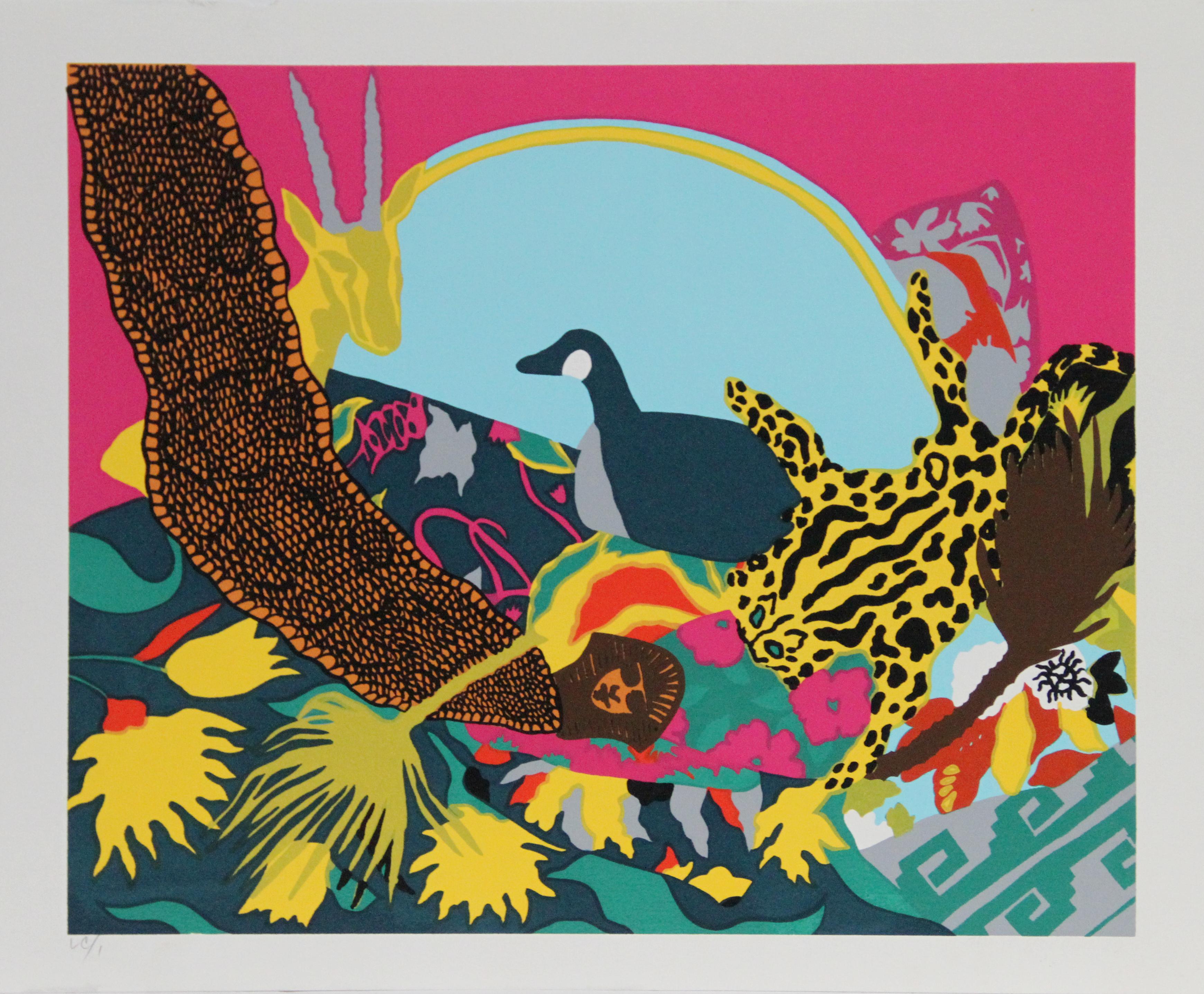
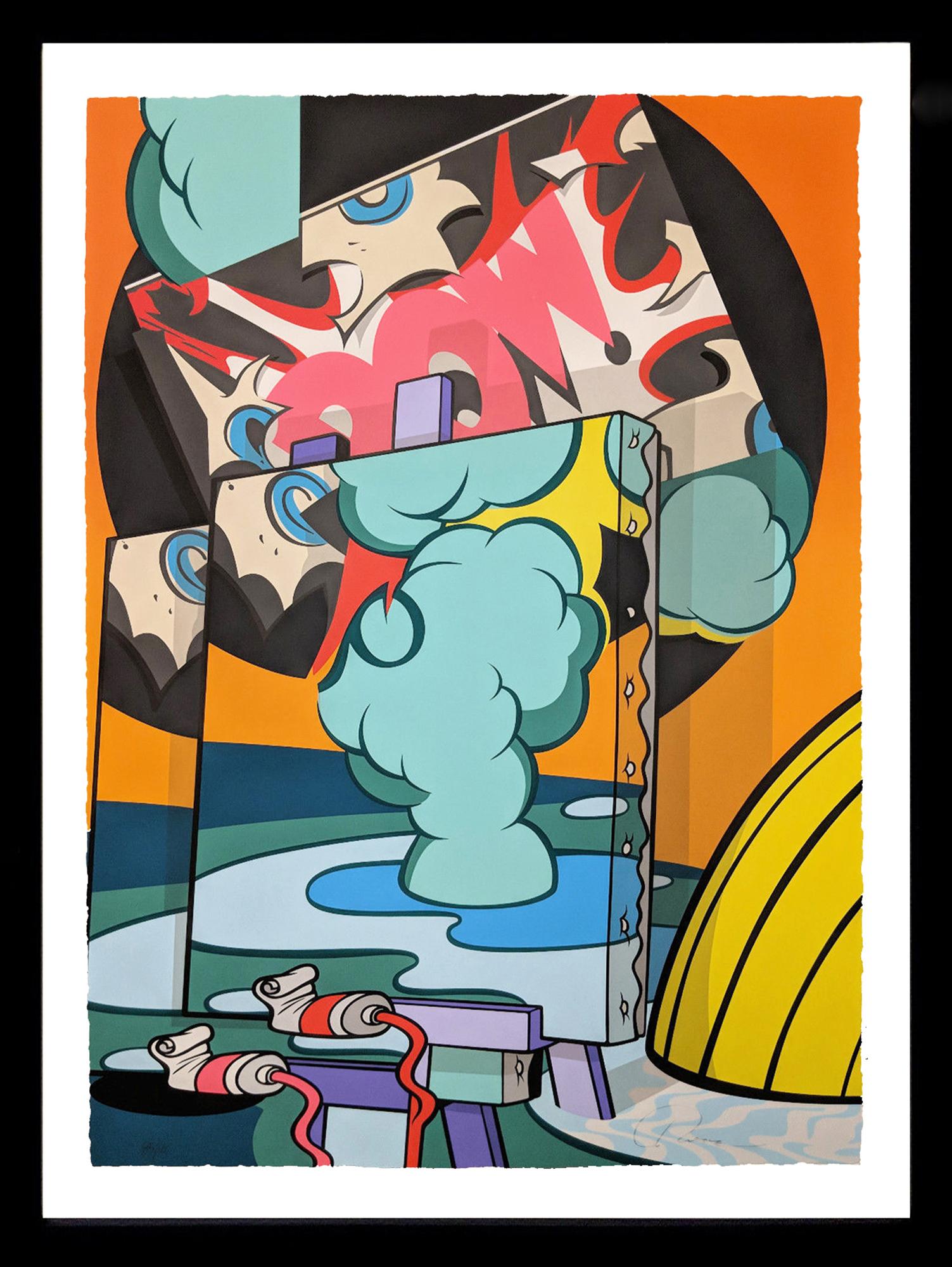
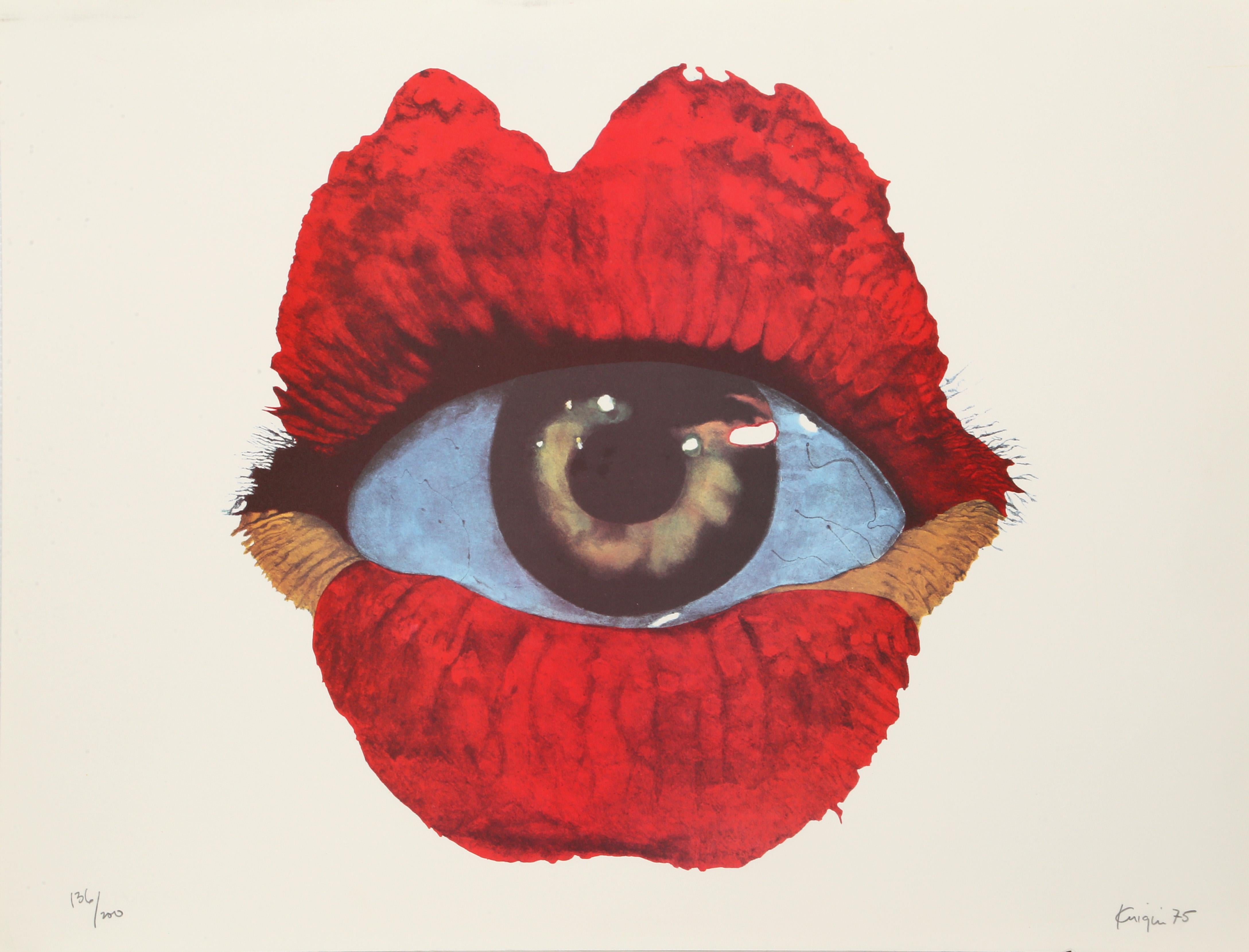
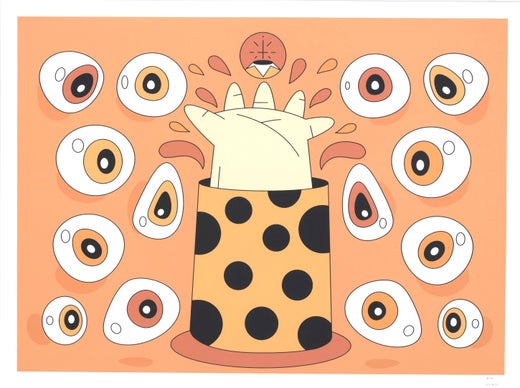
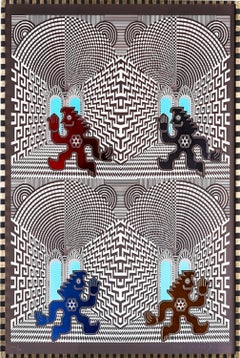
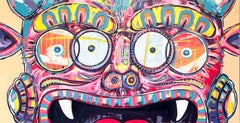
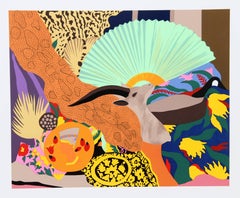
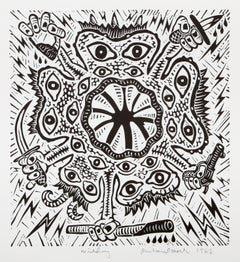
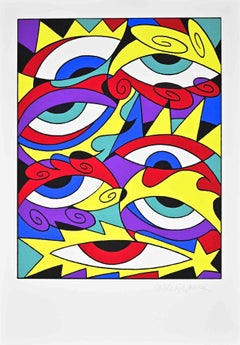
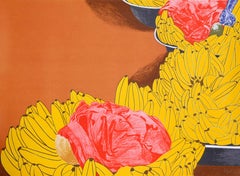
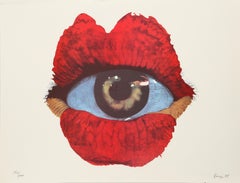
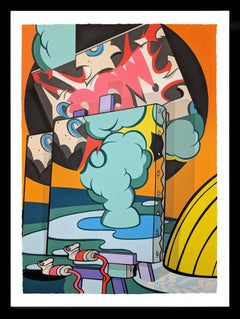
Eyes of Tiger, by Mr. Mitote
-Serigraphy,
- 44 x 59cm 17.3 x 23.2 in
- Mexican Pop Art, c. 2024
A piece from the exhibition "Cosmic Duality" by artist Mr. Mitote.
Mitote is a term we use today to describe a lively, noisy, and excessive gathering. It’s also used to depict tumultuous gatherings marked by disorder, commotion, and sometimes even quarrels. In the colonial past, mitote was a celebration commemorating the establishment of the New Spain kingdom, blending local pride with imperial solemnity. However, throughout both ancient times and the present day, mitotes serve as rituals embedded in the culture and religiosity of various indigenous groups in Mexico, such as the Nahua, Cora, Tepehuan, and Huichol. Adorned in rich attire, gathered around a fire amidst the sounds of musical instruments, and under the intoxicating influence of alcoholic beverages, mitotes serve as occasions to invoke sacred beings—whether protective deities of nature or Christian saints associated with agriculture—to pray for bountiful harvests. Mitotes encompass and have always embodied rites, myths, and life.
In homage to the artist’s name, this exhibition is presented as a mitote: a celebration displaying the intimate mythologies of its creator through various artistic expressions such as sculpture, artwork, and video. Cosmic Duality is a concept wherein Mr. Mitote delves into memories of his childhood from a contemporary perspective. His mother introduced him at a young age to the traditions and customs of her native Maltrata, Veracruz, a town steeped in the memory of a noble past wherein it fought for its autonomy. Every year on January 1st, to invoke prosperity, the dance of the huehues (meaning “old people” or “elders” in Nahuatl) is performed. According to oral and local traditions, these characters embody foes in a mocked and vanquished manner, dancing beneath the lash of a tiger or devil. Their costumes feature pre-Columbian symbols merged with elements evoking nature, alongside nods to contemporary entertainment culture.
Through the observation and interpretation of nature, numerous ancestral cultures created dual cosmologies. Far from viewing opposites, they conceived of dual complementary systems such as chaos-order, cold-heat, humidity-drought, feminine-masculine, and life-death, among others, to uphold cosmic order. Placed within the context of Mexico City, Mr. Mitote reimagines these enduring principles from ancient religious practices alongside contemporary languages. He does so through vibrant entities that blend tradition and innovation, memory and fantasy, past and present, ancestral ceremonies, and urban rituals. Each artwork serves as a reminder that across all latitudes and human territories, culture thrives, tradition evolves continuously, the past is revitalized, and the present shapes the path forward into the future.
The body has served as the quintessential conduit bridging two dual dimensions: the human and the divine, the earthly and the celestial, the microcosm and the macrocosm. In several of his artworks, Mr. Mitote invokes propitiatory dances, and ritual practices, aimed at attracting abundant rain and fostering good harvests, many of which entail risking the physical well-being and even the lives of participants. The tiger hunt or "tecuani" is one such agricultural dance deeply ingrained in the culture of Nahua peoples spanning regions such as Puebla, Morelos, Michoacán, State of Mexico, Oaxaca, and Guerrero, among Nahua, Mixtec, and Amuzgo communities. While exhibiting local variations, it symbolizes the pursuit of the jaguar (the "tecuani") by men typically depicted as elderly. The jaguar has held sacred significance in central and southern Mexican territories for over four millennia. Associated with the mysteries of the night, it served as the nahual* of priests and rulers. The presence of the tecuani-jaguar-tiger in Mr. Mitote’s work also carries a personal significance: it embodies his nahual.
Hailing from a region steeped in shamanic traditions, Mr. Mitote imbues each artwork in this exhibition with a new and distinct realm wherein the thunderous echoes of the sky intertwine with the earth’s tremors, courtesy of the magical and transfigurative powers of art. This exhibition serves as a jubilant celebration that, through geometric and vibrant forms, pays homage to and redefines the sacred violence inherent in ritual and myth: it is through death that life flourishes, dismemberment leads to unity, and sacrifice yields resurgence. In our pragmatic world, bringing myth, ritual, and magic into the contemporary sphere is akin to igniting a "mitote"—an exuberant celebration of existence in all its Cosmic Dualities.
Abraham Villavicencio (curator)
Translation from Spanish: Antonio Quiroz Miranda
*Translator’s note: In many Mesoamerican belief systems and some contemporary contexts is an attendant animal spirit and often the protector or guardian of an individual. Humans could also transform into their "nahual" or possess animal forms in more supernatural contexts.