Öyvind Fahlström
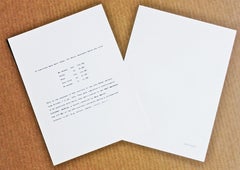
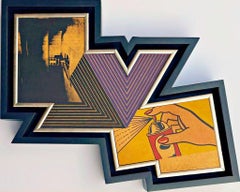
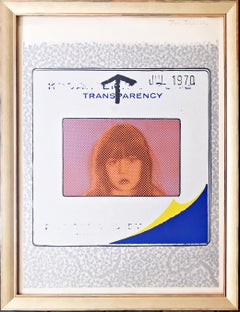
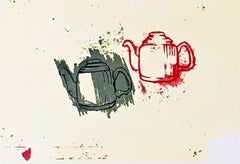
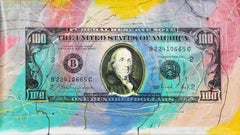
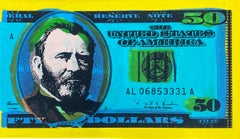
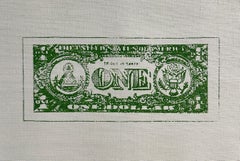
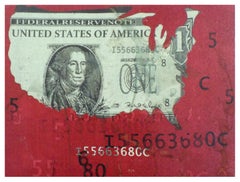
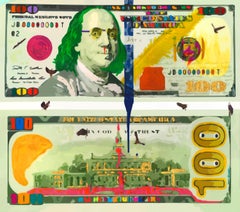
One Hundred and Eight Inflated Dollars, from the Collection of Ileana Sonnabend and the Estate of Nina Castelli, 1973
Lithograph on rag paper. Signed. Numbered. in original portfolio sleeve of rare Cranes No. 1 paper
Signed and numbered in graphite pencil recto. Printed text verso states "Copyright 1973 by Oyvind Fahlstrom Printed at Styria Studios"
12 × 9 inches
Unframed
Historic provenance! From the collection of legendary art dealer Ileana Sonnabend - wife of Leo Castelli. Rarely to market, this classic Oyvind Fahlstrom screenprint and lithograph on rag paper, was created in 1973 for the legendary "New York for Stockholm" portfolio. Other editions of this print are in the permanent collections of many major museums and public institutions worldwide, which is why they're not often to market, including the Metropolitan Museum of Art, the Museum of Modern Art, the Smithsonian American Art Museum, Moderna Museet, the Walker Art Center, the Los Angeles County Museum of Art, the Dayton Art Institute, the Frost Art Museum,the Herbert F. Johnson Museum of Art, the San Diego Museum of Art, the Princeton University Art Museum, the Pierpoint Morgan Library, and the Albertina Museum, the Kempner Art Museum - to name only a few. Mint condition; never framed. Comes in the original portfolio sleeve of Cranes Bond extra No. 1. This is the first time it will be removed from the original mahogany portfolio box which housed the entire portfolio in the Sonnabend/Castelli collection. Many works from this portfolio are already in the permanent collections of most major museums and public institutions worldwide. Very rare, especially in such fine/original condition with this impressive provenance.
In 1999, the University of Illinois organized a traveling exhibition of Fahlstrom's Graphic works, accompanied by a catalogue.
Öyvind Fahlström Biography from the exhibition:
Born in São Paolo, Brazil in 1938 of a Norwegian father and Swedish mother, Öyvind Fahlström led a peripatetic life that included years in Sweden, Italy, France, and New York. During the summer of 1939 he traveled to Sweden to visit his grandmother and was stranded by the outbreak of World War II. He attended school there until his parents returned to Stockholm in 1948. Fahlström received his degree in art history and archeology from the University of Stockholm in 1952. After receiving a grant from the Swedish-American Foundation he moved to New York in 1961, where he became immediately involved with a group of artists, including Robert Rauschenberg, Jasper Johns, and Robert Morris. Fahlström died in Stockholm in 1976.
Öyvind Fahlström was a visual artist, concrete poet, journalist, playwright, critic, filmmaker, and activist. Inspired by an eclectic range of sources, including the Surrealists, pre-Columbian manuscripts, modern Mexican art, John Cage, jazz, and underground comic artists like Crumb, Fahlström utilized diverse media, producing works in film, performance, installation, sculpture, prints, and painting. Though often classified as Pop because of his use of popular imagery, the political narratives in Fahlström’s work align him more with the ambitions of the Conceptual artists. A multi-media artist, Fahlström made use of many forms of distribution, including exhibitions, books, poetry, magazines, film, opera, television, and radio. He worked in the fields of painting, graphics, sculpture, film, comics, happenings, and radio theater. He mixed all of these areas as well as creating forms of his own.
Fahlström’s main interest was in the political implications of contemporary art. Fahlström believed in art as a force for changing consciousness and the world. His works are at once political fantasies and the result of meticulous research. He scrupulously followed economic and socio-political developments around the world, responding to ever-shifting global situations. Central to his work is a synthesis of psychodrama, truth of history, game theory, maps, puzzles, performance, and installations. His interests in language, journalism, and game-playing provided a foundation for artworks which typically invite viewer participation and incorporate variable possibilities for resolution. The works ’ visual and textual openness helps them to avoid a stern didacticism. They are poetic as well as critical.
Fahlström discussed his process in “Sausages and Tweezers – A Running Commentary” (1966):
“My basic interpretation of the concept of a game – and my artistic use of it – is not evolved from the strategy theories of von Neumann, Hermann Kahn, etc. I am more inclined to refer to Cage’s method of composition, and psychologists such as T. Leary and E. Berne. But above all, the idea of a game for me is a simple, fundamental out look on life, dating back to the time of my Concrete Manifesto (1953).”
Öyvind Fahlström was greatly under-recognized during his lifetime; however, critical interest in his work has recently exploded on the international and national scene, as demonstrated by the current retrospectives and catalogues in progress in Europe and his selection for inclusion in Documenta X, the world’s most prestigious art exposition (1997). Fahlström is viewed by many to be a progenitor of Pop Art, Installation Art and genres of political art. His work, critically received as avant·garde and socially responsible, has influenced generations of younger artists.
This exhibition traveled to six other educational institutions: the Haggerty Museum of Art (Marquette University), Selby Galleries (Ringling School of Art and Design), Gibson Art Galleries (State University of New York), The Mesaros Galleries (University of West Virginia), Herron Gallery (University of Indiana – Purdue), and Arizona State University Art Museum.
The exhibition was accompanied by 20-page, black-and-white and color catalog
Publisher
Experiments in Art & Technology, publisher; Styria Studio printer
Exhibition history
Leo Castelli exhibition of New York for Stockholm Portfolio to benefit Moderna Museet
Other editions:
Walker Art Center Leo Castelli Gallery Brooklyn Museum Pop Impressions Europe/USA, Museum of Modern Art and dozens of other venues
Provenance
Collection of Ileana Sonabend (wife of legendary dealer Leo Castelli, and pioneering art dealer in her own right) and the Estate of their daughter Nina Castelli Sundell.
(Wood portfolio box shown as proof of provenance but not included)