1 of 7

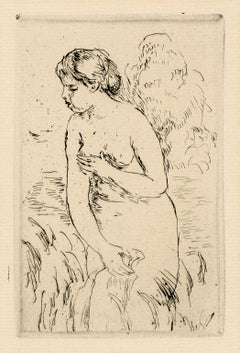
Pierre-Auguste Renoir, The Bathers, 1951 (after)

1951

$716
$89520% Off
£539.70
£676.7020% Off
€631.25
€792.2720% Off
CA$1,013.43
CA$1,273.3620% Off
A$1,031.82
A$1,295.2420% Off
CHF 594.23
CHF 743.3420% Off
MX$12,432.60
MX$15,570.3420% Off
NOK 6,896.12
NOK 8,67120% Off
SEK 6,957.76
SEK 8,752.6320% Off
DKK 4,718.31
DKK 5,922.9720% Off

Follow Pierre-Auguste Renoir Prints and Multiples to receive alerts when new items arrive

About the Item

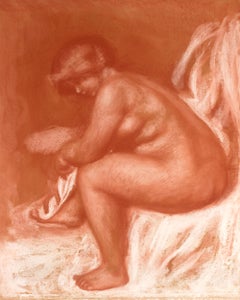
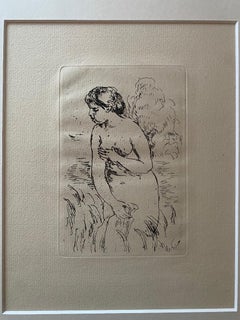
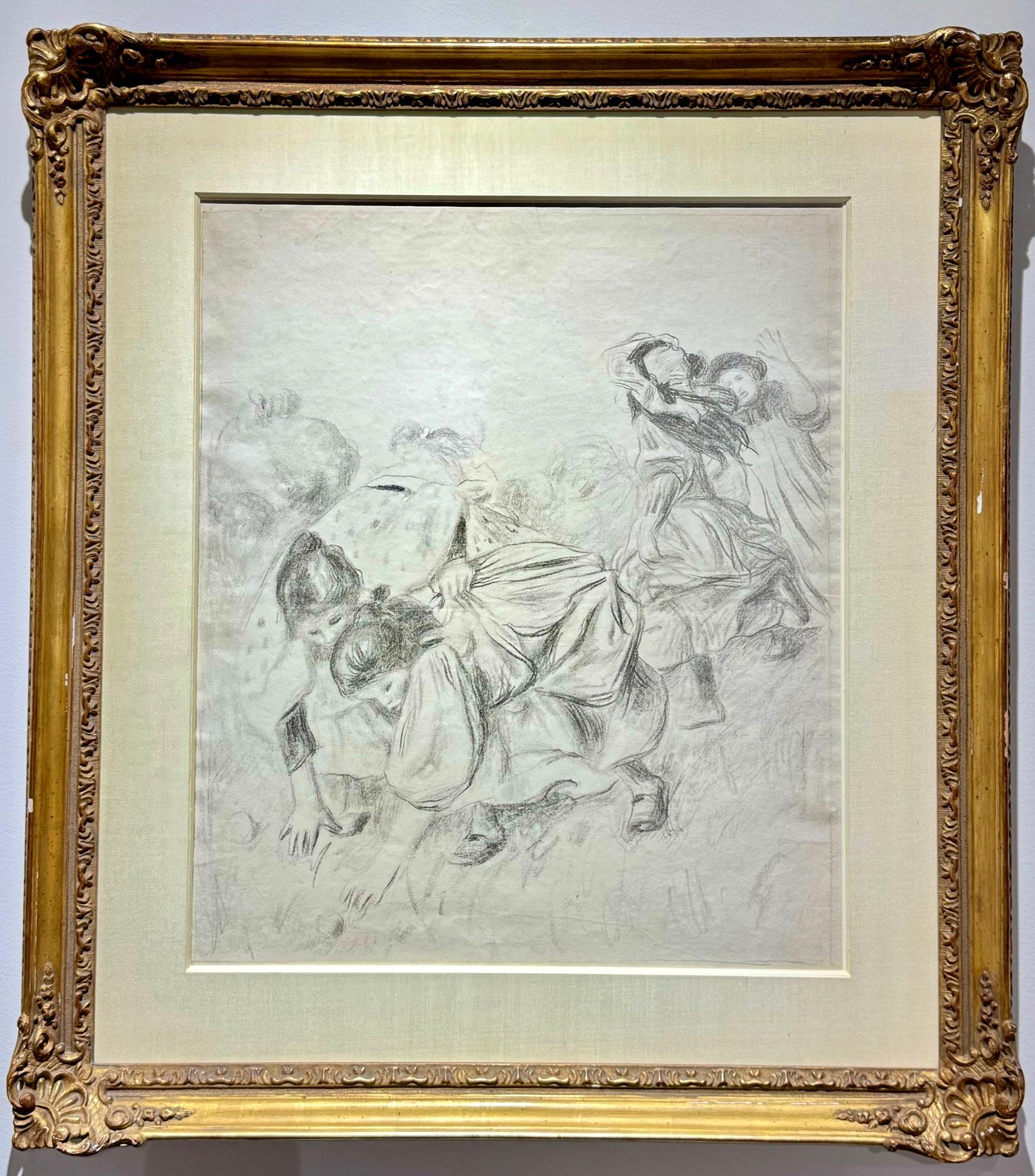
This exquisite lithograph after Pierre-Auguste Renoir (1841–1919), titled Les Baigneuses (The Bathers), from the album Les Lithographies de Renoir (The Lithographs of Renoir), originates from the 1951 edition published by Editions du livre, Monte-Carlo, under the direction of Andre Sauret, Monte-Carlo, in collaboration with Fernand Mourlot, Paris; rendered by Georges Duval, maître imprimeur, Paris; and printed by Mourlot Freres, Paris, March 25, 1951. Les Baigneuses embodies Renoir’s lifelong fascination with the female nude, harmonizing sensual form, natural light, and vibrant color into a celebration of beauty and vitality that became central to his artistic vision. Executed as a lithograph on grand velin Renage filigrane a la marque de l'editeur paper, this work measures 12.5 x 9.5 inches overall; 7.08 x 9.05 inches image. Unsigned and unnumbered as issued. The edition exemplifies the refined craftsmanship of Mourlot Freres and Georges Duval, and the exceptional production standards of Editions du livre, Monte-Carlo. Artwork Details: Artist: After Pierre-Auguste Renoir (1841–1919) Title: Les Baigneuses (The Bathers), from the album Les Lithographies de Renoir (The Lithographs of Renoir) Medium: Lithograph on grand velin Renage filigrane a la marque de l'editeur paper Dimensions: 12.5 x 9.5 inches overall; 7.08 x 9.05 inches image (31.75 x 24.1 cm overall; 18 x 23 cm image) Inscription: Unsigned and unnumbered as issued Date: 1951 Publisher: Editions du livre, Monte-Carlo, under the direction of Andre Sauret, Monte-Carlo, in collaboration with Fernand Mourlot, Paris Printer: Mourlot Freres, Paris; rendered by Georges Duval, maitre imprimeur, Paris Condition: Well preserved, consistent with age and medium Provenance: From the album Les Lithographies de Renoir (The Lithographs of Renoir), published by Editions du livre, Monte-Carlo, 1951 Notes: Excerpted from the album, This album, produced by Andre Sauret and Fernand Mourlot, has been printed in MMM examples on grand velin Renage filigrane with the publisher's brand. It has been completed to print, March 25, 1951 on the presses of Mourlot Freres and Georges Duval, maitre imprimeur, in Paris. The typography is from L'Imprimerie Union. About the Publication: Les Lithographies de Renoir (The Lithographs of Renoir), published in Monte-Carlo in 1951 under the direction of Andre Sauret in collaboration with Fernand Mourlot, stands among the most elegant postwar tributes to Pierre-Auguste Renoir’s artistic legacy. Conceived as part of the distinguished series of fine art albums issued by Editions du livre, the publication united leading masters of lithography to honor Renoir’s enduring influence on modern art. Printed on grand velin Renage filigrane a la marque de l'editeur by the ateliers of Mourlot Freres and Georges Duval, the album combined technical precision with scholarly presentation, showcasing interpretive plates rendered with exceptional fidelity and tonal refinement. It embodies the collaborative spirit between printer, publisher, and artist that characterized the golden age of French art editions, joining other monumental projects such as those devoted to Matisse, Chagall, Braque, and Picasso. A hallmark of twentieth-century art publishing, Les Lithographies de Renoir preserves the warmth and radiance of Renoir’s aesthetic through the masterful lithographic techniques that made Mourlot Freres synonymous with excellence in fine art printing. About the Artist: Pierre-Auguste Renoir (1841–1919) was one of the most influential and beloved artists in the history of modern art, a French Impressionist master whose radiant color harmonies, sensual brushwork, and joyful depictions of life helped transform the course of painting. Born in Limoges, France, into a modest family, Renoir began his career as a porcelain painter before studying at the Ecole des Beaux-Arts in Paris and joining the avant-garde circle of Claude Monet, Alfred Sisley, and Frederic Bazille. Together they pioneered plein-air painting, capturing fleeting light and atmosphere with revolutionary immediacy. Renoir’s early works, such as La Loge (1874) and Bal du moulin de la Galette (1876), embody the luminous vitality of Impressionism, while his later period, influenced by the classical mastery of Raphael, Ingres, and Rubens, brought greater structure and sensuality to his figures. His art evolved into a vision of timeless beauty expressed through color, form, and emotion, celebrating humanity and intimacy with unmatched tenderness. Even when afflicted by severe rheumatoid arthritis, Renoir continued to paint daily, his hands bound with cloth, and collaborated with sculptor Richard Guino to translate his soft, fluid touch into bronze. His influence radiated across generations—Pablo Picasso, Alexander Calder, Alberto Giacometti, Salvador Dali, Joan Miro, Wassily Kandinsky, Marcel Duchamp, and Man Ray all drew inspiration from his dedication to expressive color and emotional depth. His sensual palette profoundly impacted Henri Matisse, Pierre Bonnard, Raoul Dufy, and Andre Derain, while later artists such as Marc Chagall and Balthus inherited his lyrical humanism and poetic approach to beauty. Renoir’s art, often described as a hymn to joy, found universality in its warmth, intimacy, and reverence for life’s everyday grace. Today, his works hang in major museums worldwide, including the Musee d’Orsay, the Louvre, the National Gallery, the Metropolitan Museum of Art, and the Art Institute of Chicago, continuing to inspire collectors and artists alike. The highest auction record for Pierre-Auguste Renoir was achieved with Bal du moulin de la Galette (1876), which sold for $78.1 million USD at Sotheby’s, New York, on May 17, 1990, securing his enduring legacy as one of the greatest masters of Impressionism and one of the most cherished figures in art history. Pierre-Auguste Renoir Les Baigneuses The Bathers Les Lithographies de Renoir The Lithographs of Renoir Editions du livre Monte-Carlo 1951 lithograph Impressionism.
  • Creation Year:
    1951
  • Dimensions:
    Height: 12.5 in (31.75 cm)Width: 9.5 in (24.13 cm)
  • Medium:
  • Movement & Style:
  • After:
    Pierre-Auguste Renoir (1841-1919, French)
  • Period:
  • Condition:
  • Gallery Location:
    Southampton, NY
  • Reference Number:
    1stDibs: LU1465216799892

You May Also Like

Baigneuse Debout, à Mi-Jambes — French Impressionism

Baigneuse Debout, à Mi-Jambes — French Impressionism

By Pierre-Auguste Renoir

Located in Myrtle Beach, SC

Pierre Auguste Renoir, 'Baigneuse Debout, à Mi-Jambes (Woman Bathing, Standing Up to Her Knees in Water)', 1910, etching, edition not stated, Delteil 23. Unsigned as published. A fin...

Category

1910s Impressionist Nude Prints

Materials

Etching

'Baigneuse Debout, à Mi-Jambes' — French Impressionism

'Baigneuse Debout, à Mi-Jambes' — French Impressionism

By Pierre-Auguste Renoir

Located in Myrtle Beach, SC

Pierre Auguste Renoir, 'Baigneuse Debout, à Mi-Jambes (Woman Bathing, Standing Up to Her Knees in Water)', 1910, etching, edition not stated, Delteil 23. Unsigned as published. A fin...

Category

1910s Impressionist Nude Prints

Materials

Etching

Baigneuse debout à mi-jambes

Baigneuse debout à mi-jambes

By Pierre Auguste Renoir

Located in Santa Monica, CA

PIERRE-AUGUSTE RENOIR (French, 1841 - 1919) BAIGNEUSE DEBOUT A MI JAMBES (D., S. 23) Etching, 1910, a later impression on laid paper, the only state. Full margins with deckle edge...

Category

1910s Impressionist Figurative Prints

Materials

Etching

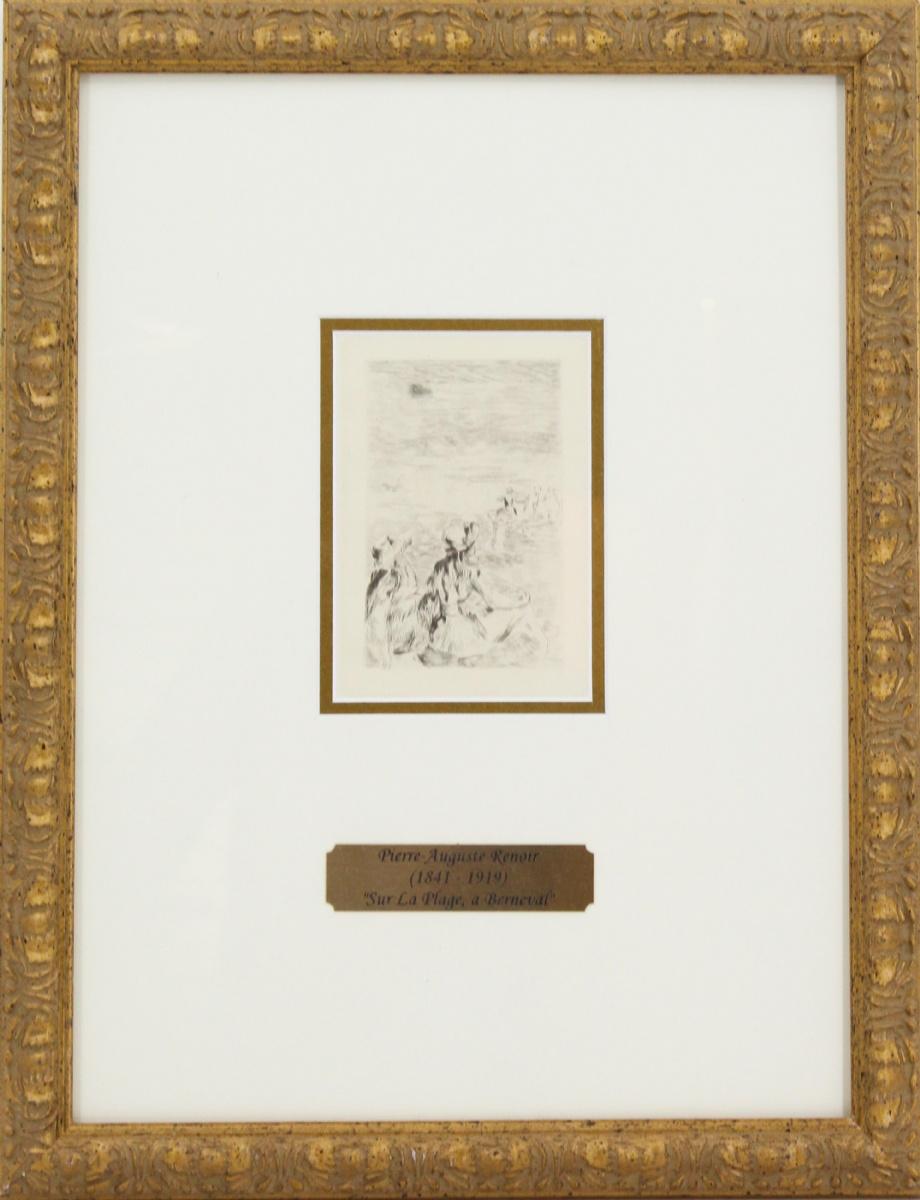
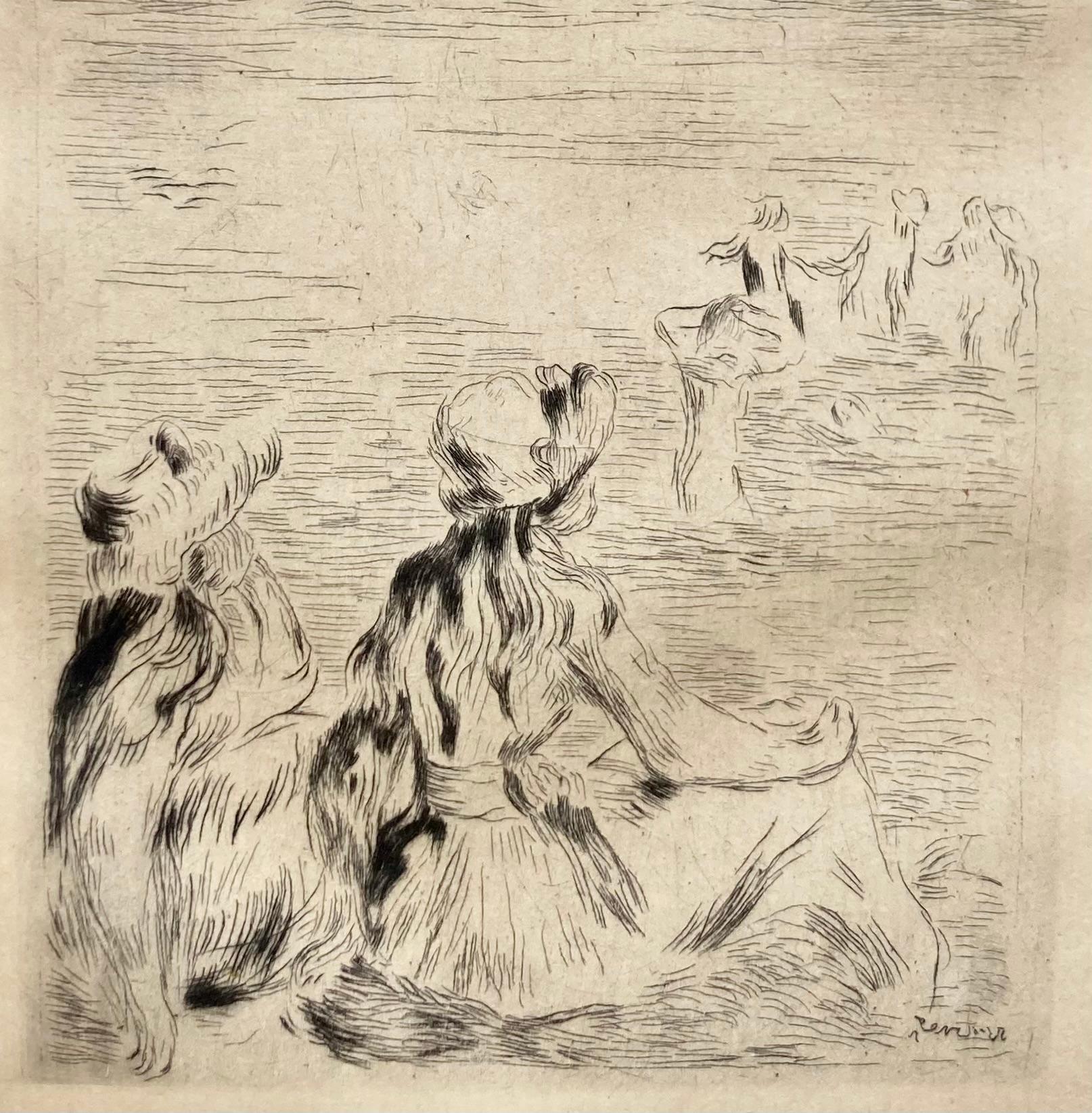
SUR LA PLAGE, a BERNEVAL

SUR LA PLAGE, a BERNEVAL

By Auguste Renoir

Located in Santa Monica, CA

PIERRE-AUGUSTE RENOR (1841 - 1919) SUR LA PLAGE, a BERNEVAL (D.: S. 5) Drypoint on laid paper. The plate was created in c. 1892. Plate 5 3/8 x 3 3/4". Sheet 11 1/4 x 10 1/8". This...

Category

1890s Impressionist Figurative Prints

Materials

Etching

Après le bain (After the bath)

Après le bain (After the bath)

By Pierre Auguste Renoir

Located in New Orleans, LA

For Pierre-Auguste Renoir, Impressionism's pre-eminent figure painter, depicting the nude was an exercise in bringing the canvas to life. He once said, “I look at a nude, I see myriads of minuscule shades. I have to find those which will make the flesh on my canvas come to life and resonate.” This compelling portrait by Renoir entitled Après le bain presents the nude figure of a woman in a serene, private moment, absorbed in the task of drying herself after a bath. The artist’s mastery of light and shading is incredible, achieving a sense of vitality in this otherwise ordinary scene. Renoir is celebrated for his figural work, especially his Rubenesque female nudes, however, it was not until the artist was in his forties that he depicted the nude with any frequency. In 1881, Renoir traveled to Italy, where he studied the works of the Renaissance masters and the ancient art of Pompeii and Rome. Upon his return to France, the nude became his favored subject, and he used the motif to combine the spontaneity of Impressionism with the solid modeling of classical painting. Renoir’s medium here, sanguine, a reddish-brown chalk, was used extensively in the Renaissance by Leonardo (who employed it in his sketches for the Last Supper), Michelangelo and Raphael. Its warm hue lends itself well to depicting flesh, and the chalk drawing allows for a greater focus on line, form and texture in a departure from the aspects of color and light that so often preoccupied the Impressionists. Après le bain conveys the impression of arrested motion with perfect naturalness, deftly capturing the moment before the elegant lines of the sitter's form change position. The sitter is almost certainly Gabrielle Renard, the nanny to Renoir’s children and a frequent model for the artist. Gabrielle was the cousin of Renoir’s wife, Aline, and came to Montmartre to work for the family at the age of 16. She developed a strong bond with the family and became a favorite subject for Renoir, appearing in several of his most important works, including his 1911 Gabrielle with a Rose (Musée d'Orsay). When Renoir began to suffer from severe rheumatoid arthritis that would eventually leave him unable to walk and scarcely able to grasp a paintbrush, it was Gabrielle that would assist the artist by positioning the paintbrush between his crippled fingers. Born in Limoges, France in 1841, Renoir began his career as an apprentice to a painter of porcelain wares. He later moved to Paris at the age of 21, enrolling at the prestigious École des Beaux-Arts. It was here, while studying under Charles Gleyre, that Renoir attained a tremendous appreciation for the academic style of painting, a quality that would last throughout his career. This was also when he met Claude Monet and several other classmates, with whom he would later form the Impressionists. Working closely with Monet, Renoir began experimenting with the portrayal of light and its effect on his canvases. The youngest member of the Impressionist movement, an astute Renoir recognized how a subject was constantly changing due to the dynamic effects of light on color. Relying heavily upon his academic training that focused on composition, lines and descriptive details, Renoir distinguished himself among his contemporaries. His intuitive use of color and expansive brushstroke, along with acute attention to his subject, have placed him among the finest painters in history. This work is accompanied by a certificate of authenticity and will be included in the forthcoming catalogue raisonné of the work of Pierre-Auguste Renoir from the Wildenstein Plattner Institute. Circa 1898 Canvas: 43 1/2" high x 35 1/2" wide Frame: 57 3/4" high x 49 1/4" wide Provenance: Galerie Durand-Ruel, Paris (acquired from the artist on January 25, 1899) J. Pereire Collection, France (1966) Sam Salz, New York (before 1981) Claus Virch, Paris French Compagny, Inc., New York Larry Silverstein, New York (circa January 1987) Le Clos de Sierne Gallery, Geneva Galerie Heyram, Paris (October 1987) Francis Gross M.S. Rau, New Orleans Literature: B. Schneider, Renoir, Berlin, 1957, p. 95 (illustrated in color, p. 83) M. Gauthier, Renoir, Paris, 1958, p. 83 (illustrated in color; erroneously dated '1916' and titled 'Woman in her toilet') F. Fosca, Renoir, L'homme et son obra, Paris, 1961, p. 280 (illustrated, p. 95; erroneously dated 'about 1890' and titled 'After the Bath...

Category

19th Century Impressionist Nude Paintings

Materials

Canvas, Paper, Chalk