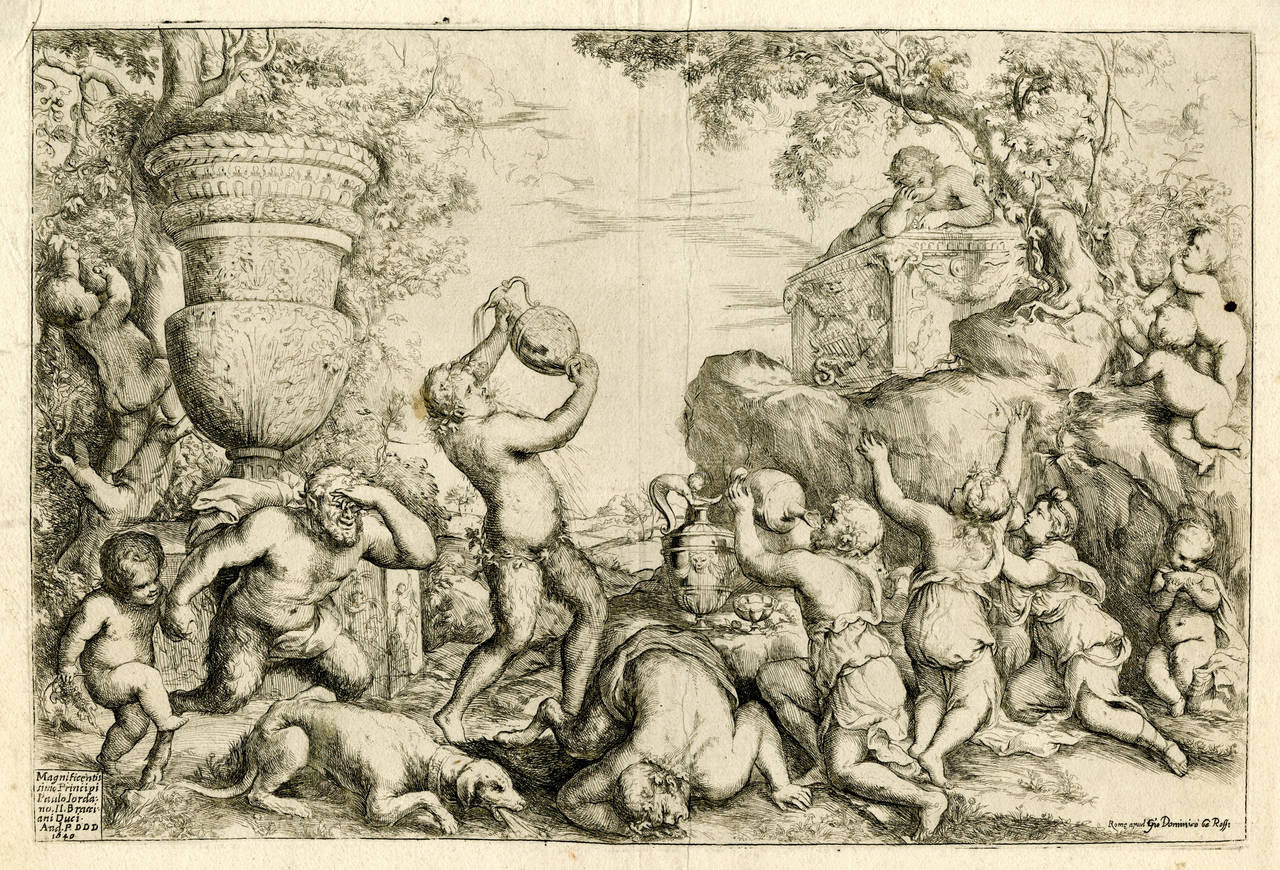
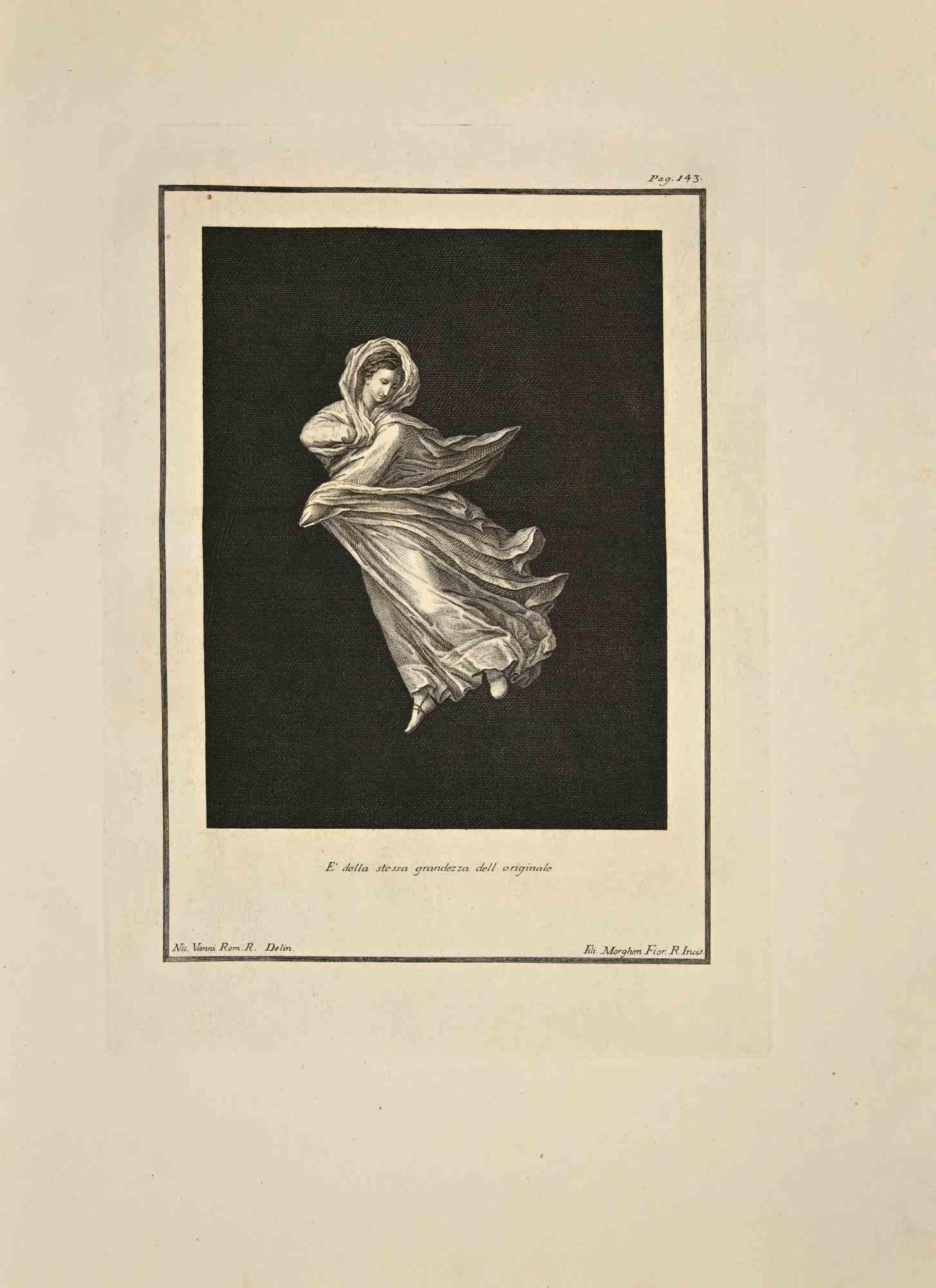
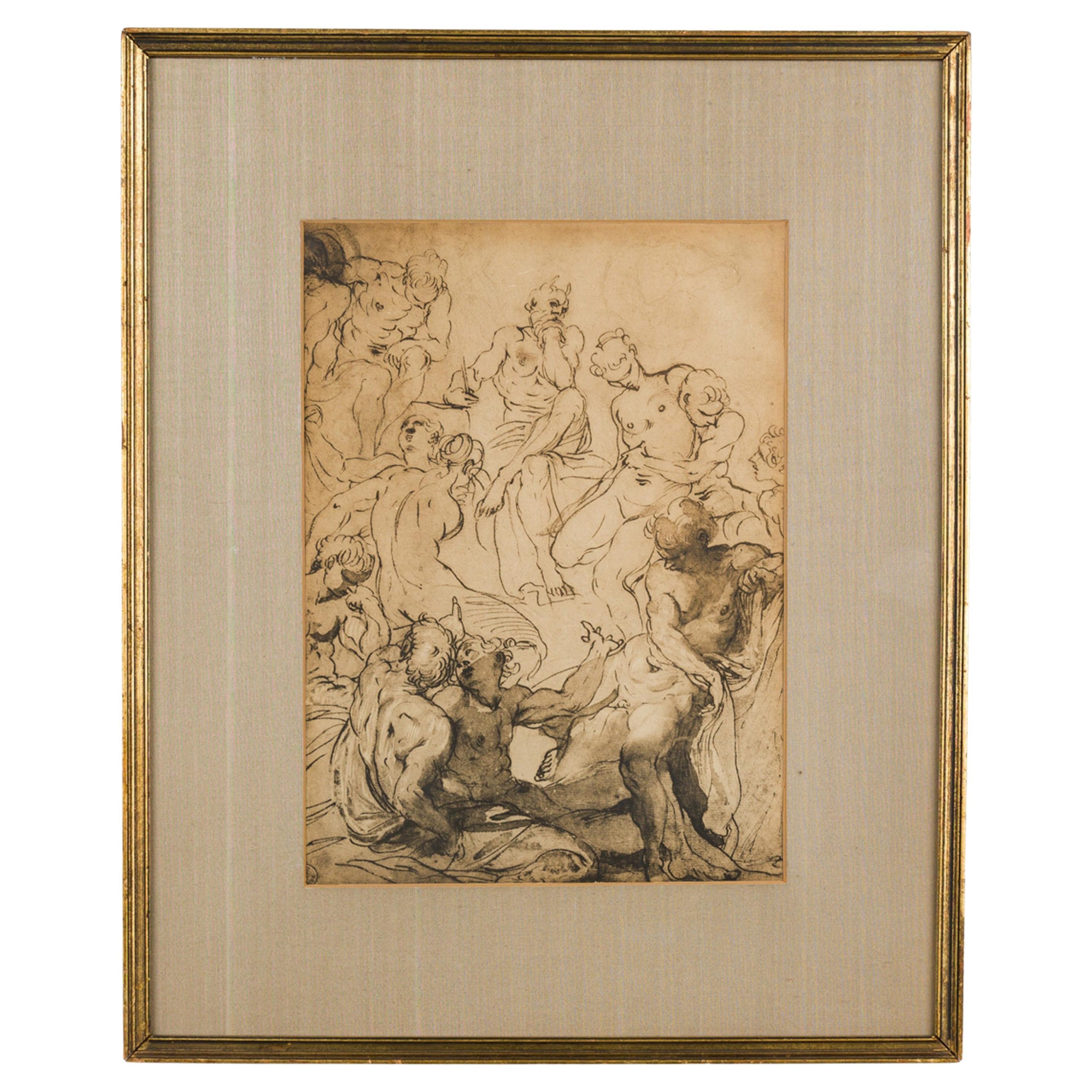
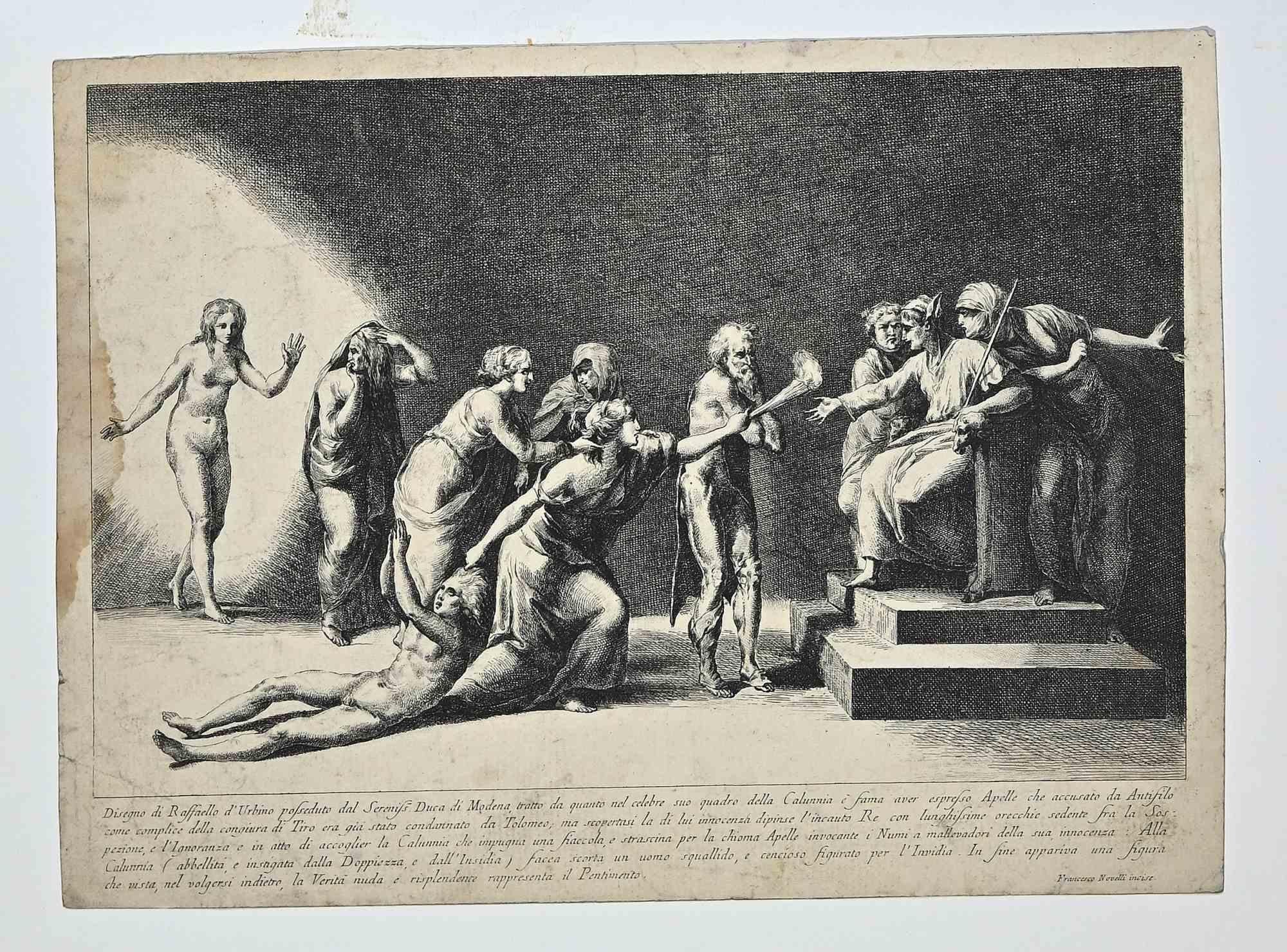
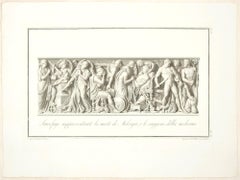
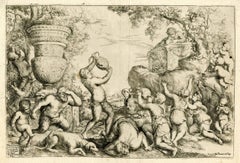
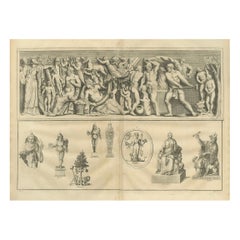
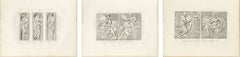
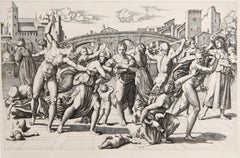
“Baccanale con Bacco, Sileno, Fauni, e Menadi” is a beautiful black and white burin and etching on paper, realized by the Italian artist Pietro Fontana (Bassano Romano,1762 – Rome, 1837), after Agostino Tofanelli (Lucca 1770 - Rome 1834), as the inscriptions on plates on lower margins report “Agostino Tofanelli del../ Pietro Fontana inc. Roma”.
This original print is numbered on plate in Roman numerals on right margin: “Tom II. /Tav. XI" and is a plate from the series "Illustrazioni de'Monumenti scelti Borghesiani già esistenti nella Villa sul Pincio (..)date ora per la prima volta in luce dal cav. Gio. Gherardo De Rossi e da Stefano Piale sotto la guida di Vincenzo Feoli", by Ennio Quirino Visconti, published by Stamperia de Romanis in Rome, 1821.
Original Title: Baccanale con Bacco, Sileno, Fauni, e Menadi, scolpiti attorno al gran vaso di marmo Pentelico
Translated Title: Bacchanal with Bacchus, Silenus, Fauns, and Maenads, carved around the large Pentelic marble vase
This old master’s original prints shows a precious piece of the Borghese's collection, a wonderful bacchanal with allegorical scenes.
In excellent conditions with some light signs of the time with some sporadic minor stains along the margins, this wonderful burin has preserved still today his fresh impression.
Illustrazioni de' Monumenti scelti Borghesiani
This collection in two volumes is a beautifully detailed catalog of classical sculptures collected by Prince Borghese (1730-1800) in his Villa on the Pincio. Ennio Quirino Visconti (1751 - 1818) wrote the texts that accompany the large branches depicting. To these writings, which were available by the son of the illustrious archaeologist, the publishers added only a few illustrations relating to some minor monument of which copper had already been engraved.
The engraved title-plate are signed by draughtsmen like Agostino Tofanelli, Stefano Tofanelli, Bernardino Nocchi, Domenico de Angelis or Teodoro Matteini, and by engravers Pietro Fontana Veneto, P. Vitali, Pietro Bettelini, Giovanni Folo Veneto, Giovanni Brunetti da Ravenna, Giovanni Ottaviani, Francesco Cecchini, Gio. Batta. Leonetti, Girolamo Carattoni, Domenico Cunego, Luigi Cunego, Alessandro Mochetti, Luigi Pizzi, Angelo Campanella or Giacomo Bossi.
The Volume I shows ancient full-length statues, of the Borghese warrior by Agasias (two plates), Greek gods and heroes and Roman famous historical figures; the last two plates represents antique Egyptian deities. There are plates representing ancient bas-reliefs, sarcophagi, of mythological subjects, the Borghese Vase, portrait busts, a vase on an altar, two statues of Amor; and two modern statues, by Bernini (the Apollo and Daphne, and the David).
«Très bel ouvrage» writes Brunet, «Grand ouvrage, le seul qui mérite, parmi ceux sur la villa Borgese, de figurer dans le chapitre aux Galeries et Collections» Vinet said, looking at this plate.
Pietro Fontana (Bassano Romano,1762 – Rome, 1837)
The Italian artist and engraver, Pietro Fontana was active in Rome and specialized in subjects dealing with the Vatican and the Papacy. He started his career as a student of Raffaello Morghen, and is best known for his complete series of engravings of the neoclassical sculptures of Canova. He became a member of the Accademia di San Luca.
Agostino Tofanelli (Lucca 1770 - Rome 1834)
Son of the engraver Andrea, Agostino Tofanelli studied with his father and his brother Stefano. In 1781 he settled in Rome to attend the courses of the Accademia del Nudo. Until the early years of the century it had a good name with a prestigious client as a draftsman and engraver; in 1807 he was appointed custodian of the Capitoline Museum, a position he held until his death. The first important assignments as a painter I saw in Rome in Palazzo Spada (1808) and in the renovation of the apartments of the Quirinale (Salon de Musique of the Empress, 1812). In 1813 he was appointed member of the Accademia di San Luca to follow the interventions in Palazzo Taverna , in the Palazzi Vaticani and in the chapel of the Quirinale. In Lucca, he was also commissioned by Maria Luisa di Borbone , for family portraits and works of biblical theme.