Want more images or videos?
Request additional images or videos from the seller
1 of 12

Rufino Tamayo
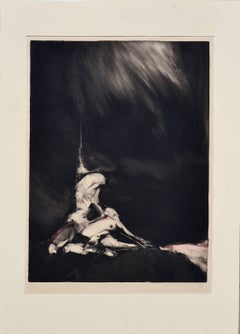
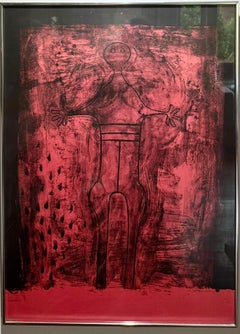
"Personaje en un Cueva" (Personage in a Cave) Surrealist Lithograph

1964

$4,560
$5,70020% Off
£3,436.42
£4,295.5320% Off
€4,015.54
€5,019.4220% Off
CA$6,470.98
CA$8,088.7320% Off
A$6,490.65
A$8,113.3120% Off
CHF 3,764.95
CHF 4,706.1820% Off
MX$79,230.87
MX$99,038.5820% Off
NOK 43,608.72
NOK 54,510.9020% Off
SEK 44,630.59
SEK 55,788.2420% Off
DKK 30,016.05
DKK 37,520.0720% Off

About the Item

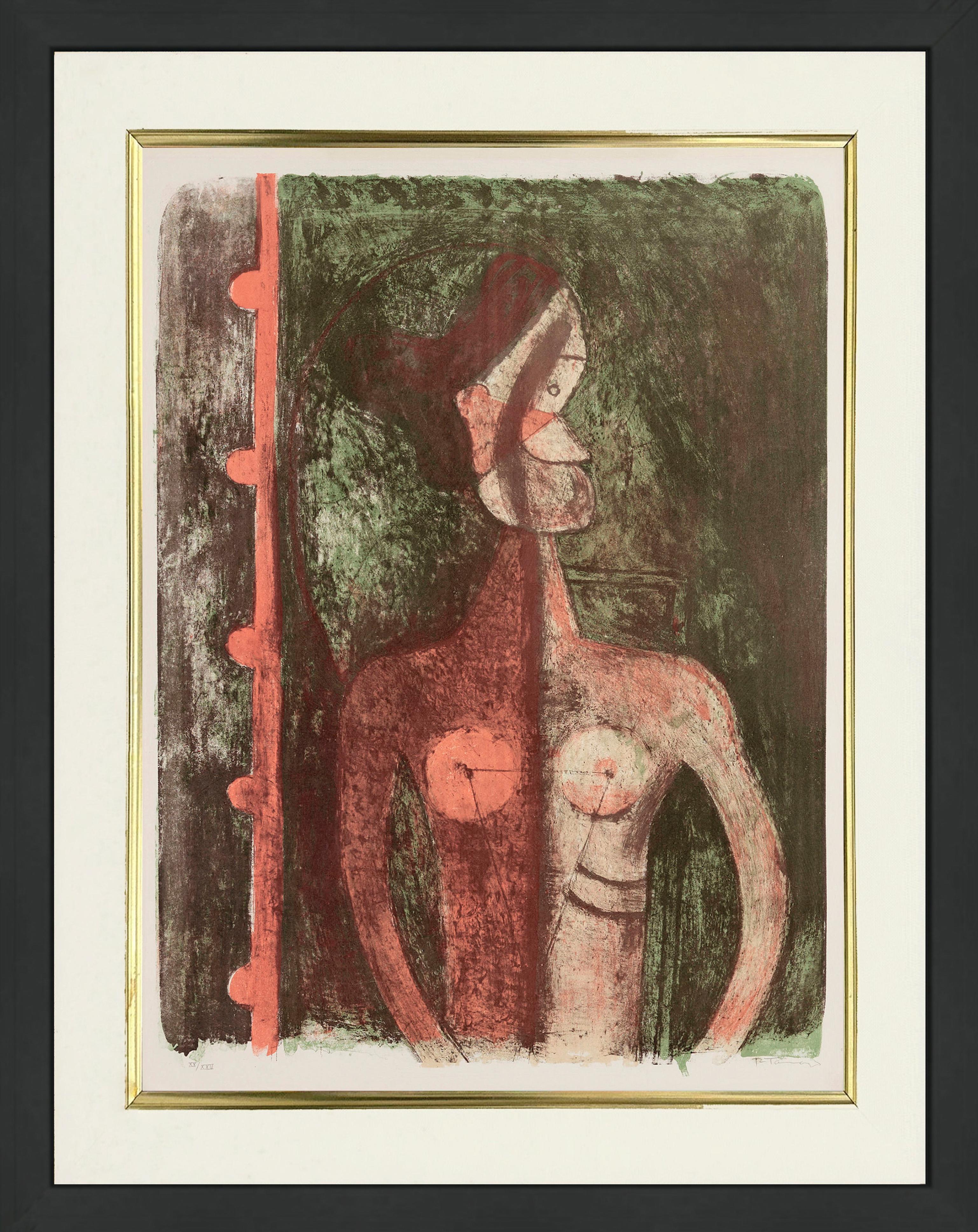
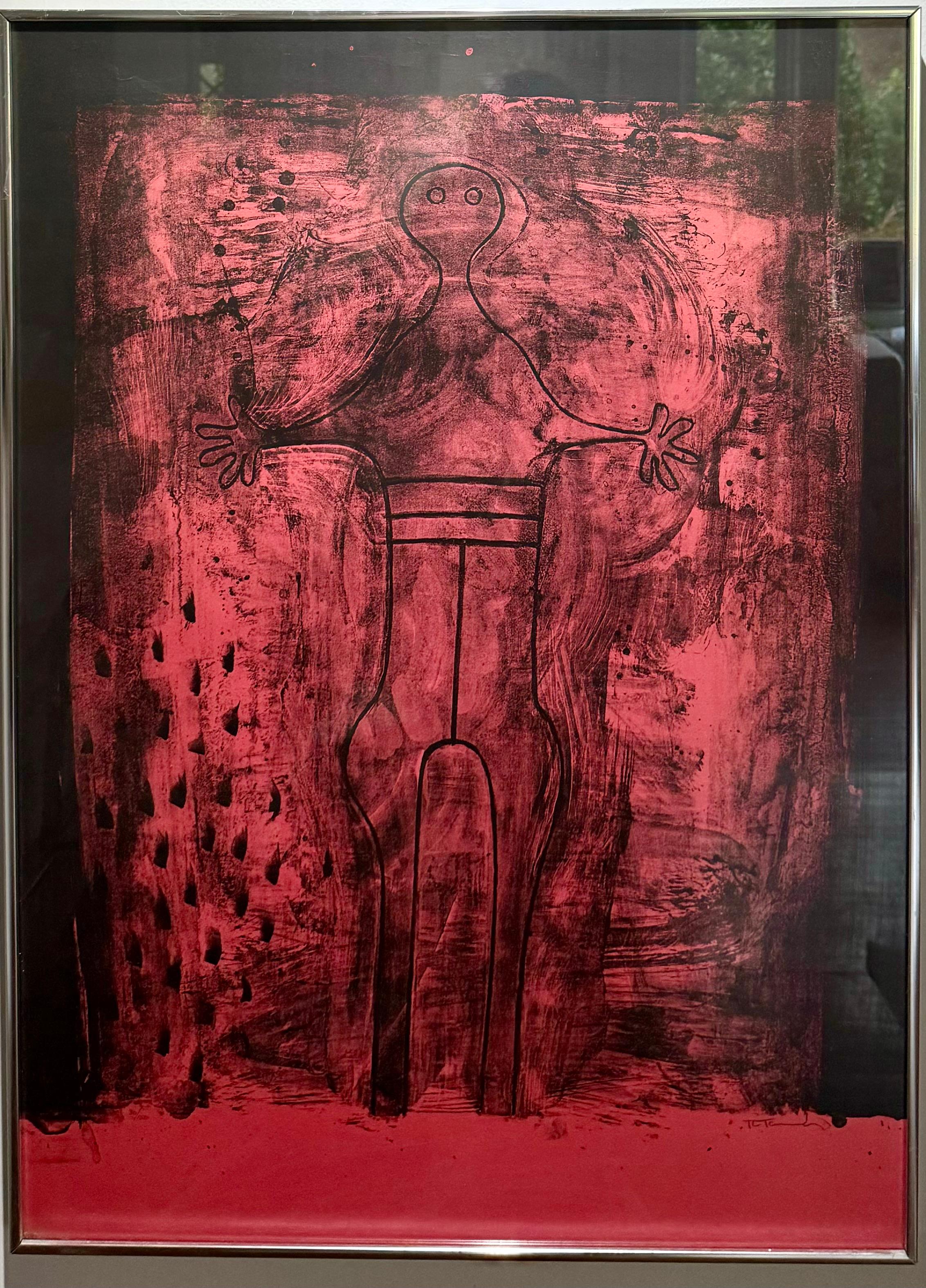
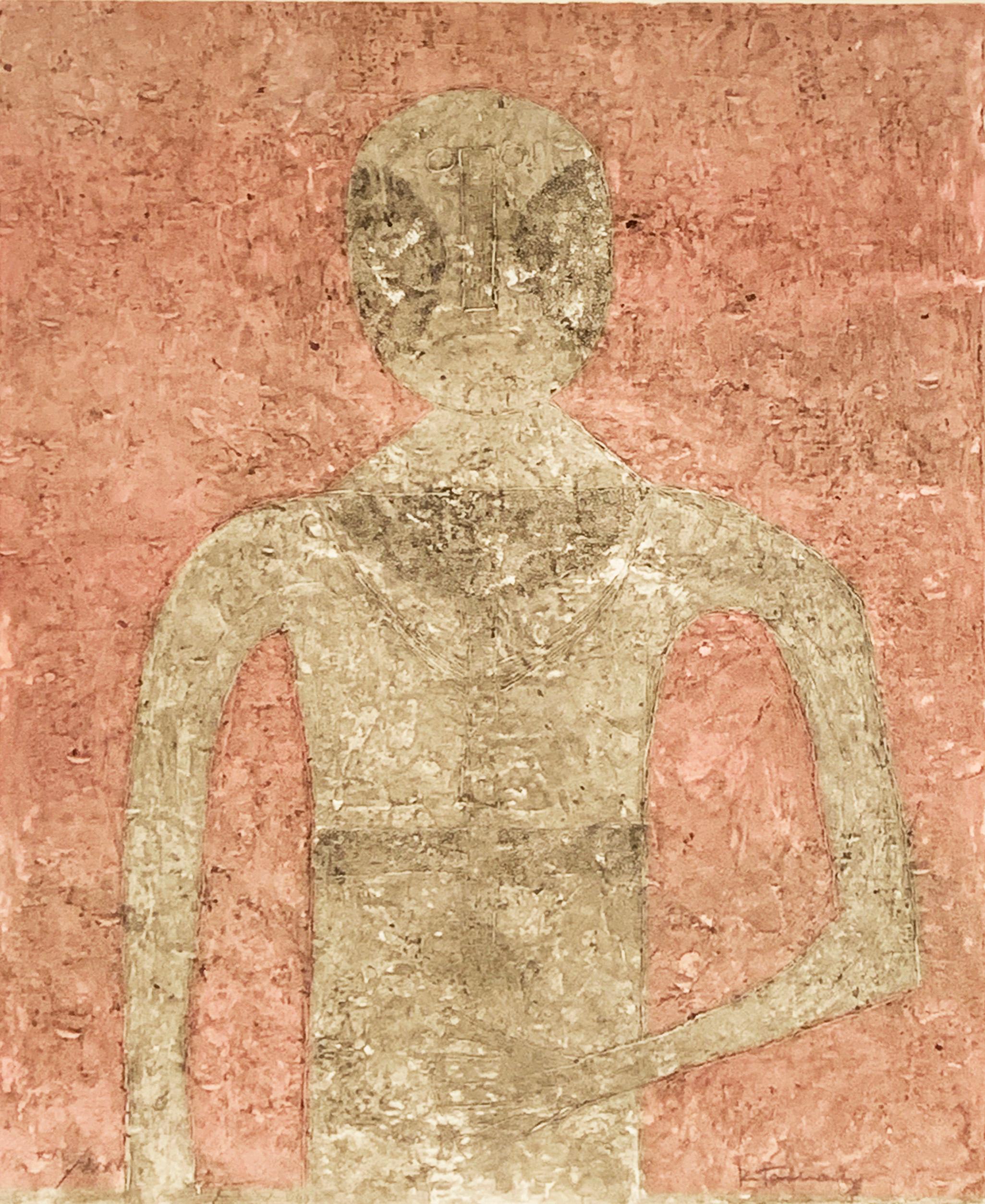
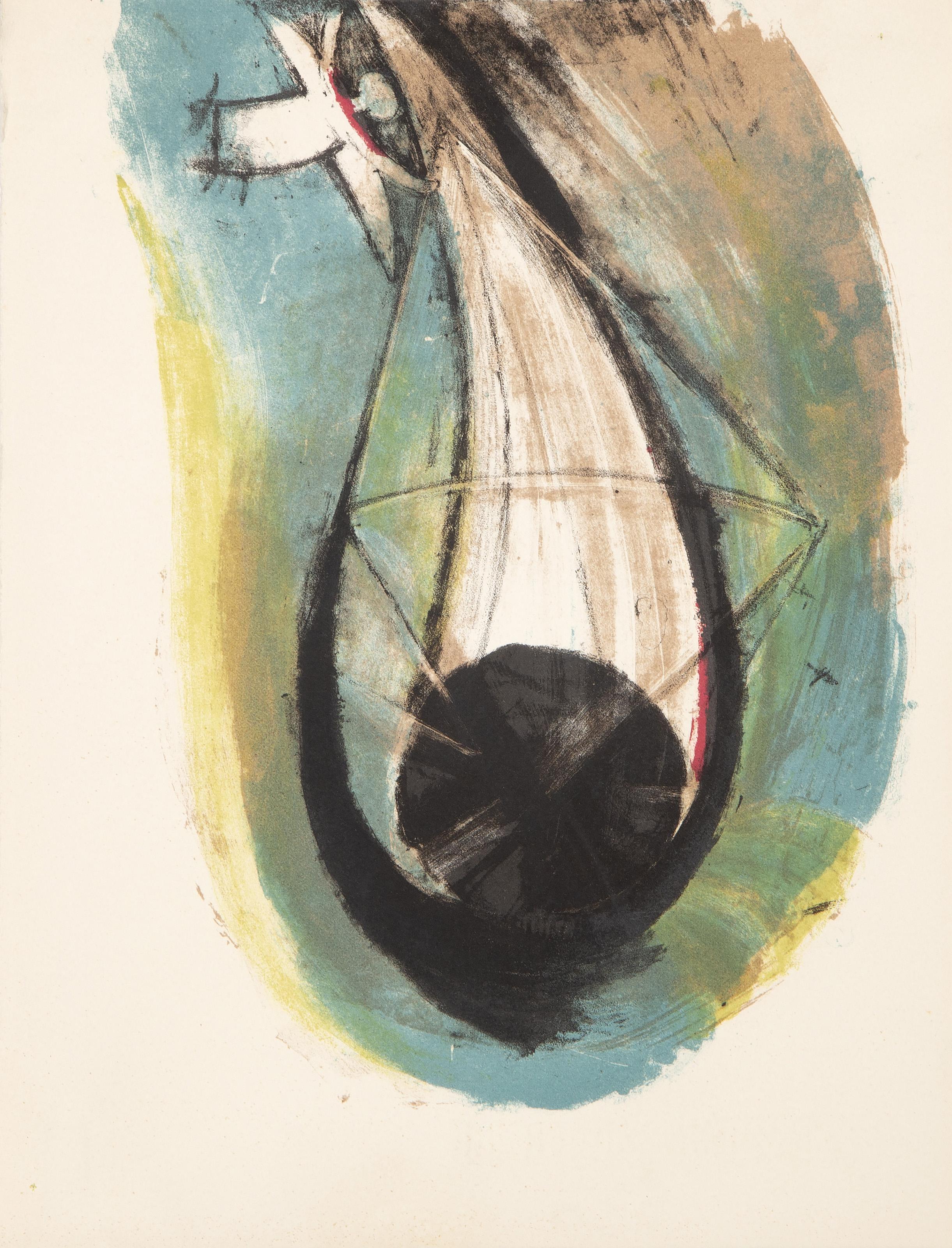
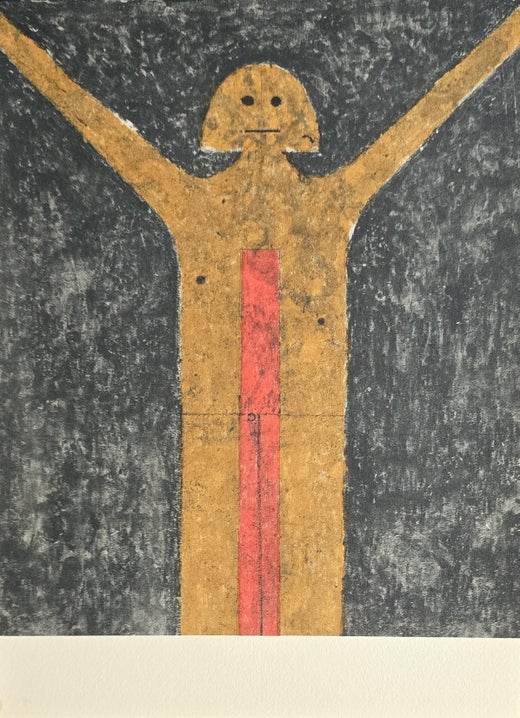
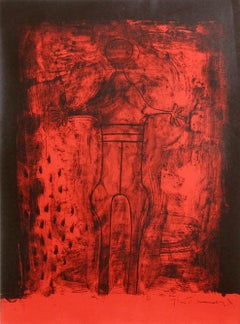
"Personaje en un Cueva" (Personage in a Cave) Surrealist Lithograph by Rufino Tamayo (b. 1899 d. 1991.) Abstract figurative lithograph featuring a textured background and bold figure. The figure is executed and dark black linework with some magenta coloring and cloaked in a deep teal outline. The figure stands to the left of the composition, creating an interesting imbalance. The background is dominated by warm orange tones and a continuation of the deep teal from the outline. Signed in bottom left "Tamayo '64" and numbered on right side "1/20 R Tamayo" Frame size: 43.75" H x 34.25" W Image size: 36" H x 26" W Paper size: 36" H x 26" W This print is the first from a limited run. Shows signs of fading in color, as other versions are much brighter and feature more red hues. Small black smudge to linen lower center minimalized. Rufino Tamayo was an Zapotec-Mexican painter primarily known for his figurative paintings which were heavily influenced by abstract expressionism and surrealism. Tamayo was born in Oaxaca de Juarez, Mexico in 1899. His father was a shoemaker and his mother worked as a seamstress. After his mother’s death when he was twelve years old, he moved to Mexico City and worked with his aunt at the city’s fruit markets. In 1917 he was enrolled by his aunt in Escuela Nacional de Artes Plasticas at San Carlos. He later studied at the Academy of Art at San Carlos. During his time as a student he was exposed to popular art movements such as cubism and fauvism. After leaving his studies he worked with Jose Vasconcelos at the Department of Ethnographic Drawings. During this time he began to cultivate his art style, aiming to create art he felt represented his Mexican roots and which was not heavily influenced by the politics at the time; as was the case for many of his contemporaries. Dissatisfied with his career in Mexico, Tamayo moved to New York City in 1926. In New York City, Tamayo continued to work and develop his style, most notably his graphic prints which employed lithography, woodblock, and etching, and were often dominated by bold but minimal color palettes. In 1959, he moved back to Mexico with his wife and continued to work there until his death in 1991. Tamayo enjoyed success and popularity during his lifetime, the Tamayo Contemporary Art Museum in Mexico City opened in 1981 and holds many of his paintings as well as others he and his wife collected throughout their lifetime. His work has been displayed across the world, including the Solomon R. Guggenheim Museum in New York City, the Naples Museum of Art, and the Museo Nacional Centro de Arte Reina Sofia in Madrid.
  • Creator:
    Rufino Tamayo (1899-1991, Mexican)
  • Creation Year:
    1964
  • Dimensions:
    Height: 43.75 in (111.13 cm)Width: 34.25 in (87 cm)Depth: 1.78 in (4.53 cm)
  • Medium:
  • Movement & Style:
  • Period:
  • Condition:
    Some discoloration and staining on the fabric of the frame. consistent with age. Paint chipping on frame has been repaired. Comes as is.
  • Gallery Location:
    Soquel, CA
  • Reference Number:
    Seller: JMA 96701stDibs: LU54215577522

More From This Seller

View All
1971 The Tarahumara Indians - Figurative Etching on Paper

1971 The Tarahumara Indians - Figurative Etching on Paper

Located in Soquel, CA

1971 The Tarahumara Indians - Figurative Etching on Paper Black and white etching of The Tarahumara Indians by Kelly English (American). The figures are outlined in thick black ink ...

Category

1970s Abstract Expressionist Figurative Prints

Materials

Paper, Ink

"cocoons?" - 1976 Surrealist Lithograph on Paper

"cocoons?" - 1976 Surrealist Lithograph on Paper

By Jim Crabb

Located in Soquel, CA

"cocoons?" - 1976 Surrealist Lithograph on Paper 1976 surrealist lithograph on paper titled "cocoons?" by Jim Crabb (American, b. 1947). This piece features a variety of lines and f...

Category

1970s Surrealist Figurative Prints

Materials

Laid Paper, Lithograph

Vintage Abstract Figurative Etching -- "Embrace"

Vintage Abstract Figurative Etching -- "Embrace"

By Patricia Way

Located in Soquel, CA

Vintage Abstract Figurative Etching - "Embrace" Vintage abstract figural "Embrace", a lithograph by Patricia Ann Way (American, 20th Century). Signed "Patricia Way" and dated "76"...

Category

1970s Abstract Expressionist Figurative Prints

Materials

Paper, Ink, Etching

"Machu Pichu" - Black and Grey Lithograph #10/200

"Machu Pichu" - Black and Grey Lithograph #10/200

By David Alfaro Siqueiros

Located in Soquel, CA

"Machu Pichu" - Black and Grey Lithograph #10/200 Bold black and grey lithograph by David Alfaro Sequeiros (Mexican, 1896-1974). This piece is a high contrast, abstracted landscape....

Category

1940s Contemporary Figurative Prints

Materials

Paper, Lithograph

"Woman In a Cage" - Original Woodcut Print on Paper

"Woman In a Cage" - Original Woodcut Print on Paper

By Louis Nadalini

Located in Soquel, CA

"Woman In a Cage" - Original Woodcut Print on Paper Original abstract expressionist woodcut print "Woman In a Cage" by Louis Nadalini (American, 1927-1995). Multicolor hues of deep ...

Category

20th Century Post-War Abstract Prints

Materials

Paper, Oil, Woodcut

"CONFIDENTIAL" Mono Print Figurative Expressionist by Victor Cartagena

"CONFIDENTIAL" Mono Print Figurative Expressionist by Victor Cartagena

By Victor Cartagena

Located in Soquel, CA

Salvadoran-born Victor Cartagena has been making art in the Bay Area since the late 80s. The work that he produced in the early to mid-1990’s battled with memories of the violence in...

Category

Early 2000s Minimalist Figurative Paintings

Materials

Rag Paper, Tissue Paper, India Ink

You May Also Like

Capitulo XXI, Surrealist Lithograph by Rufino Tamayo

Capitulo XXI, Surrealist Lithograph by Rufino Tamayo

By Rufino Tamayo

Located in Long Island City, NY

Rufino Tamayo, Mexican (1899 - 1991) - Capitulo XXI, Portfolio: Apocalypse de Saint Jean, Year: 1959, Medium: Lithograph on BFK Rives, Edition: 93/255, Size: 13 x 10 in. (33.02 x 25....

Category

1960s Surrealist Abstract Prints

Materials

Lithograph

Capitulo XI, Signed Surrealist Lithograph by Rufino Tamayo

Capitulo XI, Signed Surrealist Lithograph by Rufino Tamayo

By Rufino Tamayo

Located in Long Island City, NY

Rufino Tamayo was born in Oaxaca, Mexico. He studied at the Academia de Bellas Artes in Mexico City and worked there until 1936 when he moved to New York, where he taught at the Dalt...

Category

1950s Surrealist Abstract Prints

Materials

Lithograph

La Negra (The Black Woman)

La Negra (The Black Woman)

By Rufino Tamayo

Located in San Francisco, CA

This artwork titled "La Negra (The Black Woman)" from the suite "The Mujeres File" 1969 is an original colors lithograph on B.F.K. Rives paper by renown Mexican artist Rufino Tamayo, 1899-1991. It is hand signed and numbered 150/150 in pencil by the artist. The image size is 26.85 x 21.25 inches, sheet size is 29.5 x 22.15 inches, framed size is 42 x 35 inches. Published by Touchtone Publisher, New York, printed by Ateliers Desjobert, Paris. Referenced and pictured in the artist's catalogue raisonne by Pereda, plate #109 page 107. Custom framed in a wooden silver frame, with silver spacer and fabric matting. It is in excellent condition. About the artist: A native of Oaxaca in Southern Mexico, Rufino Tamayo's father was a shoemaker, and his mother a seamstress. Some accounts state that he was descended from Zapotec Indians, but he was actually 'mestizo' - of mixed indigenous/European ancestry. (Santa Barbara Museum of Art). He began painting at age 11. Orphaned at the age of 12, Tamayo moved to Mexico City, where he was raised by his maternal aunt who owned a wholesale fruit business. In 1917, he entered the San Carlos Academy of Fine Arts, but left soon after to pursue independent study. Four years later, Tamayo was appointed the head designer of the department of ethnographic drawings at the National Museum of Archaeology in Mexico City. There he was surrounded by pre-Colombian objects, an aesthetic inspiration that would play a pivotal role in his life. In his own work, Tamayo integrated the forms and tones of pre-Columbian ceramics into his early still lives and portraits of Mexican men and women. In the early 1920s he also taught art classes in Mexico City's public schools. Despite his involvement in Mexican history, he did not subscribe to the idea of art as nationalistic propaganda. Modern Mexican art at that time was dominated by 'The Three Great Ones' : Diego Rivera, Jose Clemente Orozco, and David Alfaro Siqueros, but Tamayo began to be noted as someone 'new' and different' for his blending of the aesthetics of post Revolutionary Mexico with the vanguard artists of Europe and the United States. After the Mexican Revolution, he focused on creating his own identity in his work, expressing what he thought was the traditional Mexico, and refusing to follow the political trends of his contemporary artists. This caused some to see him as a 'traitor' to the political cause, and he felt it difficult to freely express himself in his art. As a result, he decided to leave Mexico in 1926 and move to New York, along with his friend, the composer Carlos Chavez. The first exhibition of Tamayo's work in the United States was held at the Weyhe Gallery, New York, in that same year. The show was successful, and Tamayo was praised for his 'authentic' status as a Mexican of 'indigenous heritage', and for his internationally appealing Modernist aesthetic. (Santa Barbara Museum of Art). Throughout the late thirties and early forties New York's Valentine Gallery gave him shows. For nine years, beginning in 1938, he taught at the Dalton School in New York. In 1929, some health problems led him to return to Mexico for treatment. While there he took a series of teaching jobs. During this period he became romantically involved with the artist Maria Izquierdo...

Category

Mid-20th Century Modern Figurative Prints
Materials

Lithograph