Want more images or videos?
Request additional images or videos from the seller
1 of 5

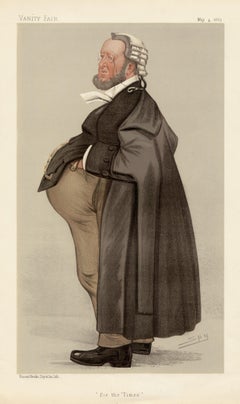
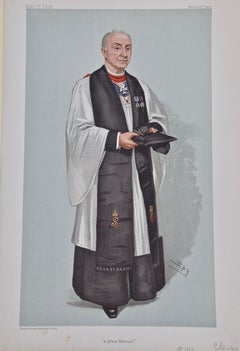
'The Speaker', Vanity Fair portrait of The Rt. Hon. Arthur Wellesley Peel

1887

$180
£135.71
€158.70
CA$254.77
A$285.29GST Included
CHF 149.36
MX$3,125.51
NOK 1,733.66
SEK 1,749.16
DKK 1,186.17

About the Item

'The Speaker' Chromolithograph, 1887. Vanity Fair portrait of The Rt. Hon. Arthur Wellesley Peel PC (1829 - 1912), who was a British Liberal politician who sat in the House of Commons from 1865 to 1895. He was Speaker of the House of Commons from 1884 until 1895 when he was raised to the peerage.Eldest son of Sir Robert Peel. Proof before lettering. 380mm by 265mm (sheet)
  • Creation Year:
    1887
  • Dimensions:
    Height: 14.97 in (38 cm)Width: 10.44 in (26.5 cm)
  • Medium:
  • Movement & Style:
  • After:
    Sir Leslie Ward
  • Period:
  • Condition:
  • Gallery Location:
    Melbourne, AU
  • Reference Number:
    1stDibs: LU1244215613782

More From This Seller

View All
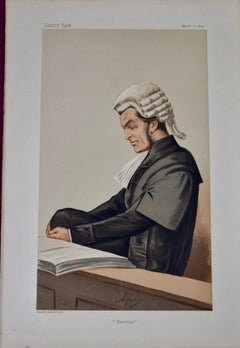
Hon. Mr Justice Swinfen Eady, Vanity Fair legal chromolithograph, 1902

Hon. Mr Justice Swinfen Eady, Vanity Fair legal chromolithograph, 1902

By Sir Leslie Ward

Located in Melbourne, Victoria

'Plausible' Vanity Fair legal portrait of The Hon. Mr Justice Swinfen Eady. Accompanied by original descriptive text pasted onto a separate sheet. 380mm by 260mm (sheet)

Category

Late 19th Century Victorian Figurative Prints

Materials

Lithograph

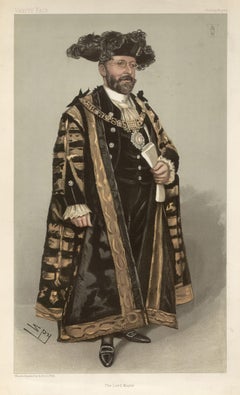
'The Lord Mayor' (Sir Joseph Dimsdale), Vanity Fair caricature portrait, 1902

'The Lord Mayor' (Sir Joseph Dimsdale), Vanity Fair caricature portrait, 1902

By Sir Leslie Ward

Located in Melbourne, Victoria

'The Lord Mayor' Chromolithograph. 1902. Vanity Fair portrait of Sir Joseph Cockfield Dimsdale (1849-1912), Lord Mayor of London 1901-1902. With original descriptive text. 395mm...

Category

Early 20th Century Victorian Figurative Prints

Materials

Lithograph

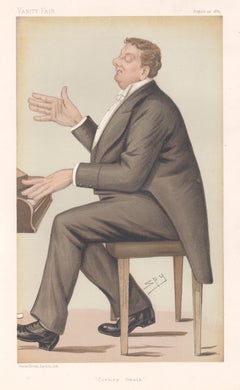
Corney Grain, Vanity Fair caricature portrait, 1885

Corney Grain, Vanity Fair caricature portrait, 1885

By Sir Leslie Ward

Located in Melbourne, Victoria

'Corney Grain' Chromolithograph. 1885. Vanity Fair portrait of Corney Grain (1844-1895) playing the piano. Corney Grain was a British barrister turned actor, entertainer, and music...

Category

Early 20th Century Victorian Figurative Prints

Materials

Lithograph

You May Also Like

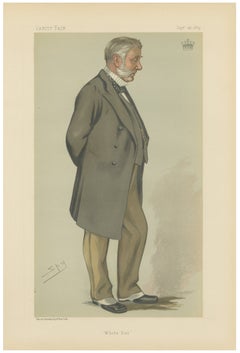
Distinguished Victorian Gentleman – Vanity Fair “White Dal” Spy Portrait 1883

Distinguished Victorian Gentleman – Vanity Fair “White Dal” Spy Portrait 1883

Located in Langweer, NL

Distinguished Victorian Gentleman – Vanity Fair “White Dal” Spy Portrait 1883 Description: This original Vanity Fair chromolithograph titled “White Dal” was published on September 22, 1883 and drawn by the celebrated Vanity Fair artist Leslie Ward, who worked under the famous pseudonym “Spy.” The portrait depicts Sir William Dalrymple, a notable British figure whose distinguished appearance and social standing made him an ideal subject for Vanity Fair’s celebrated series of satirical portraits. Ward portrays Dalrymple standing in profile with a composed and slightly formal posture. He is dressed in the refined attire typical of a well-established Victorian gentleman: a tailored frock coat, waistcoat with watch chain, crisp high-collared shirt, and neatly tied bow tie. His distinctive white side-whiskers—likely the inspiration behind the nickname “White Dal”—are rendered with careful detail, adding personality to the portrait while maintaining the elegant restraint characteristic of Leslie Ward’s work. During the late nineteenth century, Vanity Fair magazine became widely known for its weekly caricatures of prominent public figures. These portraits depicted politicians, aristocrats, military officers, artists, sportsmen, and influential members of society. While humorous in tone, the images were often respectful portrayals that captured both the physical likeness and social character of their subjects. Leslie Ward’s contributions to Vanity Fair are among the most admired within the series. His ability to combine gentle satire with refined portraiture allowed him to create images that were both entertaining and historically informative. Today these portraits serve as a visual record of the personalities who shaped Victorian public life. The print was produced using chromolithography and printed by the renowned London firm Vincent Brooks, Day & Son, one of the leading color printers of the period. Their high-quality printing techniques allowed for subtle tonal variations and soft shading, which remain visible in the delicate rendering of the clothing and facial features. Vanity Fair portraits such as this have become highly collectible decorative works, admired for their historical character, distinctive style, and elegant Victorian aesthetic. They continue to appeal to collectors of British political history as well as interior designers seeking refined nineteenth-century portrait prints. Condition: Very good condition with light age toning and occasional minor foxing consistent with age. Margins remain generous and colors well preserved. Framing tips: This portrait displays beautifully in a dark walnut or ebonized frame with an ivory or warm cream museum mat. A generous mat border enhances the elegant vertical format and complements the soft Victorian color palette. Technique: Chromolithograph Maker: Leslie Ward (“Spy”), printed by Vincent Brooks, Day & Son, London, 1883 Keywords: Vanity Fair print, White Dal Vanity Fair, Spy caricature, Leslie Ward Spy, Victorian gentleman portrait, Vanity Fair chromolithograph, British society portrait, 1883 Vanity Fair print, Victorian caricature print, antique gentleman portrait...

Category

Antique Late 19th Century British Prints
Materials

Paper

Victorian Aristocrat with Top Hat – Vanity Fair “Lord Leicester’s Nephew” 1883

Victorian Aristocrat with Top Hat – Vanity Fair “Lord Leicester’s Nephew” 1883

Located in Langweer, NL

Distinguished Victorian Gentleman – Vanity Fair “White Dal” Spy Portrait 1883 Description: This original Vanity Fair chromolithograph titled “White Dal” was published on September 22, 1883 and drawn by the celebrated Vanity Fair artist Leslie Ward, who worked under the famous pseudonym “Spy.” The portrait depicts Sir William Dalrymple, a notable British figure whose distinguished appearance and social standing made him an ideal subject for Vanity Fair’s celebrated series of satirical portraits. Ward portrays Dalrymple standing in profile with a composed and slightly formal posture. He is dressed in the refined attire typical of a well-established Victorian gentleman: a tailored frock coat, waistcoat with watch chain, crisp high-collared shirt, and neatly tied bow tie. His distinctive white side-whiskers—likely the inspiration behind the nickname “White Dal”—are rendered with careful detail, adding personality to the portrait while maintaining the elegant restraint characteristic of Leslie Ward’s work. During the late nineteenth century, Vanity Fair magazine became widely known for its weekly caricatures of prominent public figures. These portraits depicted politicians, aristocrats, military officers, artists, sportsmen, and influential members of society. While humorous in tone, the images were often respectful portrayals that captured both the physical likeness and social character of their subjects. Leslie Ward’s contributions to Vanity Fair are among the most admired within the series. His ability to combine gentle satire with refined portraiture allowed him to create images that were both entertaining and historically informative. Today these portraits serve as a visual record of the personalities who shaped Victorian public life. The print was produced using chromolithography and printed by the renowned London firm Vincent Brooks, Day & Son, one of the leading color printers of the period. Their high-quality printing techniques allowed for subtle tonal variations and soft shading, which remain visible in the delicate rendering of the clothing and facial features. Vanity Fair portraits such as this have become highly collectible decorative works, admired for their historical character, distinctive style, and elegant Victorian aesthetic. They continue to appeal to collectors of British political history as well as interior designers seeking refined nineteenth-century portrait prints. Condition: Very good condition with light age toning and occasional minor foxing consistent with age. Margins remain generous and colors well preserved. Framing tips: This portrait displays beautifully in a dark walnut or ebonized frame with an ivory or warm cream museum mat. A generous mat border enhances the elegant vertical format and complements the soft Victorian color palette. Technique: Chromolithograph Maker: Leslie Ward (“Spy”), printed by Vincent Brooks, Day & Son, London, 1883 Keywords: Vanity Fair print, White Dal Vanity Fair, Spy caricature, Leslie Ward Spy, Victorian gentleman portrait, Vanity Fair chromolithograph, British society portrait, 1883 Vanity Fair print, Victorian caricature print, antique gentleman portrait...

Category

Antique Late 19th Century British Prints
Materials

Paper

Cecil Legard 'A Judge' Vanity Fair cartoon by Cuthbert "CB" Bradley

Cecil Legard 'A Judge' Vanity Fair cartoon by Cuthbert "CB" Bradley

By Cuthbert Bradley

Located in London, GB

Cuthbert "CB" Bradley for Vanity Fair Magazine "A Judge" - The Rev Cecil Legard 11 July 1901 Lithograph 21 x 37 cm CB's cartoon depicts The Rev Cecil Legard (1843-1918), the Rector of Cottesbrooke and heir to the baronetcy. As well as a clergyman, Legard was a noted sportsman and hound expert; he was a steeplechase rider, and also edited the Foxhound Kennel Stud Book. CB depicts him judging hounds, excellently outfitted; as the biography on the reverse of the mounted lithograph notes, he might be 'the best judge of a foxhound in England'. A copy of the cartoon is held by the Kingston Lacy Estate in Dorset. Cuthbert Bradley was also a sporting man - he famously authored 'Fox-Hunting from Shire to Shire with Many Noted Packs' and worked as a sporting journalist for The Field. As well as illustrating for Vanity Fair, he painted polo and foxhunting scenes, and other pictures of equestrian interest. The majority of his Vanity Fair cartoons are of hunting men. The Vanity Fair magazine of 1868 to 1914 was subtitled 'A Weekly Show of Political, Social and Literary Wares'. Founded by Thomas Gibson...

Category

1890s Victorian More Art

Materials

Lithograph