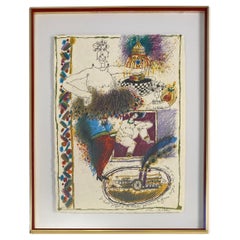
THÉO TOBIASSE (1927–2012) – FROM "AUX FRANGES DE L'ÉVEIL"
Original Lithograph on Vélin d'Arches ⚜ Hand Signed and Numbered ⚜ Black Wood Frame
A LYRICAL LINE COMPOSITION FROM TOBIASSE'S 1987 LIVRE D'ARTISTE WITH POET MARIE-AGNÈS COUROUBLE
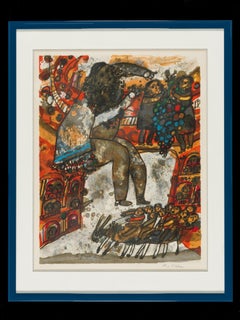
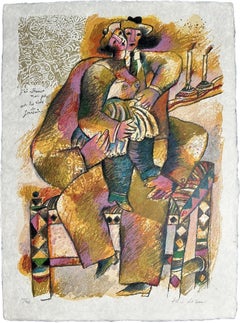
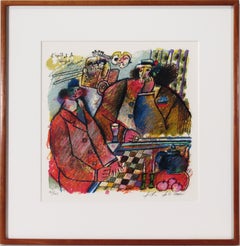
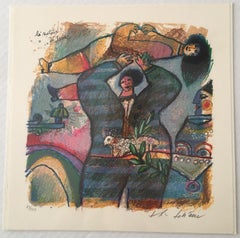
This intimate lithograph is one of six original compositions Théo Tobiasse created for the livre d'artiste "Aux franges de l'éveil" ("On the Fringes of Awakening"), a 1987 collaboration between the artist and French poet Marie-Agnès Courouble, published by master printer Pierre Chave at his celebrated atelier in Saint-Paul-de-Vence. The book pairs six unpublished poems by Courouble with six original lithographs by Tobiasse, each individually pencil signed and presented on Vélin d'Arches with deckled edges. The poems are titled "Une mouette," "Musique de Chambre," "L'homme qui marche," "Pluie," "L'invitation," and "Les cages," with each lithograph in the suite associated with one of these texts.
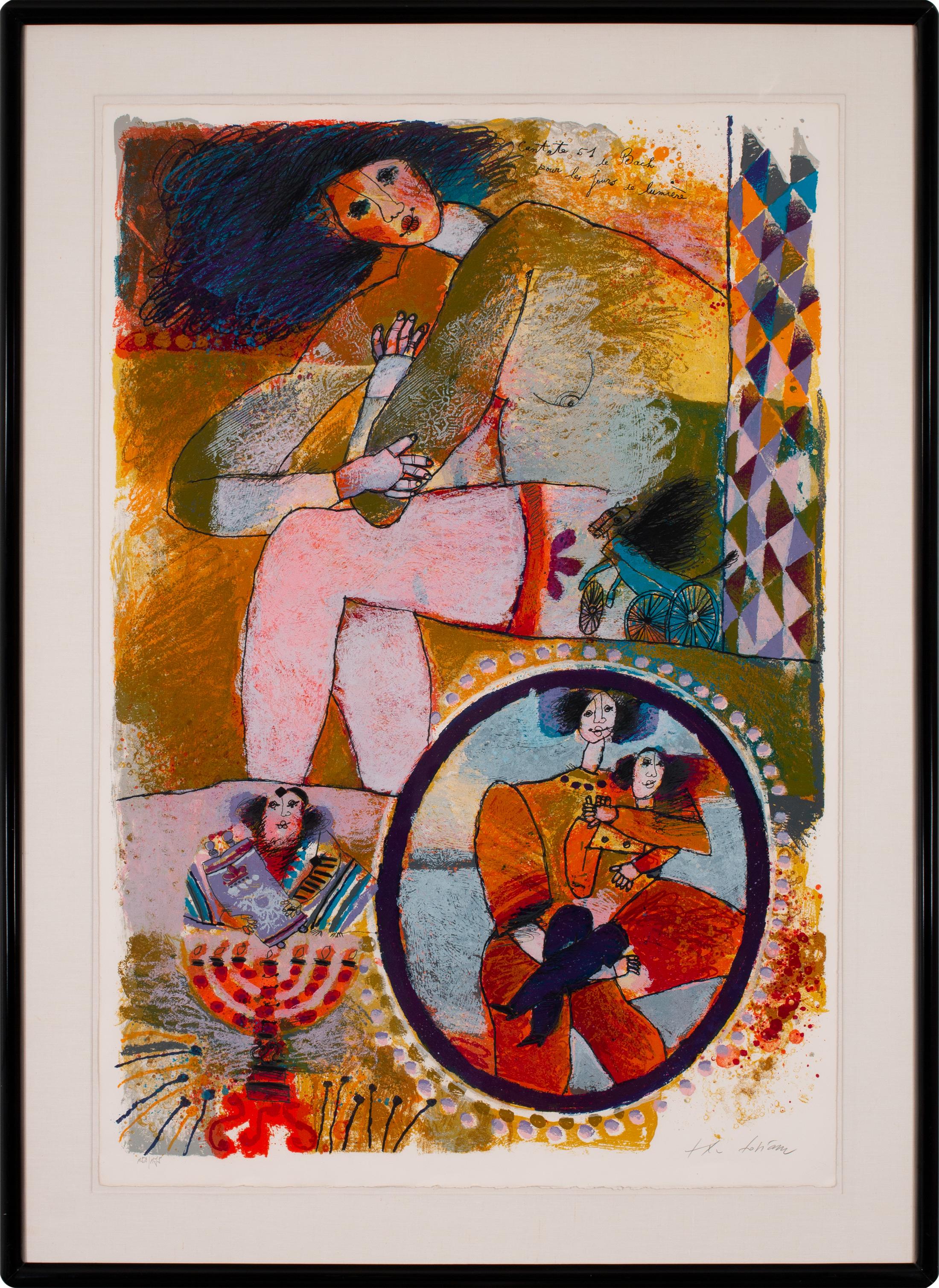
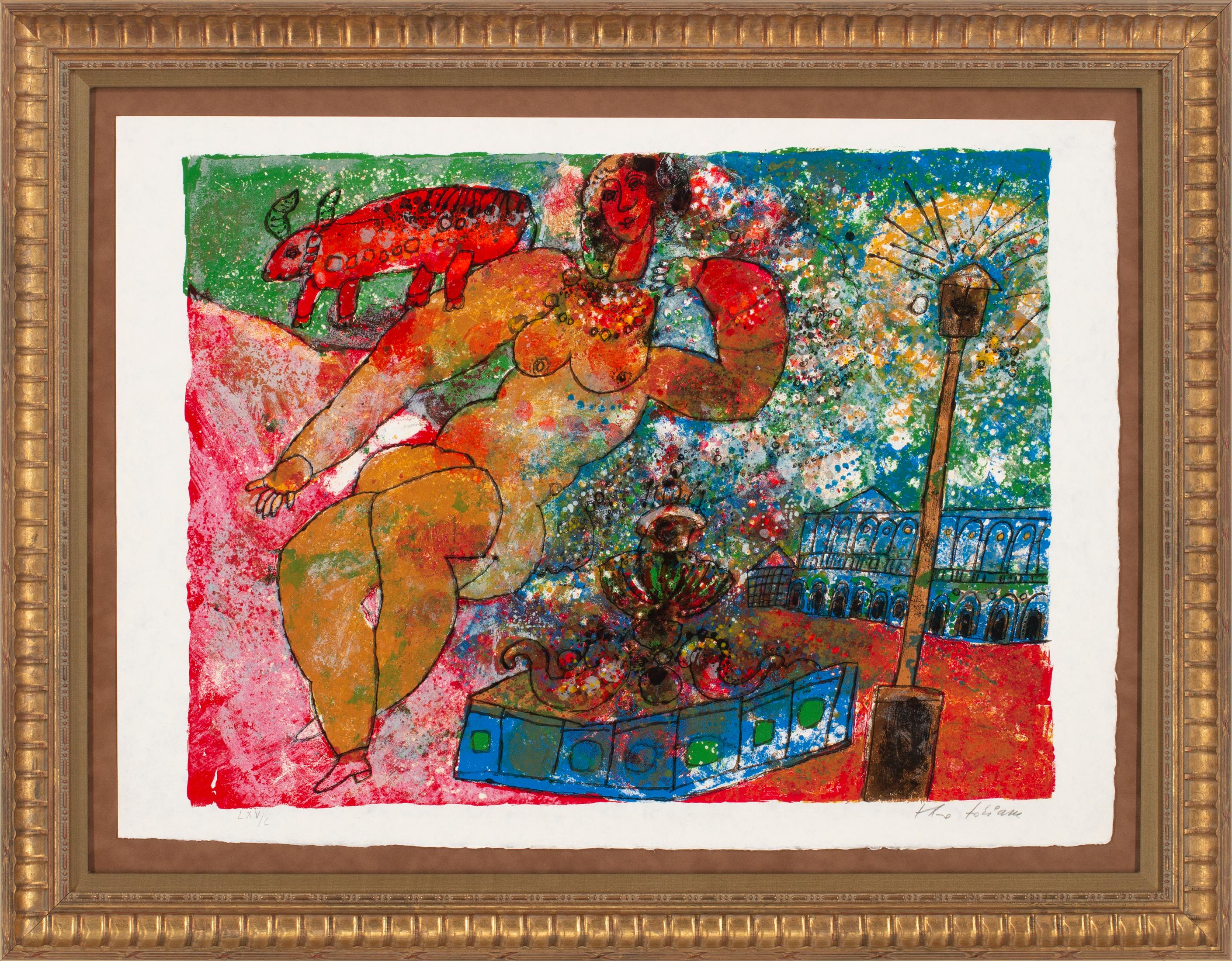
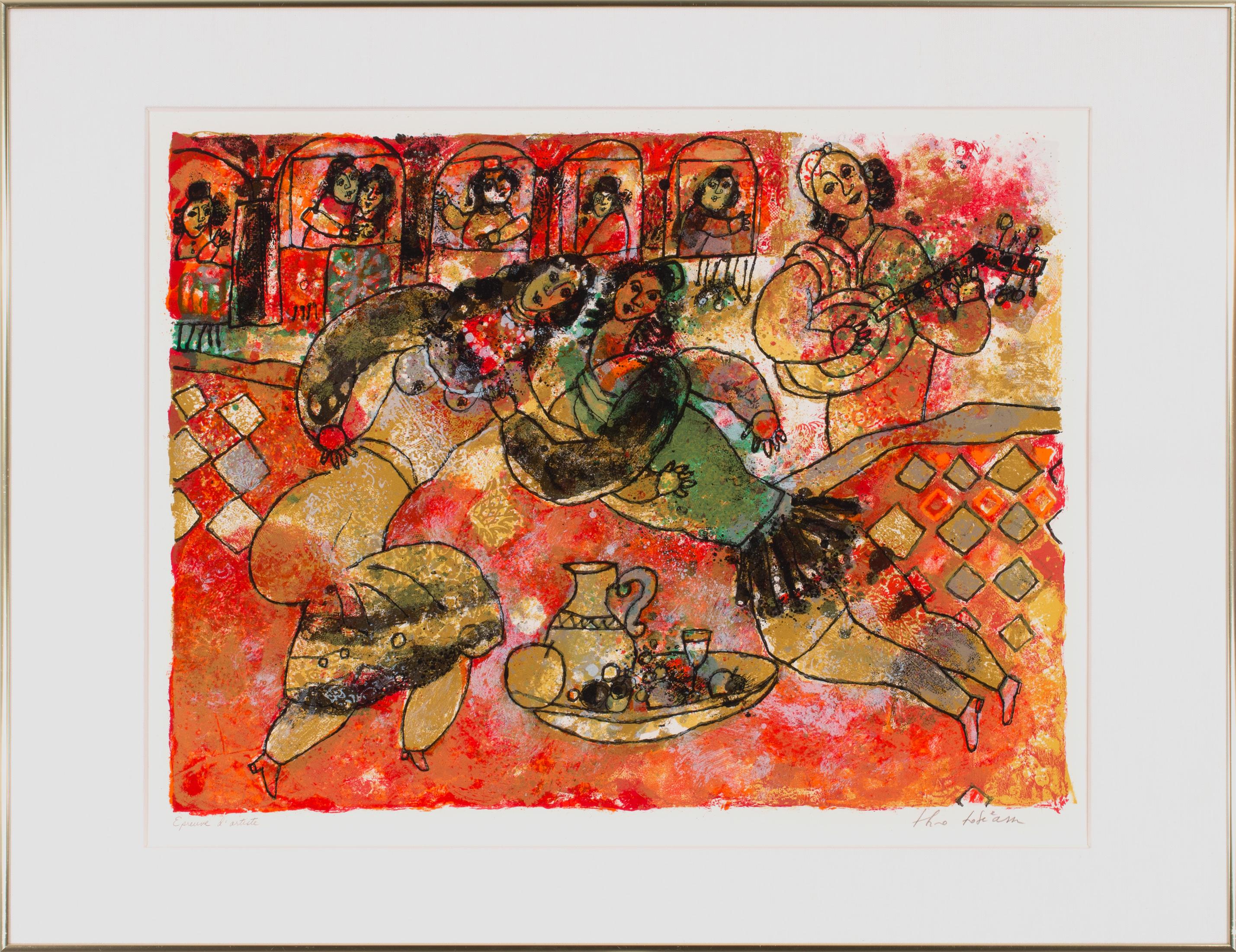
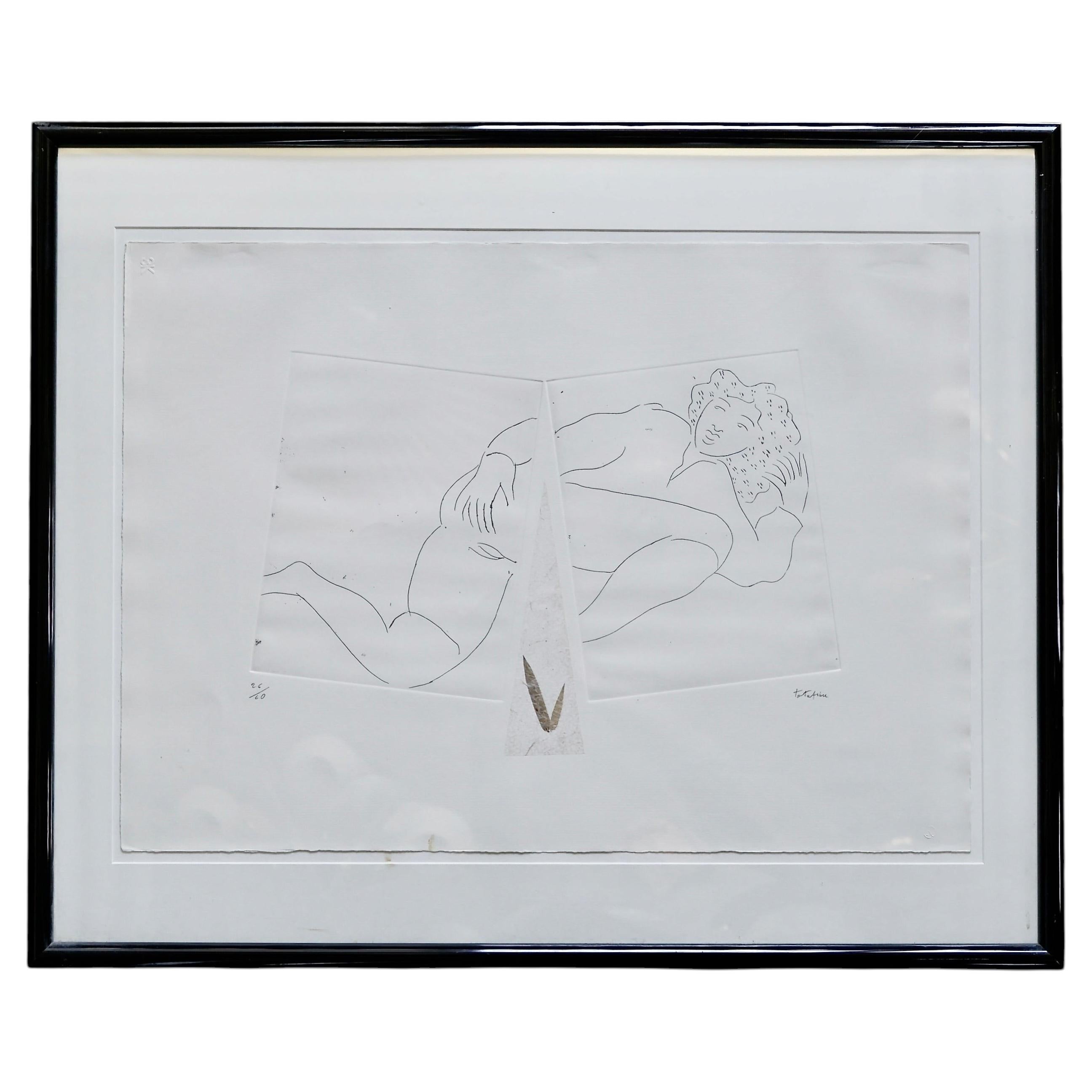
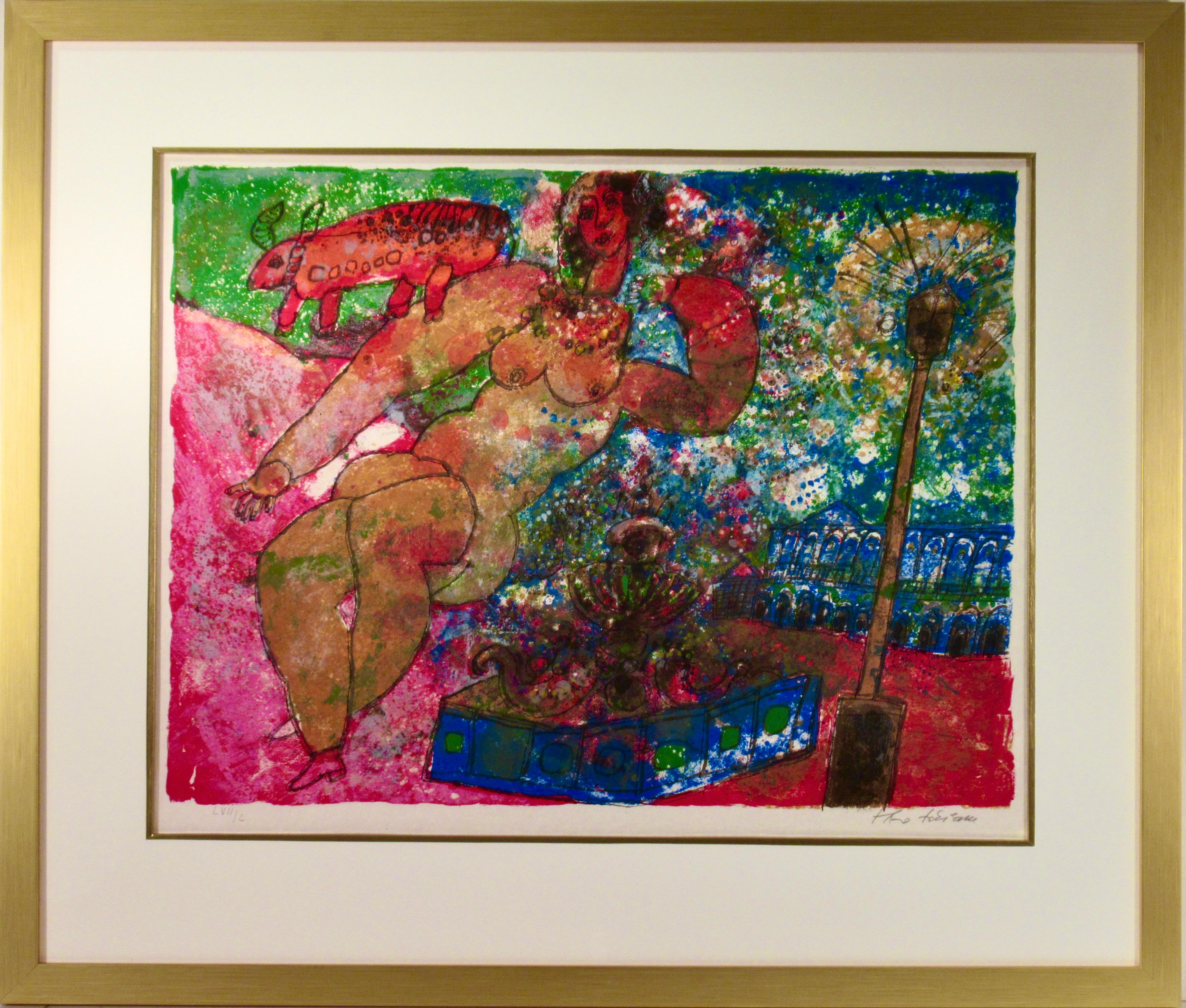
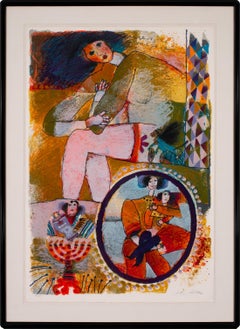
The composition unfolds entirely in fluid black ink line, an intimate counterpoint to Tobiasse's celebrated multi-color lithographic technique. In the foreground a larger woman reclines with her long flowing dark hair cascading freely, one hand drawn up to support her head and the other resting along her thigh in a posture of unguarded ease. From her breast a smaller second figure emerges, almost morphed from her form, the two bodies rendered as a single intertwined silhouette that suggests intimacy, dream, or the merging of self and other. On a separate plane in the upper right, a stylized female figure appears within a decorative panel framed by patterned columns and hanging tassels, her arms crossed and raised behind her head in a sensual stretch, evoking the appearance of an icon or ancient relief carving fixed into the wall behind the scene. A flowering bloom anchors the lower left corner, and decorative bands of swag and tassel arc across the top of the image, echoing the tapestry-like surfaces that often appear in Tobiasse's interior scenes. The contrast between the soft, organic curves of the foreground figures and the rhythmic geometry of the patterned panel creates a quiet dialogue between body and ornament.
Hand signed in pencil lower right and inscribed EA 41/50 lower left, this impression is an Épreuve d'Artiste, or Artist's Proof, from the suite's reserved edition of fifty, printed outside the main edition of 150 numbered copies on Vélin d'Arches. Presented in a clean black wood frame with crisp double matting, the lithograph suits a refined interior where line, intimacy, and quiet expression are valued: a study or library, a bedroom suite, a powder room, or a wall dedicated to small-format works on paper by School of Paris masters.
WHY COLLECT THIS WORK?
✓ Celebrated 1987 Livre d'Artiste – One of six original lithographs from the "Aux franges de l'éveil" suite
✓ Master Printed by Pierre Chave – Produced at Tobiasse's longtime collaborator's atelier in Saint-Paul-de-Vence
✓ Hand Signed and Numbered – Pencil signed lower right, inscribed EA 41/50 lower left
✓ Artist's Proof Edition – Épreuve d'Artiste, or EA, from the reserved run of fifty impressions outside the main edition of 150
✓ Poet-Artist Collaboration – Paired with unpublished poems by French poet Marie-Agnès Courouble
✓ Pure Line Composition – Fluid black ink work showcasing Tobiasse's draftsmanship at its most refined
ARTWORK DETAILS:
▸ Title: Untitled (one of six lithographs from the suite, individual title undetermined)
▸ Suite: Aux Franges de l'Éveil (On the Fringes of Awakening)
▸ Artist: Théo Tobiasse (1927–2012)
▸ Poet: Marie-Agnès Courouble
▸ Medium: Original Lithograph on Vélin d'Arches with Deckled Edges
▸ Year of Creation: 1987
▸ Signature: Hand Signed Lower Right in Pencil
▸ Edition: EA 41/50 (Épreuve d'Artiste / Artist's Proof, from a total tirage of 150 numbered + 50 EA + X HC)
▸ Publisher: Pierre Chave, Vence, France
▸ Provenance: Private Collection, Paris, France
▸ Country of Origin: France
▸ Dimensions:
— ◼︎ Image Area: 4.5 x 6 inches
— ◼︎ Paper Size: 9.5 x 7.375 inches
— ◻︎ Frame Size: 17.625 x 15.625 x 1.25 inches
▸ Condition: Excellent, commensurate with age
▸ Framing: Black Wood Frame with Double Matting, ready to display
THE ARTIST:
Théo Tobiasse (born Tobias Eidesas, 1927, Jaffa, Israel; died 2012, Cagnes-sur-Mer, France) was a French painter, printmaker, sculptor, and illustrator of Lithuanian-Jewish heritage whose work occupies a singular place in the postwar School of Paris. His family settled in Paris in 1931, where the young Tobiasse endured the Nazi occupation in hiding for two years, an experience that profoundly shaped the themes of exile, memory, and cultural identity running throughout his career. After nearly fifteen years as a successful commercial designer for firms including Hermès, Tobiasse devoted himself fully to painting after winning the Prize of Young Mediterranean Painting in 1961.
Working from his studio in Saint-Paul-de-Vence, Tobiasse developed a highly personal iconography that fused Expressionism, Surrealism, and modern primitivism. His subjects drew on biblical narratives, the experience of exile, and the cities that inspired him most: Paris, Jerusalem, Venice, and New York. Critics have noted affinities with the visionary figuration of Marc Chagall, the bold color and spiritual depth of Georges Rouault, and the textured surfaces of the School of Paris tradition. In collaboration with master printer Pierre Chave, Tobiasse pioneered a multi-color lithographic technique employing eighteen to twenty separate passes, while also producing intimate livres d'artiste in dialogue with poets and writers, of which "Aux franges de l'éveil" with Marie-Agnès Courouble is a notable example. His monumental public commissions include stained glass windows for the Great Synagogue of Nice and a decorated chapel in Le Cannet.
Tobiasse exhibited internationally throughout his career, with solo shows in Paris, New York, Tokyo, Geneva, London, and Los Angeles. The novelist Chaim Potok devoted a major monograph to his work, Théo Tobiasse: Artist in Exile (Rizzoli, New York, 1986). His paintings, prints, and sculptures are held in numerous museum, corporate, and private collections worldwide, and his work continues to resonate with collectors drawn to expressive figuration, symbolic narrative, and the visual language of memory and belonging.