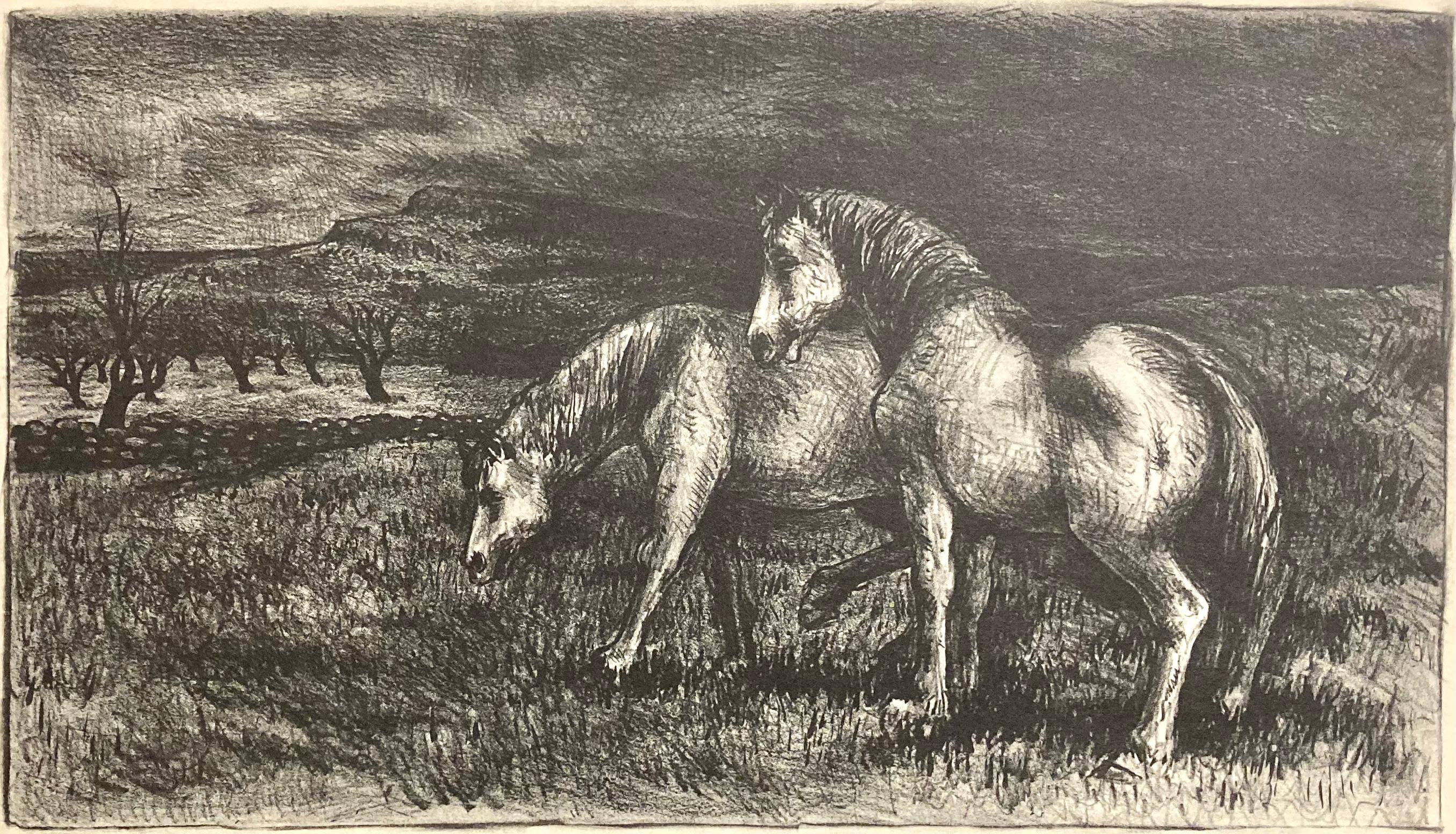
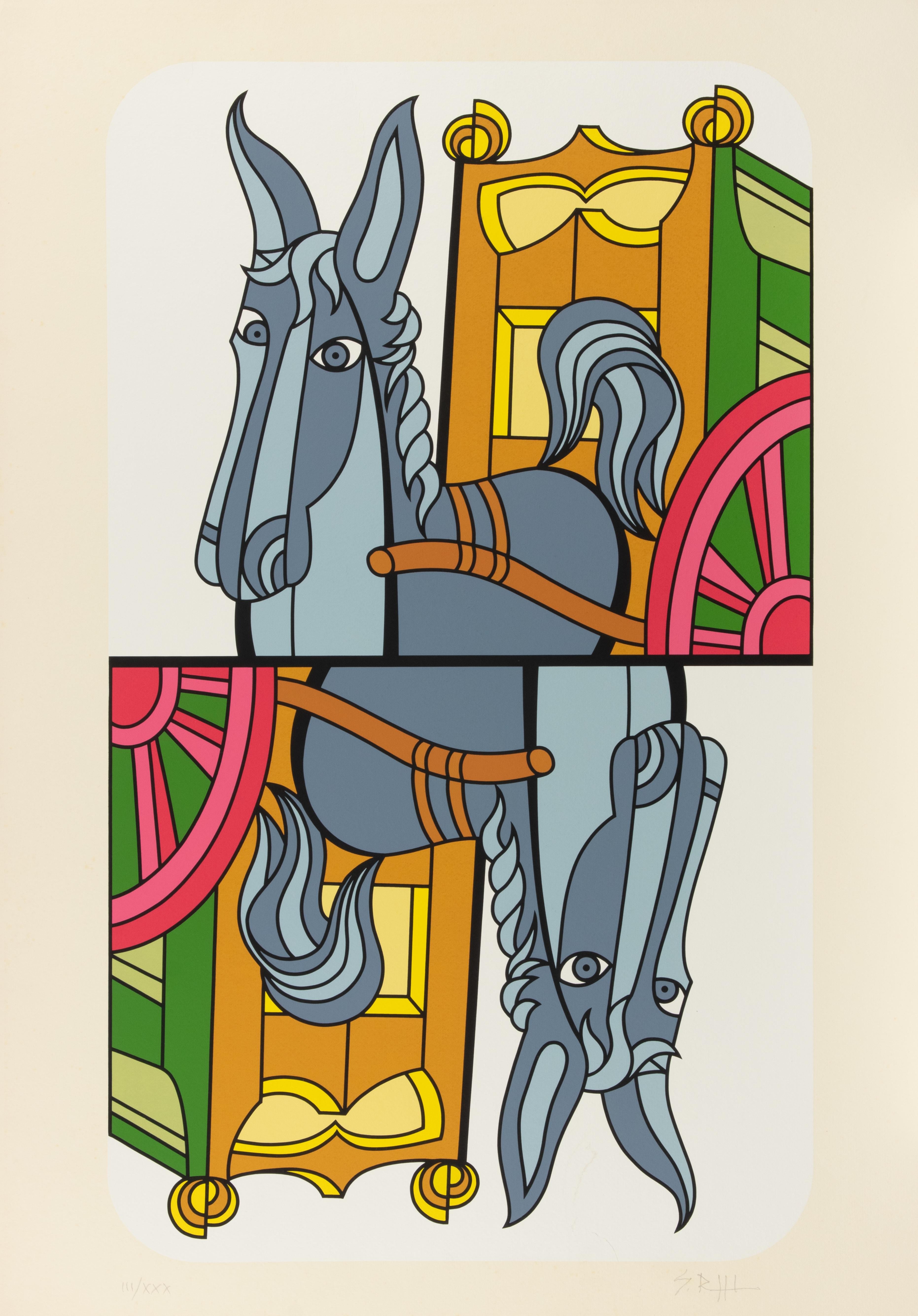
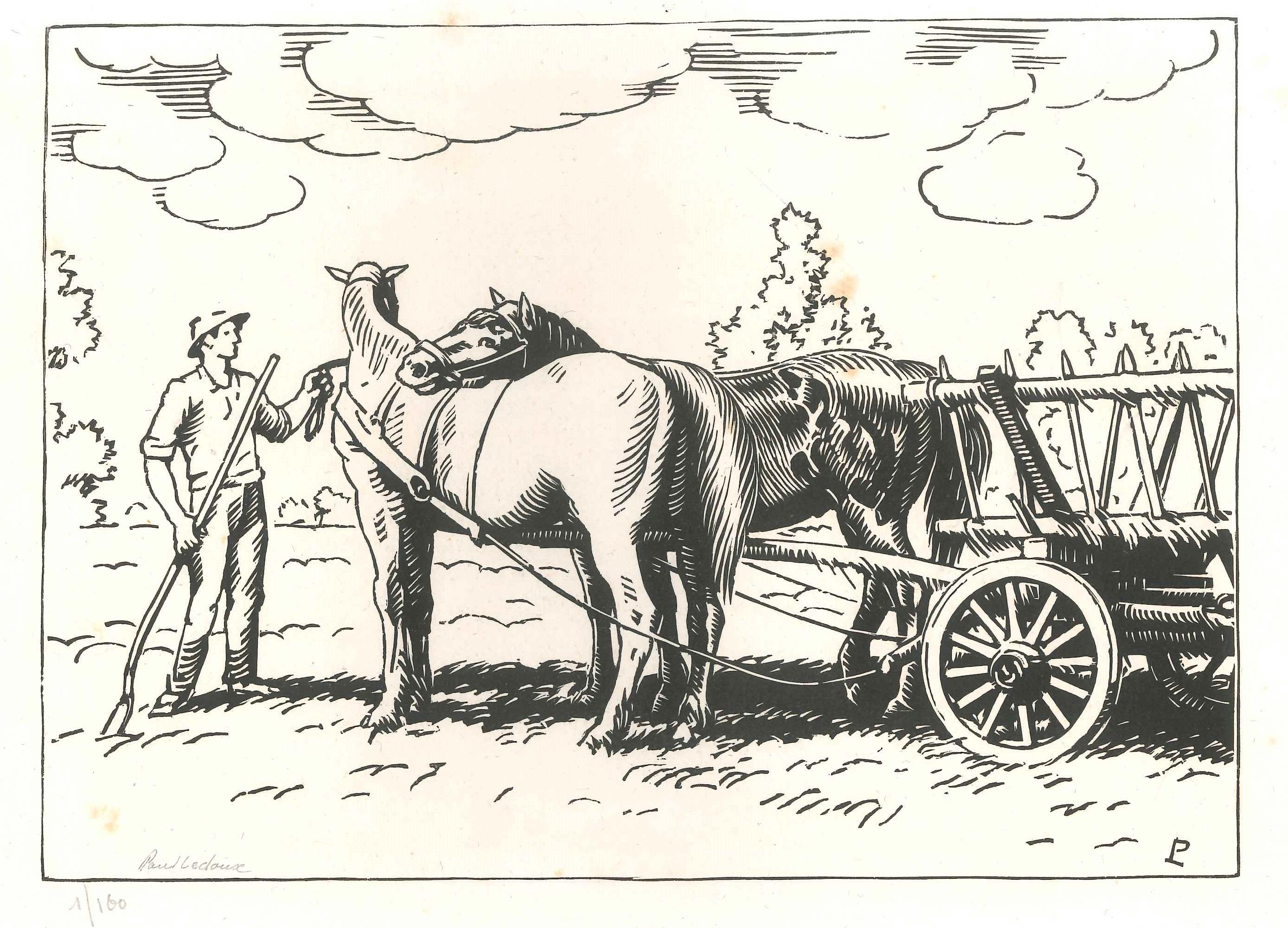
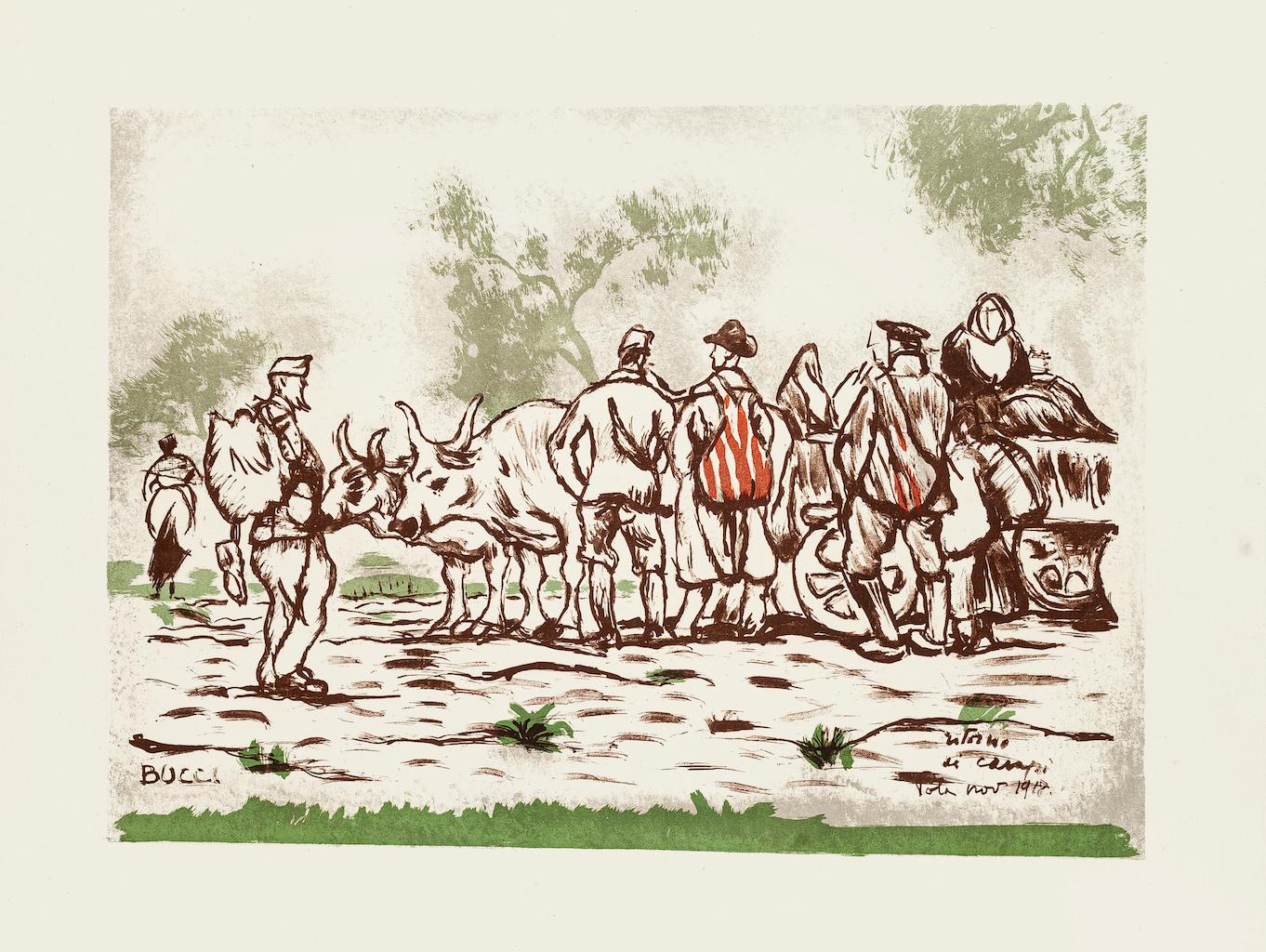
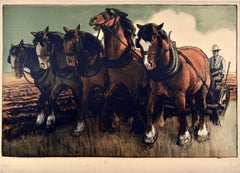
This exquisite lithograph after Thomas Gentleman (1892–1966), titled Grey Horses, S.P.11., originates from the School Prints Ltd. series, published by School Prints Ltd., London, under the direction of Brenda Rawnsley, London; printed by Baynard Press, London, under the direction of Thomas Griffiths, London, 1946. The composition reflects Gentleman’s disciplined draughtsmanship and lyrical sensitivity to atmosphere, translating equine form and structural balance into a modern yet accessible image designed for educational settings.
Executed as a lithograph in six colors on English cartridge paper, this work measures 19.49 x 29.92 inches (49.5 x 76 cm). Signed in the plate and unnumbered as issued from an edition CCC. Printed by Baynard Press, London, under the direction of Thomas Griffiths.
Artwork Details:
Artist: After Thomas Gentleman (1892–1966)
Title: Grey Horses, S.P.11.
Medium: Lithograph in six colors on English cartridge paper
Dimensions: 19.49 x 29.92 inches (49.5 x 76 cm)
Inscription: Signed in the plate and unnumbered as issued from an edition CCC
Date: 1946
Publisher: School Prints Ltd., London, under the direction of Brenda Rawnsley
Printer: Baynard Press, London, under the direction of Thomas Griffiths
Condition: Well preserved, consistent with age and medium
Provenance: From the School Prints Ltd. series, published in London, 1946
About the Publication:
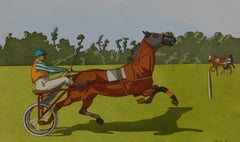
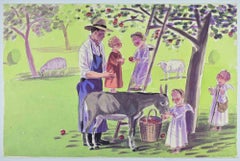
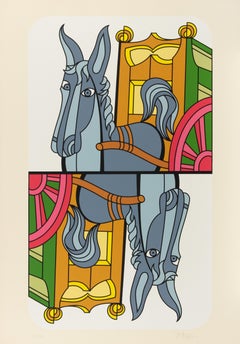
Founded in 1935 by Derek Rawnsley, School Prints Ltd. was one of the most visionary educational art initiatives in twentieth century Britain. Created alongside Picture Hire Ltd., the enterprise sought to democratize access to modern art by placing original lithographs directly into British schools. Rather than reproductions, these were authentic prints by leading contemporary artists, produced at modest scale and cost so that public education authorities could afford to participate. Following Derek Rawnsley’s death in 1943, the company was managed by Dorothy Bland before being revitalized in 1945 under the direction of Brenda Rawnsley. With guidance from the distinguished art historian Herbert Read, Rawnsley launched an ambitious commissioning program intended to introduce schoolchildren to the language of modern art. Artists were invited to produce original lithographs limited to six colors in order to maintain affordability while preserving artistic integrity. The first series, issued in 1946 and 1947, featured prominent British artists including L. S. Lowry, John Nash, Julian Trevelyan, Michael Rothenstein, Edwin La Dell, Hans Feibusch, John Skeaping, Feliks Topolski, David Gentleman, and John Tunnard. These works were printed from stone or zinc plates by Thomas Griffiths and the Baynard Press, combining high production standards with accessible pricing. At its height, the program reached approximately 4,000 subscribing schools across the United Kingdom. In 1947 Rawnsley expanded the project internationally, persuading major European modernists to participate. The European Series, launched in 1949, included original lithographs by Pablo Picasso, Georges Braque, Henri Matisse, Fernand Leger, Raoul Dufy, and Henry Moore. This remarkable collaboration brought museum caliber artists directly into the classroom, underscoring the publication’s historical importance. Technically innovative as well as culturally ambitious, portions of the later series were produced using Plastocowell plates developed by W. S. Cowell Ltd. of Ipswich, an early plastic lithographic process whose surviving matrices are now preserved in the Tate collection. Although the more avant garde works proved less popular with schools and the enterprise eventually declined, School Prints Ltd. remains a landmark in postwar art education and publishing history. Today, works bearing the School Prints Ltd. imprint are widely regarded as significant examples of mid century British printmaking and as important documents of a pioneering effort to integrate contemporary art into public education. For collectors, they represent both artistic distinction and a compelling social history narrative, combining cultural mission, technical innovation, and the participation of some of the most important artists of the twentieth century.
About the Artist:
Thomas Gentleman (1892–1966) was a distinguished British painter, illustrator, muralist, and printmaker whose refined draughtsmanship, compositional discipline, and lyrical command of atmosphere established him as a significant figure within twentieth century British art at a time when European modernism was being transformed by Pablo Picasso, Alexander Calder, Alberto Giacometti, Salvador Dali, Joan Miro, Wassily Kandinsky, Marcel Duchamp, and Man Ray. Educated at the Royal College of Art and active in London during the intellectually vibrant interwar years, Gentleman developed a style that balanced structural clarity with painterly sensitivity, absorbing the lessons of Post Impressionism and Cubist organization while remaining rooted in the traditions of British landscape painting and illustration. His landscapes, architectural views, and public commissions reveal a mastery of tonal modulation and spatial harmony, reflecting an awareness of modernist abstraction without abandoning representational integrity. Working alongside contemporaries such as Paul Nash, John Nash, Edward Bawden, and Eric Ravilious, he contributed to a broader British effort to reconcile national artistic identity with the formal innovations emerging across Europe. His book illustrations and mural projects further demonstrate his versatility, combining precise line with decorative elegance in a manner that anticipated mid century graphic modernism. Though stylistically distinct from the avant garde radicalism of Kandinsky or Duchamp, Gentleman’s measured modernity reflects the same period wide reexamination of space, structure, and perception that shaped early twentieth century art. His influence extended into later generations of British artists and designers, including his son Tom Gentleman, and continues to resonate with painters committed to disciplined composition and atmospheric nuance. Exhibited in London and collected for both private and institutional contexts, his works are valued for their quiet sophistication, historical depth, and technical assurance.
Thomas Gentleman lithograph, School Prints Ltd. 1946, Baynard Press London, Brenda Rawnsley School Prints, British mid century printmaking, Gentleman modernism, School Prints series, British modern lithograph.