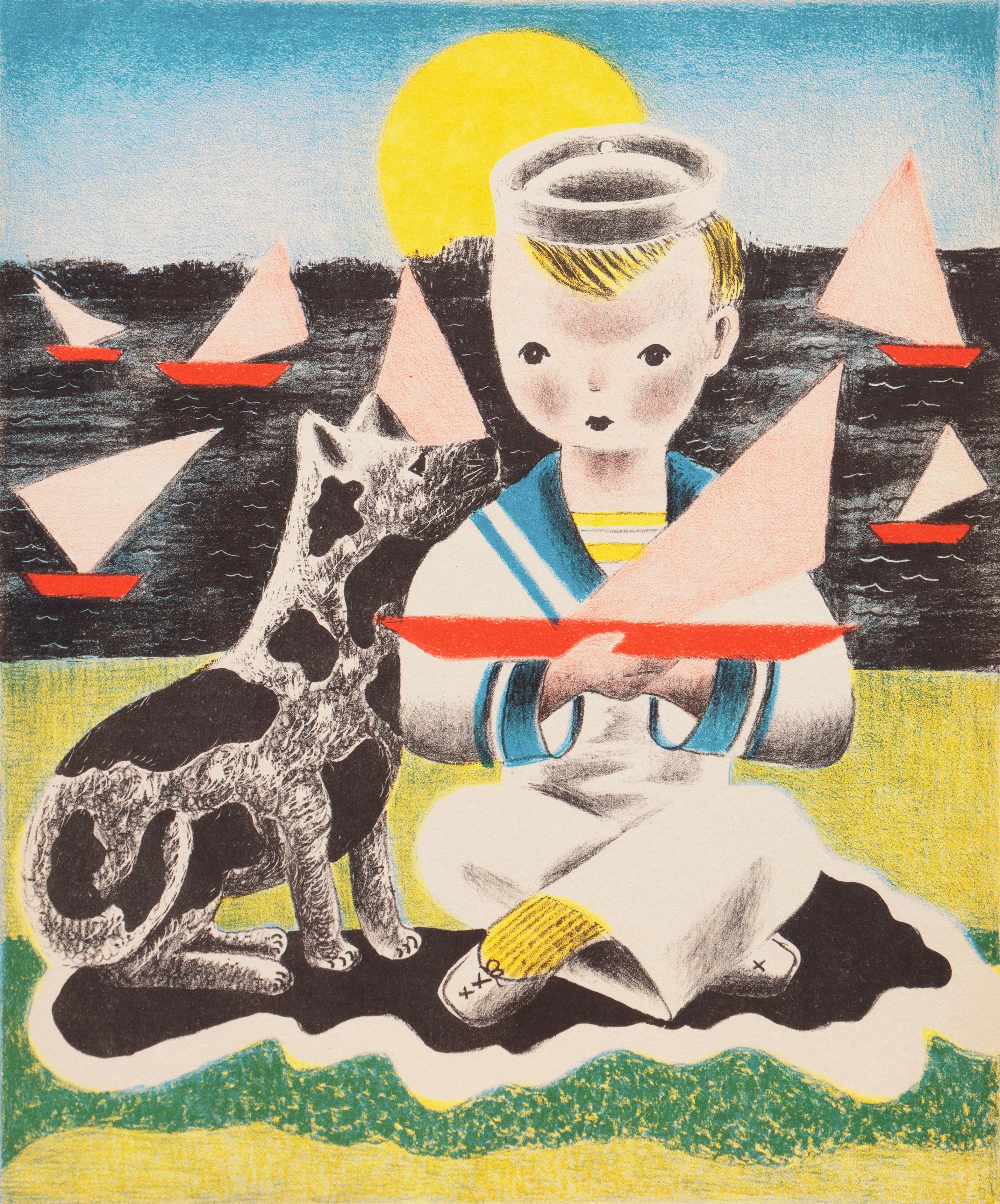
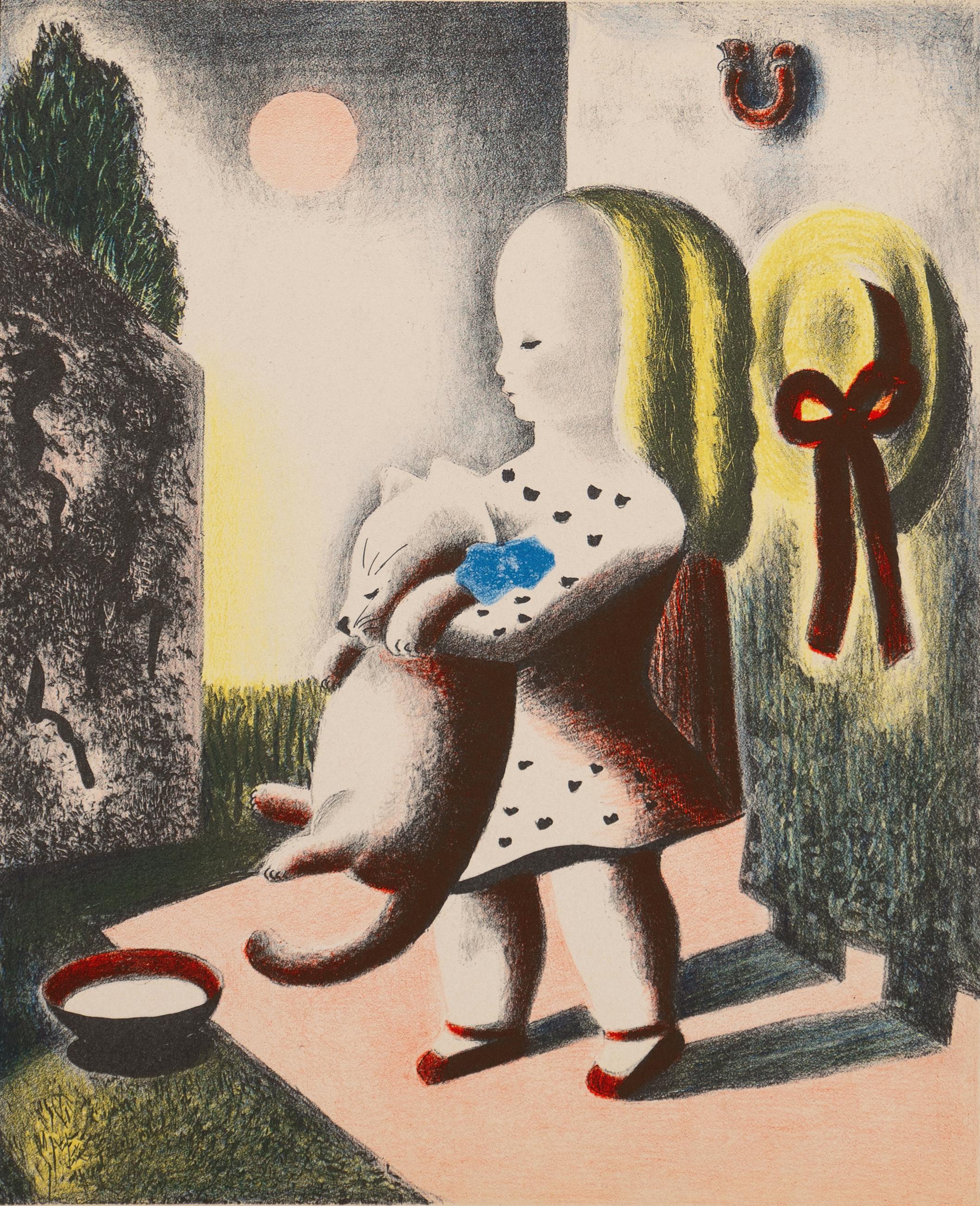
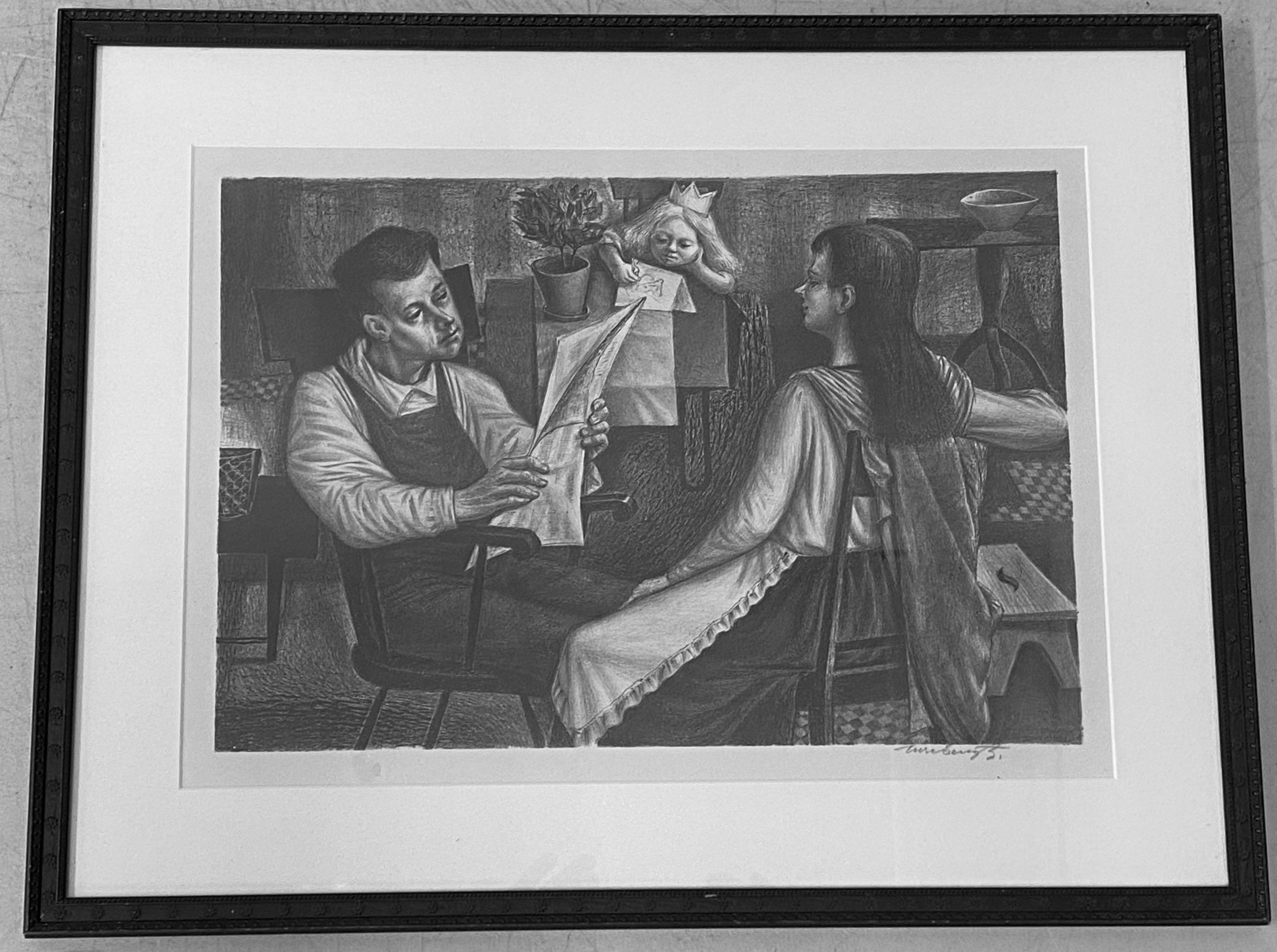
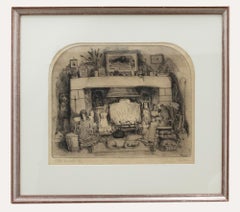
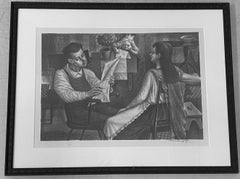
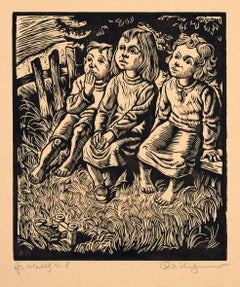
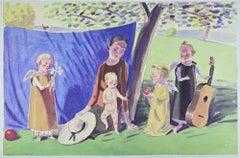
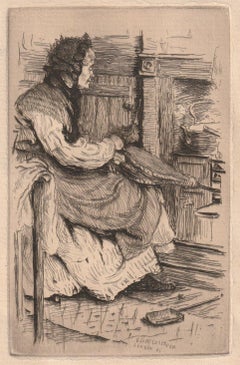
This exquisite lithograph after Thomas James Carr (1909–1999), titled Fireside, S.P.8., originates from the School Prints Ltd. series, published by School Prints Ltd., London, under the direction of Brenda Rawnsley, London; printed by Baynard Press, London, under the direction of Thomas Griffiths, London, 1946. The composition reflects Carr’s architectural balance and measured geometry, translating his refined modernist sensibility into a format designed to introduce contemporary art into the educational sphere.
Executed as a lithograph in six colors on English cartridge paper, this work measures 19.49 x 29.92 inches (49.5 x 76 cm). Signed in the plate and unnumbered as issued from an edition CCC. Printed by Baynard Press, London, under the direction of Thomas Griffiths.
Artwork Details:
Artist: After Thomas James Carr (1909–1999)
Title: Fireside, S.P.8.
Medium: Lithograph in six colors on English cartridge paper
Dimensions: 19.49 x 29.92 inches (49.5 x 76 cm)
Inscription: Signed in the plate and unnumbered as issued from an edition CCC
Date: 1946
Publisher: School Prints Ltd., London, under the direction of Brenda Rawnsley
Printer: Baynard Press, London, under the direction of Thomas Griffiths
Condition: Well preserved, consistent with age and medium
Provenance: From the School Prints Ltd. series, published in London, 1946
About the Publication:
Founded in 1935 by Derek Rawnsley, School Prints Ltd. was one of the most visionary educational art initiatives in twentieth century Britain. Created alongside Picture Hire Ltd., the enterprise sought to democratize access to modern art by placing original lithographs directly into British schools. Rather than reproductions, these were authentic prints by leading contemporary artists, produced at modest scale and cost so that public education authorities could afford to participate. Following Derek Rawnsley’s death in 1943, the company was managed by Dorothy Bland before being revitalized in 1945 under the direction of Brenda Rawnsley. With guidance from the distinguished art historian Herbert Read, Rawnsley launched an ambitious commissioning program intended to introduce schoolchildren to the language of modern art. Artists were invited to produce original lithographs limited to six colors in order to maintain affordability while preserving artistic integrity. The first series, issued in 1946 and 1947, featured prominent British artists including L. S. Lowry, John Nash, Julian Trevelyan, Michael Rothenstein, Edwin La Dell, Hans Feibusch, John Skeaping, Feliks Topolski, David Gentleman, and John Tunnard. These works were printed from stone or zinc plates by Thomas Griffiths and the Baynard Press, combining high production standards with accessible pricing. At its height, the program reached approximately 4,000 subscribing schools across the United Kingdom. In 1947 Rawnsley expanded the project internationally, persuading major European modernists to participate. The European Series, launched in 1949, included original lithographs by Pablo Picasso, Georges Braque, Henri Matisse, Fernand Leger, Raoul Dufy, and Henry Moore. This remarkable collaboration brought museum caliber artists directly into the classroom, underscoring the publication’s historical importance. Technically innovative as well as culturally ambitious, portions of the later series were produced using Plastocowell plates developed by W. S. Cowell Ltd. of Ipswich, an early plastic lithographic process whose surviving matrices are now preserved in the Tate collection. Although the more avant garde works proved less popular with schools and the enterprise eventually declined, School Prints Ltd. remains a landmark in postwar art education and publishing history. Today, works bearing the School Prints Ltd. imprint are widely regarded as significant examples of mid century British printmaking and as important documents of a pioneering effort to integrate contemporary art into public education. For collectors, they represent both artistic distinction and a compelling social history narrative, combining cultural mission, technical innovation, and the participation of some of the most important artists of the twentieth century.
About the Artist:
Thomas James Carr (1909–1999) was a British painter and printmaker whose career unfolded during the most dynamic decades of twentieth century European modernism, positioning him within a lineage shaped by Pablo Picasso’s structural reinvention of form, Alexander Calder’s spatial lyricism, Alberto Giacometti’s sculptural clarity, Salvador Dali and Joan Miro’s poetic modernism, Wassily Kandinsky’s chromatic abstraction, and the conceptual innovations of Marcel Duchamp and Man Ray; synthesizing these influences without surrendering his individuality, Carr developed a refined visual language characterized by architectural balance, measured geometry, and luminous yet restrained color harmonies that allowed modern abstraction and traditional draftsmanship to coexist in elegant equilibrium. His landscapes, harbor scenes, and figurative compositions reveal disciplined construction and atmospheric sensitivity, demonstrating how avant garde ideas could be translated into coherent, structurally sound compositions rooted in observational intelligence, while his printmaking further displayed precision of line and tonal subtlety that reinforced his reputation for craftsmanship and compositional authority. Working within the broader dialogue between realism and abstraction that defined mid century art, Carr’s paintings bridged continental experimentation and British restraint, influencing later artists drawn to structured abstraction, lyrical landscape, and carefully calibrated spatial design, and today his work continues to attract international collectors seeking museum quality twentieth century British modernism defined by balance, clarity, and enduring aesthetic strength. His highest recorded auction result was achieved in November 2014 when Harbour Scene sold at Bonhams London for approximately 7,500 GBP, confirming sustained market recognition and continued interest in his oeuvre.
Thomas James Carr lithograph, School Prints Ltd. 1946, Baynard Press London, Brenda Rawnsley School Prints, British mid century printmaking, Carr modernism, School Prints series, British modern lithograph.